https://github.com/OWASP/wpBullet
https://github.com/OWASP/wpBullet
Last synced: 10 months ago
JSON representation
- Host: GitHub
- URL: https://github.com/OWASP/wpBullet
- Owner: OWASP
- License: gpl-2.0
- Created: 2019-06-25T18:32:57.000Z (about 7 years ago)
- Default Branch: master
- Last Pushed: 2022-01-30T10:38:20.000Z (over 4 years ago)
- Last Synced: 2024-09-26T01:51:22.677Z (almost 2 years ago)
- Language: Python
- Size: 204 KB
- Stars: 62
- Watchers: 5
- Forks: 7
- Open Issues: 2
-
Metadata Files:
- Readme: README.md
- License: LICENSE
Awesome Lists containing this project
README
# wpBullet [](https://travis-ci.org/webarx-security/wpbullet) [](https://www.python.org/) [](https://github.com/webarx-security/wpbullet/blob/dev/LICENSE)
A static code analysis for WordPress Plugins/Themes (and PHP)
## Installation
Simply clone the repository, install requirements and run the script
- `$ git clone https://github.com/webarx-security/wpbullet wpbullet`
- `$ cd wpbullet`
- `$ pip install -r requirements.txt`
- `$ python wpbullet.py`
## Usage
Available options:
```
--path (required) System path or download URL
Examples:
--path="/path/to/plugin"
--path="https://wordpress.org/plugins/example-plugin"
--path="https://downloads.wordpress.org/plugin/example-plugin.1.5.zip"
--enabled (optional) Check only for given modules, ex. --enabled="SQLInjection,CrossSiteScripting"
--disabled (optional) Don't check for given modules, ex. --disabled="SQLInjection,CrossSiteScripting"
--cleanup (optional) Automatically remove content of .temp folder after scanning remotely downloaded plugin (boolean)
--report (optional) Saves result inside reports/ directory in JSON format (boolean)
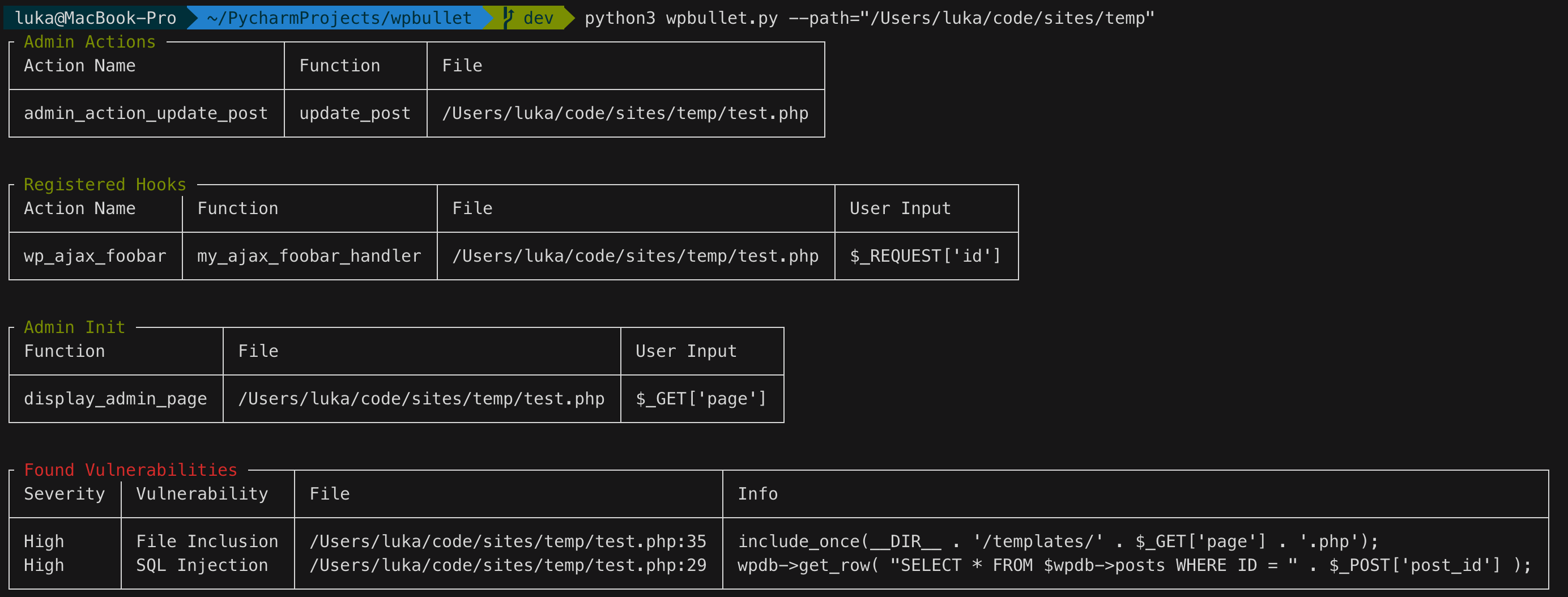
$ python wpbullet.py --path="/var/www/wp-content/plugins/plugin-name"
```
## Creating modules
Creating a module is flexible and allows for override of the `BaseClass` methods for each module as well as creating their own methods
Each module in `Modules` directory is implementing properties and methods from `core.modules.BaseClass`,
thus each module's required parameter is `BaseClass`
Once created, module needs to be imported in `modules/__init__.py`. Module and class name must be consistent
in order to module to be loaded.
__If you are opening pull request to add new module, please provide unit tests for your module as well.__
### Module template
`Modules/ExampleVulnerability.py`
```python
from core.modules import BaseClass
class ExampleVulnerability(object):
# Vulnerability name
name = "Cross-site Scripting"
# Vulnerability severity
severity = "Low-Medium"
# Functions causing vulnerability
functions = [
"print"
"echo"
]
# Functions/regex that prevent exploitation
blacklist = [
"htmlspecialchars",
"esc_attr"
]
```
#### Overriding regex match pattern
Regex pattern is being generated in `core.modules.BaseClass.build_pattern` and therefore can be overwritten in
each module class.
`Modules/ExampleVulnerability.py`
```python
import copy
...
# Build dynamic regex pattern to locate vulnerabilities in given content
def build_pattern(self, content, file):
user_input = copy.deepcopy(self.user_input)
variables = self.get_input_variables(self, content)
if variables:
user_input.extend(variables)
if self.blacklist:
blacklist_pattern = r"(?!(\s?)+(.*(" + '|'.join(self.blacklist) + ")))"
else:
blacklist_pattern = ""
self.functions = [self.functions_prefix + x for x in self.functions]
pattern = r"((" + '|'.join(self.functions) + ")\s{0,}\(?\s{0,1}" + blacklist_pattern + ".*(" + '|'.join(user_input) + ").*)"
return pattern
```
### Testing
Running unit tests: `$ python3 -m unittest`