https://github.com/Suchiman/SerilogAnalyzer
Roslyn-based analysis for code using the Serilog logging library. Checks for common mistakes and usage problems.
https://github.com/Suchiman/SerilogAnalyzer
analysis analyzer refactor roslyn serilog visual-studio
Last synced: over 1 year ago
JSON representation
Roslyn-based analysis for code using the Serilog logging library. Checks for common mistakes and usage problems.
- Host: GitHub
- URL: https://github.com/Suchiman/SerilogAnalyzer
- Owner: Suchiman
- License: apache-2.0
- Created: 2016-05-29T00:11:51.000Z (about 10 years ago)
- Default Branch: master
- Last Pushed: 2024-04-02T23:17:29.000Z (about 2 years ago)
- Last Synced: 2025-03-14T22:37:36.446Z (over 1 year ago)
- Topics: analysis, analyzer, refactor, roslyn, serilog, visual-studio
- Language: C#
- Homepage:
- Size: 437 KB
- Stars: 311
- Watchers: 17
- Forks: 31
- Open Issues: 23
-
Metadata Files:
- Readme: README.md
- License: LICENSE
Awesome Lists containing this project
- awesome-dotnet-core - SerilogAnalyzer - 使用Serilog日志库对基于Roslyn的代码进行分析。检查常见错误和使用问题。 (框架, 库和工具 / 工具)
- fucking-awesome-dotnet-core - SerilogAnalyzer - Roslyn-based analysis for code using the Serilog logging library. Checks for common mistakes and usage problems. (Frameworks, Libraries and Tools / Tools)
- awesome-dotnet-core - SerilogAnalyzer - Roslyn-based analysis for code using the Serilog logging library. Checks for common mistakes and usage problems. (Frameworks, Libraries and Tools / Tools)
- awesome-dotnet-core - SerilogAnalyzer - Roslyn-based analysis for code using the Serilog logging library. Checks for common mistakes and usage problems. (Frameworks, Libraries and Tools / Tools)
- awesome-analyzers - SerilogAnalyzer - Roslyn-based analysis for code using the [Serilog logging library](https://github.com/serilog/serilog). Checks for common mistakes and usage problems. (Popular Analyzers / 3rd party libraries)
README
# SerilogAnalyzer
Roslyn-based analysis for code using the [Serilog](http://serilog.net) logging library. Checks for common mistakes and usage problems.
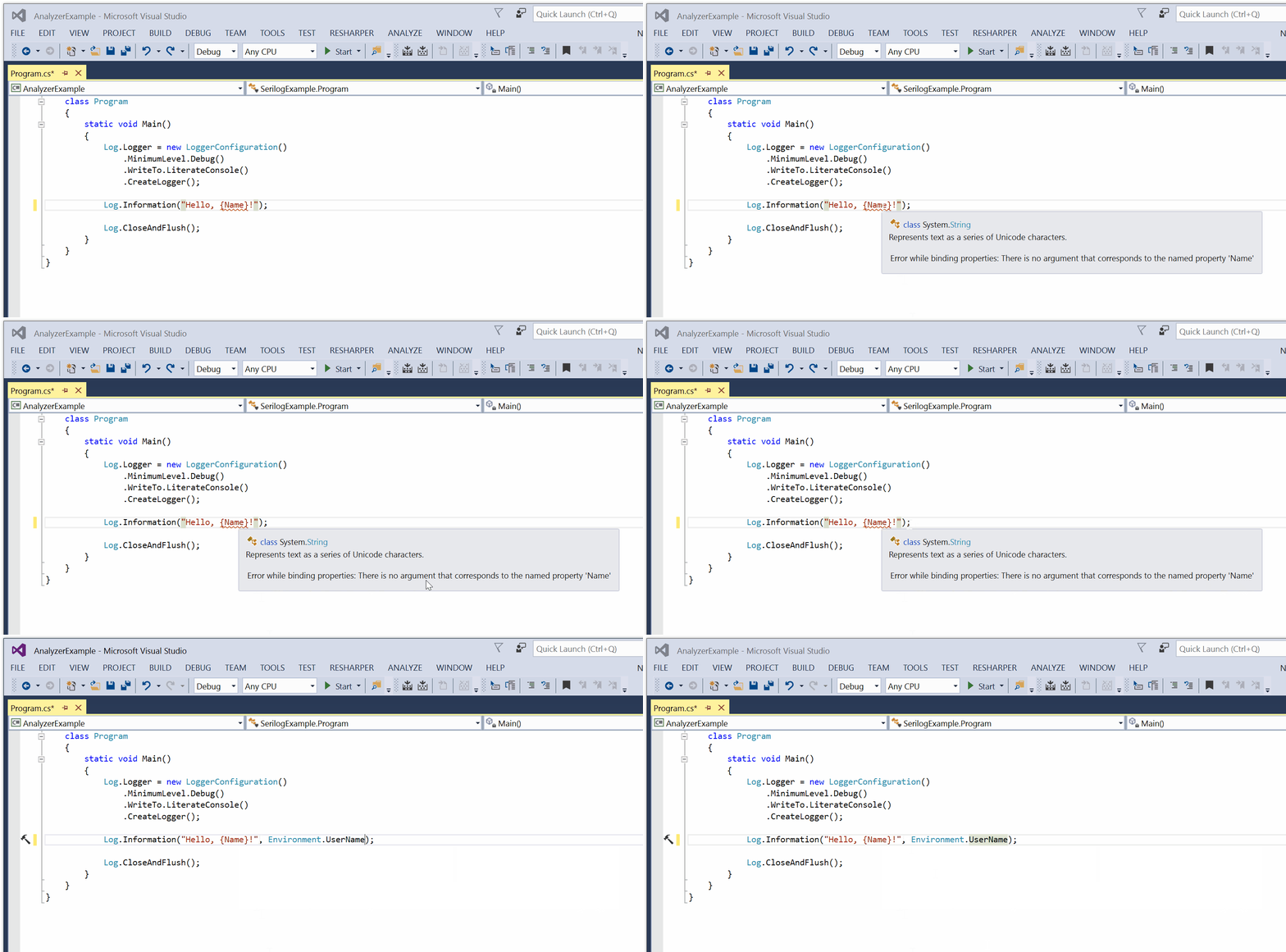
## Installing (Visual Studio)
You can get the SerilogAnalyzer from various sources:
- Grab the VSIX from the [releases list](https://github.com/Suchiman/SerilogAnalyzer/releases).
- Install it from [Visual Studio Gallery](https://marketplace.visualstudio.com/items?itemName=Suchiman.SerilogAnalyzer).
- Install the [NuGet package](https://www.nuget.org/packages/SerilogAnalyzer) into your project.
## Analyses
### `Serilog001`: Exception Usage
Checks that exceptions are passed to the `exception` argument, and not as a normal property, with a code fix to correct it.
**Detected incorrect usage:**
```csharp
catch (Exception ex)
{
Log.Error("Could not save {File}: {Error}", file, ex);
}
```
The `ex` parameter is an exception, which Serilog has special handling for if passed as the first argument.
**Correct usage:**
```csharp
catch (Exception ex)
{
Log.Error(ex, "Could not save {File}", file);
}
```
### `Serilog002`: Message Template Syntax Verifier
Checks message templates for correct syntax and emits an error if there's a violation of the templating syntax.
**Detected incorrect usage:**
```csharp
Log.Information("Saving {File to {Directory}", file, directory);
```
The first property token in the message template, `File`, is malformed.
**Correct usage:**
```csharp
Log.Information("Saving {File} to {Directory}", file, directory);
```
### `Serilog003`: Property Binding Verifier
Checks coherence between the message template tokens and the supplied arguments.
**Detected incorrect usage:**
```csharp
Log.Information("Saving {File} to {Directory}", file);
```
Here the number of arguments passed to the method (1) is less than the number of tokens in the message template (2), so the second token in the message template, `{Directory}`, will have no value.
**Correct usage:**
```csharp
Log.Information("Saving {File} to {Directory}", file, directory);
```
Each property named in the message template needs to correspond to exactly one argument.
### `Serilog004`: Constant Message Template Verifier
Checks that message templates are constant strings. This ensures that events with different data/format arguments can still be detected as instances of the same event.
**Detected incorrect usage:**
```csharp
var errorMessage = TryToCheckOutOrder(...); // etc.
Log.Error(errorMessage);
```
Because `errorMessage` generally contains failure-specific text (`"Couldn't find order 123"` ... then `124`, then `125`) the group of occurrences can't be located using the message template/event type.
This also degrades Serilog performance by filling its internal message template cache.
**Correct usage:**
```csharp
Log.Error("Order handler failed with {HandlerError}", errorMessage);
```
Correct usage is to always pass any variable data as a property to a message template.
A CodeFix is provided that converts string interpolation (`$"{...}"`), `String.Format(...)` and string concat (`"value: " + value`) to a message template
### `Serilog005`: Unique Property Name Verifier
Checks that all property names in a message template are unique.
**Detected incorrect usage:**
```csharp
Log.Information("Saving {Path} to {Path}", file, directory);
```
In this example, because both properties in the message template have the same name, Serilog can only record one of them.
**Correct usage:**
```csharp
Log.Information("Saving {File} to {Directory}", file, directory);
```
Each property in a message template must have a unique name.
### `Serilog006`: Pascal Cased Property Verifier
Checks that all property names in a message template are PascalCased.
**Detected incorrect usage:**
```csharp
Log.Information("Saving {file} to {directory}", file, directory);
```
A CodeFix is provided, that applies pascal casing.
**Correct usage:**
```csharp
Log.Information("Saving {File} to {Directory}", file, directory);
```
### `Serilog007`: Anonymous objects use destructuring Verifier
Checks that all anonymous objects passed to the logger are destructured.
**Detected incorrect usage:**
```csharp
Log.Information("Saving {File} to {Directory}", new { Name = name, Size = size }, directory);
```
A CodeFix is provided, that applies the destructuring hint.
**Correct usage:**
```csharp
Log.Information("Saving {@File} to {Directory}", new { Name = name, Size = size }, directory);
```
### `Serilog008`: Correct contextual Logger Verifier
Checks that contextual loggers are constructed with the correct type.
**Detected incorrect usage:**
```csharp
class A
{
private static readonly ILogger Logger = Logger.ForContext();
}
class B {}
```
A CodeFix is provided, that uses the correct type.
**Correct usage:**
```csharp
class A
{
private static readonly ILogger Logger = Logger.ForContext();
}
class B {}
```
## Refactors
Performs static analysis on a fluent LoggerConfiguration call to generate configuration for use with either [``](https://github.com/serilog/serilog-settings-appsettings) or [`appSettings.json`](https://github.com/serilog/serilog-settings-configuration)
