https://github.com/SurajDonthi/Multi-Camera-Person-Re-Identification
State-of-the-art model for person re-identification in Multi-camera Multi-Target Tracking. Benchmarked on Market-1501 and DukeMTMTC-reID datasets.
https://github.com/SurajDonthi/Multi-Camera-Person-Re-Identification
computer-vision convolutional-neural-networks deep-learning dukemtmc-reid market-1501 mtmct multi-camera-tracking person-reidentification pytorch pytorch-lightning spatial-temporal
Last synced: over 1 year ago
JSON representation
State-of-the-art model for person re-identification in Multi-camera Multi-Target Tracking. Benchmarked on Market-1501 and DukeMTMTC-reID datasets.
- Host: GitHub
- URL: https://github.com/SurajDonthi/Multi-Camera-Person-Re-Identification
- Owner: SurajDonthi
- License: mit
- Created: 2020-05-28T16:35:29.000Z (about 6 years ago)
- Default Branch: master
- Last Pushed: 2024-01-15T11:26:00.000Z (over 2 years ago)
- Last Synced: 2024-08-01T03:35:04.537Z (almost 2 years ago)
- Topics: computer-vision, convolutional-neural-networks, deep-learning, dukemtmc-reid, market-1501, mtmct, multi-camera-tracking, person-reidentification, pytorch, pytorch-lightning, spatial-temporal
- Language: Python
- Homepage:
- Size: 1.49 MB
- Stars: 184
- Watchers: 4
- Forks: 36
- Open Issues: 5
-
Metadata Files:
- Readme: README.md
- License: LICENSE
Awesome Lists containing this project
README
# Multi-Camera Person Re-Identification
This repository is inspired by the paper [Spatial-Temporal Reidentification (ST-ReID)](https://arxiv.org/abs/1812.03282v1)[1]. The state-of-the-art for Person Re-identification tasks. This repository offers a flexible, and easy to understand clean implementation of the model architecture, training and evaluation.
This repository has been trained & tested on [DukeMTMTC-reID](https://megapixels.cc/duke_mtmc/) and [Market-1501 datasets](https://www.kaggle.com/pengcw1/market-1501). The model can be easily trained on any new datasets with a few tweaks to parse the files!
>You can do a quick run on Google Colab: [](https://colab.research.google.com/github/SurajDonthi/Multi-Camera-Person-Re-Identification/blob/master/demo.ipynb)
Below are the metrics on the various datasets.
| Model | Size | Dataset | mAP | CMC: Top1 | CMC: Top5 |
| --------------------- | ---- | ------- | ---- | --------- | --------- |
| `resnet50-PCB+rerank` | | Market | 95.5 | 98.0 | 98.9 |
| `resnet50-PCB+rerank` | | Duke | 92.7 | 94.5 | 96.8 |
## Model Architecture
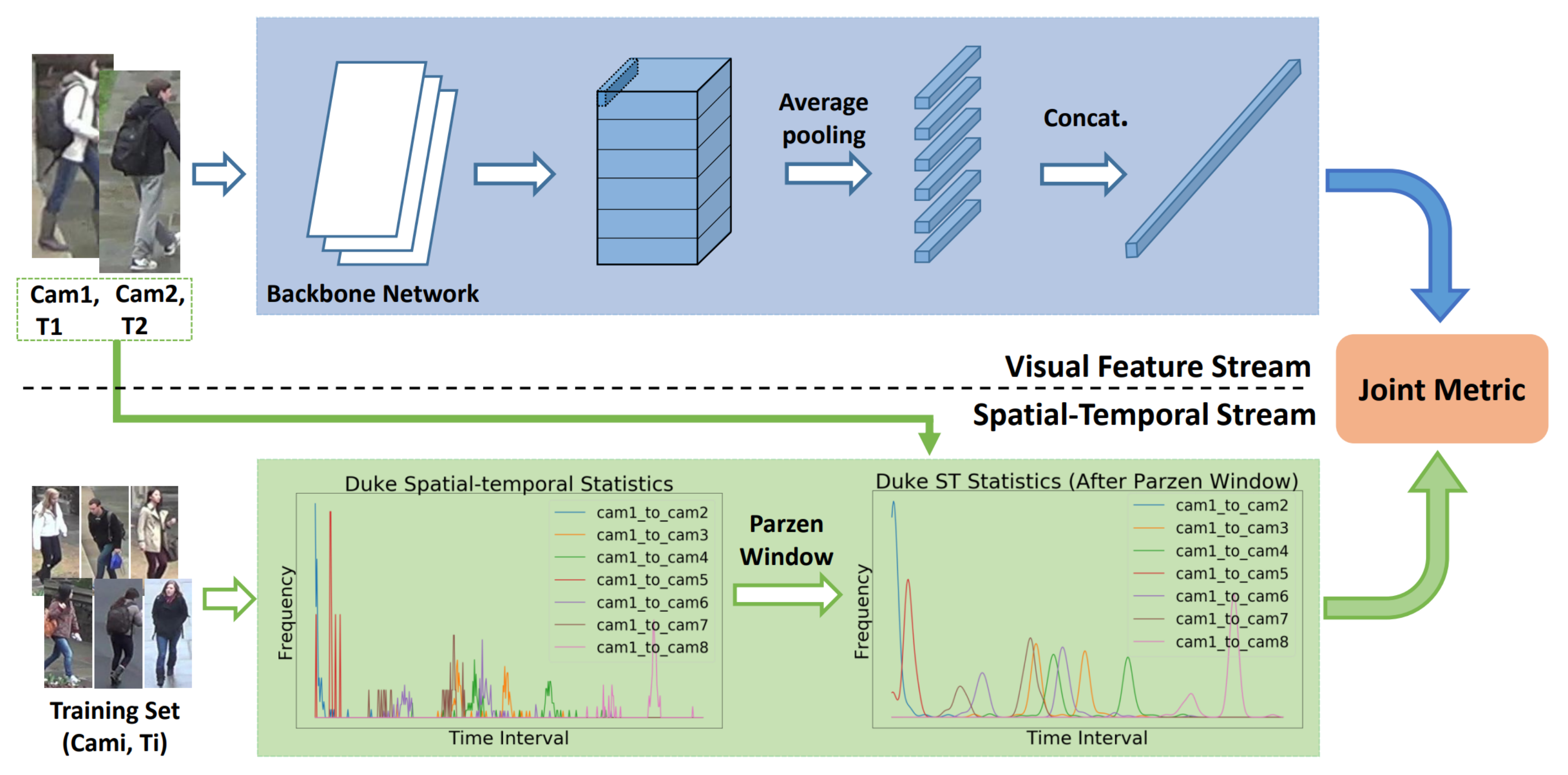
Source: Spatial-Temporal Reidentification(ST-ReID)
1. A pre-trained ResNet-50 backbone model with layers up until Adaptive Average Pooling(excluded) is used
**During Training**
> 1. The last Convolutional layer is broken into 6 (Final output size: 6 x 1) parts and separately used for predicting the person label.
> 2. The total loss of the 6 part predictions are calculated for backpropagation & weights update.
**During Testing/Evaluation/Deployment**
> 1. Only the visual feature stream up until Adaptive Average Pooling is used.
> 2. The feature vector of the query image is compared against all the feature vectors of the gallery images using a simple dot product & normalization.
> 3. The Spatio-Temporal distribution is used to calculate their spatio-temporal scores.
> 4. The joint score is then calculated from the feature score and the spatio-temporal scores.
> 5. The Cumulated Matching Score is used to find the best matching for person from the gallet set.
## Getting Started
Run the below commands in the shell.
1. Clone this repo, cd into it & install setup.py:
```sh
git clone https://github.com/SurajDonthi/MTMCT-Person-Re-Identification
cd MTMCT-Person-Re-Identification
pip install -r requirements.txt
```
2. Download the datasets. (By default you can download & unzip them to `data/raw/` directory)
You can get started by training this model. Trained models will be available soon!
*Dependencies*
This project requires `pytorch>=1.5.0`, `torchvision>=0.6.0`, `pytorch-lightning=1.1.1`, `tensorboard`, `joblib` and other common packages like `numpy`, `matplotlib` and `csv`.
NOTE: This project uses [pytorch-lightning](https://pytorch-lightning.readthedocs.io/en/latest/introduction_guide.html) which is a high-level interface to abstract away repeating Pytorch code. It helps achieve clean, & easy to maintain code with hardly any learning curve!
#### Train with your own dataset
Run the below command in the shell.
```sh
python -m mtmct_reid.train --data_dir path/to/dataset/ --dataset 'market' \
--save_distribution path/to/dataset/st_distribution.pkl --gpus 1 --max_epochs 60
```
For a detailed list of arguments you can pass, refer to [`hparams.csv`](https://github.com/SurajDonthi/MTMCT-Person-Re-Identification/blob/master/hparams.csv)
#### Monitor the training on Tensorboard
Log files are created to track the training in a new folder `logs`. To monitor the training, run the below command in the shell
```sh
tensorboard --logdir logs/
```
### Prediction/Evaluation
Using commandline:
```sh
python -m mtmct_reid.eval model_path 'path/to/model' --dataset 'market' \
--query_data_dir 'path/to/query_data/' --gallery_data_dir 'path/to/gallery_data' \
--st_distribution_path 'path/to/spatio-temporal_distribution' \
--batch_size 64 --num_workers 4 --re_rank True
```
## Metrics
The evaluation metrics used are mAP (mean Average Precision) & CMC (Cumulated Matching Characteristics)
Finding the best matches during testing:
Step 1: From a given dataset, compute it's Spatial-Temporal Distribution.
>> Requires: cam_ids, targets(labels), frames, MODEL is not required!
Step 2: Compute it's Gaussian smoothed ST-Distribution.
>> Requires: cam_ids, targets(labels), frames, MODEL is not required!
Step 3: Compute the L2-Normed features that is generated from the model.
>> Requires: Features - Performed once training is finished!
Step 4: Compute the Joint Scores.
>> Requires: Smoothed Distribution & L2-Normed Features, cam_ids, frames
Step 5: Optionally perform Re-ranking of the Generated scores.
>> Requires: Joint Scores
Step 6: Compute mAP & CMC (Cumulated Matching Characteristics; for Rank-1,Rank-5, Rank-10) for each query.
>> Requires: Reranked/Joint Scores, (query labels & cams),
(gallery labels & cams)
**References:**
[1] - [Spatial-Temporal Reidentification(ST-ReID)](https://arxiv.org/pdf/1812.03282.pdf)
[2] - [Beyond Parts Models: Person Retrieval with Refined Part Pooling](https://arxiv.org/pdf/1711.09349)
**Related repos:**
The model logic is mainly based on this [repository](https://github.com/Wanggcong/Spatial-Temporal-Re-identification).