https://github.com/UFTHaq/Motion-Capture-Leg-Limp-with-Python-OpenCV-MediaPipe
Limp Detection in Leg using OpenCV and MediaPipe with Motion Capture
https://github.com/UFTHaq/Motion-Capture-Leg-Limp-with-Python-OpenCV-MediaPipe
mediapipe-pose motion-capture opencv python
Last synced: about 1 year ago
JSON representation
Limp Detection in Leg using OpenCV and MediaPipe with Motion Capture
- Host: GitHub
- URL: https://github.com/UFTHaq/Motion-Capture-Leg-Limp-with-Python-OpenCV-MediaPipe
- Owner: UFTHaq
- License: mit
- Created: 2023-11-11T13:36:29.000Z (over 2 years ago)
- Default Branch: main
- Last Pushed: 2023-11-25T03:13:44.000Z (over 2 years ago)
- Last Synced: 2025-03-22T12:16:19.582Z (over 1 year ago)
- Topics: mediapipe-pose, motion-capture, opencv, python
- Language: Jupyter Notebook
- Homepage:
- Size: 924 KB
- Stars: 2
- Watchers: 1
- Forks: 0
- Open Issues: 1
-
Metadata Files:
- Readme: README.md
- License: LICENSE
Awesome Lists containing this project
README





# Motion Capture - Leg Limp
Limp Detection in Leg using OpenCV and MediaPipe with Motion Capture
This project combines the power of OpenCV and MediaPipe with advanced motion capture techniques to create a robust system for real-time limp detection in the
leg. By integrating motion capture capabilities, the application achieves enhanced precision in identifying and analyzing irregularities in leg movement.
If you consider this page is useful, please leave a star
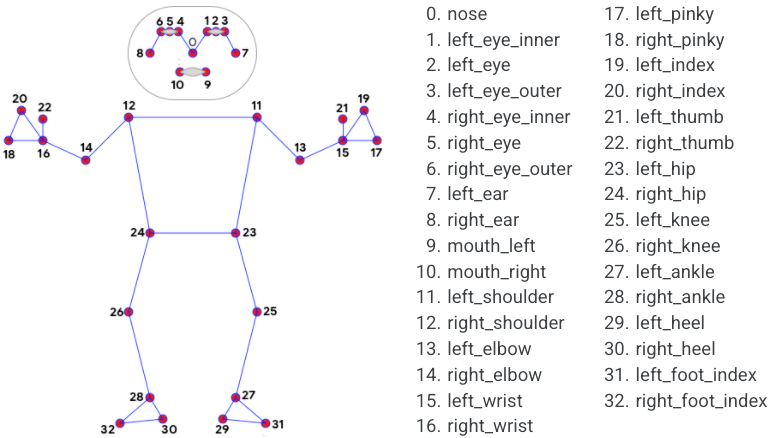
## MediaPipe - Pose Landmark
## I. You need the videos
https://github.com/UFTHaq/Motion-Capture-Leg-Limp/assets/104829519/84dbb9bd-0af4-40f3-8cc3-2725bbdb9dd0
https://github.com/UFTHaq/Motion-Capture-Leg-Limp/assets/104829519/bca10186-cbb4-4c3b-89bd-026db75f3112
## II. Then, you capture the motion
Here is the visualize graphic about the leg range of motion data captured from the video
|Normal (right-left) leg|Limp (right-left) leg|
|:-:|:-:|
| |
| |
|
|Normal (right) leg & Limp (right) leg|Normal (left) leg & Limp (left) leg|
|:-:|:-:|
| |
| |
|
## III. Take Conclusion
In image Limp (right-left) leg, it can be observed that there is a significant difference in the range of motion between the left and right legs. From this, it can be assumed that there is a limp in the left leg. The range of motion angle in the left leg (red line) tends to be smaller than the range of motion angle in the right leg because, in the limping left leg, the joint tends to lock the angle to alleviate pain caused by excessive leg movement. The larger the range of motion angle, the more pronounced the perceived pain.
If you consider this page is useful, please leave a star