https://github.com/XXIIVV/riven
Tiny Flow Based Framework
https://github.com/XXIIVV/riven
Last synced: about 1 year ago
JSON representation
Tiny Flow Based Framework
- Host: GitHub
- URL: https://github.com/XXIIVV/riven
- Owner: XXIIVV
- License: mit
- Created: 2018-02-23T01:49:27.000Z (over 8 years ago)
- Default Branch: master
- Last Pushed: 2022-10-20T02:33:17.000Z (over 3 years ago)
- Last Synced: 2024-08-04T01:27:42.922Z (almost 2 years ago)
- Language: JavaScript
- Homepage: http://wiki.xxiivv.com/Riven
- Size: 415 KB
- Stars: 413
- Watchers: 22
- Forks: 32
- Open Issues: 1
-
Metadata Files:
- Readme: README.md
- License: LICENSE.md
Awesome Lists containing this project
- awesome-list - riven
README
# Ø(Riven)
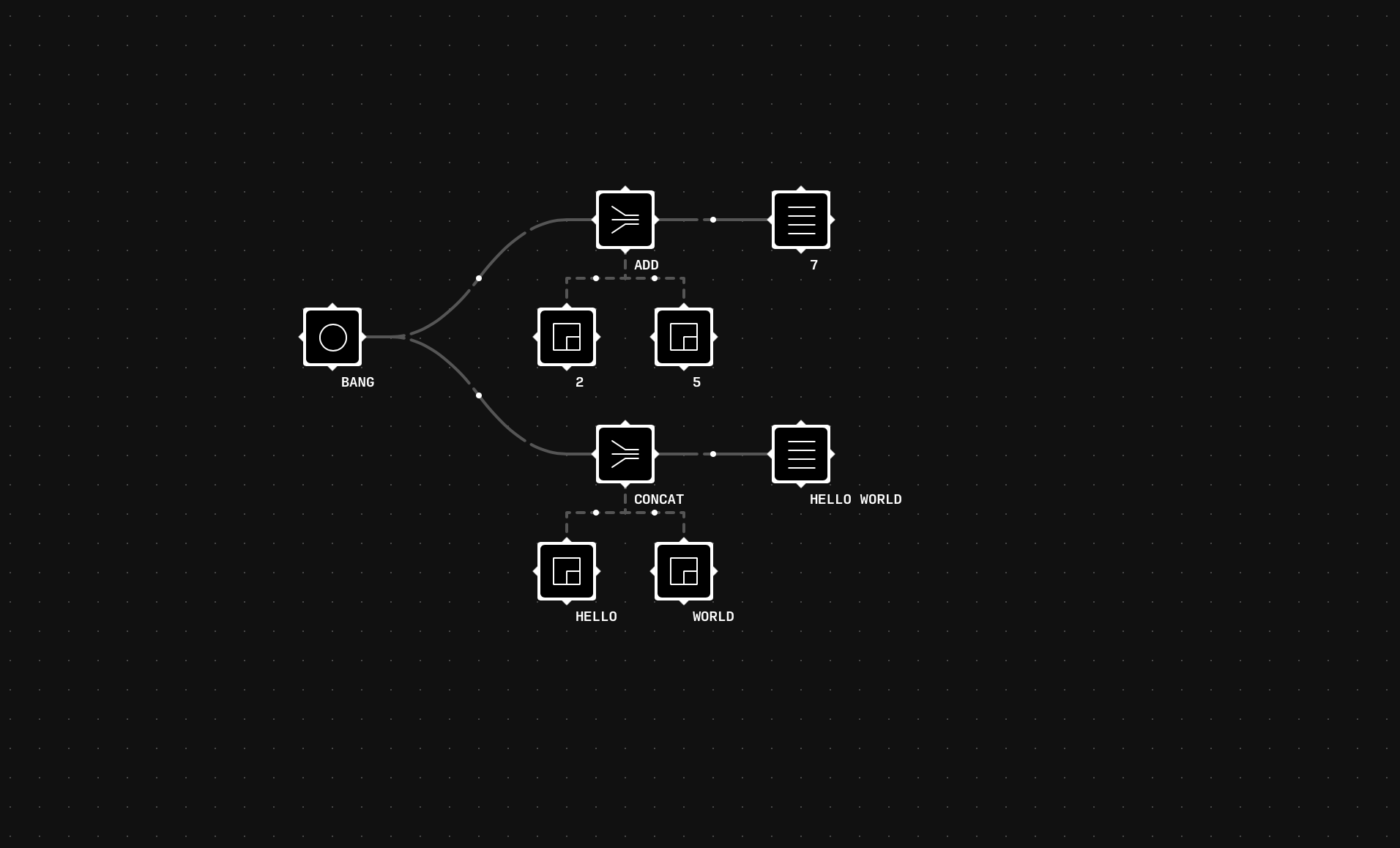
[Riven](http://wiki.xxiivv.com/Riven) is a bare minimum **flow-based programming framework** (eg: [math](https://rawgit.com/XXIIVV/Riven/master/example.math.html) & [conditional](https://rawgit.com/XXIIVV/Riven/master/example.conditional.html)). Nodes have 2 ways of communicating with each other, one is a `send/receive` pattern, the other, a `request/answer` pattern. Despite its minimal toolset, it can be expanded into a complete [web framework](http://wiki.xxiivv.com/riven.html).
## The Ø Selector
You are given a node selection tool `Ø()`, you can type the character with `alt+shift+O`(Alt +0216). If you are on Windows, or cannot easily type this character, try wrapping this function into a character of your choosing, like `function R(a){ return Ø(a); }`.
### Create a node
`Ø("template").create({x:2,y:2})` will create a **template** node at 2,2.
### Select a node
`Ø("template")` will select the **template** node.
### Connect a node
`Ø("template").connect("parser")` will connect the **template** node to the **parser** node.
You can also connect to **multiple nodes** at once with `Ø("template").connect(["parser","console"])`. The `Ø("template").bind("parser")` will create both a **connection and a syphon** between the 2 nodes.
## Communication
### .Send()
`Ø("template").send("hello")` will send *"hello"* to all receiving connected nodes.
### .Receive()
`Ø("template").receive(q) => {}`, method is triggered by send().
### .Request()
`Ø("template").request("cake")` will request *"cake"* from all answering connected nodes.
### .Answer()
`Ø("template").answer("cake")`, method is triggered by request().
## Extras
### .Bang()
`Ø("template").bang()`, is a convenience method equivalent to `.send(true)`, will send *true* to all receiving connected nodes.
### .Signal()
Looks for a connected node(receiving/answering) with the parameter id, `Ø("template").signal("parser").send("hello")`. Will send *"hello"*, directly to the *parser* node.
### Mesh
You can group nodes into scopes with `.mesh(pos,[nodes])` to visually groups the nodes into a single element that can be moved as one.
```
Ø("template").mesh({x:2,y:2},[
Ø("parser").create({x:1,y:2}),
Ø("header").create({x:2,y:3})
])
```
# That's it!
This framework does nothing else, but it does this well.
Enjoy.