https://github.com/abhiagwl/vistan
A simple library to run variational inference on Stan models.
https://github.com/abhiagwl/vistan
autograd automatic-differentiation inference inference-algorithms iw-sampling normalizing-flows posterior pystan rank-gaussian realnvp stan stan-models variational-bayes variational-inference
Last synced: 5 months ago
JSON representation
A simple library to run variational inference on Stan models.
- Host: GitHub
- URL: https://github.com/abhiagwl/vistan
- Owner: abhiagwl
- License: gpl-3.0
- Created: 2020-12-05T20:54:06.000Z (over 5 years ago)
- Default Branch: master
- Last Pushed: 2023-04-11T19:40:31.000Z (about 3 years ago)
- Last Synced: 2025-09-21T15:39:04.252Z (9 months ago)
- Topics: autograd, automatic-differentiation, inference, inference-algorithms, iw-sampling, normalizing-flows, posterior, pystan, rank-gaussian, realnvp, stan, stan-models, variational-bayes, variational-inference
- Language: Python
- Homepage:
- Size: 280 KB
- Stars: 33
- Watchers: 2
- Forks: 3
- Open Issues: 2
-
Metadata Files:
- Readme: README.md
- License: LICENSE
Awesome Lists containing this project
README
# vistan
`vistan` is a simple library to run variational inference algorithms on Stan models.
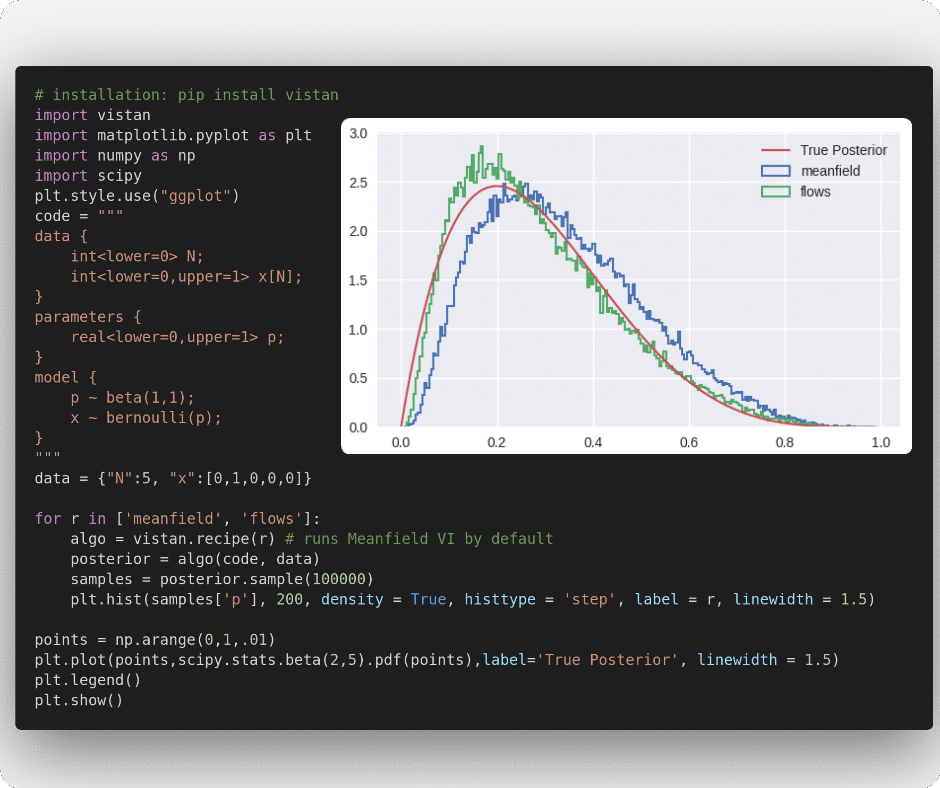
`vistan` uses [autograd][1] and [PyStan][2] under the hood. The aim is to provide a "petting zoo" to make it easy to play around with the different variational methods discussed in the NeurIPS 2020 paper [Advances in BBVI][3].
[1]: https://github.com/HIPS/autograd
[2]: https://github.com/stan-dev/pystan
[3]: https://proceedings.neurips.cc/paper/2020/file/c91e3483cf4f90057d02aa492d2b25b1-Paper.pdf
## Features
> - **Initialization:** Laplace's method to initialize full-rank Gaussian
> - **Gradient Estimators:** Total-gradient, STL, DReG, closed-form entropy
> - **Variational Families:** Full-rank Gaussian, Diagonal Gaussian, RealNVP
> - **Objectives:** ELBO, IW-ELBO
> - **IW-sampling:** Posterior samples using importance weighting
## Installation
```
pip install vistan
```
## Usage
The typical usage of the package would have the following steps:
1. Create an algorithm. This can be done in two wasy:
- The easiest is to use a pre-baked recipe as `algo=vistan.recipe('meanfield')`. There are various options:
+ `'advi'`: Run our implementation of ADVI's PyStan.
+ `'meanfield'`: Full-factorized Gaussia a.k.a meanfield VI
+ `'fullrank'`: Use a full-rank Gaussian for better dependence between latent variables
+ `'flows'`: Use a RealNVP flow-based VI
+ `'method x'`: Use methods from the paper [Advances in BBVI][3] where x is one of `[0, 1, 2, 3a, 3b, 4a, 4b, 4c, 4d]`
- Alternatively, you can create a custom algorithm as `algo=vistan.algorithm()`. Some most frequent arguments:
+ `vi_family`: This can be one of `['gaussian', 'diagonal', 'rnvp']` (Default: `gaussian`)
+ `max_iter`: The maximum number of optimization iterations. (Default: 100)
+ `optimizer`: This can be `'adam'` or `'advi'`. (Default: `'adam'`)
+ `grad_estimator`: What gradient estimator to use. Can be `'Total-gradient'`, `'STL'`, `'DReG'`, or `'closed-form-entropy'`. (Default: `'DReG'`)
+ `M_iw_train`: The number of importance samples. Use `1` for standard variational inference or more for importance-weighted variational inference. (Default: 1)
+ `per_iter_sample_budget`: The total number of evaluations to use in each iteration. (Default: 100)
2. Get an approximate posterior as `posterior=algo(code, data)`. This runs the algorithm on Stan model given by the string `code` with observations given by the `data`.
3. Draw samples from the approximate posterior as `samples=posterior.sample(100)`. You can also draw samples using importance weighting as `posterior.sample(100, M_iw_sample=10)`. Further, you can evaluate the log-probability of the posterior as `posterior.log_prob(latents)`.
## Citing vistan
If you use vistan, please, consider citing:
```
@inproceedings{aagrawal2020,
author = {Abhinav Agrawal and
Daniel R. Sheldon and
Justin Domke},
title = {Advances in Black-Box {VI:} Normalizing Flows, Importance Weighting,
and Optimization},
booktitle = {Advances in Neural Information Processing Systems 33: Annual Conference
on Neural Information Processing Systems 2020, NeurIPS 2020, December
6-12, 2020, virtual},
year = {2020},
}
```
## Recipes
Recipies refers to set of predetermined hyperparameters that let you quickly run some common variational algorithms.
### Meanfield Gaussian
`'meanfield'` runs the fully factorized Gaussian VI optimized using `Adam`
```python
import vistan
import matplotlib.pyplot as plt
import numpy as np
import scipy
code = """
data {
int N;
int x[N];
}
parameters {
real p;
}
model {
p ~ beta(1,1);
x ~ bernoulli(p);
}
"""
data = {"N":5, "x":[0,1,0,0,0]}
algo = vistan.recipe() # runs Meanfield VI by default
posterior = algo(code, data)
samples = posterior.sample(100000)
points = np.arange(0,1,.01)
plt.hist(samples['p'], 200, density = True, histtype = 'step')
plt.plot(points,scipy.stats.beta(2,5).pdf(points),label='True Posterior')
plt.legend()
plt.show()
```
### Full-rank Gaussian
`'fullrank'`, as the name suggests, optimizes full-rank Gaussian VI using `Adam`
```python
algo = vistan.recipe("fullrank")
posterior = algo(code, data)
samples = posterior.sample(100000)
points = np.arange(0, 1, .01)
plt.hist(samples['p'], 200, density=True, histtype='step')
plt.plot(points, scipy.stats.beta(2, 5).pdf(points), label='True Posterior')
plt.legend()
plt.show()
```
### Flow-based VI
`'flows'` optimizes a RealNVP inspired flow distribution for variational approximation using `Adam`
```python
algo = vistan.recipe("flows")
posterior = algo(code, data)
samples = posterior.sample(100000)
points = np.arange(0, 1, .01)
plt.hist(samples['p'], 200, density=True, histtype='step')
plt.plot(points, scipy.stats.beta(2, 5).pdf(points), label='True Posterior')
plt.legend()
plt.show()
```
### ADVI
`'advi'` runs our implementation of PyStan's ADVI and uses their custom step-sequence scheme
```python
algo = vistan.recipe("advi")
posterior = algo(code, data)
samples = posterior.sample(100000)
points = np.arange(0, 1, .01)
plt.hist(samples['p'], 200, density=True, histtype='step')
plt.plot(points, scipy.stats.beta(2, 5).pdf(points), label='True Posterior')
plt.legend()
plt.show()
```
### Methods from [Advances in BBVI][3]
`method x` runs implementation of different variational methods from [Advances in BBVI][3], where `x` is one of `[0, 1, 2, 3a, 3b, 4a, 4b, 4c, 4d]`
```python
# Try method 0, 1, 2, 3a, 3b, 4a, 4b, 4c, 4d
algo = vistan.recipe("method 4d")
posterior = algo(code, data)
samples = posterior.sample(100000)
points = np.arange(0, 1, .01)
plt.hist(samples['p'], 200, density=True, histtype='step')
plt.plot(points, scipy.stats.beta(2, 5).pdf(points), label='True Posterior')
plt.legend()
plt.show()
```
## Custom algorithms
You can also specify custom VI algorithms to work with your Stan models using `vistan.algorithm`. Please, see the documentation of `vistan.algorithm` for a complete list of supported arguments.
```python
algo = vistan.algorithm(
M_iw_train=2,
grad_estimator="DReG",
vi_family="gaussian",
per_iter_sample_budget=10,
max_iters=100)
posterior = algo(code, data)
samples = posterior.sample(100000)
points = np.arange(0, 1, .01)
plt.hist(samples['p'], 200, density=True, histtype='step')
plt.plot(points, scipy.stats.beta(2, 5).pdf(points), label='True Posterior')
plt.legend()
plt.show()
```
### IW-sampling
We provide support to use IW-sampling at inference time; this importance weights `M_iw_sample` candidate samples and picks one (see [Advances in BBVI][3] for more information.) IW-sampling is a post-hoc step and can be used with almost any variational scheme.
```python
samples = posterior.sample(100000, M_iw_sample=10)
points = np.arange(0, 1, .01)
plt.hist(samples['p'], 200, density=True, histtype='step')
plt.plot(points, scipy.stats.beta(2, 5).pdf(points), label='True Posterior')
plt.legend()
plt.show()
```
### Initialization
We provide support to use Laplace's method to initialize the parameters for Gaussian VI.
```python
algo = vistan.algorithm(vi_family='gaussian', LI=True)
posterior = algo(code, data)
samples = posterior.sample(100000)
points = np.arange(0, 1, .01)
plt.hist(samples['p'], 200, density=True, histtype='step')
plt.plot(points, scipy.stats.beta(2, 5).pdf(points), label='True Posterior')
plt.legend()
plt.show()
```
### Building your own inference algorithms
We provide access to the `model.log_prob` function we use internally for optimization. This allows you to evaluate the log density in the unconstrained space for your Stan model. Also, this function is differentiable in `autograd`.
```python
log_prob = posterior.model.log_prob
```
## Limitations
> - We currently only support inference on all latent parameters in the model
> - No support for data sub-sampling.