https://github.com/aflplusplus/cov-analysis
afl-cov successor - simpler and using modern llvm tools
https://github.com/aflplusplus/cov-analysis
Last synced: 2 days ago
JSON representation
afl-cov successor - simpler and using modern llvm tools
- Host: GitHub
- URL: https://github.com/aflplusplus/cov-analysis
- Owner: AFLplusplus
- License: agpl-3.0
- Created: 2026-04-14T17:21:12.000Z (2 months ago)
- Default Branch: main
- Last Pushed: 2026-06-20T17:58:33.000Z (7 days ago)
- Last Synced: 2026-06-20T19:21:41.403Z (7 days ago)
- Language: Shell
- Size: 670 KB
- Stars: 22
- Watchers: 1
- Forks: 2
- Open Issues: 0
-
Metadata Files:
- Readme: README.md
- License: LICENSE
Awesome Lists containing this project
README
# cov-analysis - Fuzzing Code Coverage for AFL++, libFuzzer, libafl, and honggfuzz
Replacing `afl-cov` and `libfuzzer-cov` with modern coverage gathering and great features!
Version: 1.0.0
- [Introduction](#introduction)
- [Prerequisites](#prerequisites)
- [Supported Fuzzers](#supported-fuzzers)
- [Workflow](#workflow)
- [Step 1: Build a Coverage Binary](#step-1-build-a-coverage-binary)
- [Step 2: Generate Coverage Report](#step-2-generate-coverage-report)
- [Step 3: Diff Two Coverage Reports](#step-3-diff-two-coverage-reports)
- [Step 4: Identifying unstable code lines](#step-4-identifying-unstable-code-lines)
- [Step 5: Search which inputs reach a line](#step-5-search-which-inputs-reach-a-line)
- [Parallelized AFL Execution](#parallelized-afl-execution)
- [Usage Information](#usage-information)
- [cov-analysis report (default)](#cov-analysis-report-default)
- [cov-analysis build](#cov-analysis-build)
- [cov-analysis driver](#cov-analysis-driver)
- [cov-analysis diff](#cov-analysis-diff)
- [cov-analysis stability](#cov-analysis-stability)
- [cov-analysis search](#cov-analysis-search)
- [License](#license)
## Introduction
`cov-analysis` generates **LLVM source-based code coverage** reports from a fuzzing corpus. It auto-detects the on-disk layout used by [AFL++](https://github.com/AFLplusplus/AFLplusplus) (queue/crashes/timeouts directories, single or parallel), libFuzzer and libafl (flat corpus dir plus `crash-*`/`leak-*`/`oom-*` artifacts), and honggfuzz (flat corpus plus `SIG*.fuzz` crash files). It replays each input through a coverage-instrumented binary, merges the raw profiles, and produces HTML, text, and JSON reports via `llvm-profdata` and `llvm-cov`.
This is a rewrite of the original cov-analysis. Key changes in 1.0.0:
- New: diff reports comparing coverage between two runs
- New: stability analysis identifying source lines with non-deterministic hit counts
- Replaced gcov/lcov/genhtml with LLVM source-based coverage (`-fprofile-instr-generate`, `llvm-profdata`, `llvm-cov`) - faster, more accurate under optimization
- `cov-analysis build` sets compiler flags and builds the target; `cov-analysis driver` emits a ready-to-use `coverage_driver.c` for `LLVMFuzzerTestOneInput` harnesses
- `cov-analysis diff` generates an HTML diff report comparing coverage between two JSON exports
- Rewritten in bash (was Python)
## Prerequisites
- `clang` (any version down to 11)
- `llvm-profdata` and `llvm-cov` — auto-detected to match the selected clang
version. When a versioned compiler is chosen (e.g. `CC=clang-22`, or the
default `clang` reports version 22), the matching `llvm-profdata-22` /
`llvm-cov-22` are used so the raw profiles merge without a version mismatch.
- AFL++ (`afl-fuzz`), libafl, libfuzzer, Honggfuzz, ... - only needed to produce the corpus, not to run `cov-analysis`
## Supported Fuzzers
| Fuzzer | Detected by | Input files replayed |
|------------|--------------------------------------------|-------------------------------------------------------------------------------|
| AFL++ | `/queue/` or `/*/queue/` exists | `queue/id:*`, `crashes/id:*`, `timeouts/id:*` |
| libFuzzer | flat directory of files, no `queue/` | all files except `crash-*`/`leak-*`/`oom-*`/`timeout-*`/`slow-unit-*` |
| libafl | flat directory of files, no `queue/` | all files except `crash-*`/`leak-*`/`oom-*`/`timeout-*`/`slow-unit-*` |
| honggfuzz | flat directory of files, no `queue/` | all files except `SIG*.fuzz` and `HONGGFUZZ.REPORT.TXT` |
For libFuzzer, libafl and honggfuzz, crash-like files (above) are still replayed, but under the `-T` timeout so a hanging input can't stall the run.
Override auto-detection with `--layout afl|flat`.
## Workflow
Note: `cov-analysis` uses the `TMPDIR` environment variable if present.
### Step 1: Build a Coverage Binary
Use `cov-analysis build` to set the correct compiler flags and build your target:
```bash
# Set up a coverage build (run once per build step)
cd /path/to/project-cov/
cov-analysis build ./configure --disable-shared
cov-analysis build make -j$(nproc)
```
`cov-analysis build` sets:
```
CC=clang CXX=clang++
CFLAGS="-fprofile-instr-generate -fcoverage-mapping -DFUZZING_BUILD_MODE_UNSAFE_FOR_PRODUCTION=1"
LDFLAGS="-fprofile-instr-generate"
```
**Important:** `FUZZING_BUILD_MODE_UNSAFE_FOR_PRODUCTION=1` must match what was used during fuzzing - it disables the same checksums/HMACs that AFL++ bypassed.
#### For `LLVMFuzzerTestOneInput` harnesses
Generate a replay driver and link it against your coverage-instrumented library:
```bash
cov-analysis driver -o coverage_driver.c
clang -fprofile-instr-generate -fcoverage-mapping \
-c coverage_driver.c -o coverage_driver.o
clang -fprofile-instr-generate \
coverage_driver.o -L./build -ltarget -o cov
```
The driver loops over all file arguments, calls `LLVMFuzzerTestOneInput` for each, and installs a crash handler that flushes profiling data so crashing inputs still contribute to the report.
### Step 2: Generate Coverage Report
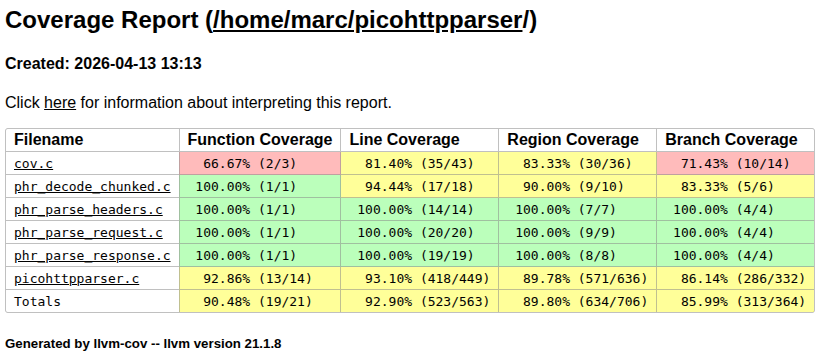
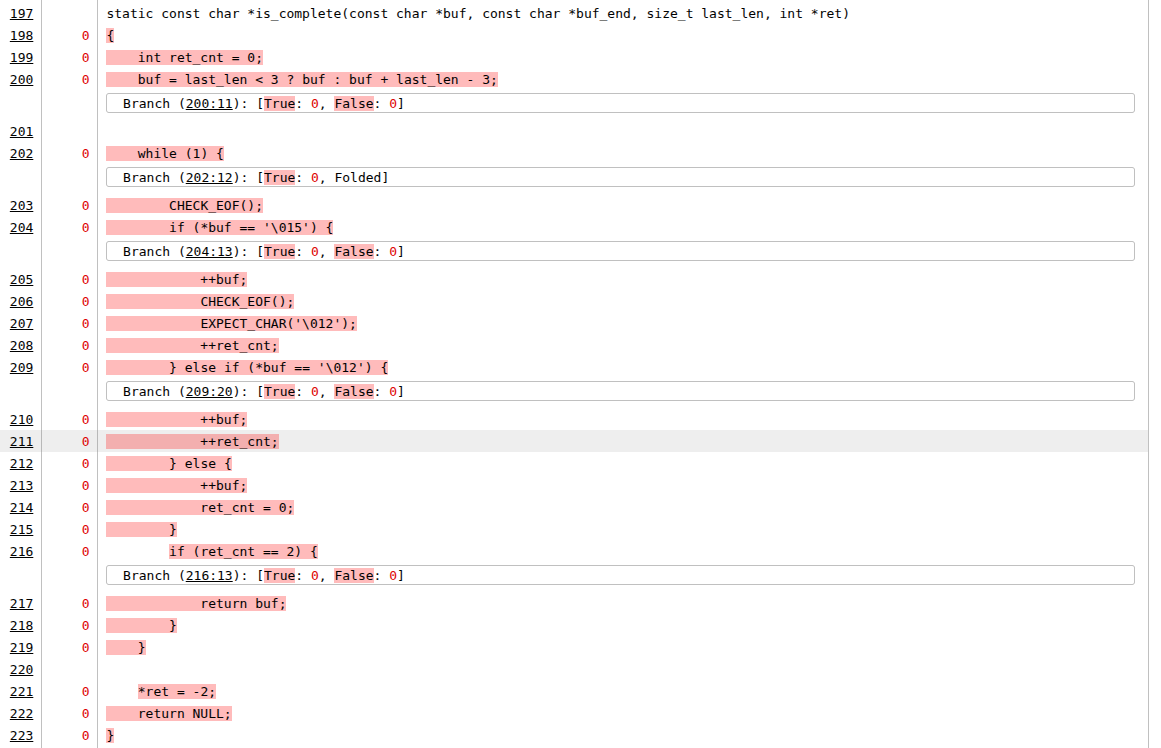
This step produces an `llvm-cov` coverage report with regions and branches:
```bash
cd /path/to/project-cov/
cov-analysis -d /path/to/afl-fuzz-output/ -e "./cov @@"
```
To replay coverage with multiple workers, add `-t`:
```bash
cov-analysis -d /path/to/afl-fuzz-output/ -e "./cov @@" -t 8
```
`cov-analysis` will for AFL++:
1. Replay all `queue/id:*` files in batch (fast)
2. Replay `crashes/id:*` and `timeouts/id:*` one-by-one with a timeout
3. Merge `.profraw` profiles with `llvm-profdata`
4. Generate reports in `/path/to/afl-fuzz-output/cov/`
For libfuzzer/libafl/Honggfuzz `cov-analysis` will:
1. Replay all files in the directory
2. Crash files are replayed one-by-one with a timeout
Output:
```
/path/to/afl-fuzz-output/cov/
html/index.html ← browse this for annotated source coverage
text/ ← text format, suitable for automated analysis
summary.txt ← per-file line/branch/function percentages
coverage.json ← machine-readable export
coverage.profdata ← merged profile (baseline for iterative improvement)
```
For stdin-based targets (binary reads from stdin, no file argument):
```bash
cov-analysis -d /path/to/afl-fuzz-output/ -e "./target"
```
#### libFuzzer corpus
```bash
cov-analysis -d /path/to/libfuzzer-corpus/ -e "./cov @@"
```
Corpus files are replayed in batch mode. If your libFuzzer run used `-artifact_prefix=./crashes/`, point a second run at that directory to cover crash inputs too — or move artifacts into the corpus dir beforehand.
#### honggfuzz workspace
```bash
cov-analysis -d /path/to/hfuzz-workdir/ -e "./cov @@"
```
`SIG*.fuzz` crash files are replayed under the `-T` timeout. The `HONGGFUZZ.REPORT.TXT` metadata file is ignored automatically.
#### Cross-referencing static reachability
If you have run the companion [fuzz-reachability](https://github.com/AFLplusplus/fuzz-reachability)
analyzer, pass its output with `--reachability` to tell apart coverage gaps that
are worth chasing from dead weight you can safely ignore:
```bash
cov-analysis -d /path/to/afl-fuzz-output/ -e "./cov @@" \
--reachability /path/to/reachability/test.json
```
`--reachability` accepts the analyzer's JSON report, its output directory
(holding `reached.txt` / `not_reached.txt`), or a single SanitizerCoverage
allow/ignore `.txt` list. The normal `llvm-cov` HTML and text reports are
annotated **in place** (no separate report). In the HTML file view each
function's lines are tinted:
- **covered** — keeps `llvm-cov`'s usual coloring
- **amber** — statically *reachable* but never reached (the actionable gap;
a lighter amber marks functions reachable only through over-approximated
indirect calls)
- **dark grey** — statically *unreachable*, so it is expected to stay
uncovered — ignore it
- **purple** — covered yet flagged unreachable (a static-analysis anomaly worth
a look, since the analyzer claims it never under-reports)
The HTML `index.html` gains a tally banner. The text source view (`text/`) gets
a per-line marker column (`U` unreachable, `R` reachable-but-unreached,
`A` anomaly), and `summary.txt` gains a reachability tally plus the explicit
list of reachable-but-not-reached functions to go after.
**The coverage numbers themselves are recomputed to exclude unreachable
functions.** Normally a function coverage of `5/6` counts a statically-dead
function in the denominator even though the harness can never reach it. With
`--reachability`, the Function / Line / Region / Branch numbers in both
`index.html` and `summary.txt` drop every statically-unreachable function from
the denominators (and numerators), so the percentages reflect only code the
harness can actually reach — e.g. that `5/6` becomes `5/5`. The numbers come
straight from `llvm-cov report -show-functions` (so they match llvm-cov's own
math exactly), re-summed over the reachable set; the unmodified figures remain
in `coverage.json`. With `--reachability` the HTML index is rendered flat
(directory grouping disabled) so its cells can be rewritten reliably.
`cov-analysis diff` accepts the same `--reachability` flag; it splits the
"still uncovered functions" list in the diff report into reachable (amber,
actionable) and unreachable (grey, expected dead).
### Step 3: Diff Two Coverage Reports
Compare coverage between two `llvm-cov` JSON exports and generate an HTML diff report:
```bash
cov-analysis diff coverage_old.json coverage_new.json
```
If you use the same output directory for a subsequent run, `cov-analysis` renames the existing `coverage.json` to `coverage_old.json` automatically, so `cov-analysis diff` works with no arguments.
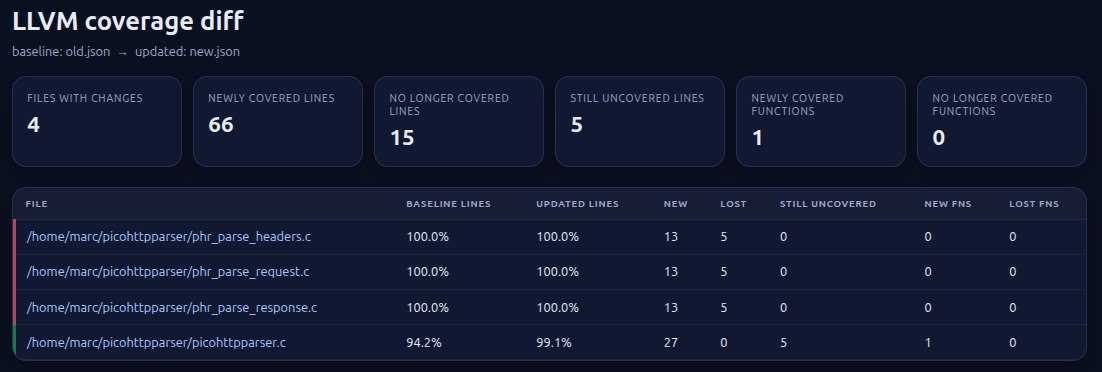
The report is written to `/coverage_diff.html` and shows:
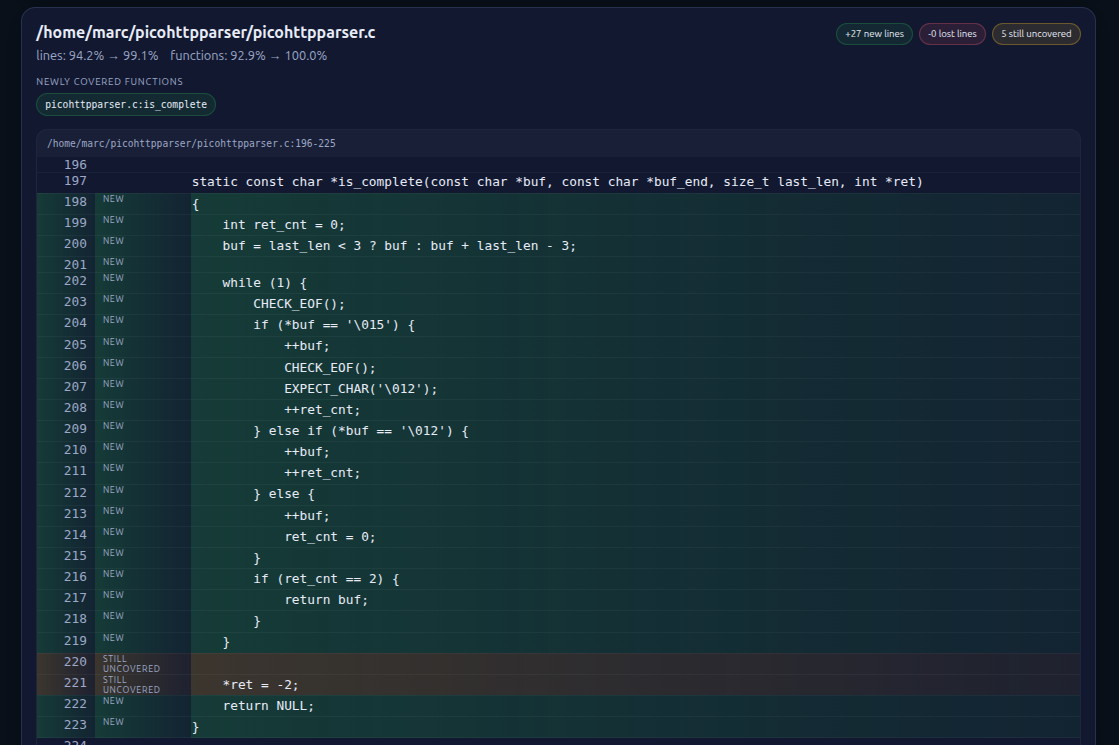
- Newly covered and no-longer-covered lines per file
- Newly covered and lost functions
- Source code snippets annotated with coverage change
If the JSON paths are omitted, `cov-analysis diff` defaults to `/coverage_old.json` and `/coverage.json`. Run with no arguments and neither default report present in the current directory, it prints the help instead of an error.
The HTML diff report looks like this:
### Step 4: Identifying unstable code lines
Ever wondered which source lines cause AFL++ or libafl to report instability in a fuzz target?
The `stability` command identifies them.
```bash
cov-analysis stability -d ../afl/out -e "./cov @@"
```
This will give you the exact lines that are problematic, e.g.:
```
Stability Report
--------------------------------------------------------
Corpus size : 2 inputs
Runs : 8
Stability : 74.0% (91/123 executed lines stable)
~~ Variable-count lines (32 lines):
Lines with varying hit counts:
/prg/cov-analysis/tests/unstable.c:35-37
/prg/cov-analysis/tests/unstable.c:43
/prg/cov-analysis/tests/unstable.c:46-48
/prg/cov-analysis/tests/unstable.c:51-52
/prg/cov-analysis/tests/unstable.c:55-61
/prg/cov-analysis/tests/unstable.c:64-66
/prg/cov-analysis/tests/unstable.c:69-70
/prg/cov-analysis/tests/unstable.c:75-85
[!] Unstable coverage detected.
```
### Step 5: Search which inputs reach a line
Wonder which corpus entries actually exercise a particular source line? The
`search` command replays each input in isolation and reports the ones that
reach `FILE:LINE`:
```bash
cov-analysis search src/parser.c:142 -d ../afl/out -e "./cov @@"
```
Matching input paths are printed to stdout (one per line, sorted) so the result
pipes cleanly; progress and the summary go to stderr:
```
src/parser.c:142 is reachable; scanning...
out/queue/id:000017,...
out/queue/id:000094,...
[+] 2 of 142 inputs reach src/parser.c:142
```
By default only queue/corpus entries are scanned. Add `--crashes` to also scan
crash and timeout inputs, and `-t N` to parallelize:
```bash
cov-analysis search src/parser.c:142 -d ../afl/out -e "./cov @@" --crashes -t 8
```
A fast union pre-check replays the whole corpus once first; if no input reaches
the line, `search` reports `0 of N` immediately (and tells you whether the line
is merely unreached or not present in the coverage data at all) without the full
per-input scan.
Pipe the reaching inputs straight into another tool:
```bash
cov-analysis search src/parser.c:142 -d ../afl/out -e "./cov @@" | xargs -I{} cp {} ./hits/
```
### Parallelized AFL Execution
For parallel AFL runs (`afl-fuzz -o sync_dir`), point `-d` at the top-level sync directory. `cov-analysis` automatically discovers all fuzzer instance subdirectories:
```bash
cov-analysis -d /path/to/sync_dir/ -e "./cov @@"
```
## Usage Information
### cov-analysis report (default)
```
Usage: cov-analysis [report] [options]
Required:
-d Fuzzing output directory (AFL++, libFuzzer, libafl, or honggfuzz)
-e Coverage command. Use @@ as input file placeholder.
Omit @@ to feed input via stdin instead. For a cov-analysis
driver binary (which reads files, not stdin), @@ is appended
automatically when omitted.
Optional:
-o Report output directory (default: /cov)
-t Parallel replay workers/forks (default: 1)
-T Timeout for crash/timeout replay (default: 5)
--layout Force layout: 'afl' or 'flat' (default: auto-detect)
--ignore-regex Filename regex to exclude from llvm-cov reports
(default: /usr/include/)
--reachability
Cross-reference fuzz-reachability output (its JSON report,
output directory, or a sancov allow/ignore .txt list) and
annotate the HTML + text reports in place: functions tinted
amber=reachable but not reached, dark grey=unreachable,
purple=covered yet flagged unreachable; text gets a U/R/A
marker column and summary.txt a reachability tally.
-v Verbose output
-q Quiet mode
-V Print version and exit
-h, --help Print this help and exit
```
### cov-analysis build
```
Usage: cov-analysis build [args...]
Sets CC/CXX/CFLAGS/CXXFLAGS/LDFLAGS for LLVM source-based coverage and
runs the given build command.
```
### cov-analysis driver
```
Usage: cov-analysis driver [-o output.c]
Emits coverage_driver.c source to stdout (or to -o FILE).
Use this for LLVMFuzzerTestOneInput harnesses to replay corpus files.
The driver loops over all file arguments, calls LLVMFuzzerTestOneInput
for each, and installs a crash handler that flushes profiling data so
crashing inputs still contribute to the coverage report.
Options:
-o Write driver source to FILE instead of stdout
```
### cov-analysis diff
```
Usage: cov-analysis diff [-o ] [--reachability
] [ ]
Compare coverage between two llvm-cov JSON exports and generate an
HTML diff report showing newly covered, lost, and still-uncovered
lines and functions.
Defaults to /coverage_old.json and /coverage.json.
--reachability
cross-references fuzz-reachability output (JSON, output
directory, or a sancov .txt list) and splits the still-uncovered functions
into reachable (amber, actionable) vs unreachable (grey, expected dead).
```
### cov-analysis stability
```
Usage: cov-analysis stability [options]
Run each corpus input N times with LLVM coverage, collect per-line hit
counts, and flag lines where counts vary across runs as "unstable."
Reports a stability percentage. If instability is found with the default
4 runs, reruns for a total of 8 to confirm.
Resilient to flaky passes: a pass whose profiles cannot be collected or
merged (e.g. a crashing input that left a truncated .profraw behind) is
skipped and the run continues with the remaining passes, as long as at
least 2 passes succeed.
Required:
-d
Fuzzing output directory (AFL++, libFuzzer, libafl, or honggfuzz)
-e Coverage command. Use @@ as input file placeholder.
Omit @@ to feed input via stdin instead. For a cov-analysis
driver binary (which reads files, not stdin), @@ is appended
automatically when omitted.
Optional:
-n Number of runs per corpus pass (default: 4)
-s Only consider source lines whose file path contains
this prefix (e.g. -s src/)
-t Parallel replay workers (default: 1)
--layout Force layout: 'afl' or 'flat' (default: auto-detect)
-v Verbose output
-q Quiet mode (suppress all [+] output)
-V Print version and exit
-h, --help Print this help and exit
```
The command outputs a **Stability Report** showing corpus size, number of runs, and the stability percentage (stable executed lines / total executed lines). If unstable lines are found, they are listed with file paths and line number ranges. If any pass failed to collect or merge its profiles, it is skipped and the report notes how many runs were actually analyzed.
Examples:
```bash
cov-analysis stability -d out/ -e "./cov @@"
cov-analysis stability -d out/ -e "./cov @@" -n 8 -s src/
cov-analysis stability -d ./corpus -e "./cov @@" -t 4
```
### cov-analysis search
```
Usage: cov-analysis search FILE:LINE -d -e "" [options]
Report which corpus entries reach a given source line. Each input is replayed
in isolation; an input "reaches" FILE:LINE when its line-execution count for
that line is > 0. Matching input paths print to stdout (sorted, one per line);
progress and the summary go to stderr.
Required:
FILE:LINE Source location, e.g. src/foo.c:123 (single line)
-d Fuzzing output directory (AFL++, libFuzzer, libafl, or honggfuzz)
-e Coverage command. Use @@ as input file placeholder.
Omit @@ to feed input via stdin instead. For a cov-analysis
driver binary (which reads files, not stdin), @@ is appended
automatically when omitted.
Optional:
--crashes Also scan crash and timeout inputs (default: corpus only)
-t Parallel workers for the per-input scan (default: 1)
-T Per-input replay timeout in seconds (default: 5)
--layout Force layout: 'afl' or 'flat' (default: auto-detect)
-v Verbose output
-q Quiet mode
-V Print version and exit
-h, --help Print this help and exit
```
## License
`cov-analysis` is released under the **GNU Affero General Public License 3**.