https://github.com/akazukin5151/electoral-systems
Simulating different electoral systems
https://github.com/akazukin5151/electoral-systems
approval-voting borda elections electoral-system-visualization electoral-systems first-past-the-post irv julia range-voting simulation visualization
Last synced: 5 months ago
JSON representation
Simulating different electoral systems
- Host: GitHub
- URL: https://github.com/akazukin5151/electoral-systems
- Owner: akazukin5151
- License: gpl-3.0
- Created: 2020-03-11T23:11:20.000Z (over 6 years ago)
- Default Branch: master
- Last Pushed: 2023-02-17T21:47:56.000Z (over 3 years ago)
- Last Synced: 2024-05-21T03:40:48.538Z (about 2 years ago)
- Topics: approval-voting, borda, elections, electoral-system-visualization, electoral-systems, first-past-the-post, irv, julia, range-voting, simulation, visualization
- Language: Julia
- Size: 635 KB
- Stars: 6
- Watchers: 1
- Forks: 0
- Open Issues: 0
-
Metadata Files:
- Readme: README.md
- License: LICENSE
Awesome Lists containing this project
README
# Electoral Systems [](https://nbviewer.jupyter.org/github/akazukin5151/electoral-systems/blob/master/run_elections.ipynb) [](https://www.gnu.org/licenses/gpl-3.0.txt) [](https://img.shields.io/badge/status-inactive-green)
> **Note** also see: Yee diagrams for proportional representation methods: https://github.com/akazukin5151/approportionment
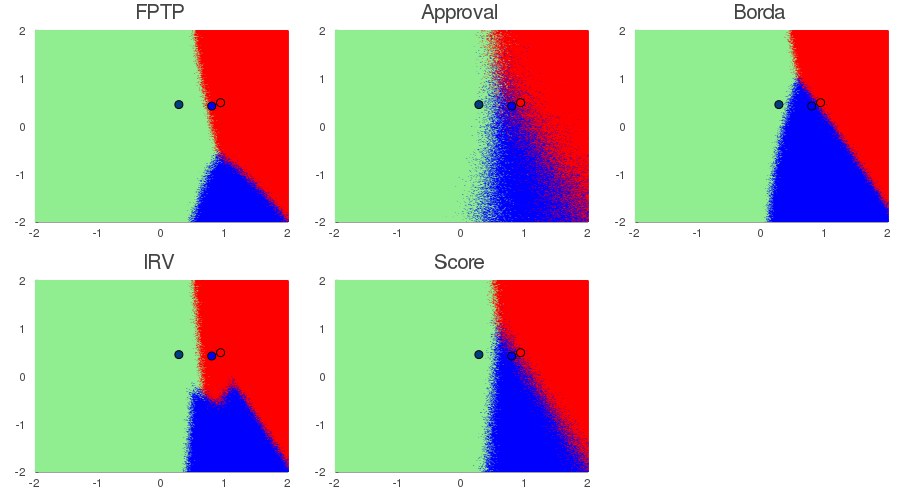
Simulates virtual elections under different electoral systems. Voters and candidates are distributed on a 2D plane corresponding to their ideology. For more details read below
Inspired by Ka Yee-Ping's [Voting Simulation Visualizations](http://zesty.ca/voting/sim/) and Nicky Case's [To build a better ballot](https://ncase.me/ballot/)

The above is a preview of approval_bullet(). It simulates when some voters under approval voting cast insincere ballots and bullet vote. That means they only approve their top candidate, even though they might approve of others. The title of each graph corresponds to the proportion of voters that are bullet voting.
If everyone is bullet voting, then the election should be exactly the same as under FPTP. However, it appears that bullet voting under approval voting actually is more effect than FPTP in suppressing the third candidate. Or there's something very wrong with my implementation
This is a Julia re-write of a previous version that was written in Python. Python is too slow for the number crunching needed here, and actually Altair fails to plot the graph anyway. So Julia it is.
## Note: the first run on both JupyterLab and .jl/REPL is extremely slow, because all the dependencies have to be compiled
Slow in the scale of minutes.
Look at PackageCompiler to precompile them. Precompiling JuliaPlots by following [this](https://julialang.github.io/PackageCompiler.jl/dev/examples/plots/) worked for me.
# Usage (with JupyterLab, recommended)
1. Unfortunately, Binder is stuck on an ancient version of iJulia, so you need to install JupyterLab yourself and just open `run_elections.ipynb`
2. Run all cells
# Usage (with .jl file)
1. Make sure `elections.jl` and `testing.jl` are in the same folder
2. Run with `julia "path_to_folder/run_elections.jl"`
You can those functions for other purposes as well:
1. Inside Julia (REPL), type `push!(LOAD_PATH, "path_of_your_folder")`. You may want to add it to your startup.jl as well
2. In a new .jl file, put `using elections` in the top
3. Just use the functions like `fptp(...)`
To get the "ideal" image shown above, change the `0.1` to `0.01` in [this line](https://github.com/akazukin5151/electoral-systems/blob/6a8141f6ee995b46fcc8bfc80a951d82d6c9308f/run_elections.jl#L6). **Warning: will use lots of memory and take minutes.**
# Testing
Unit tests require `Test` and `InteractiveUtils` to be installed. The latter doesn't need to be explicitly `using`'ed if you're running the tests the Jupyter notebook
1. Make sure `elections.jl` and `testing.jl` are in the same folder
2. Run with `julia "path_to_folder/testing.jl"`