https://github.com/albertms10/music_notes
Music theory Dart library
https://github.com/albertms10/music_notes
dart education midi music music-notation music-theory
Last synced: about 1 month ago
JSON representation
Music theory Dart library
- Host: GitHub
- URL: https://github.com/albertms10/music_notes
- Owner: albertms10
- License: bsd-3-clause
- Created: 2020-06-01T23:59:43.000Z (about 6 years ago)
- Default Branch: main
- Last Pushed: 2026-04-27T11:58:12.000Z (about 1 month ago)
- Last Synced: 2026-04-27T13:22:50.169Z (about 1 month ago)
- Topics: dart, education, midi, music, music-notation, music-theory
- Language: Dart
- Homepage: https://pub.dev/packages/music_notes
- Size: 1.96 MB
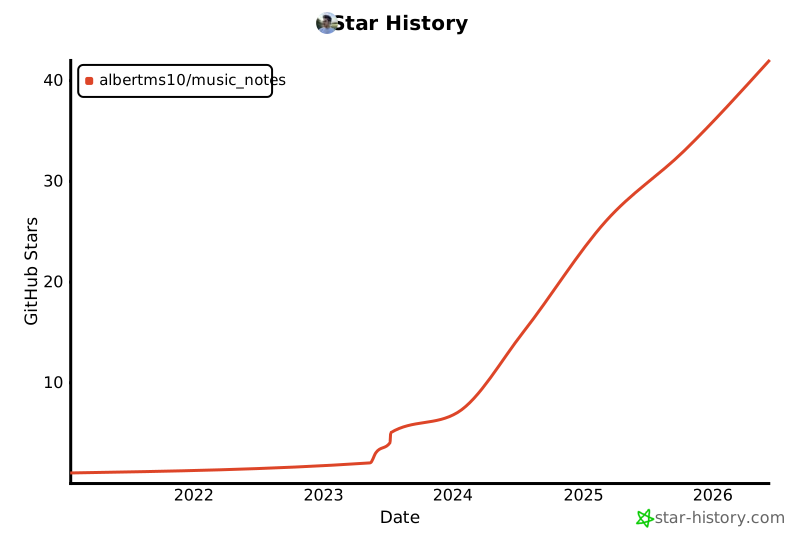
- Stars: 40
- Watchers: 4
- Forks: 11
- Open Issues: 14
-
Metadata Files:
- Readme: README.md
- Changelog: CHANGELOG.md
- License: LICENSE
- Code of conduct: CODE_OF_CONDUCT.md
- Codeowners: CODEOWNERS
- Security: SECURITY.md
Awesome Lists containing this project
README

[](https://coveralls.io/github/albertms10/music_notes?branch=main)
[](https://pub.dev/packages/music_notes)
[](https://api.securityscorecards.dev/projects/github.com/albertms10/music_notes)
[](https://www.bestpractices.dev/projects/8718)
[](https://opensource.org/license/bsd-3-clause/)
[](https://pub.dev/packages/very_good_analysis)
A comprehensive Dart library for effortlessly working with music theory concepts,
offering an elegant and beautifully crafted API.
## Features
- Notes, accidentals, and enharmonic operations
- Intervals, qualities, and circle of fifths
- Chords, scales, harmonic functions, inversions and retrogrades
- Keys, key signatures, and modes
- Frequencies and tuning systems (_work in progress_)
## Usage
Import the package into your Dart code:
```dart
import 'package:music_notes/music_notes.dart';
```
Now, you can use the provided APIs to perform various music theory operations.
For more detailed usage instructions and examples, please refer to the
[API documentation](https://pub.dev/documentation/music_notes/latest/).
### Notes
Define a `Note` from a `NoteName` (`.a` to `.g`) and an `Accidental`, or using their
shorthand static constants:
```dart
const Note(.e, .flat); // E♭
Note.c; // C
Note.d; // D
Note.f; // F
```
`NoteName`s can be obtained from semitones or ordinal:
```dart
NoteName.fromSemitones(2); // NoteName.d
NoteName.fromSemitones(9); // NoteName.a
NoteName.fromOrdinal(3); // NoteName.e
NoteName.fromOrdinal(7); // NoteName.b
```
Alter a `Note` with `sharp` or `flat`:
```dart
Note.c.sharp; // C♯
Note.d.flat; // D♭
Note.g.flat.flat; // G𝄫
Note.f.sharp.sharp.sharp; // F𝄪♯
```
And position them in the octave, resulting in `Pitch`es:
```dart
Note.f.inOctave(4); // F4
Note.b.flat.inOctave(5); // B♭5
```
Or parse them in both scientific and Helmholtz notations:
```dart
NoteName.parse('b'); // NoteName.b
Note.parse('a#'); // A♯
Pitch.parse("g''"); // G5
Pitch.parse('Eb3'); // E♭3
```
Get their difference in semitones:
```dart
NoteName.c.difference(.e); // 4
NoteName.a.difference(.e); // -5
NoteName.a.positiveDifference(.e); // 7
Note.c.difference(.e.flat); // 3
Pitch.parse('C').difference(.parse("c''''")); // 60
```
Transpose them:
```dart
Note.g.flat.transposeBy(-Interval.m3); // E♭
Note.b.inOctave(3).transposeBy(.P5); // F♯4
```
Respell them by any criteria:
```dart
Note.c.sharp.respellByNoteName(.d); // D♭
Note.e.flat.respellByAccidental(.sharp); // D♯
Note.g.flat.inOctave(3).respellByOrdinalDistance(-1); // F♯3
Note.g.sharp.respelledUpwards; // A♭
Note.a.flat.respelledDownwards; // G♯
Note.b.sharp.inOctave(4).respelledSimple; // C5
```
Compare two `Pitch`es based on their semitones:
```dart
Note.c.inOctave(4) < Note.c.inOctave(5); // true
Note.d.inOctave(3) > Note.f.inOctave(4); // false
Note.a.flat.inOctave(5) >= Note.g.sharp.inOctave(5); // true
```
Know whether two `Note`s or `Pitch`es are enharmonically equivalent:
```dart
Note.f.sharp.isEnharmonicWith(Note.g.flat); // true
Note.c.inOctave(4).isEnharmonicWith(Note.b.sharp.inOctave(3)); // true
Note.a.isEnharmonicWith(Note.b.flat); // false
```
Represent them as [`PitchClass`es](https://en.wikipedia.org/wiki/Pitch_class):
```dart
Note.d.flat.toClass(); // {C♯|D♭}
Note.a.inOctave(4).toClass(); // {A}
```
Perform [`PitchClass` multiplications (modulo 12)]():
```dart
PitchClass.cSharp * 7; // {G}
PitchClass.d * 7; // {D}
// observe one semitone upwards results in ascending fifths G -> D.
PitchClass.cSharp * 5; // {F}
PitchClass.d * 5; // {A♯|B♭}
// observe one semitone upwards results in ascending fourths F -> B-flat.
```
Represent them using any notation formatter:
```dart
Note.d.flat
..format() // D♭
..format(const GermanNoteNotation()) // Des
..format(const RomanceNoteNotation.symbol()); // Re♭
Note.b.flat.inOctave(-1).format(); // B♭-1
Note.c.inOctave(6).format(HelmholtzPitchNotation.english); // c‴
PitchClass.c.format(); // {C}
PitchClass.dSharp.format(); // {D♯|E♭}
PitchClass.f.format(const IntegerPitchClassNotation()); // 5
PitchClass.aSharp.format(const IntegerPitchClassNotation()); // t
```
### Intervals
Create an `Interval`:
```dart
const Interval.imperfect(.tenth, .major); // M10
Interval.d5; // d5
Size.sixth.augmented; // A6
Size.eleventh.simple.perfect; // P4
```
Or parse it from a string:
```dart
Interval.parse('m3'); // m3
Interval.parse('P-5'); // P-5
Interval.parse('AA6'); // AA6
```
Turn it descending:
```dart
-Interval.m7; // m-7
(-Interval.P5).direction; // -1
Interval.M3.descending; // M-3
(-Interval.P4).ascending; // P4
(-Interval.P4).withDescending(false); // P4
```
Perform common interval operations:
```dart
Interval.m3.inversion; // M6
Interval.A4.inversion; // d5
Interval.m9.inversion; // M7
Interval.m9.simple; // m2
Interval.P11.simple; // P4
(-Interval.M3).simple; // M-3
Interval.P5.isCompound; // false
Interval.M9.isCompound; // true
(-Interval.P11).isCompound; // true
Interval.P5.isDissonant; // false
Interval.d5.isDissonant; // true
Interval.M7.isDissonant; // true
```
Respell an `Interval` by size:
```dart
Interval.A4.respellBySize(.fifth); // d5
Interval.d3.respellBySize(.second); // M2
```
Calculate the `Interval` between two notes:
```dart
Note.c.interval(.g); // P5
Note.d.interval(.f.sharp).inversion; // m6
NoteName.d.intervalSize(.f); // 3
NoteName.a.intervalSize(.e); // 5
```
Know the intervallic distance between two notes:
```dart
Interval.P5.circleDistance(from: .c, to: .d);
// (2, notes: [C, G, D])
Interval.P4.circleDistance(from: .b.flat, to: .d);
// (-4, notes: [B♭, F, D, G, D])
```
And even explore the circle of fifths or any circle of intervals
up to a distance:
```dart
Interval.P5.circleFrom(Note.c).take(13).toList();
// [C, G, D, A, E, B, F♯, C♯, G♯, D♯, A♯, E♯, B♯]
Note.c.circleOfFifths(distance: 3); // [E♭, B♭, F, C, G, D, A]
Note.c.splitCircleOfFifths.down.take(6).toList();
// [F, B♭, E♭, A♭, D♭, G♭]
Note.c.splitCircleOfFifths.up.take(8).toList();
// [G, D, A, E, B, F♯, C♯, G♯]
Note.d.circleOfFifthsDistance; // 2
Note.a.flat.circleOfFifthsDistance; // -4
Note.c.fifthsDistanceWith(.e.flat); // -3
Note.b.fifthsDistanceWith(.f.sharp); // 1
```
Know whether two `Interval`s are enharmonically equivalent:
```dart
Interval.M3.isEnharmonicWith(Interval.d4); // true
Interval.A4.isEnharmonicWith(Interval.d5); // true
Interval.P1.isEnharmonicWith(Interval.m2); // false
```
Represent them as [`IntervalClass`es](https://en.wikipedia.org/wiki/Interval_class):
```dart
Interval.M2.toClass(); // {M2|d3}
Interval.m6.toClass(); // {M3|d4}
Interval.P8.toClass(); // {P1}
```
Compare two `Interval`s based on their semitones:
```dart
Interval.m3 < .P5; // true
Interval.m7 <= .P5; // false
-Interval.P4 > .M3; // true
```
Add, subtract and multiply `Interval`s and `IntervalClass`es:
```dart
Interval.m2 + .M2; // m3
Interval.M2 + .P4; // P5
IntervalClass.tritone + .M2; // {M3|d4}
IntervalClass.M3 + .P4; // {m3}
IntervalClass.P4 - .m3; // {M2|d3}
IntervalClass.P4 * -1; // {P4}
IntervalClass.M2 * 0; // {P1}
IntervalClass.m3 * 2; // {A4|d5}
```
Represent them as a string:
```dart
Interval.m2.format(); // m2
Interval.A6.format(); // A6
IntervalClass.M2.format(); // {M2|d3}
IntervalClass.P4.format(); // {P4}
IntervalClass.tritone.format(); // {A4|d5}
```
### Keys
Create a `Key` or get it from a given `Note`:
```dart
const Key(.e, .minor); // E minor
Note.a.flat.major; // A♭ major
```
Know its `KeySignature`:
```dart
Note.d.major.signature; // {D major, B minor} +2 fifths (F♯ C♯)
Note.e.flat.minor.signature;
// {G♭ major, E♭ minor} −6 fifths (B♭ E♭ A♭ D♭ G♭ C♭)
```
Whether it is theoretical:
```dart
Note.e.major.isTheoretical; // false
Note.a.flat.minor.isTheoretical; // true
```
And its relative and parallel `Key`s:
```dart
Note.d.major.relative; // B minor
Note.c.minor.relative; // E♭ major
Note.f.minor.parallel; // F major
Note.c.sharp.major.parallel; // C♯ minor
```
Represent it using any notation formatter:
```dart
Note.d.flat.major.format(); // D♭ major
Note.c.major.format(const RomanceKeyNotation()); // Do maggiore
Note.e.flat.minor.format(const GermanKeyNotation()); // es-Moll
```
### Key signatures
Create a `KeySignature`:
```dart
KeySignature.fromDistance(4); // {E major, C♯ minor} +4 fifths (F♯ C♯ G♯ D♯)
KeySignature([.b.flat, .e.flat]); // {B♭ major, G minor} −2 fifths (B♭ E♭)
KeySignature([.g.sharp, .a.sharp]); // Non-canonical (G♯ A♯)
```
Increment them by sharps or flats:
```dart
KeySignature.fromDistance(-4).incrementBy(-1);
// {E♭ major, C minor} −3 fifths (B♭ E♭ A♭)
KeySignature([.f.sharp, .c.sharp]).incrementBy(3);
// {B major, G♯ minor} +5 fifths (F♯ C♯ G♯ D♯ A♯)
```
And know its `Key`s:
```dart
KeySignature([.f.sharp]).keys[TonalMode.major]; // G major
KeySignature.empty.keys[TonalMode.minor]; // A minor
```
Non-canonical key signatures are also supported, although they
return `null` when asked about their fifths distance or keys:
```dart
KeySignature([.a.flat])
..isCanonical // false
..distance // null
..keys; // {}
```
### Modes
Get each `Mode`’s `ScalePattern`:
```dart
TonalMode.minor.scale; // ScalePattern.minor
ModalMode.locrian.scale; // ScalePattern.locrian
```
Their [Dorian Brightness Quotient]:
```dart
ModalMode.lydian.brightness; // 3
ModalMode.dorian.brightness; // 0
ModalMode.aeolian.brightness; // -1
```
Or its mirrored version:
```dart
ModalMode.ionian.mirrored; // ModalMode.phrygian
ModalMode.aeolian.mirrored; // ModalMode.mixolydian
```
### Scales
Create a `Scale` from a `ScalePattern`:
```dart
ScalePattern.lydian.on(Note.d); // D Lydian (D E F♯ G♯ A B C♯ D)
ScalePattern.wholeTone.on(Note.f); // F Whole-tone (F G A B C♯ D♯ F)
ScalePattern.majorPentatonic.on(Note.g.flat);
// G♭ Major pentatonic (G♭ A♭ B♭ D♭ E♭ G♭)
```
Or get it from a `Key`:
```dart
Note.a.flat.major.scale; // A♭ Major (ionian) (A♭ B♭ C D♭ E♭ F G A♭)
Note.d.minor.scale; // D Natural minor (aeolian) (D E F G A B♭ C D)
```
Even experiment with any `ScaleDegree` or `HarmonicFunction`:
```dart
ScalePattern.lydian.on(Note.e).degree(.iv); // A♯
Note.c.major.scale.functionChord(
HarmonicFunction.dominantV / .dominantV,
); // D
```
Rearrange any collection of `Note`s, `Pitch`es or `PitchClass`es
as `inversion` or `retrograde`:
```dart
{.b, .a.sharp, .d}.inversion.toSet(); // {B, C, G♯}
{.dSharp, .g, .fSharp}.retrograde.toSet();
// {{F♯|G♭}, {G}, {D♯|E♭}}
```
Or know its numeric representation:
```dart
{.b, .aSharp, .d, .e}
..numericRepresentation()
.toSet() // {0, 11, 3, 5}
..numericRepresentation(reference: .d)
.toSet() // {9, 8, 0, 2}
..deltaNumericRepresentation.toList(); // [0, -1, 4, 2]
```
### Chords
Create a `Chord` from a series of `Note`s or a `ChordPattern`:
```dart
Chord([.a, .c.sharp, .e]); // A
ChordPattern.augmentedTriad.add11().add13().on(Note.d.sharp); // D♯+11 13
```
Or build it on top of a `Note`:
```dart
Note.f.minorTriad.add7().add9(.minor);
// F-7 ♭9
Note.e.flat.diminishedTriad.add7().transposeBy(.m2);
// F♭ø
```
Or modify its root triad:
```dart
Note.g.minorTriad.major; // G
Note.f.sharp.majorTriad.add9().diminished; // F♯dim
```
### Frequencies
Get the `Frequency` of a `Pitch`:
```dart
Note.a.inOctave(4).frequency(); // 440
Note.a.inOctave(4).frequency(temperature: const Celsius(18));
// 438.4619866006409
```
Create a `TuningFork` from a `Pitch` and a reference `Frequency`,
or using its shorthand static constants:
```dart
Note.a.inOctave(4).at(const Frequency(438)); // A438
TuningFork.a440; // A440
TuningFork.c256; // C256
```
And use it in a `TuningSystem`:
```dart
Note.b.flat
.inOctave(4)
.frequency(
tuningSystem: const EqualTemperament.edo12(fork: .c256),
); // 456.1401436878537
```
Get the `Frequency` at a given temperature:
```dart
const Frequency(440).at(const Celsius(18)); // 438.4619866006409
const Frequency(440).at(const Celsius(24)); // 443.07602679871826
```
Get the closest `Pitch` from a given `Frequency`:
```dart
const Frequency(432).closestPitch(); // A4−32
const Frequency(314).closestPitch(); // E♭4+16
const Frequency(440).closestPitch(temperature: const Celsius(24)); // A4−12
```
And combining both `frequency` and `closestPitch` methods,
the harmonic series of a given `Pitch`:
```dart
Note.c.inOctave(1).harmonics().take(16).toSet();
// {C1±0, C2±0, G2+2, C3±0, E3−14, G3+2, A♯3−31, C4±0,
// D4+4, E4−14, F♯4−49, G4+2, A♭4+41, A♯4−31, B4−12, C5±0}
```
Create a `ClosestPitch` by adding or subtracting `Cent`s to a `Pitch`:
```dart
Note.f.sharp.inOctave(4) + const Cent(16); // F♯4+16
Note.g.flat.inOctave(5) - const Cent(8.236); // G♭5−8
```
Or parse a `ClosestPitch` from a string:
```dart
ClosestPitch.parse('A4'); // A4±0
ClosestPitch.parse('E♭3-28'); // E♭3−28
ClosestPitch.parse('A4+12.6').format(
const StandardClosestPitchNotation(fractionDigits: 1),
); // A4+12.6
```
### In a nutshell
```dart
ScalePattern
.lydian // Lydian (M2 M2 M2 m2 M2 M2 m2)
.on(Note.parse('a')) // A Lydian (A B C♯ D♯ E F♯ G♯ A)
.transposeBy(.M2) // B Lydian (B C♯ D♯ E♯ F♯ G♯ A♯ B)
.degree(.iii) // D♯
.respelledUpwards // E♭
.major // E♭ major
.relative // C minor
.scale // C Natural minor (aeolian) (C D E♭ F G A♭ B♭ C)
.degreeChord(.v) // G-
.add9(); // G-9
```
## Similar projects in other languages
- `mingus` [Python](https://github.com/bspaans/python-mingus)
- `modest` [Lua](https://github.com/esbudylin/modest)
- `music21` [Python](https://github.com/cuthbertLab/music21)
- `sharp11` [JavaScript](https://github.com/jsrmath/sharp11)
- `teoria` [JavaScript](https://github.com/saebekassebil/teoria)
- `tonal` [JavaScript](https://github.com/tonaljs/tonal)
- `tonic` [JavaScript](https://github.com/osteele/tonic.ts) | [Dart](https://github.com/osteele/dart-tonic)
## Contributing
Contributions are welcome! If you encounter any issues or have suggestions for improvements, please feel free to open an issue or submit a pull request on the [GitHub repository](https://github.com/albertms10/music_notes/pulls).
## Star History
## License
This package is released under the [BSD-3-Clause License](LICENSE).
[Dorian Brightness Quotient]: https://mynewmicrophone.com/dorian-brightness-quotient