https://github.com/andreliar/pea-audit
Audit French PEA (Plan d'Épargne en Actions) eligibility of ETFs by reading their KID with a vision LLM (Gemma 4 via Ollama Cloud). Pluggable LLM + KID source registry, versioned prompts, 13/13 eval baseline.
https://github.com/andreliar/pea-audit
etf fastapi france gemma kid llm ollama pea personal-finance priips streamlit vision-llm
Last synced: about 1 month ago
JSON representation
Audit French PEA (Plan d'Épargne en Actions) eligibility of ETFs by reading their KID with a vision LLM (Gemma 4 via Ollama Cloud). Pluggable LLM + KID source registry, versioned prompts, 13/13 eval baseline.
- Host: GitHub
- URL: https://github.com/andreliar/pea-audit
- Owner: AndreLiar
- License: mit
- Created: 2026-05-24T17:36:54.000Z (about 1 month ago)
- Default Branch: main
- Last Pushed: 2026-05-24T18:44:53.000Z (about 1 month ago)
- Last Synced: 2026-05-24T19:28:32.736Z (about 1 month ago)
- Topics: etf, fastapi, france, gemma, kid, llm, ollama, pea, personal-finance, priips, streamlit, vision-llm
- Language: Python
- Homepage: https://pypi.org/project/pea-audit/
- Size: 197 KB
- Stars: 0
- Watchers: 0
- Forks: 0
- Open Issues: 0
-
Metadata Files:
- Readme: README.md
- Changelog: CHANGELOG.md
- Contributing: CONTRIBUTING.md
- License: LICENSE
- Audit: audit_cli.py
Awesome Lists containing this project
README
# pea-audit
[](https://pypi.org/project/pea-audit/)
[](https://pypi.org/project/pea-audit/)
[](https://github.com/AndreLiar/pea-audit/actions/workflows/ci.yml)
[](LICENSE)
Audit French **PEA** (Plan d'Épargne en Actions) eligibility of ETFs by reading their **KID** (Key Information Document) with a vision LLM. Tells you whether a fund is actually eligible for a French PEA account — with verbatim citations from the document.
> **What is a PEA?** France's tax-sheltered stock account (€150k cap, gains tax-free after 5 years). It only accepts EU-domiciled equities, or UCITS funds that *synthetically* replicate non-EU indexes (S&P 500, MSCI World, Nasdaq, …) via a swap on an EU-equity basket. Physical-replication funds of non-EU indexes — most iShares Core / Vanguard ETFs — don't qualify. **This library tells you which side of that line your fund is on.**
> **What's in this repo?** Two things: **`pea-audit`** — the library you `pip install` (lives in `pea_audit/`) — and **ETFTracker** — a reference app that consumes it (Streamlit dashboard + CLI + FastAPI at the repo root, plus `etftracker/` helper code). Most of this README is about the library; see [ETFTracker.md](ETFTracker.md) for the app side (French).
**Releases:** see [CHANGELOG.md](CHANGELOG.md) — latest is v0.2.1, current major-feature drop is [v0.2.0](https://github.com/AndreLiar/pea-audit/releases/tag/v0.2.0) (async API, typed Enums, prompt-version cache key, SSRF guard, 51 unit tests).
```
$ python audit_cli.py samples/amundi_pea_monde_kid.pdf
📄 Audit de : samples/amundi_pea_monde_kid.pdf
✅ ÉLIGIBLE PEA (confiance : high)
Émetteur : Amundi
ISIN : FR001400U5Q4
Indice : MSCI World Index EUR
Réplication : synthetic_swap
Le fonds est éligible au PEA car il utilise une réplication synthétique
via swap (IFT) avec un panier d'actions européennes ≥75%.
Preuves :
p.1 — « Le Fonds est éligible au Plan d'Épargne en Actions français (PEA) ... »
p.1 — « La performance sera échangée contre celle de l'Indice de Référence ... »
```
## Why
PEA eligibility is opaque and *changes silently* — issuers re-domicile, swap counterparties, switch to ESG-screened variants, and rename funds (e.g. Amundi PEA Nasdaq-100 silently became "Amundi PEA US Tech Screened" under the same ticker). Brokers don't always flag this. `pea-audit` reads each fund's KID directly and tells you what the document actually says, with quotes you can verify.
## Install
```bash
pip install pea-audit
```
Optional extras:
```bash
pip install 'pea-audit[observability]' # adds Langfuse for LLM tracing
pip install 'pea-audit[evals]' # adds pyyaml for the eval suite
pip install 'pea-audit[dev]' # everything above + python-dotenv
```
## Quickstart
Get an Ollama Cloud key at , then:
```python
from pathlib import Path
from pea_audit import audit_pdf, VerdictCache
from pea_audit.llm import OllamaCloudClient
# Ollama Cloud keys look like "<32-hex-char id>.<24-char secret>"
# (not "sk-..." — that's the OpenAI format)
llm = OllamaCloudClient(api_key="abcdef0123456789abcdef0123456789.EXAMPLE-KEY-DO-NOT-USE")
# Cache is opt-in. Library never writes to disk unless you supply one.
cache = VerdictCache(Path("./cache"))
verdict = audit_pdf("path/to/kid.pdf", llm=llm, cache=cache)
print(verdict.eligible) # Eligible.YES | NO | UNCERTAIN (also == "yes" / "no" / "uncertain")
print(verdict.replication) # Replication.PHYSICAL | SYNTHETIC_SWAP | UNKNOWN
print(verdict.isin) # deterministic — extracted from PDF text + Luhn-validated
for c in verdict.evidence:
print(f" p.{c.page}: « {c.quote} »")
```
**Don't have a KID PDF handy?** The repo ships `samples/amundi_pea_monde_kid.pdf` — clone or download it to try the example end-to-end on a real (PEA-eligible) Amundi fund.
**More examples?** See [`examples/`](examples/) — 5 runnable demos (basic audit, audit-by-ticker, custom `VisionLLM`, custom `KIDSource`, async batch with `asyncio.gather`).
### Audit by ticker (built-in URL registry)
```python
from pea_audit import audit_ticker, VerdictCache
from pea_audit.llm import OllamaCloudClient
llm = OllamaCloudClient(api_key="")
cache = VerdictCache(Path("./cache"))
result = audit_ticker("EWLD.PA", llm=llm, kid_dir=Path("./kids"), cache=cache)
from pea_audit import Eligible
assert result.verdict.eligible is Eligible.YES # also: == "yes" still works
```
Built-ins ship for the most common French ETFs (Amundi PEA range, BNP Paribas Easy). Add more:
```python
from pea_audit.sources import register_source, KIDSource
register_source(KIDSource(
ticker="LYX.PA",
isin="FR0010411884",
url="https://www.lyxoretf.fr/.../kid.pdf",
issuer="Lyxor",
))
```
### Async usage
Use `aaudit_pdf` + `AsyncOllamaCloudClient` from `asyncio` code — FastAPI handlers, webhook receivers, parallel batches:
```python
import asyncio
from pea_audit import aaudit_ticker, VerdictCache
from pea_audit.llm import AsyncOllamaCloudClient
async def main():
llm = AsyncOllamaCloudClient(api_key="...")
cache = VerdictCache(Path("./cache"))
# 4 audits in parallel, ~one HTTP round-trip total instead of four
return await asyncio.gather(*[
aaudit_ticker(t, llm=llm, kid_dir=Path("./kids"), cache=cache)
for t in ["EWLD.PA", "PAEEM.PA", "ESE.PA", "PANX.PA"]
])
asyncio.run(main())
```
`AsyncVisionLLM` is the protocol sibling of `VisionLLM` — bring your own async provider (Claude vision via `anthropic`, OpenAI, …).
## Architecture
```mermaid
flowchart LR
A[KID PDF] --> B[pypdfium2
rasterize pages]
A --> C[pypdfium2
text layer]
C --> D[ISIN regex
+ Luhn check]
B --> E[VisionLLM
analyze_images]
D -.-> E
E --> F[PeaVerdict
eligible / replication
isin / evidence]
F --> G[VerdictCache
sha256-keyed]
G --> H[Your app:
CLI / Streamlit / FastAPI / …]
style E fill:#dbeafe,stroke:#1e40af
style D fill:#dcfce7,stroke:#166534
style F fill:#fef3c7,stroke:#854d0e
```
The LLM judges *what the document says*; deterministic regex + Luhn reconciles the ISIN string (vision is fuzzy on alphanumerics). The cache is opt-in — pass `cache=None` for a stateless library.
Two protocols make it extensible without forking:
### `VisionLLM` — swap the model
```python
from typing import Any, Protocol
class VisionLLM(Protocol):
def analyze_images(
self,
images: list[bytes],
prompt: str,
schema: dict[str, Any],
system: str | None = None,
) -> dict[str, Any]: ...
```
The default `OllamaCloudClient` wraps Gemma 4 via Ollama Cloud with `tenacity` retries on transient errors and optional Langfuse tracing. Anyone can implement this protocol to plug in Claude vision, GPT-4o, Gemini, a local Ollama instance, etc. An `AsyncVisionLLM` sibling exists for async backends.
### `KIDSource` — add issuers
```python
from pea_audit.sources import register_source, KIDSource, get_source, all_sources
```
A registry of ticker → KID URL mappings. Ships builtins for Amundi (URL pattern), BNP Paribas (per-fund UUIDs); URL helpers for BlackRock/iShares + Vanguard are importable but don't auto-register (most of their funds are PEA-ineligible — they're for testing the negative path).
## Eval baseline
The repo ships **13 regression cases** under `evals/cases/*.yaml` — 7 PEA-eligible synthetic-swap, 6 ineligible physical non-EEA — covering Amundi, BNP, BlackRock/iShares, Vanguard. Current baseline on Gemma 4 31b-cloud: **13/13 (100%)**. Run before any prompt or model change:
```bash
python evals/run.py # compares against evals/baseline.json
python evals/run.py --save-baseline # snapshot the current pass-set
```
Exit code `2` on regression (a previously-passing case now fails) — wire into CI to gate prompt/model changes.
## What does it cost?
Default backend is Gemma 4 31b-cloud via Ollama Cloud:
| Operation | Approx. cost | Notes |
|---|---|---|
| One audit (cold cache) | ~$0.02 | 1 PDF, ~3 pages, vision model |
| One audit (cache hit) | $0 | sha256 lookup, no LLM call |
| Full eval suite (13 cases, cold) | ~$0.25 | Once per prompt/model change |
| Monthly portfolio re-audit (4 funds, force-refresh) | ~$0.10 | One scheduled run per month |
Bring your own LLM via `VisionLLM` and the cost equation becomes *your provider's per-image price × ~3 pages per KID*. The library doesn't add overhead beyond one model call per audit.
## Production niceties
- **Retries on transient errors** — `tenacity` with exponential backoff (1s → 4s → 16s), only on network/timeout/5xx (not on 4xx or schema errors that won't self-resolve)
- **SSRF guard on downloads** — `_download_kid` rejects non-`http(s)` schemes, enforces a 20 MB streaming cap, verifies `Content-Type` looks like PDF before writing to disk (matters because `KIDSource.url` is user-registrable)
- **Optional observability** — Langfuse traces per LLM call (model, input/output, tokens, latency). Activates when `LANGFUSE_PUBLIC_KEY`/`LANGFUSE_SECRET_KEY` are set, silent no-op otherwise
- **Deterministic ISINs** — vision misreads of the 12-char ISIN string are corrected by regex-extracting candidates from the PDF text layer and validating with the Luhn check digit
- **Versioned prompts** — `pea_audit/prompts/audit_v{N}.md` files, selected via `prompt_version=` parameter; rollback is a config change, not a code edit. The version is part of the cache key, so upgrading a prompt automatically invalidates stale verdicts
- **Hard vs soft fields in diffs** — `compare_verdicts()` defaults to comparing only categorical fields (`eligible`, `replication`, `isin`) so monthly re-audit doesn't false-fire on LLM rephrasing of free-text issuer/index names
## Known limitations
- **LLM variance** — across repeated runs with the same prompt + model + PDFs, the eval pass rate oscillates between 11/13 and 13/13. The two flaky cases (iShares Core S&P 500 + iShares Nasdaq 100) sometimes return `replication: unknown` instead of `physical`; the LLM's `summary_fr` still reasons correctly, only the structured field wavers. **Eligibility verdict is stable** in all observed runs. Candidate v0.3 fix: multi-sample voting (run N=3, take majority).
- **Vision-only ISIN reads can drift** — mitigated by the Luhn-validated text-layer extractor, but scanned PDFs without a text layer fall back to the LLM's vision read and can be wrong on alphanumeric ISINs (e.g. `FR001400U5Q4` → `FR00140056U4`). The verdict & replication fields are reliable; the ISIN field on scanned PDFs is best-effort.
- **The audit verdict is LLM-judged**, not regulatory advice. The library cites the actual KID text so you can verify — always do, especially before buying.
## Reference app: ETFTracker
The repo also ships a personal-tool app that consumes the library: a French ETF portfolio tracker with a Streamlit dashboard, monthly re-audit cron, FastAPI service, and Docker compose deployment. See [ETFTracker.md](ETFTracker.md) (French) for that side.
To run it:
```bash
cp positions.csv.example positions.csv # edit with your own holdings
cp .env.example .env # add your OLLAMA_API_KEY
docker compose up -d web # → http://localhost:8502
# or: streamlit run dashboard.py
```
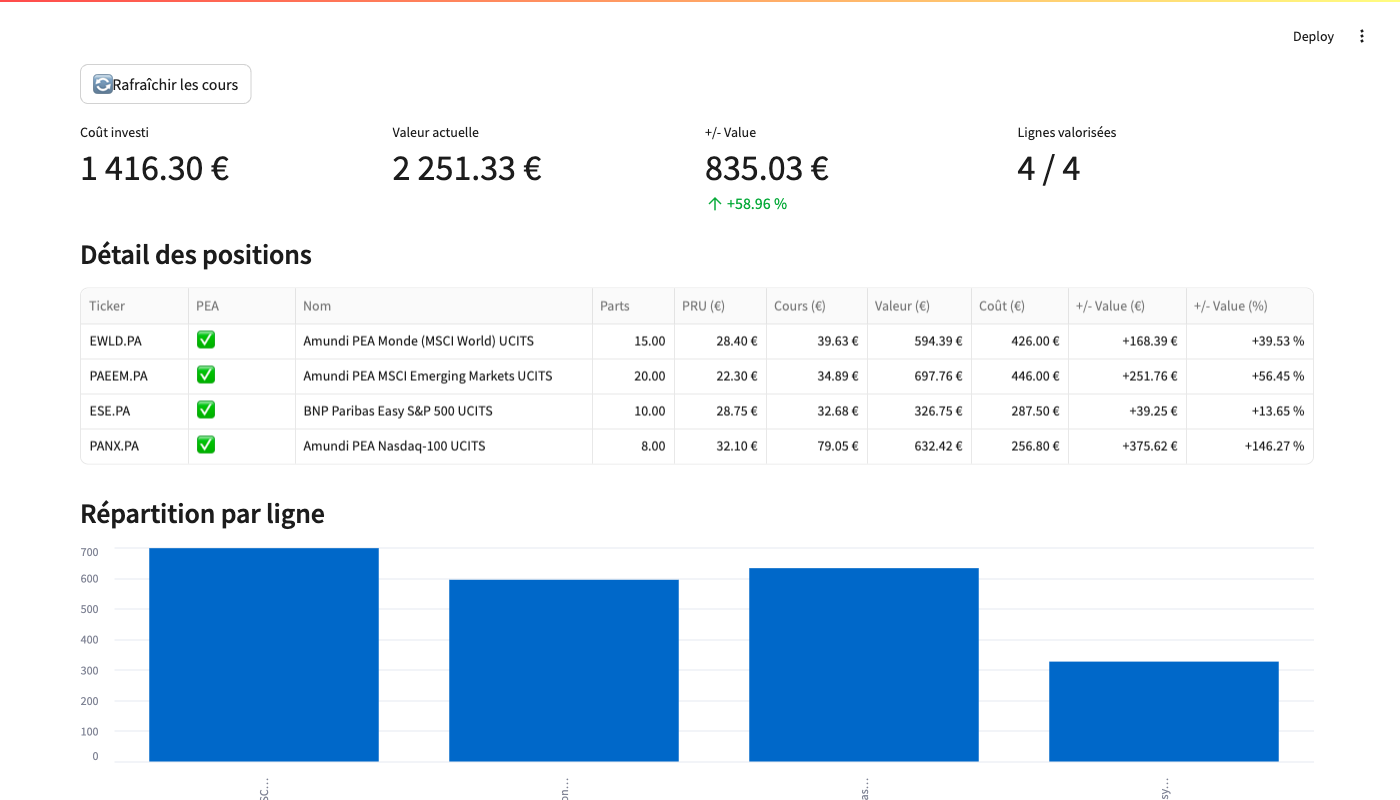
> *Streamlit "Portefeuille" tab — 4 holdings with live yfinance prices and PEA-eligibility badges (✅ from the audit cache).*
### Not a developer?
Three options if you don't write Python but want to check your PEA:
1. **Run the dashboard locally** with the 3 commands above. No code edits required after `positions.csv` is filled.
2. **Upload via the HTTP API** — `docker compose up -d api` then `POST /audit/upload` with a PDF (Swagger docs at http://localhost:8080/docs).
3. **Hire a developer** — realistically the best option for non-technical PEA holders. The library exists so a hosted version of this is buildable in a weekend.
## Contributing
See [CONTRIBUTING.md](CONTRIBUTING.md). Maintainer? See [PUBLISHING.md](PUBLISHING.md). Release history: [CHANGELOG.md](CHANGELOG.md).
## License
[MIT](LICENSE).