https://github.com/angular-architects/nx-ddd-plugin
Nx plugin for structuring a monorepo with domains and layers
https://github.com/angular-architects/nx-ddd-plugin
Last synced: 5 months ago
JSON representation
Nx plugin for structuring a monorepo with domains and layers
- Host: GitHub
- URL: https://github.com/angular-architects/nx-ddd-plugin
- Owner: angular-architects
- Created: 2020-03-08T13:11:33.000Z (over 6 years ago)
- Default Branch: main
- Last Pushed: 2025-07-13T15:07:27.000Z (11 months ago)
- Last Synced: 2025-09-20T10:31:12.285Z (9 months ago)
- Language: TypeScript
- Size: 2.61 MB
- Stars: 333
- Watchers: 6
- Forks: 56
- Open Issues: 39
-
Metadata Files:
- Readme: README.md
Awesome Lists containing this project
README
# DDD Plugin for Angular Nx Monorepos
## Versions
The package versions are aligned with the _Angular_ version.
* for **Nx < v19** and **NG v17** use _v17.0.5_.
* for **Nx < v20** and **NG v18** use _v18.0.1_.
* for **Nx >= v20** and **NG v18** use _v18.1.1_.
* for **Nx >= v20** and **NG v19** use _v19.0.7_.
* for **Nx >= v21.2** and **NG v20** use _v20.0.0_.
**Breaking change** in v18.1.0:
The naming of the **Nx** `includePaths` has changed to only use one "/".
Until _v18.0.1_, the generated `includePaths` were like this, which is illegal in **npm**:
```json
"@org/booking/domain": ["libs/booking/domain/src/index.ts"],
"@org/booking/feature-test": ["libs/booking/feature-test/src/index.ts"]
```
Starting with _v18.1.0_, the generated `includePaths` are using dashes instead:
```json
"@org/booking-domain": ["libs/booking/domain/src/index.ts"],
"@org/booking-feature-test": ["libs/booking/feature-test/src/index.ts"]
```
## About
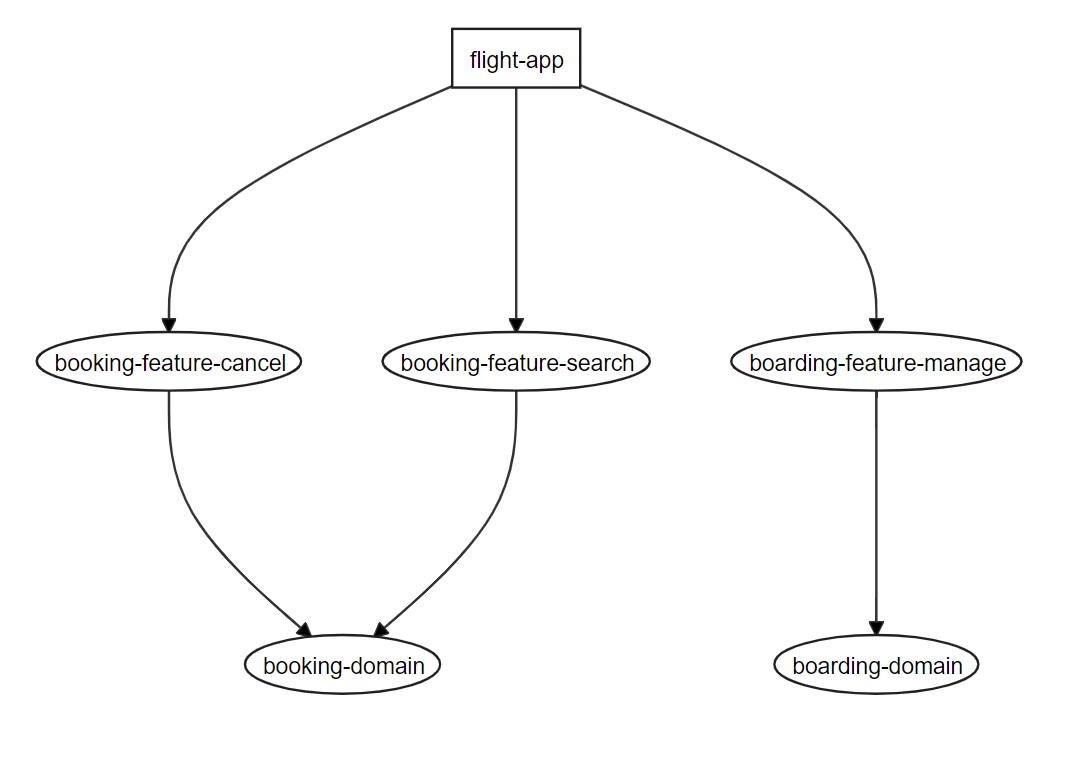
This plugin installs some schematics which automate slicing your Nx workspace into domains and layers according to Nrwl's best practices and our ideas about [client-side DDD with Angular](- [Blog: All about DDD for Angular & Frontend Architectures](https://www.angulararchitects.io/blog/all-about-ddd-for-frontend-architectures-with-angular-co/)):
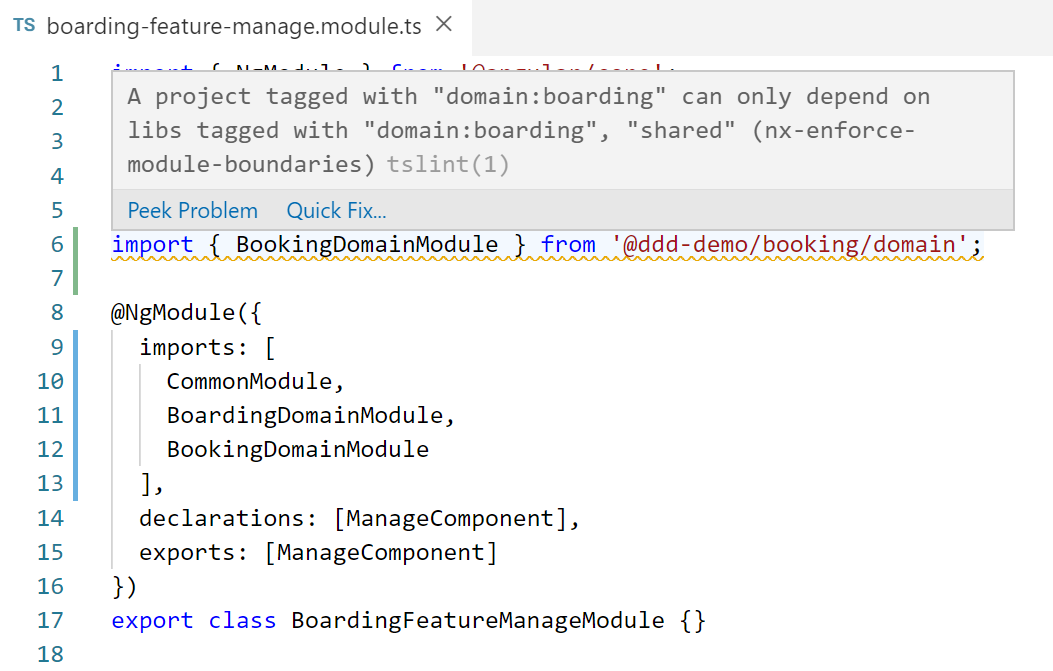
The generated access restrictions prevent unwanted access between libraries respecting layers and domains:
## Features
- 🗺️ Generating domains with domain libraries including a facades, models, and data services
- ⚙️ Generating feature libraries including a feature components using the facades
- 🙅♂️ Adding linting rules for access restrictions between domains as proposed by Nrwl
- 🙅♀️ Adding linting rules for access restrictions between layers as proposed by Nrwl (supports tslint and eslint)
- 🔥 Optionally generates skeleton for NGRX and integrates it into the DDD design (`--ngrx` switch, needs @ngrx/schematics)
- 💥 Supports Standalone Components
### Features Overview Video

## Usage
Add this plugin to a Nx workspace:
```
npm i @angular-architects/ddd
nx g @angular-architects/ddd:init
```
Instead, you can also use ng add, however, Nx currently emits a warning when using ng add:
```
nx add @angular-architects/ddd
```
Add domains and features manually:
```
nx g @angular-architects/ddd:domain booking --addApp
nx g @angular-architects/ddd:domain boarding --addApp
nx g @angular-architects/ddd:feature search --domain booking --entity flight
nx g @angular-architects/ddd:feature cancel --domain booking
nx g @angular-architects/ddd:feature manage --domain boarding
```
For NGRX support, just add the `--ngrx` switch:
```
nx g @angular-architects/ddd:domain luggage --addApp --ngrx
nx g @angular-architects/ddd:feature checkin --domain luggage --entity luggage-list --ngrx
[...]
```
This example assumes that you have an app `flight-app` in place.
These schematics also wire up the individual libs. To see the result, create a dependency graph:
```
npm run dep-graph
```

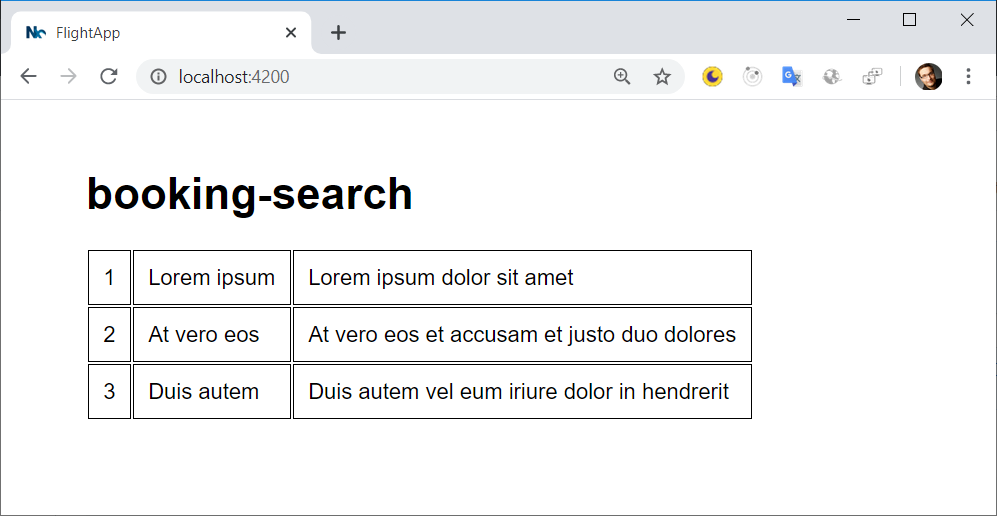
To see that the skeleton works end-to-end, call the generated feature component in your `app.component.html`:
```html
```
You don't need any TypeScript or Angular imports. The plugin already took care about that. After running the example, you should see something like this:
## Standalone Components
All generators have a switch ``--standalone`` to support Standalone Components:
```
nx g @angular-architects/ddd:domain booking --addApp --standalone
nx g @angular-architects/ddd:feature search --domain booking --entity flight --standalone
```
Don't mix Standalone Components and traditional ones within the same domain.
**Since version 19**, standalone **defaults to true**.
## Generated Structure
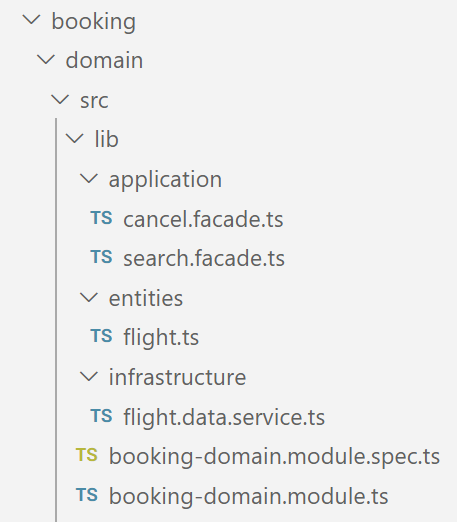
The included schematics generate a folder for each domain. This folder contains feature libs as well as a library with the domain logic:
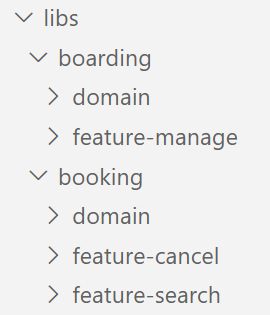
The domain layer is subdivided into three parts:
### Generated Structure for Domain Library
- **application:** Contains application services. This is a DDD term for what we call facades in Angular nowadays. They orchestrate everything for a use case given so that a feature component only needs to communicate with one such facade. Also, it hides details for state management. While the generates facades just use a `BehaviorSubject`, feel free to add a library like NGRX underneath. As such a modifications changes nothing from the component's perspective, you can use facades to introduce NGRX later on demand.
- **entities:** Client-side data model including logic operating on it (like validations).
- **infrastructure:** Services for communicating with the backend.
## Consider Automatically Checking Access Restrictions
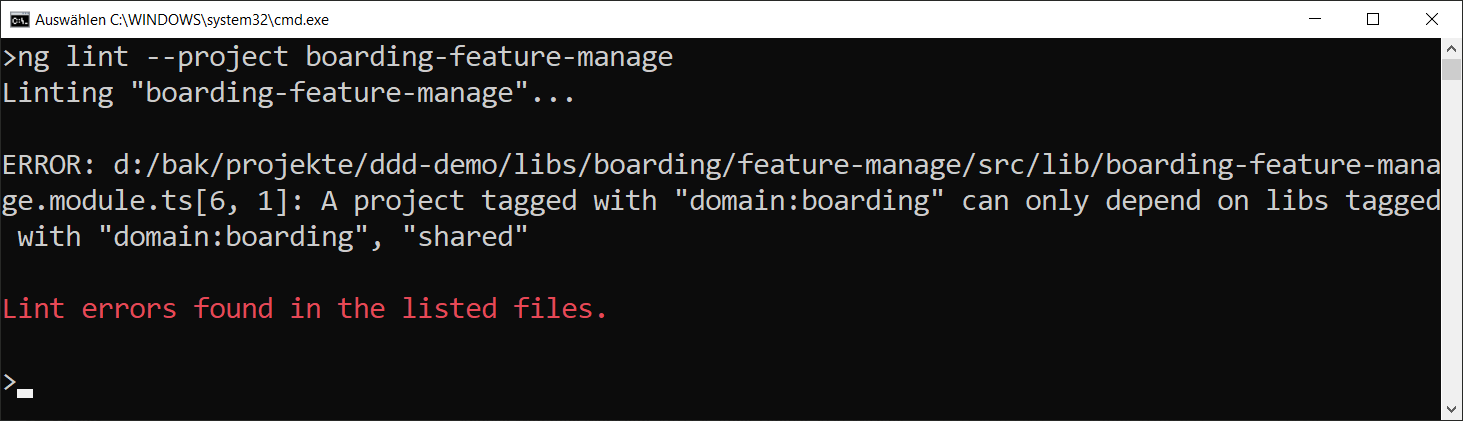
As the access restrictions defined with Nx use linting, you can check against them at the command line too. Hence, you might consider including this into your automated build process.
## Demo Application
see https://github.com/angular-architects/ddd-demo
## Resources
- [Blog: All about DDD for Angular & Frontend Architectures](https://www.angulararchitects.io/blog/all-about-ddd-for-frontend-architectures-with-angular-co/)
- [Nx](https://nx.dev/web)
- [Nrwl's eBook about monorepos and best practices](https://go.nrwl.io/angular-enterprise-monorepo-patterns-new-book)
- [Recording of session about this architecture](https://www.youtube.com/watch?v=94HFD391zkE&t=1s)
- [Article series about DDD with Angular](https://www.softwarearchitekt.at/aktuelles/sustainable-angular-architectures-1/)
- [Our eBook on Enterprise Angular](https://www.angulararchitects.io/en/ebooks/micro-frontends-and-moduliths-with-angular/)
## More Architecture
- [Enterprise Architecture Workshop](https://www.angulararchitects.io/en/training/advanced-angular-architecture-workshop/)
- [Angular Architects Blog](https://www.angulararchitects.io/en/blog/)
## Get in touch with authors
- [ManfredSteyer on X](https://x.com/ManfredSteyer), [LX_T on X](https://x.com/LX_T)