https://github.com/ankur-anand/unisondb
A streaming multimodal database for Edge AI, and Edge Computing.
https://github.com/ankur-anand/unisondb
ai-agents database edge-computing go golang golang-database grpc grpc-go key-value multi-modal replicated row-column streaming streaming-data streaming-database unisondb wide-column-database
Last synced: 6 months ago
JSON representation
A streaming multimodal database for Edge AI, and Edge Computing.
- Host: GitHub
- URL: https://github.com/ankur-anand/unisondb
- Owner: ankur-anand
- License: apache-2.0
- Created: 2025-02-02T19:05:51.000Z (over 1 year ago)
- Default Branch: main
- Last Pushed: 2026-01-04T15:40:19.000Z (6 months ago)
- Last Synced: 2026-01-05T22:16:16.534Z (6 months ago)
- Topics: ai-agents, database, edge-computing, go, golang, golang-database, grpc, grpc-go, key-value, multi-modal, replicated, row-column, streaming, streaming-data, streaming-database, unisondb, wide-column-database
- Language: Go
- Homepage: https://unisondb.io/
- Size: 2.95 MB
- Stars: 386
- Watchers: 5
- Forks: 14
- Open Issues: 5
-
Metadata Files:
- Readme: README.md
- License: LICENSE
Awesome Lists containing this project
README
## UnisonDB
> Store, stream, and sync instantly — **UnisonDB** is a **log-native, real-time database** that replicates like a **message bus for AI and Edge Computing**.

[](https://github.com/ankur-anand/unisondb/actions/workflows/go.yml)
[](https://coveralls.io/github/ankur-anand/unisondb?branch=main)
[](LICENSE)
[](https://unisondb.io/docs/getting-started/)
[](#)
## What UnisonDB Is
UnisonDB is an open-source database designed specifically for [**Edge AI**](https://www.ibm.com/think/topics/edge-ai) and [**Edge Computing**](https://en.wikipedia.org/wiki/Edge_computing).
It is a **reactive**, [**log-native**](https://www.unisondb.io/docs/architecture/) and [**multi-model database**](https://en.wikipedia.org/wiki/Multi-model_database) built for real-time and edge-scale applications. UnisonDB combines a [**B+Tree storage engine**](https://en.wikipedia.org/wiki/B%2B_tree) with WAL-based ([**Write-Ahead Logging**](https://en.wikipedia.org/wiki/Write-ahead_logging)) streaming replication, enabling near-instant fan-out replication across hundreds of nodes — all while preserving strong consistency and durability.
## Key Features
- **Multi-Modal Storage**: Key-Value, Wide-Column, and Large Objects (LOB)
- **Streaming Replication**: WAL-based replication with sub-second fan-out to 100+ edge replicas
- **Real-Time Notifications**: ZeroMQ-based(Side-car) change notifications with sub-millisecond latency
- **Durable**: B+Tree storage with Write-Ahead Logging
- **Edge-First Design**: Optimized for edge computing and local-first architectures
- **Namespace Isolation**: Multi-tenancy support with namespace-based isolation

## Use Cases
UnisonDB is built for **distributed edge-first architectures** systems where **data and computation must live close together** — reducing network hops, minimizing latency, and enabling real-time responsiveness at scale.
By **co-locating data with the services that use it**, UnisonDB removes the traditional boundary between the database and the application layer.
Applications can react to local changes instantly, while UnisonDB’s WAL-based replication ensures eventual consistency across all replicas globally.
## Fan-Out Scaling
UnisonDB can fan out updates to 100+ edge nodes in just a few milliseconds from a single upstream—and because it supports multi-hop relaying,
that reach compounds naturally. Each hop carries the network + application latency of its link;
In a simple 2-hop topology:
- **Hop 1:** Primary → 100 hubs (≈250–500ms)
- **Hop 2:** Each hub → 100 downstream edge nodes (similar latency)
- **Total reach:** 100 + 10,000 = 10,100 nodes
Even at 60k–80k `SET` ops/sec with 1 KB values, UnisonDB can propagate those updates across 10,000+ nodes within seconds—without Kafka, Pub/Sub, CDC pipelines, or heavyweight brokers. (See the [Relayer vs Latency benchmarks](#performance-testing-local-replication) below for measured numbers.)
## Quick Start
```bash
# Clone the repository
git clone https://github.com/ankur-anand/unisondb
cd unisondb
# Build
go build -o unisondb ./cmd/unisondb
# Run in server mode (primary)
./unisondb server --config config.toml
# Use the HTTP API
curl -X PUT http://localhost:4000/api/v1/default/kv/mykey \
-H "Content-Type: application/json" \
-d '{"value":"bXl2YWx1ZQ=="}'
```
## Documentation
1. [Getting Started with UnisonDB](https://unisondb.io/docs/getting-started/)
2. [Complete Configuration Guide](https://unisondb.io/docs/getting-started/configurations/)
3. [Architecture Overview](https://unisondb.io/docs/architecture/)
4. [HTTP API Reference](https://unisondb.io/docs/api/http-api/)
5. [Backup and Restore](https://unisondb.io/docs/operations/backup-restore/)
6. [Deployment Topologies](https://unisondb.io/docs/deployment/)
7. [Rough Roadmap](https://github.com/ankur-anand/unisondb/wiki/Roadmap)
UnisonDB implements a pluggable storage backend architecture supporting two BTree implementations:
- [BoltDB](https://github.com/etcd-io/bbolt): Single-file, ACID-compliant BTree.
- [LMDB](https://en.wikipedia.org/wiki/Lightning_Memory-Mapped_Database): Memory-mapped ACID-compliant BTree with copy-on-write semantics.
## Redis-Compatible Benchmark: UnisonDB vs BadgerDB vs BoltDB vs LMDB
This benchmark compares the **write and read performance** of four databases — **UnisonDB**, **BadgerDB**, *LMDB** and **BoltDB** — using a Redis-compatible interface and the official [`redis-benchmark`](https://redis.io/docs/latest/operate/oss_and_stack/management/optimization/benchmarks/) tool.
### What We Measured
- **Throughput**: Requests per second for `SET` (write) and `GET` (read) operations
- **Latency**: p50 latency in milliseconds
- **Workload**: 50 iterations of mixed `SET` and `GET` operations (200k ops per run)
- **Concurrency**: 10 parallel clients, 10 pipelined requests, 4 threads
- **Payload Size**: 1KB
### Test Environment
```
Chip: Apple M2 Pro
Total Number of Cores: 10 (6 performance and 4 efficiency)
Memory: 16 GB
Unisondb Btree Backend - LMDB
```
All three databases were tested under identical conditions to highlight differences in write path efficiency, read performance, and I/O characteristics. The Redis-compatible server implementation can be found in `internal/benchtests/cmd/redis-server/`.
### Results

## Performance Testing: Local Replication
### Test Setup
We validated the WAL-based replication architecture using the `pkg/replicator` component. It Uses the same redis-compatible
bench tool but this time the server is started a `n=[100,200,500,750,1000]` goroutine that is an independent WAL reader, capturing critical performance metrics:
1. Physical Latency Tracking: Measures p50, p90, p99, and max latencies Vs Relayer.
2. SET, GET Latency vs Relayer
3. SET, GET Throughput Vs Relayer.
### Results


### Test Replication Flow

---
## Why UnisonDB
> Traditional databases persist. Stream systems propagate.
UnisonDB does both — turning every write into a durable, queryable stream that replicates seamlessly across the edge.
### The Problem: Storage and Streaming Live in Different Worlds
Modern systems are reactive — every change needs to **propagate instantly** to dashboards, APIs, caches, and edge devices.
Yet, databases were built for persistence, not propagation.
You write to a database, then stream through Kafka.
You replicate via CDC.
You patch syncs between cache and storage.
This split between **state and stream** creates friction:
- Two systems to maintain and monitor
- Eventual consistency between write path and read path
- Network latency on every read or update
- Complex fan-out when scaling to hundreds of edges
---
### The Gap
**LMDB** and **BoltDB** excel at local speed — but stop at one node.
**etcd** and **Consul** replicate state — but are consensus-bound and small-cluster only.
**Kafka** and **NATS** stream messages — but aren’t queryable databases.
| System | Strength | Limitation |
|---------|-----------|-------------|
| LMDB / BoltDB | Fast local storage | No replication |
| etcd / Consul | Cluster consistency | No local queries, low fan-out |
| Kafka / NATS | Scalable streams | No storage or query model |
---
### The Solution: Log-Native by Design
UnisonDB fuses **database semantics** with **streaming mechanics** — the log *is* the database.
Every write is durable, ordered, and instantly available as a replication stream.
No CDC, no brokers, no external pipelines.
Just one unified engine that:
- Stores data in **B+Trees** for predictable reads
- Streams data via **WAL replication** to thousands of nodes
- Reacts instantly with **sub-second fan-out**
- Keeps local replicas fully queryable, even offline
UnisonDB eliminates the divide between “database” and “message bus,”
enabling **reactive, distributed, and local-first** systems — without the operational sprawl.
> **UnisonDB collapses two worlds — storage and streaming — into one unified log-native core.**
> The result: a single system that stores, replicates, and reacts — instantly.
---
## Core Architecture
UnisonDB is built on three foundational layers:
1. **WALFS** - Write-Ahead Log File System (mmap-based, optimized for reading at scale).
2. **Engine** - Hybrid storage combining WAL, MemTable, and B-Tree
3. **Replication** - WAL-based streaming with offset tracking
## The Layered View
UnisonDB stacks a multi-model engine on top of WALFS — a log-native core that unifies storage, replication, and streaming into one continuous data flow.
```
+-----------------------------------------------------------+
| Multi-Model API Layer |
| (KV, Wide-Column, LOB, Txn Engine, Query) |
+-----------------------------------------------------------+
| Engine Layer |
| WALFS-backed MemTable + B-Tree Store |
| (writes → WALFS, reads → B-Tree + MemTable) |
+-----------------------------------------------------------+
| WALFS (Core Log) | Replication Layer |
| Append-only, mmap-based | WAL-based streaming |
| segmented log | (followers tail WAL)|
| Commit-ordered, replication-safe | Offset tracking, |
| | catch-up, tailing |
+-----------------------------------------------------------+
| Disk |
+-----------------------------------------------------------+
```
## 1. WALFS (Write-Ahead Log)
### Overview
WALFS is a memory-mapped, segmented write-ahead log implementation designed for **both writing AND reading at scale**.
Unlike traditional WALs that optimize only for sequential writes, WALFS provides efficient random access for replication, and real-time tailing.

### Segment Structure
Each WALFS segment consists of two regions:
```
+----------------------+-----------------------------+-------------+
| Segment Header | Record 1 | Record 2 |
| (64 bytes) | Header + Data + Trailer | ... |
+----------------------+-----------------------------+-------------+
```
#### Segment Header (64 bytes)
| Offset | Size | Field | Description |
|--------|------|-----------------|----------------------------------------------|
| 0 | 4 | Magic | Magic number (`0x5557414C`) |
| 4 | 4 | Version | Metadata format version |
| 8 | 8 | CreatedAt | Creation timestamp (nanoseconds) |
| 16 | 8 | LastModifiedAt | Last modification timestamp (nanoseconds) |
| 24 | 8 | WriteOffset | Offset where next chunk will be written |
| 32 | 8 | EntryCount | Total number of chunks written |
| 40 | 4 | Flags | Segment state flags (e.g. Active, Sealed) |
| 44 | 12 | Reserved | Reserved for future use |
| 56 | 4 | CRC | CRC32 checksum of first 56 bytes |
| 60 | 4 | Padding | Ensures 64-byte alignment |
#### Record Format (8-byte aligned)
Each record is written in its own aligned frame:
| Offset | Size | Field | Description |
|---------|----------|---------|--------------------------------------------------|
| 0 | 4 bytes | CRC | CRC32 of `[Length \| Data]` |
| 4 | 4 bytes | Length | Size of the data payload in bytes |
| 8 | N bytes | Data | User payload (FlatBuffer-encoded LogRecord) |
| 8 + N | 8 bytes | Trailer | Canary marker (`0xDEADBEEFFEEEDFACE`) |
| ... | ≥0 bytes | Padding | Zero padding to align to 8-byte boundary |
### WALFS Reader Capabilities
WALFS provides powerful reading capabilities essential for replication and recovery:
#### 1. **Forward-Only Iterator**
```go
reader := walLog.NewReader()
defer reader.Close()
for {
data, pos, err := reader.Next()
if err == io.EOF {
break
}
// Process record
}
```
- **Zero-copy reads** - data is a memory-mapped slice
- **Position tracking** - each record returns its `(SegmentID, Offset)` position
- **Automatic segment traversal** - seamlessly reads across segment boundaries
#### 2. **Offset-Based Reads**
```go
// Read from a specific offset (for replication catch-up)
offset := Offset{SegmentID: 5, Offset: 1024}
reader, err := walLog.NewReaderWithStart(&offset)
```
#### Use cases:
* Efficient seek without scanning
* Follower catch-up from last synced position
* Recovery from checkpoint
#### 3. **Active Tail Following**
```go
// For real-time replication (tailing active WAL)
reader, err := walLog.NewReaderWithTail(&offset)
for {
data, pos, err := reader.Next()
if err == ErrNoNewData {
// No new data yet, can retry or wait
continue
}
}
```
#### Behavior:
* Returns ErrNoNewData when caught up (not io.EOF)
* Enables low-latency streaming
* Supports multiple parallel readers
### Why WALFS is Different
Unlike traditional "write-once, read-on-crash" WALs, WALFS optimizes for:
* Continuous replication - Followers constantly read from primary's WAL
* Real-time tailing - Low-latency streaming of new writes
* Parallel readers - Multiple replicas read concurrently without contention
---
## 2. Engine (dbkernel)
### Overview
The Engine orchestrates writes, reads, and persistence using three components:
* WAL (WALFS) - Durability and replication source
* MemTable (SkipList) - In-memory write buffer
* B-Tree Store - Persistent index for efficient reads
### Flow Diagram

### FlatBuffer Schema
UnisonDB uses FlatBuffers for zero-copy serialization of WAL records:
#### Benefits:
* No deserialization on replicas
* Fast replication
#### Why FlatBuffers?
**Replication efficiency** - No deserialization needed on replicas


### Transaction Support
UnisonDB provides **atomic multi-key transactions**:
```go
txn := engine.BeginTxn()
txn.Put("k1", value1)
txn.Put("k2", value2)
txn.Put("k3", value3)
txn.Commit() // All or nothing
```
#### Flow

**Transaction Properties:**
- **Atomicity** - All writes become visible on commit, or none on abort
- **Isolation** - Uncommitted writes are hidden from readers
### LOB (Large Object) Support
Large values can be chunked and streamed using TXN.
#### Flow

**LOB Properties:**
- **Transactional** - All chunks committed atomically
- **Streaming** - Can write/read chunks incrementally
- **Efficient replication** - Replicas get chunks as they arrive
### Wide-Column Support
UnisonDB supports partial updates to column families:

**Benefits:**
- **Efficient updates** - Only modified columns are written/replicated
- **Flexible schema** - Columns can be added dynamically
- **Merge semantics** - New columns merged with existing row
---
## 3. Replication Architecture
### Overview
Replication in UnisonDB is **WAL-based streaming** - designed around the WALFS reader capabilities. Followers continuously stream WAL records from the primary's WALFS and apply them locally.
### Design Principles
1. **Offset-based positioning** - Followers track their replication offset `(SegmentID, Offset)`
2. **Catch-up from any offset** - Can resume replication from any position
3. **Real-time streaming** - Active tail following for low-latency replication
4. **Self-describing records** - FlatBuffer LogRecords are self-contained
5. **Batched streaming** - Records sent in batches for efficiency
### Replication Flow
* Offset-based positioning - Followers track (SegmentID, Offset) Independently.
* Catch-up from any offset - Resume from any position
* Real-time streaming - Active tail following for low latency

---
## Why is Traditional KV Replication Insufficient?
> Most traditional key-value stores were designed for simple, point-in-time key-value operations — and their replication
models reflect that. While this works for basic use cases, it quickly breaks down under real-world
demands like multi-key transactions, large object handling, and fine-grained updates.
### Key-Level Replication Only
Replication is often limited to raw key-value pairs.
There’s no understanding of higher-level constructs like rows, columns,
or chunks — making it impossible to efficiently replicate partial updates or large structured objects.
### No Transactional Consistency
Replication happens on a per-operation basis, not as part of an atomic unit.
Without multi-key transactional guarantees, systems can fall into inconsistent states across replicas,
especially during batch operations, network partitions, or mid-transaction failures.
### Chunked LOB Writes Become Risky
When large values are chunked and streamed to the store, traditional replication models expose chunks as they arrive.
If a transfer fails mid-way, replicas may store incomplete or corrupted objects, with no rollback or recovery mechanism.
### No Awareness of Column-Level Changes
Wide-column data is treated as flat keys or opaque blobs. If only a single column is modified,
traditional systems replicate the entire row, wasting bandwidth,
increasing storage overhead, and making efficient synchronization impossible.
### Operational Complexity Falls on the User
Without built-in transactional semantics, developers must implement their own logic for deduplication,
rollback, consistency checks, and coordination — which adds fragility and complexity to the system.
### Storage Engine Tradeoffs
• LSM-Trees (e.g., RocksDB) excel at fast writes but suffer from high read amplification and costly background compactions, which hurt latency and predictability.
• B+Trees (e.g., BoltDB,LMDB) offer efficient point lookups and range scans, but struggle with high-speed inserts and lack native replication support.
## How UnisonDB Solves This. :white_check_mark:
UnisonDB combines append-only logs for high-throughput ingest with B-Trees for fast and efficient range reads — while offering:
* Transactional, multi-key replication with commit visibility guarantees.
* Chunked LOB writes that are fully atomic.
* Column-aware replication for efficient syncing of wide-column updates.
* Isolation by default — once a network-aware transaction is started, all intermediate writes are fully isolated and not visible to readers until a successful txn.Commit().
* Built-in replication via gRPC WAL streaming + B-Tree snapshots.
* Zero-compaction overhead, high write throughput, and optimized reads.
## Development
```sh
make lint
make test
```
## certificate for Local host
```shell
brew install mkcert
## install local CA
mkcert -install
## Generate gRPC TLS Certificates
## these certificate are valid for hostnames/IPs localhost 127.0.0.1 ::1
mkcert -key-file grpc.key -cert-file grpc.crt localhost 127.0.0.1 ::1
```
## License
[Apache License, Version 2.0](https://www.apache.org/licenses/LICENSE-2.0)
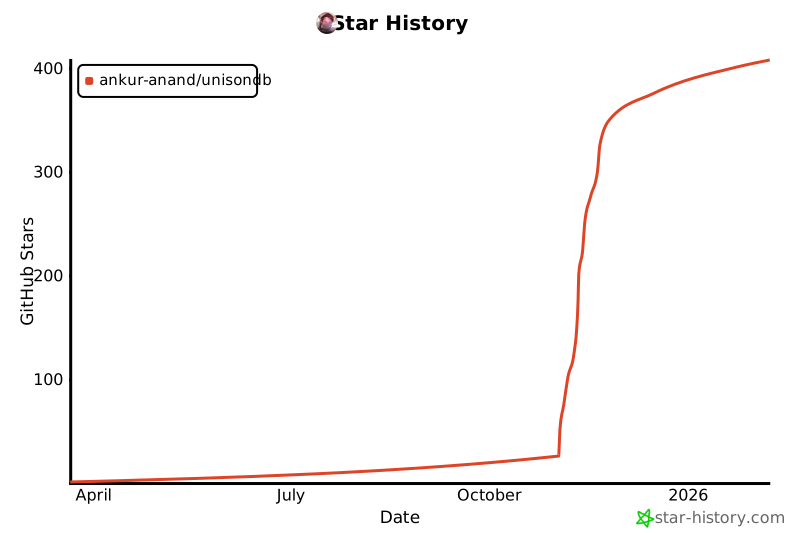
## Star History
[](https://www.star-history.com/#ankur-anand/unisondb&type=date&legend=top-left)