https://github.com/ashishpatel26/regularization-collection-deeplearning
This is Collection of Regularization Deep learning techniques with code and paper
https://github.com/ashishpatel26/regularization-collection-deeplearning
alphadropout deeplearning dropout dropout-keras dropout-probability dropout-pytorch l1-normalization l2normalization machinelearning regularization regularization-hyperparameters regularization-methods
Last synced: 7 months ago
JSON representation
This is Collection of Regularization Deep learning techniques with code and paper
- Host: GitHub
- URL: https://github.com/ashishpatel26/regularization-collection-deeplearning
- Owner: ashishpatel26
- Created: 2020-06-01T13:38:53.000Z (about 6 years ago)
- Default Branch: master
- Last Pushed: 2020-06-01T13:41:26.000Z (about 6 years ago)
- Last Synced: 2025-03-13T08:35:20.231Z (over 1 year ago)
- Topics: alphadropout, deeplearning, dropout, dropout-keras, dropout-probability, dropout-pytorch, l1-normalization, l2normalization, machinelearning, regularization, regularization-hyperparameters, regularization-methods
- Size: 1.95 KB
- Stars: 3
- Watchers: 3
- Forks: 2
- Open Issues: 0
-
Metadata Files:
- Readme: README.md
Awesome Lists containing this project
README
## New Regularization Technique for Deep Learning
**Regularization** is a technique used for tuning the function by adding an additional penalty term in the error function. The additional term controls the excessively fluctuating function such that the coefficients don't take extreme values.
---
### **Famous Regularization Technique used By Industry**
**1.L1 & L2 Regularization:**

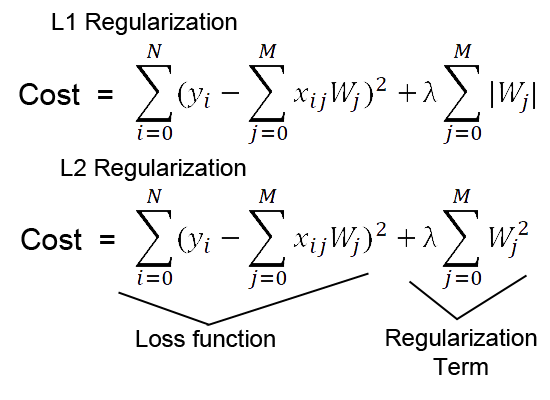
* **L1 regularization** adds an **L1** penalty equal to the absolute value of the magnitude of coefficients.
* **L2 regularization** adds an **L2** penalty equal to the square of the magnitude of coefficients.
**2.DropOut**


* **Dropout** is a **regularization** technique patented by Google for reducing overfitting in neural networks by preventing complex co-adaptations on training data.
* **Eq. 1** shows loss for a regular network and Eq. 2 for a dropout network. In **Eq. 2**, the dropout rate **is 𝛿**, where **𝛿 ~ Bernoulli(*p*)**. This means 𝛿 is equal to **1** with probability *p* and **0** otherwise.
* **Relationship between Dropout** and **Regularization**, A **Dropout rate of** 0.5 will lead **to** the maximum **regularization**, and. Generalization **of Dropout to** Gaussian-Dropout.
* **Code:** [**Tensorflow.Keras**](https://www.tensorflow.org/api_docs/python/tf/keras/layers/Dropout) | [**Pytorch**](https://pytorch.org/docs/stable/nn.html?highlight=dropout#torch.nn.Dropout)
* **Reference:** https://papers.nips.cc/paper/4878-understanding-dropout.pdf
**Dropout Variant:**
1. Alpha Dropout: [**Tensorflow**](https://www.tensorflow.org/api_docs/python/tf/keras/layers/AlphaDropout) | [**Pytorch**](https://pytorch.org/docs/master/generated/torch.nn.AlphaDropout.html) | [**Paper**](https://arxiv.org/abs/1706.02515)
2. Gaussian Dropout: [**Tensorflow**](https://www.tensorflow.org/api_docs/python/tf/keras/layers/GaussianDropout) | **[Pytorch](https://github.com/j-min/Dropouts/blob/master/Gaussian_Variational_Dropout.ipynb)** | **Paper**
3. Spatial Dropout: [**Tensorflow**](https://www.tensorflow.org/api_docs/python/tf/keras/layers/SpatialDropout1D) | [**Pytorch**](https://github.com/davidtvs/PyTorch-ENet/blob/master/models/enet.py) | **[Paper](https://arxiv.org/abs/1411.4280)**
4. State Dropout: [**Tensorflow**](https://www.tensorflow.org/api_docs/python/tf/compat/v1/nn/rnn_cell/DropoutWrapper) | [**Pytorch**](https://discuss.pytorch.org/t/dropout-for-lstm-state-transitions/17112) | **Paper**
5. Recurrent Dropout: [**Tensorflow**](https://www.tensorflow.org/addons/api_docs/python/tfa/rnn/LayerNormLSTMCell) | **[Pytorch](https://discuss.pytorch.org/t/how-to-use-lstmcell-with-layernorm/47747)** | [**Paper**](https://arxiv.org/abs/1607.06450)
----
***This Markdown is continuously Updated.. Stay Tuned...!!!***