https://github.com/auto-flow/ultraopt
Distributed Asynchronous Hyperparameter Optimization better than HyperOpt. 比HyperOpt更强的分布式异步超参优化库。
https://github.com/auto-flow/ultraopt
automl bayesian-optimization blackbox-optimization hyperopt hyperparameter-optimization machine-learning multi-fidelity optimization python
Last synced: 3 months ago
JSON representation
Distributed Asynchronous Hyperparameter Optimization better than HyperOpt. 比HyperOpt更强的分布式异步超参优化库。
- Host: GitHub
- URL: https://github.com/auto-flow/ultraopt
- Owner: auto-flow
- License: bsd-3-clause
- Created: 2020-12-14T07:48:49.000Z (over 5 years ago)
- Default Branch: main
- Last Pushed: 2022-01-22T09:06:59.000Z (over 4 years ago)
- Last Synced: 2025-12-01T20:55:03.110Z (7 months ago)
- Topics: automl, bayesian-optimization, blackbox-optimization, hyperopt, hyperparameter-optimization, machine-learning, multi-fidelity, optimization, python
- Language: Python
- Homepage: https://auto-flow.github.io/ultraopt/zh/
- Size: 10.3 MB
- Stars: 108
- Watchers: 4
- Forks: 15
- Open Issues: 3
-
Metadata Files:
- Readme: README.md
- License: LICENSE
Awesome Lists containing this project
README

[](https://travis-ci.org/auto-flow/ultraopt)
[](https://badge.fury.io/py/ultraopt)
[](https://pypi.python.org/pypi/ultraopt)


[](https://github.com/auto-flow/ultraopt/stargazers) [](https://github.com/auto-flow/ultraopt/network) [](https://zenodo.org/record/4430148)
`UltraOpt` : **Distributed Asynchronous Hyperparameter Optimization better than HyperOpt**.
---
`UltraOpt` is a simple and efficient library to minimize expensive and noisy black-box functions, it can be used in many fields, such as HyperParameter Optimization(**HPO**) and
Automatic Machine Learning(**AutoML**).
After absorbing the advantages of existing optimization libraries such as
[HyperOpt](https://github.com/hyperopt/hyperopt)[[5]](#refer-5), [SMAC3](https://github.com/automl/SMAC3)[[3]](#refer-3),
[scikit-optimize](https://github.com/scikit-optimize/scikit-optimize)[[4]](#refer-4) and [HpBandSter](https://github.com/automl/HpBandSter)[[2]](#refer-2), we develop
`UltraOpt` , which implement a new bayesian optimization algorithm : Embedding-Tree-Parzen-Estimator(**ETPE**), which is better than HyperOpt' TPE algorithm in our experiments.
Besides, The optimizer of `UltraOpt` is redesigned to adapt **HyperBand & SuccessiveHalving Evaluation Strategies**[[6]](#refer-6)[[7]](#refer-7) and **MapReduce & Async Communication Conditions**.
Finally, you can visualize `Config Space` and `optimization process & results` by `UltraOpt`'s tool function. Enjoy it !
Other Language: [中文README](README.zh_CN.md)
- **Documentation**
+ English Documentation is not available now.
+ [中文文档](https://auto-flow.github.io/ultraopt/zh/)
- **Tutorials**
+ English Tutorials is not available now.
+ [中文教程](https://github.com/auto-flow/ultraopt/tree/main/tutorials_zh)
**Table of Contents**
- [Installation](#Installation)
- [Quick Start](#Quick-Start)
+ [Using UltraOpt in HPO](#Using-UltraOpt-in-HPO)
+ [Using UltraOpt in AutoML](#Using-UltraOpt-in-AutoML)
- [Our Advantages](#Our-Advantages)
+ [Advantage One: ETPE optimizer is more competitive](#Advantage-One-ETPE-optimizer-is-more-competitive)
+ [Advantage Two: UltraOpt is more adaptable to distributed computing](#Advantage-Two-UltraOpt-is-more-adaptable-to-distributed-computing)
+ [Advantage Three: UltraOpt is more function comlete and user friendly](#advantage-three-ultraopt-is-more-function-comlete-and-user-friendly)
- [Citation](#Citation)
- [Referance](#referance)
# Installation
UltraOpt requires Python 3.6 or higher.
You can install the latest release by `pip`:
```bash
pip install ultraopt
```
You can download the repository and manual installation:
```bash
git clone https://github.com/auto-flow/ultraopt.git && cd ultraopt
python setup.py install
```
# Quick Start
## Using UltraOpt in HPO
Let's learn what `UltraOpt` doing with several examples (you can try it on your `Jupyter Notebook`).
You can learn Basic-Tutorial in [here](https://auto-flow.github.io/ultraopt/zh/_tutorials/01._Basic_Tutorial.html), and `HDL`'s Definition in [here](https://auto-flow.github.io/ultraopt/zh/_tutorials/02._Multiple_Parameters.html).
Before starting a black box optimization task, you need to provide two things:
- parameter domain, or the **Config Space**
- objective function, accept `config` (`config` is sampled from **Config Space**), return `loss`
Let's define a Random Forest's HPO **Config Space** by `UltraOpt`'s `HDL` (Hyperparameter Description Language):
```python
HDL = {
"n_estimators": {"_type": "int_quniform","_value": [10, 200, 10], "_default": 100},
"criterion": {"_type": "choice","_value": ["gini", "entropy"],"_default": "gini"},
"max_features": {"_type": "choice","_value": ["sqrt","log2"],"_default": "sqrt"},
"min_samples_split": {"_type": "int_uniform", "_value": [2, 20],"_default": 2},
"min_samples_leaf": {"_type": "int_uniform", "_value": [1, 20],"_default": 1},
"bootstrap": {"_type": "choice","_value": [True, False],"_default": True},
"random_state": 42
}
```
And then define an objective function:
```python
from sklearn.ensemble import RandomForestClassifier
from sklearn.datasets import load_digits
from sklearn.model_selection import cross_val_score, StratifiedKFold
from ultraopt.hdl import layering_config
X, y = load_digits(return_X_y=True)
cv = StratifiedKFold(5, True, 0)
def evaluate(config: dict) -> float:
model = RandomForestClassifier(**layering_config(config))
return 1 - float(cross_val_score(model, X, y, cv=cv).mean())
```
Now, we can start an optimization process:
```python
from ultraopt import fmin
result = fmin(eval_func=evaluate, config_space=HDL, optimizer="ETPE", n_iterations=30)
result
```
```
100%|██████████| 30/30 [00:36<00:00, 1.23s/trial, best loss: 0.023]
+-----------------------------------+
| HyperParameters | Optimal Value |
+-------------------+---------------+
| bootstrap | True:bool |
| criterion | gini |
| max_features | log2 |
| min_samples_leaf | 1 |
| min_samples_split | 2 |
| n_estimators | 200 |
+-------------------+---------------+
| Optimal Loss | 0.0228 |
+-------------------+---------------+
| Num Configs | 30 |
+-------------------+---------------+
```
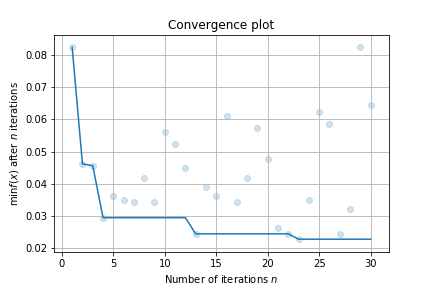
Finally, make a simple visualizaiton:
```python
result.plot_convergence()
```
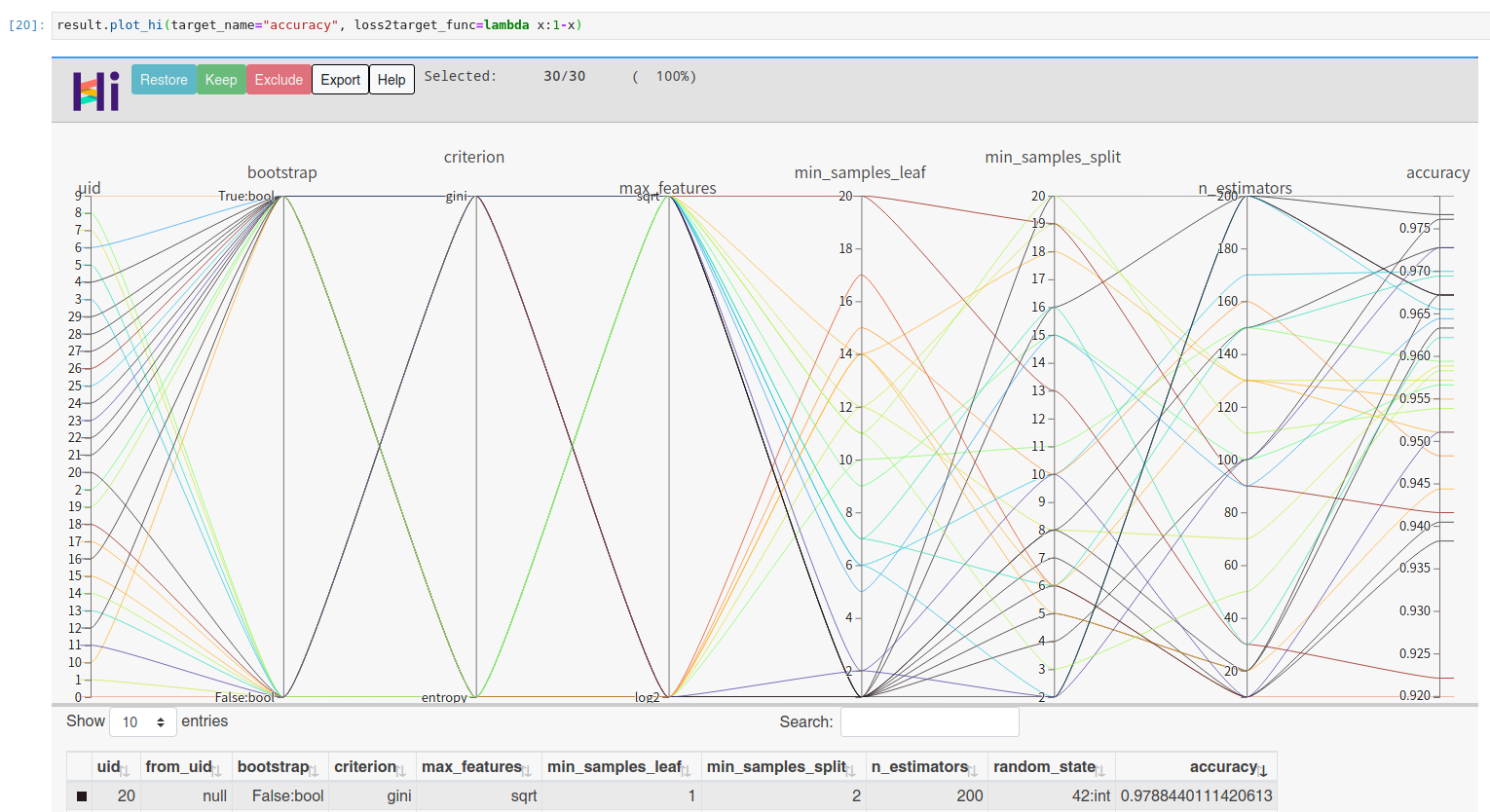
You can visualize high dimensional interaction by facebook's hiplot:
```python
!pip install hiplot
result.plot_hi(target_name="accuracy", loss2target_func=lambda x:1-x)
```
## Using UltraOpt in AutoML
Let's try a more complex example: solve AutoML's **CASH Problem** [[1]](#refer-1) (Combination problem of Algorithm Selection and Hyperparameter optimization)
by BOHB algorithm[[2]](#refer-2) (Combine **HyperBand**[[6]](#refer-6) Evaluation Strategies with `UltraOpt`'s **ETPE** optimizer) .
You can learn Conditional Parameter and complex `HDL`'s Definition in [here](https://auto-flow.github.io/ultraopt/zh/_tutorials/03._Conditional_Parameter.html), AutoML implementation tutorial in [here](https://auto-flow.github.io/ultraopt/zh/_tutorials/05._Implement_a_Simple_AutoML_System.html) and Multi-Fidelity Optimization in [here](https://auto-flow.github.io/ultraopt/zh/_tutorials/06._Combine_Multi-Fidelity_Optimization.html).
First of all, let's define a **CASH** `HDL` :
```python
HDL = {
'classifier(choice)':{
"RandomForestClassifier": {
"n_estimators": {"_type": "int_quniform","_value": [10, 200, 10], "_default": 100},
"criterion": {"_type": "choice","_value": ["gini", "entropy"],"_default": "gini"},
"max_features": {"_type": "choice","_value": ["sqrt","log2"],"_default": "sqrt"},
"min_samples_split": {"_type": "int_uniform", "_value": [2, 20],"_default": 2},
"min_samples_leaf": {"_type": "int_uniform", "_value": [1, 20],"_default": 1},
"bootstrap": {"_type": "choice","_value": [True, False],"_default": True},
"random_state": 42
},
"KNeighborsClassifier": {
"n_neighbors": {"_type": "int_loguniform", "_value": [1,100],"_default": 3},
"weights" : {"_type": "choice", "_value": ["uniform", "distance"],"_default": "uniform"},
"p": {"_type": "choice", "_value": [1, 2],"_default": 2},
},
}
}
```
And then, define a objective function with an additional parameter `budget` to adapt to **HyperBand**[[6]](#refer-6) evaluation strategy:
```python
from sklearn.neighbors import KNeighborsClassifier
import numpy as np
def evaluate(config: dict, budget: float) -> float:
layered_dict = layering_config(config)
AS_HP = layered_dict['classifier'].copy()
AS, HP = AS_HP.popitem()
ML_model = eval(AS)(**HP)
scores = []
for i, (train_ix, valid_ix) in enumerate(cv.split(X, y)):
rng = np.random.RandomState(i)
size = int(train_ix.size * budget)
train_ix = rng.choice(train_ix, size, replace=False)
X_train,y_train = X[train_ix, :],y[train_ix]
X_valid,y_valid = X[valid_ix, :],y[valid_ix]
ML_model.fit(X_train, y_train)
scores.append(ML_model.score(X_valid, y_valid))
score = np.mean(scores)
return 1 - score
```
You should instance a `multi_fidelity_iter_generator` object for the purpose of using **HyperBand**[[6]](#refer-6) Evaluation Strategy :
```python
from ultraopt.multi_fidelity import HyperBandIterGenerator
hb = HyperBandIterGenerator(min_budget=1/4, max_budget=1, eta=2)
hb.get_table()
```
iter 0
iter 1
iter 2
stage 0
stage 1
stage 2
stage 0
stage 1
stage 0
num_config
4
2
1
2
1
3
budget
1/4
1/2
1
1/2
1
1
let's combine **HyperBand** Evaluation Strategies with `UltraOpt`'s **ETPE** optimizer , and then start an optimization process:
```python
result = fmin(eval_func=evaluate, config_space=HDL,
optimizer="ETPE", # using bayesian optimizer: ETPE
multi_fidelity_iter_generator=hb, # using HyperBand
n_jobs=3, # 3 threads
n_iterations=20)
result
```
```
100%|██████████| 88/88 [00:11<00:00, 7.48trial/s, max budget: 1.0, best loss: 0.012]
+--------------------------------------------------------------------------------------------------------------------------+
| HyperParameters | Optimal Value |
+-----------------------------------------------------+----------------------+----------------------+----------------------+
| classifier:__choice__ | KNeighborsClassifier | KNeighborsClassifier | KNeighborsClassifier |
| classifier:KNeighborsClassifier:n_neighbors | 4 | 1 | 3 |
| classifier:KNeighborsClassifier:p | 2:int | 2:int | 2:int |
| classifier:KNeighborsClassifier:weights | distance | uniform | uniform |
| classifier:RandomForestClassifier:bootstrap | - | - | - |
| classifier:RandomForestClassifier:criterion | - | - | - |
| classifier:RandomForestClassifier:max_features | - | - | - |
| classifier:RandomForestClassifier:min_samples_leaf | - | - | - |
| classifier:RandomForestClassifier:min_samples_split | - | - | - |
| classifier:RandomForestClassifier:n_estimators | - | - | - |
| classifier:RandomForestClassifier:random_state | - | - | - |
+-----------------------------------------------------+----------------------+----------------------+----------------------+
| Budgets | 1/4 | 1/2 | 1 (max) |
+-----------------------------------------------------+----------------------+----------------------+----------------------+
| Optimal Loss | 0.0328 | 0.0178 | 0.0122 |
+-----------------------------------------------------+----------------------+----------------------+----------------------+
| Num Configs | 28 | 28 | 32 |
+-----------------------------------------------------+----------------------+----------------------+----------------------+
```
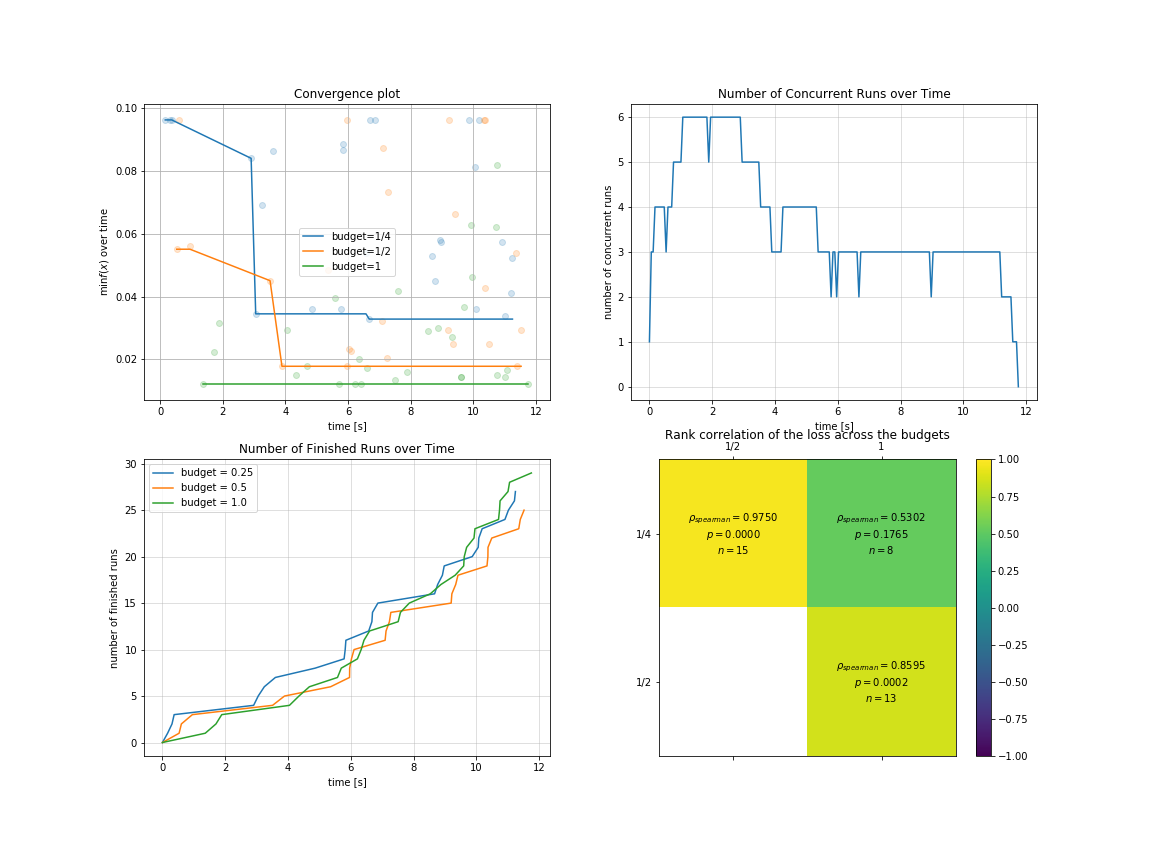
You can visualize optimization process in `multi-fidelity` scenarios:
```python
import pylab as plt
plt.rcParams['figure.figsize'] = (16, 12)
plt.subplot(2, 2, 1)
result.plot_convergence_over_time();
plt.subplot(2, 2, 2)
result.plot_concurrent_over_time(num_points=200);
plt.subplot(2, 2, 3)
result.plot_finished_over_time();
plt.subplot(2, 2, 4)
result.plot_correlation_across_budgets();
```
# Our Advantages
## Advantage One: ETPE optimizer is more competitive
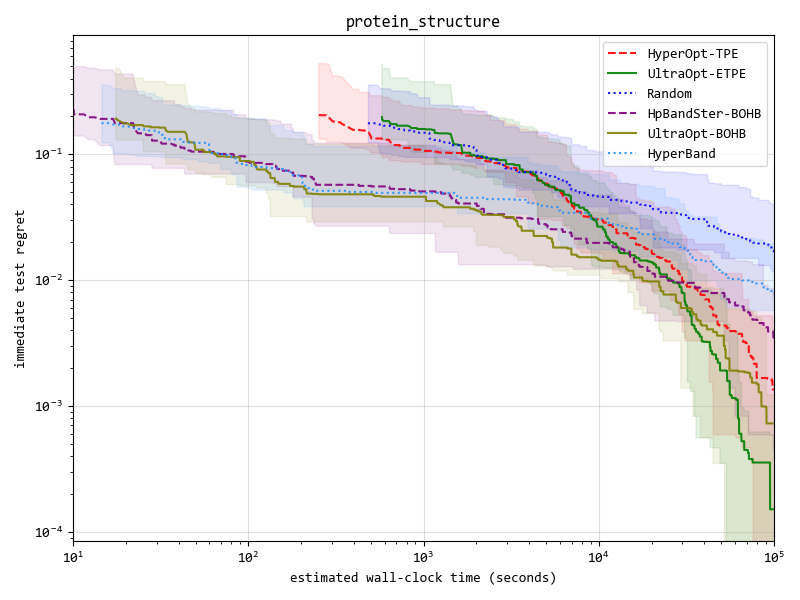
We implement 4 kinds of optimizers(listed in the table below), and `ETPE` optimizer is our original creation, which is proved to be better than other `TPE based optimizers` such as `HyperOpt's TPE` and `HpBandSter's BOHB` in our experiments.
Our experimental code is public available in [here](https://github.com/auto-flow/ultraopt/tree/main/experiments), experimental documentation can be found in [here](https://auto-flow.github.io/ultraopt/zh/experiments.html) .
|Optimizer|Description|
|-----|---|
|ETPE| Embedding-Tree-Parzen-Estimator, is our original creation, converting high-cardinality categorical variables to low-dimension continuous variables based on TPE algorithm, and some other aspects have also been improved, is proved to be better than `HyperOpt's TPE` in our experiments. |
|Forest |Bayesian Optimization based on Random Forest. Surrogate model import `scikit-optimize` 's `skopt.learning.forest` model, and integrate Local Search methods in `SMAC3`| .
|GBRT| Bayesian Optimization based on Gradient Boosting Resgression Tree. Surrogate model import `scikit-optimize` 's `skopt.learning.gbrt` model. |
|Random| Random Search for baseline or dummy model. |
Key result figure in experiment (you can see details in [experimental documentation](https://auto-flow.github.io/ultraopt/zh/experiments.html) ) :
## Advantage Two: UltraOpt is more adaptable to distributed computing
You can see this section in the documentation:
- [Asynchronous Communication Parallel Strategy](https://auto-flow.github.io/ultraopt/zh/_tutorials/08._Asynchronous_Communication_Parallel_Strategy.html)
- [MapReduce Parallel Strategy](https://auto-flow.github.io/ultraopt/zh/_tutorials/09._MapReduce_Parallel_Strategy.html)
## Advantage Three: UltraOpt is more function comlete and user friendly
UltraOpt is more function comlete and user friendly than other optimize library:
| | UltraOpt | HyperOpt |Scikit-Optimize|SMAC3 |HpBandSter |
|------------------------------------------|-------------|-------------|---------------|-------------|-------------|
|Simple Usage like `fmin` function |✓ |✓ |✓ |✓ |×|
|Simple `Config Space` Definition |✓ |✓ |✓ |×|×|
|Support Conditional `Config Space` |✓ |✓ |× |✓ |✓ |
|Support Serializable `Config Space` |✓ |×|× |×|×|
|Support Visualizing `Config Space` |✓ |✓ |× |×|×|
|Can Analyse Optimization Process & Result |✓ |×|✓ |×|✓ |
|Distributed in Cluster |✓ |✓ |× |×|✓ |
|Support HyperBand[[6]](#refer-6) & SuccessiveHalving[[7]](#refer-7) |✓ |×|× |✓ |✓ |
# Citation
```bibtex
@misc{Tang_UltraOpt,
author = {Qichun Tang},
title = {UltraOpt : Distributed Asynchronous Hyperparameter Optimization better than HyperOpt},
month = January,
year = 2021,
doi = {10.5281/zenodo.4430148},
version = {v0.1.0},
publisher = {Zenodo},
url = {https://doi.org/10.5281/zenodo.4430148}
}
```
-----
Reference
[1] [Thornton, Chris et al. “Auto-WEKA: combined selection and hyperparameter optimization of classification algorithms.” Proceedings of the 19th ACM SIGKDD international conference on Knowledge discovery and data mining (2013): n. pag.](https://arxiv.org/abs/1208.3719)
[2] [Falkner, Stefan et al. “BOHB: Robust and Efficient Hyperparameter Optimization at Scale.” ICML (2018).](https://arxiv.org/abs/1807.01774)
[3] [Hutter F., Hoos H.H., Leyton-Brown K. (2011) Sequential Model-Based Optimization for General Algorithm Configuration. In: Coello C.A.C. (eds) Learning and Intelligent Optimization. LION 2011. Lecture Notes in Computer Science, vol 6683. Springer, Berlin, Heidelberg.](https://link.springer.com/chapter/10.1007/978-3-642-25566-3_40)
[4] https://github.com/scikit-optimize/scikit-optimize
[5] [James Bergstra, Rémi Bardenet, Yoshua Bengio, and Balázs Kégl. 2011. Algorithms for hyper-parameter optimization. In Proceedings of the 24th International Conference on Neural Information Processing Systems (NIPS'11). Curran Associates Inc., Red Hook, NY, USA, 2546–2554.](https://dl.acm.org/doi/10.5555/2986459.2986743)
[6] [Li, L. et al. “Hyperband: A Novel Bandit-Based Approach to Hyperparameter Optimization.” J. Mach. Learn. Res. 18 (2017): 185:1-185:52.](https://arxiv.org/abs/1603.06560)
[7] [Jamieson, K. and Ameet Talwalkar. “Non-stochastic Best Arm Identification and Hyperparameter Optimization.” AISTATS (2016).](https://arxiv.org/abs/1502.07943)