https://github.com/ayyucedemirbas/sign_language_classification
We build and train a classifier model on ASL_Alphabet Dataset from scratch. And we fine-tune ResNet50 model which pretrained on imagenet.
https://github.com/ayyucedemirbas/sign_language_classification
classification feature-extraction fine-tuning residual-networks resnet-50 sign-language tensorflow
Last synced: 2 months ago
JSON representation
We build and train a classifier model on ASL_Alphabet Dataset from scratch. And we fine-tune ResNet50 model which pretrained on imagenet.
- Host: GitHub
- URL: https://github.com/ayyucedemirbas/sign_language_classification
- Owner: ayyucedemirbas
- License: gpl-3.0
- Created: 2022-11-07T03:46:55.000Z (over 3 years ago)
- Default Branch: main
- Last Pushed: 2022-11-14T03:41:06.000Z (over 3 years ago)
- Last Synced: 2025-12-01T20:40:33.542Z (7 months ago)
- Topics: classification, feature-extraction, fine-tuning, residual-networks, resnet-50, sign-language, tensorflow
- Language: Jupyter Notebook
- Homepage:
- Size: 26.2 MB
- Stars: 1
- Watchers: 1
- Forks: 0
- Open Issues: 0
-
Metadata Files:
- Readme: README.md
- License: LICENSE
Awesome Lists containing this project
README
# Sign_Language_Classification
We build and train a classifier model on [ASL_Alphabet Dataset](https://www.kaggle.com/datasets/grassknoted/asl-alphabet). We get 0.99333 accuracy on the validation set.
The model looks like this:

inputs= keras.Input(shape=(100,100,3))
#x = data_augmentation(inputs)
x = layers.experimental.preprocessing.Rescaling(1./255)(inputs)
#Block: 1
x = Conv2D(64, kernel_size=(3, 3), activation='relu',padding='SAME')(x)
residual = x
x = SeparableConv2D(64, kernel_size=(3, 3), activation='relu',padding='SAME')(x)
x = MaxPooling2D(pool_size=(2, 2), padding = 'same')(x)
residual = Conv2D(64,1, strides=2)(residual)
x = layers.add([x, residual])
x = Dropout(0.3)(x)
x = SeparableConv2D(32, kernel_size=(3, 3), activation='relu',padding='SAME')(x)
residual = x
x = SeparableConv2D(32, kernel_size=(3, 3), activation='relu',padding='SAME')(x)
x = MaxPooling2D(pool_size=(2, 2))(x)
residual = Conv2D(32,1, strides=2)(residual)
x = layers.add([x, residual])
x = Dropout(0.3)(x)
x = Flatten(name='flatten')(x)
x = Dense(units=32, activation='relu')(x)
outputs = Dense(units=29, activation='softmax')(x)
model= keras.Model(inputs=inputs, outputs=outputs)
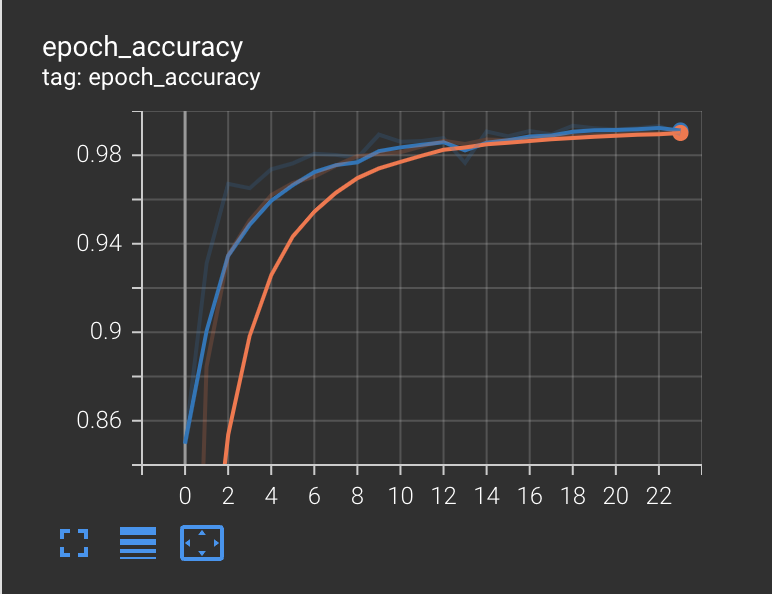
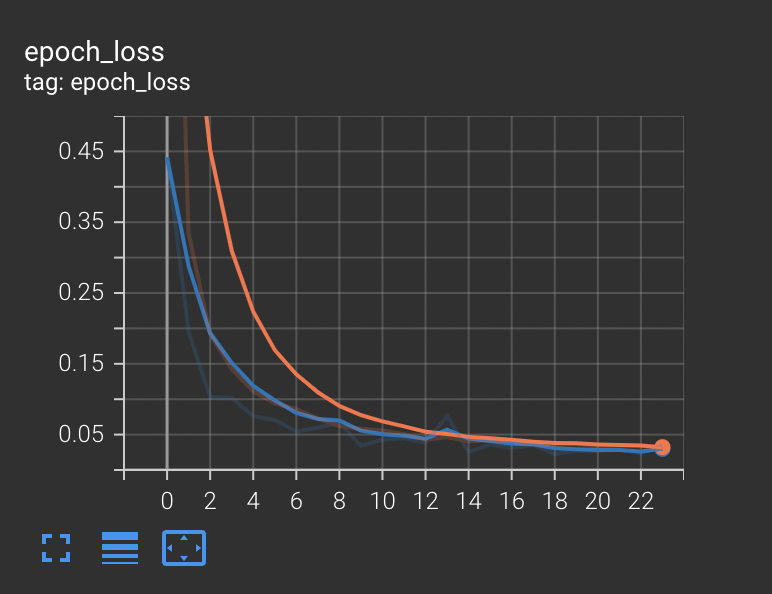
We also fine-tune ResNet50 model which pretrained on imagenet. We simply freeze all the layers except the last four layers and train those four layers instead of training the whole model.
We get the pretrained ResNet50 model, and build our model as follows:
resnet_base= tf.keras.applications.ResNet50(
include_top=False,
weights="imagenet",
input_shape=(224, 224, 3),
)
resnet_base.trainable = True
for layer in resnet_base.layers[: -4]:
layer.trainable=False
inputs= keras.Input(shape=(224,224,3))
x = data_augmentation(inputs)
x = keras.applications.resnet50.preprocess_input(x)
x = resnet_base(x)
x = Flatten()(x)
x = Dense(256)(x)
x = Dropout(0.5)(x)
outputs = Dense(units=29, activation='softmax')(x)
model= keras.Model(inputs=inputs, outputs=outputs)