https://github.com/bioMate-AI/biomate-bioconductor-kb
BioMate-KB Bioconductor Skills — 200 packages (top 100 by downloads + 100 rising stars) as vignette-grounded Claude/agent skills, with per-package workflow recipes
https://github.com/bioMate-AI/biomate-bioconductor-kb
Last synced: 3 days ago
JSON representation
BioMate-KB Bioconductor Skills — 200 packages (top 100 by downloads + 100 rising stars) as vignette-grounded Claude/agent skills, with per-package workflow recipes
- Host: GitHub
- URL: https://github.com/bioMate-AI/biomate-bioconductor-kb
- Owner: bioMate-AI
- License: other
- Created: 2026-05-27T03:10:25.000Z (about 2 months ago)
- Default Branch: main
- Last Pushed: 2026-06-15T23:21:08.000Z (about 1 month ago)
- Last Synced: 2026-06-16T01:11:46.896Z (about 1 month ago)
- Language: Python
- Homepage:
- Size: 1.15 MB
- Stars: 352
- Watchers: 22
- Forks: 40
- Open Issues: 0
-
Metadata Files:
- Readme: README.md
- Changelog: CHANGELOG.md
- License: LICENSE
- Citation: CITATION.cff
Awesome Lists containing this project
- awesome-agent-skills - biomate-bioconductor-kb - BioMate knowledge-base skills for Bioconductor packages, with vignette-grounded workflows and package-specific recipes. (Industry Skills)
README
# BioMate-KB — Bioconductor Skills
**200 Bioconductor packages — the top 100 most-downloaded plus the top 100 rising stars — formatted as Claude Code Skills.**
A skill bundle in [Claude Code Skills](https://docs.anthropic.com/en/docs/claude-code/skills-overview) format. It covers the 100 most-used Bioconductor packages **and** the top 100 rising-star packages (newly released since ~2021 and fast-growing) from the BioMate-KB knowledge base. Each skill teaches Claude when to choose a package, **the workflows it supports** (each analysis as a recipe), what parameters to set, how to interpret results, and what pitfalls to avoid.
## What's here
```
skills/ (200 packages · 12 domains) ⭐ = rising star
├── transcriptomics/ (97 — DESeq2, edgeR, limma · ⭐ standR, Voyager, sechm, crisprScore)
├── genomics/ (33 — GenomicRanges, Biostrings · ⭐ rBLAST, syntenet, ggmanh)
├── general/ (19 — Biobase, DOSE · ⭐ immunotation, faers, mosbi)
├── proteomics/ (16 — MSnbase, mixOmics, mzR · ⭐ MatrixQCvis, MsDataHub, TargetDecoy)
├── epigenomics/ (10 — ChIPseeker, minfi · ⭐ HiCExperiment, HiContacts, epigraHMM)
├── single-cell/ (8 — SingleCellExperiment · ⭐ demuxmix, hoodscanR, MuData)
├── variant-calling/ (4 — VariantAnnotation, snpStats, vsn)
├── metagenomics/ (4 — phyloseq, microbiome, DirichletMultinomial)
├── imaging/ (4 — flowCore, EBImage · ⭐ lisaClust, cytoviewer)
├── annotation/ (2 — biomaRt, KEGGgraph)
├── enrichment/ (2 — enrichplot, ReactomePA)
└── metabolomics/ (1 — ⭐ rgoslin)
```
A package that supports multiple analyses lists each as a `### ` recipe under a **`## Workflows`** section (e.g. DESeq2 → standard / multi-factor / LRT; crisprscore → on-target / off-target / indel scoring). The most-used 100 cover ~56% of Bioconductor analysis-package download volume; the rising-star 100 surface newly-important methods before they reach the top by volume. Beyond this 200-package sample, the full BioMate KB has runnable workflows for **1,818** Bioconductor packages — **~87% of analysis-package download volume** — available via [BioMate Cloud](https://biomate.ai).
**Bioconductor version:** these skills are grounded against **Bioconductor 3.21** (pinned explicitly — `release` is a moving pointer that drops packages as it advances, e.g. several rising stars dropped out of 3.23). The pinned version is recorded in `MANIFEST.json` (`bioconductor_version`); re-fetch a different snapshot with `BIOC_VERSION=… python3 extraction/fetch_authoritative_sources.py`.
## Full package list
All **200 packages** — with category, description, and the workflows each one supports — are in
**[PACKAGES.md](PACKAGES.md)** (one page, four columns; ⭐ marks rising stars).
### Packages per domain

### Workflows per domain
A package with multiple analyses contributes one `### ` recipe subsection per workflow — **390 workflows
across the 200 packages; 89 are multi-workflow** (e.g. DESeq2 → DE / multi-factor / QC-transform /
LRT; crisprScore → 6 scoring recipes).

## How these 200 were selected
Two ranked sets of 100:
- **Top 100 by downloads** — ranked purely by the official Bioconductor download score
(`bioc_pkg_scores.tab`). These cover **~56% of Bioconductor analysis-package download volume**. Because the rank
is by raw volume, this set includes both **analysis tools** (DESeq2, edgeR, limma, fgsea, …) and
the **foundational data-structure / I/O / annotation** packages nearly every analysis imports
(GenomicRanges, Biostrings, SingleCellExperiment, AnnotationHub, …).
- **Top 100 rising stars** — restricted to **analysis** packages (infrastructure, data-container,
and GUI packages excluded), recently released (first release ≥ 2021) and fast-growing in 2025
(year-over-year download growth + ≥ 3,000 distinct download IPs), ranked by 2025 downloads. They
surface newly-important methods *before* they reach the top by raw volume.
Together these 200 packages cover **~57% of Bioconductor's analysis-package download volume**
(foundational infrastructure and data-container packages — which alone are ~40% of raw
downloads — are not counted as analysis volume). The full **BioMate-KB** goes much further:
runnable workflows for **1,818** analysis packages — **~87% of analysis-package download
volume**.
> **Note on domains.** Domain labels come from BioMate's catalog and are intentionally coarse —
> *transcriptomics* is a broad catch-all that absorbs most single-cell, spatial, and gene-set tools
> (scater / scran / monocle / SingleR are single-cell; fgsea / GSVA are enrichment) — which is why
> it dominates the charts, and why the small *single-cell* (8) and *annotation* (2) folders are
> remnants of the same imperfect classifier rather than clean boundaries. We keep BioMate's labels
> for traceability; treat the domain folders as a rough guide, not a strict ontology.
**Our contribution** — unique among public skill libraries:
1. **The only per-R/Bioconductor-package library** — **200** packages here, **1,818** in the full KB.
Every other public set is task-oriented or Python-centric; none provide per-package R/Bioconductor
knowledge at this depth (the closest R one, wolf5996, has 13 skills and covers R *packaging*, not
Bioconductor analysis).
2. **Vignette-grounded & fact-verified** — every R function named in a skill is verified to appear in
that package's own Bioconductor vignette (mean verify **0.91**), not free-form LLM prose.
3. **Per-package workflow recipes** — a package's distinct analyses are explicit `### ` recipes
(**390** across the 200) — *how to run it*, not just *what it is*.
4. **Executable backing** — the same knowledge runs as managed, validated workflows on
[BioMate Cloud](https://www.biomate.ai) for **1,818** packages.
## Tutorial: Bulk RNA-seq → DESeq2 → STRINGdb Gene Interaction Network
This walkthrough shows how BioMate routes a plain-English bulk RNA-seq request through DESeq2, GO enrichment, and an **interactive STRINGdb protein-protein interaction panel** — without writing R code.
**What the demo covers:**
- Natural-language workflow routing to DESeq2 + clusterProfiler
- Differential expression on 120 samples (human GRCh38, control vs treated)
- GO enrichment (enrichGO) identifying apoptotic regulation as the top pathway
- **Interactive gene interaction panel** — STRINGdb network visualization of the top 2,841 DEGs, with nodes coloured by log₂FC and edges weighted by STRING confidence score
- AI findings summary + citable methods section + citation export
[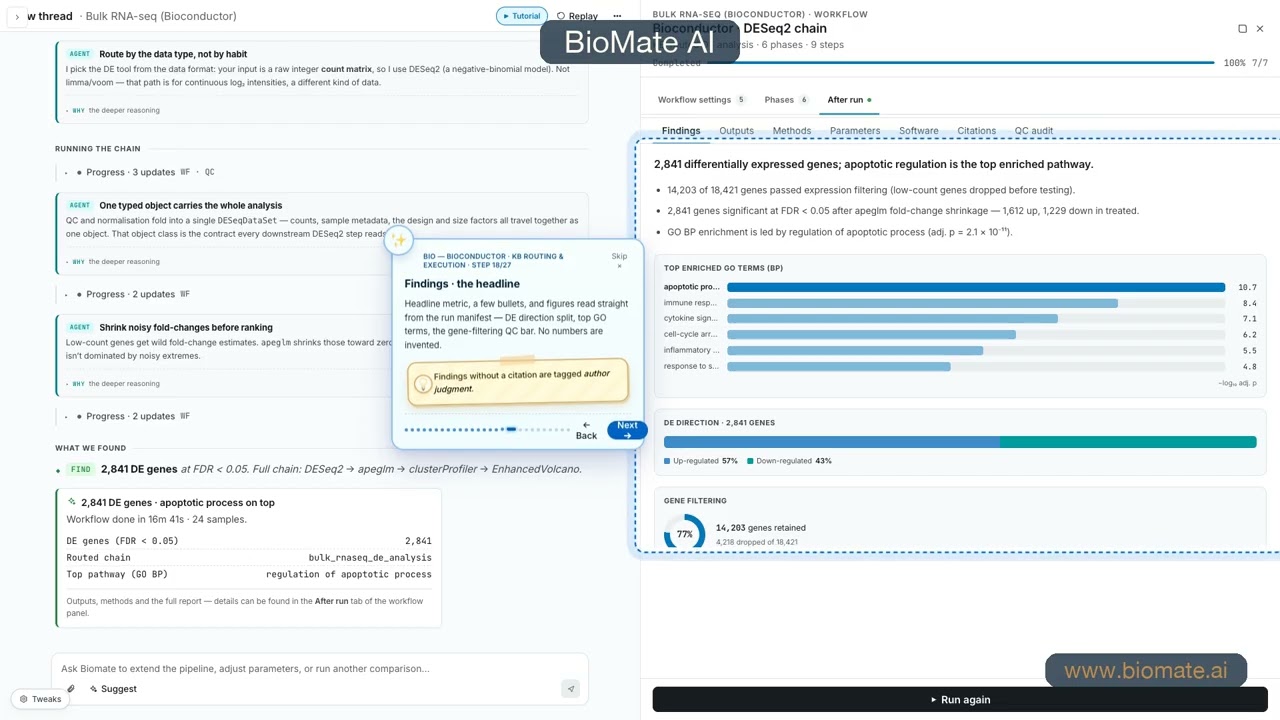](https://youtu.be/WL8Jk7M8n1g)
*▶ Click the image above to watch the tutorial on YouTube.*
For all tutorials (single-cell Seurat, DNA methylation, bispecific antibody design, CAR-T, base editing, GLP-1 modality selection, BCMA myeloma triage) see the **[BioMate Tutorial Page →](https://biomate.ai/tutorials.html)**
---
## Want the full collection?
This bundle covers 200 Bioconductor packages (top 100 by downloads + 100 rising stars). **[BioMate AI](https://www.biomate.ai)** gives you:
- **Broad Bioconductor coverage** — runnable workflows for **1,818** packages (**~87%** of analysis-package download volume), plus nf-core and drug-discovery pipelines across genomics, proteomics, and more
- **Efficient parallel computing** — workflows run in the cloud with automatic scaling, no cluster setup required
- **Interactive visualization & analysis** — inspect, filter, and re-run results through linked charts and per-step QC dashboards, with AI-assisted interpretation that links every claim back to the underlying data
- **Reproducible reporting** — methods and results documents generated with complete parameter and software-version provenance, formatted for publication and audit
**Free for academic and non-profit researchers** — [register at www.biomate.ai](https://www.biomate.ai) (no credit card required).
Commercial plans available. Questions or collaboration inquiries: [contact@biomate.ai](mailto:contact@biomate.ai)
## How to use
```bash
# Clone
git clone https://github.com/bioMate-AI/biomate-bioconductor-kb.git
cd biomate-bioconductor-kb
# Install all skills into Claude Code (global)
find skills -name "SKILL.md" | while read f; do
pkg=$(dirname "$f" | xargs basename)
cp "$f" ~/.claude/skills/bioconductor-${pkg}.md
done
```
Or copy a single domain:
```bash
# Only RNA-seq DE skills
find skills/transcriptomics -name "SKILL.md" | while read f; do
pkg=$(dirname "$f" | xargs basename)
cp "$f" ~/.claude/skills/bioconductor-${pkg}.md
done
```
Each `SKILL.md` is a self-contained Claude Code skill file — Claude discovers it automatically once it's in `~/.claude/skills/` (global) or `.claude/skills/` (project-level).
## Ranking source
Packages are ordered by Bioconductor's official monthly download score:
- Source:
- Snapshot taken: 2026-05-21
- Top 100 by download score + 100 analysis rising stars = 200 packages, together **~57% of Bioconductor analysis-package download volume**
Because the ranking is by download volume, the bundle includes both **analysis tools** (DESeq2, edgeR, limma, fgsea, …) and the **core data-structure, I/O, and annotation packages** that nearly every analysis depends on (GenomicRanges, Biostrings, SingleCellExperiment, AnnotationHub, …) — the latter rank highly precisely because they are imported everywhere. Both are useful to an agent: the analysis packages teach *how to analyze*, the foundational ones *how to represent and load* the data.
## Knowledge layer, not pipelines
These skills are the **knowledge layer** — when and why to use each package, with parameters, assumptions, pitfalls, and alternatives. They are not runnable pipelines and carry no infrastructure details.
**BioMate hosts and executes these workflows for you** — managed compute, automated QC, and reproducible outputs — powered by this same Bioconductor know-how. For end-to-end cloud execution, see **[BioMate](https://www.biomate.ai)**.
## License
- **Skill content** (`skills/**/*.md`, `MANIFEST.json`): **CC-BY-4.0** — share + adapt with attribution.
- **Extraction scripts** (`extraction/*.py`): **Apache-2.0** — use, modify, distribute.
- **Underlying Bioconductor packages** retain their own (mostly Artistic-2.0 / GPL) licenses.
## Citation
If you use this skill bundle in research, please cite:
> Zhang, Y. (2026). *BioMate-KB: A Real-Execution-Validated Workflow Knowledge Base for Bioconductor* (3.0). Zenodo. https://doi.org/10.5281/zenodo.20616356
And, for the execution-grounding methodology:
> Zhang, Y. (2026). *Structure Grounding Is Not Enough: Real Execution as the Ground Truth for LLM-Generated Bioinformatics Workflows* (Version v3). Zenodo. https://doi.org/10.5281/zenodo.20616544
Concept DOIs (always resolve to the latest version): BioMate-KB — https://doi.org/10.5281/zenodo.20616355 · Structure Grounding — https://doi.org/10.5281/zenodo.20616543
## Regenerating the bundle
```bash
# Re-fetch the latest Bioconductor download scores
curl -O https://bioconductor.org/packages/stats/bioc/bioc_pkg_scores.tab
# Regenerate the download-ranked set (top 100 by default).
# The 100 rising-star skills are a separately-curated set (analysis packages,
# first release >= 2021, ranked by 2025 download growth) generated per-package
# via extract_skill.py, then vignette-grounded with enrich_v2_grounded.py.
python3 extraction/generate_bundle.py --top 100
# Single package
python3 extraction/extract_skill.py \\
--db \\
--pkg DESeq2 \\
--out my-deseq2-skill.md
```
The extraction code (`extraction/extract_skill.py`) is intentionally minimal (~300 lines) and reads only from BioMate's public knowledge fields — `tool_knowledge.{use_cases, limitations, alternatives, recommended_parameters, primary_citation, benchmark_papers}` and `tools.scientific_context`. Internal and infrastructure fields are excluded.
## Versioning
**v2.0.0** (2026-06-15) — full history in **[CHANGELOG.md](CHANGELOG.md)**. Skills are pinned to
**Bioconductor 3.21** (recorded in `MANIFEST.json`).
Since v1.0.0: coverage doubled to **200 packages** (added the top 100 rising stars), per-package
`## Workflows` recipes, and a full package table + coverage charts.
Planned: track new Bioconductor releases, expand coverage (top-1000 if community demand justifies),
and refine `SKILL.md` sections (Q&A, gotchas, more examples).
## Contributing
Open an issue or PR for:
- Errors in any SKILL.md
- Suggestions for new sections to extract
- Packages missing from the top-100 / rising-star sets that should be included
## Acknowledgments
Bioconductor download statistics published by the Bioconductor Core Team. SKILL.md format from [Anthropic Claude Code](https://docs.anthropic.com/en/docs/claude-code/skills-overview).