https://github.com/buildbuddy-io/reninja
Reninja: faster, more observable ninja builds
https://github.com/buildbuddy-io/reninja
build-tools ninja-build remote-caching remote-execution
Last synced: 4 months ago
JSON representation
Reninja: faster, more observable ninja builds
- Host: GitHub
- URL: https://github.com/buildbuddy-io/reninja
- Owner: buildbuddy-io
- License: apache-2.0
- Created: 2025-08-28T23:13:08.000Z (11 months ago)
- Default Branch: main
- Last Pushed: 2026-03-10T05:16:09.000Z (5 months ago)
- Last Synced: 2026-03-10T13:40:26.685Z (5 months ago)
- Topics: build-tools, ninja-build, remote-caching, remote-execution
- Language: Go
- Homepage:
- Size: 2.91 MB
- Stars: 12
- Watchers: 1
- Forks: 0
- Open Issues: 1
-
Metadata Files:
- Readme: README.md
- License: LICENSE
Awesome Lists containing this project
README
# Reninja
```
____ _____ _ _ ___ _ _ _ _
| _ \| ____| \ | |_ _| \ | | | | / \
| |_) | _| | \| || || \| |_ | |/ _ \
| _ <| |___| |\ || || |\ | |_| / ___ \
|_| \_\_____|_| \_|___|_| \_|\___/_/ \_\
```
Reninja is a complete reimplementation of the Ninja build system
focused on correctness, remote caching, remote execution, and build
telemetry.
## Features
- **Drop in replacement for Ninja** - If it works in Ninja, Reninja
will build it too. By default, all flags and options are honored,
even the hidden 🐢 ones.
- **Build visibility** - use the timing profile (flame graph) to
visualize the slow parts of the build and fix them.
- **Remote caching** - allows for massive reductions in CPU usage and
drastically reduces build times by not building the same thing twice.
- **Remote execution** - run builds with massive parallelization (`-j
2000`) to speed them up. Build LLVM, from scratch, in 3 minutes!
- **Extensive unit and integration tests** - all Ninja tests were
ported over, and new ones added for Reninja-only
functionality. Additional parity tests ensure that Reninja and Ninja
produce the same outputs.
## Quick Start
#### Install the Reninja binary:
```shell
go install github.com/buildbuddy-io/reninja/cmd/reninja@latest
```
#### Build locally
This does the exact same thing as ninja.
```shell
reninja
```
#### Build with Build Event Stream (BES) enabled
```shell
reninja --bes_backend=remote.buildbuddy.io --results_url=https://app.buildbuddy.io/invocation
```
This will show basic information about the build and allow for later
analysis of build time trends. [Example
build](https://app.buildbuddy.io/invocation/695b24ca-b8ea-4781-9594-6b621474455c)
#### Build your project with BES and Remote Cache enabled
```shell
reninja --bes_backend=remote.buildbuddy.io --results_url=https://app.buildbuddy.io/invocation --remote_cache=remote.buildbuddy.io
```
This will show more information about the build (including the timing
profile!) and allow for reusing cached results from previous builds
which is significantly faster than building from scratch. [Example
build](https://app.buildbuddy.io/invocation/93289e2d-595e-4452-8cb5-61874935fe98)

#### Build with remote execution (see [Remote Execution](#remote-execution) below for details)
```shell
SRC=$PWD
BUILD_DIR=$SRC/build-rbe
mkdir -p "$BUILD_DIR"
docker run --rm \
--user "$(id -u):$(id -g)" \
-v "$SRC:$SRC" \
-v "$(which ninja):/usr/local/bin/ninja:ro" \
-w "$BUILD_DIR" \
gcr.io/flame-public/rbe-ubuntu22-04:ninja \
cmake -G Ninja \
-DCMAKE_SUPPRESS_REGENERATION=ON \
"$SRC"
reninja -C $BUILD_DIR --bes_backend=remote.buildbuddy.io \
--results_url=https://app.buildbuddy.io \
--remote_executor=remote.buildbuddy.io \
--container_image=gcr.io/flame-public/rbe-ubuntu22-04:ninja \
--remote_header=x-buildbuddy-api-key=YOUR_API_KEY_HERE \
-j 1000
```
This will run all build actions remotely and download the results of
each action. [Example
build](https://app.buildbuddy.io/invocation/aec6d04d-d354-4d69-9811-ab08d5cb2bca)
[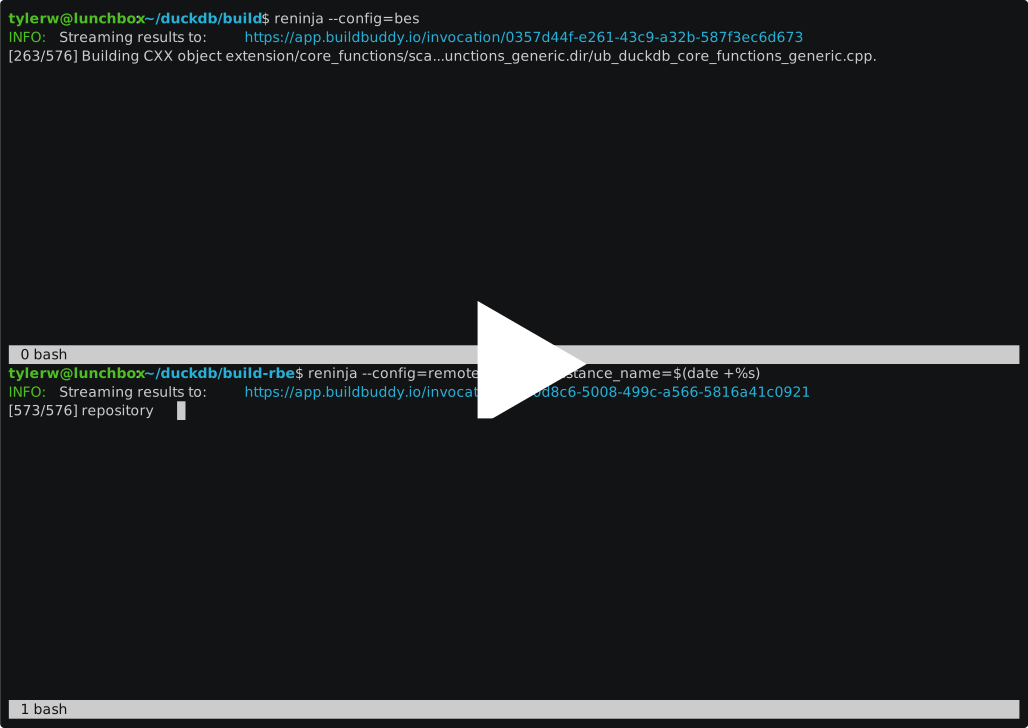](https://asciinema.org/a/yvz42ATqgpJHtEU4)
## About
Reninja owes its existence to the original [Ninja Build
System](https://ninja-build.org/) and all credit goes to the [original
author](https://neugierig.org/) and [many open source
contributors](https://github.com/ninja-build/ninja/graphs/contributors).
All bugs / mistakes are my own.
## Motivation
Ninja is an excellent and **simple** build tool. Many projects have
modified it to add in various forms of observability or remote
execution. I wanted to roll up some of those improvements in one place
and also add proper support for *remote caching* and *remote
execution*, which do not cleanly fit in the original project due to
complex networking requirements and extensive (proto, gRPC)
dependencies.
At BuildBuddy, we've spent a lot of time building tools for
[Bazel](https://bazel.build/) and our customers derive a lot of value
from being able to build and test their software in a remote execution
environment or with more observability.
I wanted to make those features available to ninja-based projects and
offer Reninja as a simple, generic replacement for distcc-style
building. There's nothing BuildBuddy specific here -- Reninja is just
a normal [remote-apis](https://github.com/bazelbuild/remote-apis/)
client.
## Installation
Because Reninja is a golang application, you can install it with `go install`:
```shell
go install github.com/buildbuddy-io/reninja/cmd/reninja@latest
```
We also offer prebuilt binaries for Linux and Mac attached to the github release:
```shell
curl -fSL "https://github.com/buildbuddy-io/reninja/releases/latest/download/reninja-$(uname -s | tr '[:upper:]' '[:lower:]')-$(uname -m | sed
's/x86_64/amd64/;s/aarch64/arm64/')" -o reninja
mv reninja /usr/local/bin/ninja
```
## NinjaRC (Config file configuration)
One powerful feature Reninja borrows from Bazel is the ability to read
config files from various locations that define common build
flags. This can be used to define a common build configuration (host,
remote namespace, container image, etc) that all builders of the
project should use.
Out of the box, Reninja will look for a file called `.ninjarc` in the
following places:
- the CWD (`.ninjarc`)
- the project root (`%workspace%/.ninjarc`)
- the user's home directory (`~/.ninjarc`)
- the system etc dir (`/etc/.ninjarc`)
A contrived, basic `.ninjarc` file might look like this:
```
build:local --bes_backend="grpc://localhost:1985"
build:local --remote_cache="grpc://localhost:1985"
build:local --remote_executor="grpc://localhost:1985"
build:local --results_url="http://localhost:8080/invocation"
```
This config specifies that for "build" commands, when the --config
flag value is "local", the `--bes_backend`, `--remote_cache` and
`--results_url` flags will be set.
A more useful example might look like this:
```
common --remote_header=x-buildbuddy-api-key=YOUR_API_KEY_HERE
build:bes --bes_backend=remote.buildbuddy.io
build:bes --results_url=https://app.buildbuddy.io/invocation
build:cache --config=bes --remote_cache=remote.buildbuddy.io
build:remote --config=cache --remote_executor=remote.buildbuddy.io
build:remote --container_image="gcr.io/flame-public/rbe-ubuntu22-04:ninja"
build:remote -j 2000
# default to bes + caching, allow passing "--config=remote" to rexec
build --config=cache
```
This config defines three different modes `bes`, `cache`, and `remote`
and selects `cache` by default for ninja builds. The special `common`
section is *always* expanded.
## Two-stage Cache Lookups
Remote caching with Reninja is more challenging than with Bazel
because build actions (edges, in ninja parlance) do not always fully
declare *all* of their inputs. That's because not all inputs are known
at build time -- headers may pull in other headers implicitly.
When a command runs for the first time, the compiler will often
generate a Dependency File (depfile) that contains information about
the source file's dependencies. After the command finishes, Reninja
will read these depfiles and use this information to update the build
graph for subsequent builds, avoiding recompilation of objects with no
changed dependencies.
Typically, in a remote cache, compiled object files are looked up
using a hash of all of their inputs. If any input changes, the hash
will change and the object will be a cache-miss and be recompiled.
Extending this mechanism to Reninja is tricky though: if you only look
at an actions explicit inputs, you may not recompile the object when
you should. But implicit inputs are not known until the compilation
has already run once, so if you lookup actions this way, you'll have
cache misses for partial builds or across users.
Reninja does a two-stage lookup: the hashes of an edge's explicit
inputs are looked up to find the list of implicit deps. The hashes of
those implicit deps are looked up to find the actual compiled
object. This way if either explicit or implicit inputs change, the
object will be recompiled.
This means you can run two clean builds in a row, and get 100% cache
hit rate on the second build.
## Remote Execution
Remote execution with Reninja is similarly challenging. Edges do not
always fully declare *all* of their inputs, so remote actions may not
have all the files needed for compilation. Additionally, CMake
defaults to configuring against the installed system libraries rather
than specifying everything at the project level (cmake toolchains are
kind of an option here, but not often used).
To sidestep these issues, remote execution with Reninja generally
requires two things:
1. configuring the build inside a container
2. using include scanning to determine the inputs for an action
Building projects this way has the nice property that all contributors
to the project are working with a commonly known set of tools --
everything is fully declared either in the container image used for
remote execution or in the source code.
Here's an example of using ninja with remote execution to build duckdb
(a small to mid-size c++ project configured with cmake):
Clone the repo:
```shell
cd ~/
git clone https://github.com/duckdb/duckdb.git --depth=1
mkdir -p ~/duckdb/build-rbe
```
Configure it with cmake (against a docker image):
```shell
docker run --rm \
--user "$(id -u):$(id -g)" \
-v "$HOME/duckdb:$HOME/duckdb" \
-v "$(which ninja):/usr/local/bin/ninja:ro" \
-w "$HOME/duckdb/build-rbe" \
gcr.io/flame-public/rbe-ubuntu22-04:ninja \
cmake -G Ninja -DCMAKE_SUPPRESS_REGENERATION=ON $HOME/duckdb
```
Run the build using remote execution:
```shell
cd ~/duckdb/build-rbe
reninja --bes_backend=remote.buildbuddy.io \
--results_url=https://app.buildbuddy.io/invocation \
--remote_executor=remote.buildbuddy.io \
--container_image=gcr.io/flame-public/rbe-ubuntu22-04:ninja \
--remote_header=x-buildbuddy-api-key=YOUR_API_KEY_HERE \
-j 2000
```
Run the unit tests inside the container:
```shell
docker run --rm \
--user "$(id -u):$(id -g)" \
-v "$HOME/duckdb:$HOME/duckdb" \
-w "$HOME/duckdb/build-rbe" \
gcr.io/flame-public/rbe-ubuntu22-04:ninja \
$HOME/duckdb/build-rbe/test/unittest
```
## Usage of AI
Is this just another AI slop project? **No!**
Reninja was born from a bet (could AI do this?) but since the [initial
version](https://github.com/buildbuddy-io/reninja/commit/8c1bde042af17056246167a338b74aa2172b728c)
I have re-written each file by hand in go. I have occasionally relied
on claude to port unit tests, but only after writing several examples
myself would I then ask it to port more tests following my lead.
Some other BES, remote caching, and remote execution libraries were
borrowed from BuildBuddy and lightly modified to be suitable for
Reninja.