https://github.com/cgomesu/bash-logistic-function
Implementation of the logistic function in GNU bash and bc
https://github.com/cgomesu/bash-logistic-function
bash basic-calculator gnu logistic mathematical-modelling mathematics
Last synced: 2 months ago
JSON representation
Implementation of the logistic function in GNU bash and bc
- Host: GitHub
- URL: https://github.com/cgomesu/bash-logistic-function
- Owner: cgomesu
- License: mit
- Created: 2020-11-06T14:47:50.000Z (over 5 years ago)
- Default Branch: master
- Last Pushed: 2020-11-11T19:16:01.000Z (over 5 years ago)
- Last Synced: 2025-06-11T12:45:29.367Z (about 1 year ago)
- Topics: bash, basic-calculator, gnu, logistic, mathematical-modelling, mathematics
- Language: Shell
- Homepage:
- Size: 1.34 MB
- Stars: 2
- Watchers: 1
- Forks: 0
- Open Issues: 0
-
Metadata Files:
- Readme: README.md
- License: LICENSE
Awesome Lists containing this project
README
# bash-logistic-function
An implementation of the [**logistic function**](https://en.wikipedia.org/wiki/logistic_function) written in [**GNU bash**](https://www.gnu.org/software/bash/) and [**GNU basic calculator** (bc)](https://www.gnu.org/software/bc/). It requires four parameters (`-x`, `-m`, `-L`, `-k`) to output the value of *f(x)*. If there is an error, the function exits with `status 1`; otherwise, it exists with `status 0`. (Errors won't generate any message unless the function is called in debug mode with the argument `-d`.)
This code was meant to be used programatically to output values of a given logistic model across values of a random variable *X*. See [**Examples**](#examples).
# Usage
```
./logistic-function -h
Usage:
./logistic-function -x VALUE -m VALUE -L VALUE -k VALUE [OPTIONS]
Logistic function:
-x real* value of a variable X
-m real* m = x0: Midpoint of X
-L real* max value of f(x)
-k real* growth rate
* acceptable inputs:
integers: ..., -1, 0, 1, ...
fractions: ..., -1/2, -.25, 0, .25, 1/2, ...
positive exps: ..., "-(2^2)", 0, 2^2, ...
natural exps: "e(VALUE)"
natural logs: "l(VALUE)"
square roots: "sqrt(VALUE)"
sines: "s(VALUE)"
cosines: "c(VALUE)"
arctangents: "a(VALUE)"
Options:
-d enable debug messages.
-h show this help message.
-s int # of decimals to compute f(x). default: 20.
-S int # of decimals in the output. default: 2.
Example:
logistic-function -x .5 -m 0 -L 1 -k 1 -s 10 -S 4
Author: cgomesu
Repo: https://github.com/cgomesu/bash-logistic-function
```
# Demo

# Examples
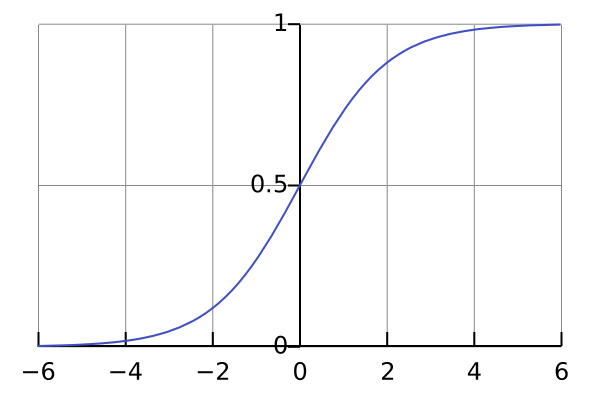
For the examples below, it was assumed that `logistic-function` is in the current user's `$PATH` (e.g., `/usr/local/bin`). In addition, the logistic model was always the **standard logistic sigmoid function** with parameters *m* = 0, *L* = 1, and *k* = 1:
## If test
Test if a value of *X* (provided as the first argument) returns a valid status
```
#!/bin/bash
if logistic-function -x "$1" -m 0 -L 1 -k 1 &>/dev/null; then
# do something if valid
else
# do something else
fi
exit 0
```
## For loop
Output values of *f(x)* for *x* = -1 to *x* = 1 in .1 increments
```
#!/bin/bash
# in GNU systems, make use of seq to handle non-integers in a sequence
for x in $(seq '-1' .1 1); do logistic-function -x "$x" -m 0 -L 1 -k 1; done
exit 0
```