https://github.com/chen0040/java-libsvm
Package provides the direct java conversion of the origin libsvm C codes as well as a number of adapter to make it easier to program with libsvm on Java
https://github.com/chen0040/java-libsvm
anomaly-detection binary-classification java libsvm libsvm-format multi-class-classification one-class-learning outlier-detection regression supervised-learning svm unsupervised-learning
Last synced: about 1 year ago
JSON representation
Package provides the direct java conversion of the origin libsvm C codes as well as a number of adapter to make it easier to program with libsvm on Java
- Host: GitHub
- URL: https://github.com/chen0040/java-libsvm
- Owner: chen0040
- License: mit
- Created: 2017-05-02T04:14:17.000Z (about 9 years ago)
- Default Branch: master
- Last Pushed: 2017-05-24T03:20:12.000Z (about 9 years ago)
- Last Synced: 2025-07-01T05:02:48.864Z (about 1 year ago)
- Topics: anomaly-detection, binary-classification, java, libsvm, libsvm-format, multi-class-classification, one-class-learning, outlier-detection, regression, supervised-learning, svm, unsupervised-learning
- Language: Java
- Homepage:
- Size: 249 KB
- Stars: 6
- Watchers: 1
- Forks: 2
- Open Issues: 0
-
Metadata Files:
- Readme: README.md
- License: LICENSE
Awesome Lists containing this project
README
# java-libsvm
Package provides the direct java conversion of the origin libsvm
[](https://travis-ci.org/chen0040/java-libsvm) [](https://coveralls.io/github/chen0040/java-libsvm?branch=master)
# Install
Add the following dependency to your POM file:
```
com.github.chen0040
java-libsvm
1.0.4
```
# Usage
The package use data frame as containers for training and testing data (Please refers to this [link](https://github.com/chen0040/java-data-frame) on how to create a data frame from file or from scratch)
# One-class SVM
Below is the code to create and train a one-class SVM:
```java
OneClassSVM algorithm = new OneClassSVM();
algorithm.fit(training_data)
```
Below is the code to predict if data point is an outlier:
```java
algorithm.isAnomaly(data_point)
```
# SVR
Below is the code to create and train a SVR for regression modelling:
```java
SVR algorithm = new SVR();
algorithm.fit(training_data)
```
Below is the code to perform data regression prediction:
```java
algorithm.isAnomaly(data_point)
```
# BinarySVC
Below is the code to create and train a BinarySVC for binary classification:
```java
BinarySVC algorithm = new BinarySVC();
algorithm.fit(training_data)
```
Below is the code to perform data binary classification:
```java
algorithm.isInClass(data_point)
```
# OneVsOneSVC
Below is the code to create and train a OneVsOneSVC for multi-class classification:
```java
BinarySVC algorithm = new BinarySVC();
algorithm.fit(training_data)
```
Below is the code to perform multi-class classification:
```java
algorithm.classify(data_point)
```
# Data Format
The data format default is the DataFrame class, which can be used to load csv and libsvm format text file. Please refers to the unit test cases on how they can be used.
# Sample codes
### Sample code for OneClassSVM:
Below is a sample code example of the one-class SVM for the example below here:
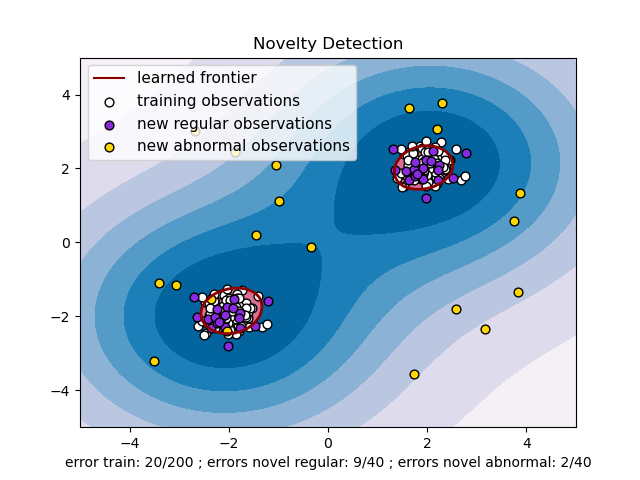
```java
import com.github.chen0040.data.frame.DataFrame;
import com.github.chen0040.data.frame.DataQuery;
import com.github.chen0040.data.frame.Sampler;
import com.github.chen0040.svmext.oneclass.OneClassSVM;
DataQuery.DataFrameQueryBuilder schema = DataQuery.blank()
.newInput("c1")
.newInput("c2")
.newOutput("anomaly")
.end();
Sampler.DataSampleBuilder negativeSampler = new Sampler()
.forColumn("c1").generate((name, index) -> randn() * 0.3 + (index % 2 == 0 ? -2 : 2))
.forColumn("c2").generate((name, index) -> randn() * 0.3 + (index % 2 == 0 ? -2 : 2))
.forColumn("anomaly").generate((name, index) -> 0.0)
.end();
Sampler.DataSampleBuilder positiveSampler = new Sampler()
.forColumn("c1").generate((name, index) -> rand(-4, 4))
.forColumn("c2").generate((name, index) -> rand(-4, 4))
.forColumn("anomaly").generate((name, index) -> 1.0)
.end();
DataFrame trainingData = schema.build();
trainingData = negativeSampler.sample(trainingData, 200);
System.out.println(trainingData.head(10));
DataFrame crossValidationData = schema.build();
crossValidationData = negativeSampler.sample(crossValidationData, 40);
DataFrame outliers = schema.build();
outliers = positiveSampler.sample(outliers, 40);
final double threshold = 0.5;
OneClassSVM algorithm = new OneClassSVM();
algorithm.set_gamma(0.1);
algorithm.set_nu(0.1);
algorithm.thresholdSupplier = () -> 0.0;
algorithm.fit(trainingData);
for(int i = 0; i < crossValidationData.rowCount(); ++i){
boolean predicted = algorithm.isAnomaly(crossValidationData.row(i));
logger.info("predicted: {}\texpected: {}", predicted, crossValidationData.row(i).target() > threshold);
}
for(int i = 0; i < outliers.rowCount(); ++i){
boolean predicted = algorithm.isAnomaly(outliers.row(i));
logger.info("outlier predicted: {}\texpected: {}", predicted, outliers.row(i).target() > threshold);
}
```
### Sample codes for SVR
Below is another complete sample code of the SVR to predict y = 4 + 0.5 * x1 + 0.2 * x2:

```java
import com.github.chen0040.data.frame.DataFrame;
import com.github.chen0040.data.frame.DataQuery;
import com.github.chen0040.data.frame.Sampler;
import com.github.chen0040.svmext.oneclass.SVR;
DataQuery.DataFrameQueryBuilder schema = DataQuery.blank()
.newInput("x1")
.newInput("x2")
.newOutput("y")
.end();
// y = 4 + 0.5 * x1 + 0.2 * x2
Sampler.DataSampleBuilder sampler = new Sampler()
.forColumn("x1").generate((name, index) -> randn() * 0.3 + index)
.forColumn("x2").generate((name, index) -> randn() * 0.3 + index * index)
.forColumn("y").generate((name, index) -> 4 + 0.5 * index + 0.2 * index * index + randn() * 0.3)
.end();
DataFrame trainingData = schema.build();
trainingData = sampler.sample(trainingData, 200);
System.out.println(trainingData.head(10));
DataFrame crossValidationData = schema.build();
crossValidationData = sampler.sample(crossValidationData, 40);
SVR svr = new SVR();
svr.fit(trainingData);
for(int i = 0; i < crossValidationData.rowCount(); ++i){
double predicted = svr.transform(crossValidationData.row(i));
double actual = crossValidationData.row(i).target();
System.out.println("predicted: " + predicted + "\texpected: " + actual);
}
```
### Sample code for BinarySVC
Below is another complete sample code of the BinarySVC for binary classification:
```java
import com.github.chen0040.data.frame.DataFrame;
import com.github.chen0040.data.frame.DataQuery;
import com.github.chen0040.data.frame.Sampler;
import com.github.chen0040.svmext.classifiers.BinarySVC;
DataQuery.DataFrameQueryBuilder schema = DataQuery.blank()
.newInput("c1")
.newInput("c2")
.newOutput("anomaly")
.end();
Sampler.DataSampleBuilder negativeSampler = new Sampler()
.forColumn("c1").generate((name, index) -> randn() * 0.3 + (index % 2 == 0 ? -2 : 2))
.forColumn("c2").generate((name, index) -> randn() * 0.3 + (index % 2 == 0 ? -2 : 2))
.forColumn("anomaly").generate((name, index) -> 0.0)
.end();
Sampler.DataSampleBuilder positiveSampler = new Sampler()
.forColumn("c1").generate((name, index) -> rand(-4, 4))
.forColumn("c2").generate((name, index) -> rand(-4, 4))
.forColumn("anomaly").generate((name, index) -> 1.0)
.end();
DataFrame trainingData = schema.build();
trainingData = negativeSampler.sample(trainingData, 200);
trainingData = positiveSampler.sample(trainingData, 200);
System.out.println(trainingData.head(10));
DataFrame crossValidationData = schema.build();
crossValidationData = negativeSampler.sample(crossValidationData, 40);
crossValidationData = positiveSampler.sample(crossValidationData, 40);
BinarySVC algorithm = new BinarySVC();
algorithm.fit(trainingData);
BinaryClassifierEvaluator evaluator = new BinaryClassifierEvaluator();
for(int i = 0; i < crossValidationData.rowCount(); ++i){
boolean predicted = algorithm.isInClass(crossValidationData.row(i));
boolean actual = crossValidationData.row(i).target() > 0.5;
evaluator.evaluate(actual, predicted);
System.out.println("predicted: " + predicted + "\texpected: " + actual);
}
evaluator.report();
```
### Sample codes for OneVsOneSVC
Below is another complete sample code of the OneVsOneSVC for multi-class classification:
```java
import com.github.chen0040.data.frame.DataFrame;
import com.github.chen0040.data.frame.DataQuery;
import com.github.chen0040.data.frame.Sampler;
import com.github.chen0040.svmext.classifiers.OneVsOneSVC;
InputStream irisStream = new FileInputStream("iris.data");
DataFrame irisData = DataQuery.csv(",", false)
.from(irisStream)
.selectColumn(0).asNumeric().asInput("Sepal Length")
.selectColumn(1).asNumeric().asInput("Sepal Width")
.selectColumn(2).asNumeric().asInput("Petal Length")
.selectColumn(3).asNumeric().asInput("Petal Width")
.selectColumn(4).asCategory().asOutput("Iris Type")
.build();
TupleTwo parts = irisData.shuffle().split(0.9);
DataFrame trainingData = parts._1();
DataFrame crossValidationData = parts._2();
System.out.println(crossValidationData.head(10));
OneVsOneSVC multiClassClassifier = new OneVsOneSVC();
multiClassClassifier.fit(trainingData);
ClassifierEvaluator evaluator = new ClassifierEvaluator();
for(int i=0; i < crossValidationData.rowCount(); ++i) {
String predicted = multiClassClassifier.classify(crossValidationData.row(i));
String actual = crossValidationData.row(i).categoricalTarget();
System.out.println("predicted: " + predicted + "\tactual: " + actual);
evaluator.evaluate(actual, predicted);
}
evaluator.report();
```