https://github.com/chovanecm/python-genetic-algorithm
Genetic algorithm "library"
https://github.com/chovanecm/python-genetic-algorithm
genetic-algorithm
Last synced: 8 months ago
JSON representation
Genetic algorithm "library"
- Host: GitHub
- URL: https://github.com/chovanecm/python-genetic-algorithm
- Owner: chovanecm
- License: mit
- Created: 2016-12-30T17:36:53.000Z (about 9 years ago)
- Default Branch: master
- Last Pushed: 2017-01-11T14:29:23.000Z (almost 9 years ago)
- Last Synced: 2025-03-30T04:31:46.097Z (9 months ago)
- Topics: genetic-algorithm
- Language: Python
- Size: 10.7 KB
- Stars: 12
- Watchers: 1
- Forks: 4
- Open Issues: 0
-
Metadata Files:
- Readme: README.md
- License: LICENSE
Awesome Lists containing this project
README
# mchgenalg
Genetic algorithm "library"
Current version: 0.2
## About the library
The "library" was created for a Czech Technical University's course "Problems and algorithms".
It supports evolving individuals composed of fixed-length binary genomes.
## Installation
Install the library:
pip install https://github.com/chovanecm/python-genetic-algorithm/archive/master.zip#egg=mchgenalg
Or directly:
python setup.py install
## Usage:
The following example shows using the library to solve a very simple problem
of maximizing the number of one-values in a vector.
```python
from mchgenalg import GeneticAlgorithm
import numpy as np
# First, define function that will be used to evaluate the fitness
def fitness_function(genome):
# let's count the number of one-values in the genome
# this will be our fitness
sum = np.sum(genome)
return sum
# Configure the algorithm:
population_size = 10
genome_length = 20
ga = GeneticAlgorithm(fitness_function)
ga.generate_binary_population(size=population_size, genome_length=genome_length)
# How many pairs of individuals should be picked to mate
ga.number_of_pairs = 5
# Selective pressure from interval [1.0, 2.0]
# the lower value, the less will the fitness play role
ga.selective_pressure = 1.5
ga.mutation_rate = 0.1
# If two parents have the same genotype, ignore them and generate TWO random parents
# This helps preventing premature convergence
ga.allow_random_parent = True # default True
# Use single point crossover instead of uniform crossover
ga.single_point_cross_over = False # default False
# Run 1000 iteration of the algorithm
# You can call the method several times and adjust some parameters
# (e.g. number_of_pairs, selective_pressure, mutation_rate,
# allow_random_parent, single_point_cross_over)
ga.run(1000)
best_genome, best_fitness = ga.get_best_genome()
# If you want, you can have a look at the population:
population = ga.population
# and the fitness of each element:
fitness_vector = ga.get_fitness_vector()
```
### Signle-point crossover vs uniform crossover [from Wikipedia]
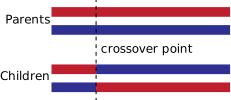
A single crossover point on both parents' organism strings is selected. All data beyond that point in either organism string is swapped between the two parent organisms. The resulting organisms are the children:
The uniform crossover uses a fixed mixing ratio between two parents. Unlike single- and two-point crossover, the uniform crossover enables the parent chromosomes to contribute the gene level rather than the segment level.
If the mixing ratio is 0.5, the offspring has approximately half of the genes from first parent and the other half from second parent, although cross over points can be randomly chosen as seen below:
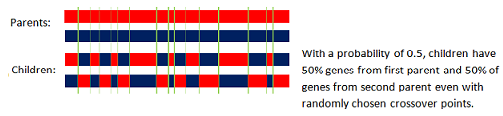
The mixing ratio in mchgenalg is 0.5.