https://github.com/clojure-vim/neovim-client
Neovim plugin client library for Clojure
https://github.com/clojure-vim/neovim-client
Last synced: 8 months ago
JSON representation
Neovim plugin client library for Clojure
- Host: GitHub
- URL: https://github.com/clojure-vim/neovim-client
- Owner: clojure-vim
- License: epl-1.0
- Created: 2015-04-26T05:25:42.000Z (about 11 years ago)
- Default Branch: master
- Last Pushed: 2021-04-13T20:59:45.000Z (about 5 years ago)
- Last Synced: 2025-09-20T16:07:44.152Z (9 months ago)
- Language: Clojure
- Size: 4.73 MB
- Stars: 115
- Watchers: 6
- Forks: 11
- Open Issues: 3
-
Metadata Files:
- Readme: README.md
- License: LICENSE
Awesome Lists containing this project
README
# neovim-client
A client library for creating Neovim plugins written in Clojure.
[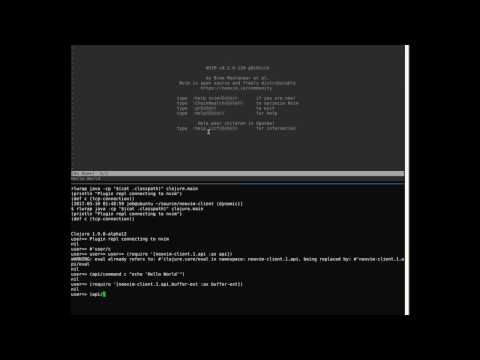](https://www.youtube.com/watch?v=pCuEDiKXV5Q)
## Dependencies
* [Neovim](https://github.com/neovim/neovim)
* [Java Development Kit](http://www.oracle.com/technetwork/java/javase/overview/)
(JDK) Standard Edition (SE) version 8
## Usage
### Repl
Launch Neovim, explicitly setting the `NVIM_LISTEN_ADDRESS`
```
NVIM_LISTEN_ADDRESS=127.0.0.1:7777 nvim
```
From the repository directory:
```
$> lein repl
user=> (def c (tcp-connection))
user=> (require '[neovim-client.1.api :as api])
user=> (api/command c ":echo 'Hello Neovim!'")
...
```
Alternatively, if you've got tmux installed, you can use run the script
`./tmux-run-dev.sh`, which will start Neovim, a repl, and execute similar
setup code.
### Examples
#### Included Sample Plugin
##### Installation
One way to install the sample plugin is by running `./deploy-local.sh` script,
included, which copies the sample plugin to `~/.vim/bundle`, and then ensure
Neovim's runtimepath is set correctly by adding `set
runtimepath^=~/.vim/bundle/sample-plugin` to `.vimrc`.
##### Running
This plugin stays running, and maintains state. Additionally, it shows how
plugins are actually servers, which Neovim can make requests to via
rpcnotify().
```
:echo SamplePluginCount()
```
#### Socket Repl Plugin
A simple alternative to vim-fireplace. Send code in vim buffers to a built-in
Clojure socket repl.
https://github.com/jebberjeb/clojure-socketrepl.nvim
## Neovim API Versions (Levels)
Neovim's RPC API is
[versioned separately](https://github.com/neovim/neovim/pull/5535) from
Neovim itslef, using a monotonically increasing integer. The API's version is
tracked using a value called `api_level`, which can be found by examining the
output of `:echo api_info()`.
Currently, levels 0 - 1 are supported.
In the future, this library can be updated to support a new level by:
* Updating the API metadata `$> nvim --api-info > resources/api-info.mp`
* Generating code from the metadata using `neovim-client.parser/generate`
## Changes
### Version 0.1.0
* Generate code for api_level 0 - 1 from metadata generated using Neovim
version 0.2.0
* Hand-written functions moved to `-ext` namespaces
* Added unit tests which use `nvim --embed` process
* Support Unix Domain Sockets
* Verify api_level available on connection
## Future
### Tighter Integration with Neovim
Neovim's strategy for [remote plugins](http://neovim.io/doc/user/remote_plugin.html#remote-plugin) says that it's ok to create a remote plugins as "arbitrary programs that communicate directly with the high-level Nvim API and are called via [msgpack-rpc]". That's exactly what the included sample-plugin does (utilizing neovim-client).
However, it goes on to outline a better approach, utilizing a "plugin host". While neovim-client could potentially fill that role, considerably more work is needed.
### Performance
Individual plugins can be distributed as jars using AOT compilation. Additionally, porting this client library to Clojurescript would facilitate a fast startup time, via Node.
## License
Distributed under the same license as Neovim.