https://github.com/codebox/convnet-designer
A utility for designing Convolutional Neural Networks
https://github.com/codebox/convnet-designer
convolutional-neural-networks tensorflow
Last synced: about 1 year ago
JSON representation
A utility for designing Convolutional Neural Networks
- Host: GitHub
- URL: https://github.com/codebox/convnet-designer
- Owner: codebox
- License: mit
- Created: 2016-04-04T20:27:37.000Z (over 10 years ago)
- Default Branch: master
- Last Pushed: 2019-03-06T08:33:40.000Z (over 7 years ago)
- Last Synced: 2023-10-20T18:59:17.667Z (over 2 years ago)
- Topics: convolutional-neural-networks, tensorflow
- Language: JavaScript
- Homepage: https://codebox.net/pages/tensorflow-convnet-designer
- Size: 101 KB
- Stars: 27
- Watchers: 5
- Forks: 10
- Open Issues: 2
-
Metadata Files:
- Readme: README.md
- License: LICENSE
Awesome Lists containing this project
README
# Convolutional Neural Network Designer
This utility is intended to help anyone who needs to design a Convolutional Neural Network, and may be particularly useful if using [Google's Tensorflow library](https://www.tensorflow.org/).
The utility is [available to use online](https://codebox.net/convnetdesigner/main.html), or can be downloaded from GitHub and used offline by opening the main.html file in a web browser.
The utility performs the following functions:
* Visualises the network, showing the relative layer sizes and helping to ensure that the overal 'shape' of the network is correct:
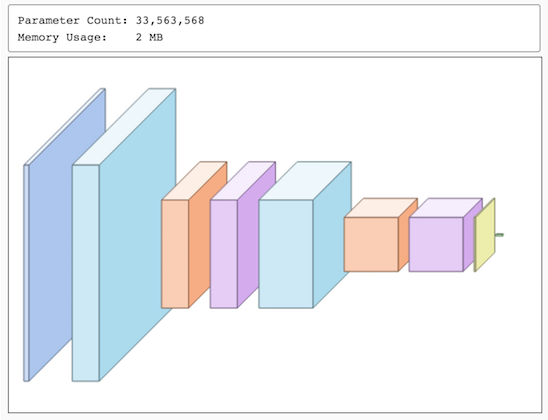
* Computes the total number of parameters required by the network, allowing the computational complexity of different designs to be compared
* Estimates the amount of memory required by the network
* Validates patch size and stride values for convolutional layers, automatically applying zero-padding if required
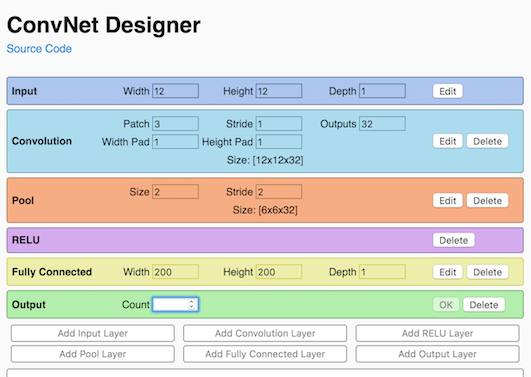
* Validates pool size and stride values for pooling layers
* Generates the Tensorflow code required to construct the network (example code below)
x0 = tf.placeholder(tf.float32, shape=[None, 49152])
x1 = tf.reshape(x0, [-1,128,128,3])
x2 = tf.Variable(tf.truncated_normal([3, 3, 3, 32], stddev=0.1))
x3 = tf.nn.conv2d(x1, x2, strides=[1, 1, 1, 1], padding='SAME')
x4 = tf.nn.max_pool(x3, ksize=[1, 2, 2, 1], strides=[1, 2, 2, 1], padding='SAME')
x5 = tf.Variable(tf.constant(0.1, shape=[32]))
x6 = tf.nn.relu(x4 + x5)
x7 = tf.reshape(x6, [-1,64,64,32])
x8 = tf.Variable(tf.truncated_normal([3, 3, 32, 64], stddev=0.1))
x9 = tf.nn.conv2d(x7, x8, strides=[1, 1, 1, 1], padding='SAME')
x10 = tf.nn.max_pool(x9, ksize=[1, 2, 2, 1], strides=[1, 2, 2, 1], padding='SAME')
x11 = tf.Variable(tf.constant(0.1, shape=[64]))
x12 = tf.nn.relu(x10 + x11)
x13 = tf.Variable(tf.truncated_normal([65536, 1024], stddev=0.1))
x14 = tf.reshape(x12, [-1, 65536])
x15 = tf.matmul(x14, x13)
x16 = tf.Variable(tf.truncated_normal([1024, 2], stddev=0.1))
x17 = tf.reshape(x15, [-1, 1024])
y_conv = tf.matmul(x17, x16)