https://github.com/codingjoe/naming-things
Solving computer science's second-hardest problem
https://github.com/codingjoe/naming-things
conventions
Last synced: 5 months ago
JSON representation
Solving computer science's second-hardest problem
- Host: GitHub
- URL: https://github.com/codingjoe/naming-things
- Owner: codingjoe
- License: cc0-1.0
- Created: 2025-11-19T10:01:14.000Z (8 months ago)
- Default Branch: main
- Last Pushed: 2026-02-01T20:37:15.000Z (6 months ago)
- Last Synced: 2026-02-01T21:51:44.203Z (6 months ago)
- Topics: conventions
- Homepage:
- Size: 68.4 KB
- Stars: 2
- Watchers: 0
- Forks: 0
- Open Issues: 1
-
Metadata Files:
- Readme: README.md
- License: LICENSE
Awesome Lists containing this project
README
# _Naming Things_
**A humble effort to solve computer science's second-hardest problem.**
> [!TIP]
> **Usage:**
> Simply copy the following snippet into your `AGENTS.md` or `CONTRIBUTING.md` file.
>
> ```markdown
> When writing code, you MUST ALWAYS follow the [naming-things](https://raw.githubusercontent.com/codingjoe/naming-things/refs/heads/main/README.md) guidelines.
>
> ```
- [Classes and Functions](#classes-and-functions)
- [Unit Tests](#unit-tests)
- [Time](#time)
- [Abbreviations](#abbreviations)
- [Metrics, Measurements, and Units](#metrics-measurements-and-units)
- [Utils & Helpers](#utils--helpers)
- [Synonyms](#synonyms)
- [Avoid Negations](#avoid-negations)
- [Versioning](#versioning)
# Preamble
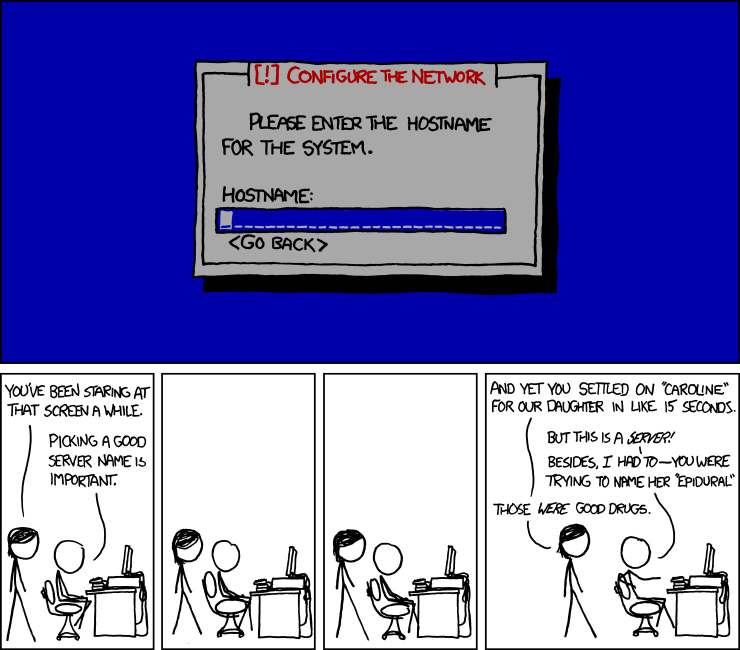
> There are only two hard things in Computer Science: cache invalidation and naming things.
>
> — Phil Karlton
This document concerns natural language conventions, not syntax or code style. Rules are language-agnostic, but examples are given in Python.
[](https://xkcd.com/910/)
## Classes and Functions
### Classes
Class names are nouns or noun phrases. Think German compound nouns. E.g., `UserProfile`, `OrderItem`, `PaymentProcessor`.
Class names are singular because while its instances may represent multiple entities (e.g., a `User` class representing multiple user instances), the class itself is a blueprint for a single entity.
#### Inheritance
Specialize, don't generalize. If you feel the urge to name a base class `BaseSomething` or `AbstractSomething`, go the other way.
Make children more specific, not parents more general.
##### Do's
```python
class Vehicle:
"""A means of transporting people or goods."""
class Car(Vehicle):
"""A road vehicle, typically with four wheels, powered by an internal combustion engine or electric motor."""
class SUV(Car):
"""A pedestrian death machine."""
```
##### Don'ts
```python
class BaseCar:
"""A road vehicle, typically with four wheels, powered by an internal combustion engine or electric motor."""
class SportsCar(BaseCar):
"""Only fun in Germany."""
```
### Functions
Function represents an action a caller can perform. Use verbs or verb phrases. E.g., `send()`, `calculate_total()`.
Function names must clearly communicate their external behavior, including side effects. E.g., `fetch_or_404()` makes it explicit that it may raise a 404 error.
They must not expose internal implementation details. E.g., avoid `send_via_smtp()`; use `send()` instead.
Loose functions should be the exception, not the rule. Prefer class methods or instance methods to group related functionality. If a function includes a noun in its name, it probably belongs to that noun's class. E.g., instead of `fetch_user_profile(user_id)`, implement `UserProfile.fetch(user_id)`.
### Methods
Avoid including object names, as the method is probably attached to the wrong class. E.g., instead of `user.send_email()`, use `UserEmail(user).send()`.
### Variables
Avoid assigning variables that are only used once. If a value is asserted immediately or returned in the next line without further access, use it inline.
## Unit Tests
Unit tests should match their API counterparts to be easily navigable and discoverable. A simple text search for a function or class must reveal both its implementation and tests quickly.
Test names use double underscores to separate the function or class name from the scenario (e.g., `test_get_user__ok`, `test_get_user__raise_value_error`). Test classes are prefixed with `Test` in Python or wrapped in `describe` blocks in JavaScript. Test descriptions must use imperative mood and avoid redundant words like "should", "expect", or "it". Assertion messages must add meaningful context beyond the assertion itself or be omitted. In Node.js, use strict assertions by default with `import assert from "node:assert/strict"` for shorter function names and stricter equality checks.
### Do's
```python
def get_user(user_id):
"""Fetch user from database."""
...
class TestGetUser: # prefix with Test
def test_get_user__ok(self): # double underscore separates scenario
"""Return user when found.""" # imperative mood
assert isinstance(get_user(1), User) # inline single-use values
def test_get_user__raise_value_error(self): # descriptive scenario name
"""Raise ValueError when user ID is invalid.""" # meaningful context
with pytest.raises(ValueError):
get_user(-1)
```
```javascript
import assert from "node:assert/strict"; // strict assertions by default
function getUser(userId) {
// Fetch user from database
}
describe("getUser", () => { // wrap in describe block
test("ok", () => { // no "should", "expect", or "it"
assert(getUser(1) instanceof User); // inline single-use values
});
test("raise ValueError", () => { // descriptive scenario
assert.throws(() => getUser(-1), ValueError);
});
});
// assertion messages add context or are omitted
assert.ok(user.age >= 18, "User must be adult to access premium features");
assert.equal(user.name, "Alice"); // omit when self-explanatory
```
### Don'ts
```python
def test_validate_email(self):
"""It should return True when email is valid.""" # avoid "should", "it"
def test_validate_email(self):
"""We expect True for valid emails.""" # avoid "expect"
def test_create_user__ok(self):
"""Return user instance."""
user = create_user("Alice") # unnecessary variable
assert isinstance(user, User)
```
```javascript
test("validateEmail", () => {
// It should return true when email is valid // avoid "it", "should"
});
test("createUser__ok", () => {
const user = createUser("Alice"); // unnecessary variable
assert(user instanceof User);
});
assert.equal(user.name, "Alice", "user.name should equal Alice"); // repeats assertion
```
## Time
_[Time zones are hard](https://www.youtube.com/watch?v=-5wpm-gesOY); don't make it harder._
### Events & Points in Time
Points in time should always have a little `at`-suffix to communicate they represent a specific moment rather than a duration or interval.
Furthermore, they must be in the language's date type (e.g., `datetime` in Python, `Date` in JavaScript) as well as timezone-aware.
Hindsight is 20/20; name all dates in the past tense, e.g., `created_at`, `updated_at`, `deleted_at`. Even if the event is in the future, e.g., `scheduled_at`, `expired_at`, `started_at`. Time passes. By the time you are debugging code, everything is in the past.
Avoid locale-specific string representations or include a timezone suffix. Suffix dates according to their [IANA timezone](https://en.wikipedia.org/wiki/List_of_tz_database_time_zones).
#### Do's
```python
import datetime
# base case
created_at: datetime.datetime = datetime.datetime.now(tz=datetime.timezone.utc)
# local date with timezone
created_at_europe_berlin: datetime.date = datetime.date.today()
created_at_utc: datetime.date = datetime.date.today()
# UNIX Epoch timestamp
created_at_ts: float = datetime.datetime.now(tz=datetime.timezone.utc).timestamp()
# ISO 8601 string with timezone
created_at_iso: str = datetime.datetime.now(tz=datetime.timezone.utc).isoformat()
```
#### Don'ts
```python
import datetime
# present tense
start = datetime.datetime.now(tz=datetime.timezone.utc)
# no event suffix
created = datetime.datetime.now()
# naive datetime
created_at: datetime.datetime = datetime.datetime.now()
```
### Durations and intervals
Durations should be either unambiguously typed (e.g., `timedelta` in Python, `Duration` in Java) or have a suffix indicating the unit of time (e.g., `secs`, `ms`, `mins`, `hours`, `days`).
#### Do's
```python
import datetime
# typed duration
timeout: datetime.timedelta = datetime.timedelta(seconds=30)
# unit suffix
timeout_secs: int = 30
timeout_ms: int = 30000
```
#### Don'ts
```python
# no interval specific type or unit
timeout: int = 30
```
## Abbreviations
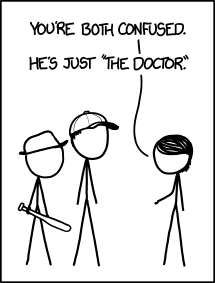
> Abbreviations rely on context you may or may not have.
>
> — [CodeAesthetic](https://www.youtube.com/watch?v=-J3wNP6u5YU)
[](https://xkcd.com/1221/)
**Don't use abbreviations!**
Unless… they are technical acronyms that are universally known outside your team's domain, e.g., `HTML`, `URL`. Use them if they are more common than their unabbreviated counterparts.
### Do's
- **HTML** (HyperText Markup Language)
- **URL** (Uniform Resource Locator)
- **URI** (Uniform Resource Identifier)
- **CPU** (Central Processing Unit)
- **GPU** (Graphics Processing Unit)
- **RAM** (Random Access Memory)
- **JSON** (JavaScript Object Notation)
- **XML** (eXtensible Markup Language)
- **HTTP** (HyperText Transfer Protocol)
- **HTTPS** (HyperText Transfer Protocol Secure)
- **FTP** (File Transfer Protocol)
- **SMTP** (Simple Mail Transfer Protocol)
- **DNS** (Domain Name System)
- **TLS** (Transport Layer Security)
- **SSL** (Secure Sockets Layer)
- **TCP** (Transmission Control Protocol)
- **UDP** (User Datagram Protocol)
- **SQL** (Structured Query Language)
- **API** (Application Programming Interface)
- **GUI** (Graphical User Interface)
- **IDE** (Integrated Development Environment)
- **OS** (Operating System)
- **IPv4** (Internet Protocol Version 4)
- **IPv6** (Internet Protocol Version 6)
### Don'ts
- IP – could mean `Intellectual Property`, use `IPv4` or `IPv6`
- temp – use `temporary` or `temperature`
- addr – use `address`
- num – use `number`
- cnt – use `count`
- cfg – use `config` or `configuration`
- msg – use `message`
- calc – use `calculate` or `calculation`
- init – use `initialize` or `initialization`
- var – use `variable`
- obj – use `object`
- func – use `function` or `method`
- btn – use `button`
- usr – use `user`
- pwd – use `password`
- db – use `database`
## Metrics, Measurements, and Units
### Units
Add an explicit unit suffix to all measurements. Use [SI unit symbols](https://en.wikipedia.org/wiki/International_System_of_Units#Unit_symbols) for brevity.
When persisting metrics, consider using SI (metric) units instead of [freedom units](https://en.wiktionary.org/wiki/freedom_units), as they are the international standard and simplify conversions.
#### Do's
```python
class WeatherReport:
temperature_c: float # temperature in degrees Celsius
distance_km: float # distance in kilometers
weight_kg: float # weight in kilograms
speed_kmh: float # speed in kilometers per hour
volume_l: float # volume in liters
```
#### Don'ts
```python
class WeatherReport:
temperature: float # ambiguous
distance: float # ambiguous
weight: float # ambiguous
speed: float # ambiguous
volume: float # ambiguous
```
### Sizes
Always be explicit about sizes. Size matters! Do you know the size of a BIGINT or a SMALLINT in your database of choice?
#### Do's
```python
from PIL import Image
class Profile:
picture_w1200: Image # if width is 1200 pixels and height is variable
picture_w400_h300: Image # if width is 400 pixels and height is 300 pixels
```
#### Don'ts
```python
from PIL import Image
class Profile:
picture_small: Image # ambiguous
picture_large: Image # ambiguous
picture_thumbnail: Image # ambiguous
```
## Utils & Helpers
> **[Resterampe /ˈʁɛstɐˌʁampə/](https://en.wiktionary.org/wiki/Resterampe)**
>
> A German term for a place where leftover goods are collected and sold cheaply.
Avoid generic names like `utils`, `helpers`, `common`, `shared`, `lib`, `core`, `base`, `foundation`, `services`, `components`, etc.
For type-agnostic functions, use inheritance and class methods to group them meaningfully.
E.g., instead of a `utils` module with a function `to_json(obj)`, create a `Object.to_json(self)` method on relevant classes.
If there isn't a type yet, create one. E.g., instead of a `helpers` module with a function `send_email(to, subject, body)`, create an `EmailClient` class with a `send_email(self, to, subject, body)` method.
## Synonyms
Avoid synonyms to reduce cognitive load. Pick one term and stick with it throughout your codebase.
Here's a non-exhaustive list of common synonyms and their preferred alternatives:
| Avoid | Prefer |
| ------------------------------ | --------- |
| fetch/retrieve | fetch |
| search/query/find | search |
| get/load/access | get |
| send/dispatch/transmit | send |
| create/make/build | create |
| delete/remove/destroy | delete |
| update/modify/change | update |
| calculate/compute/determine | calculate |
| item/thing/object | item |
| data/info/information | data |
| value/val/amount | value |
| list/array/collection | list |
| clean/sanitize/normalize | clean |
| start/begin/initiate | start |
| stop/end/terminate | stop |
| many/multiple/numerous/several | multiple |
Be specific and avoid vague terms. E.g., instead of `number`, use `count`, `index`, `mean`, etc.
Here's a non-exhaustive list of ambiguous terms and their preferred alternatives:
| Avoid | Prefer |
| ------- | ----------------- |
| number | count/index/mean |
| average | mean/median |
| amount | sum/count/min/max |
### Exceptions
Some terms have contextual meanings and should be used explicitly in those contexts.
#### Get vs. Fetch vs. Search
- **Get**: Use for simple, synchronous access to data already in memory or readily available.
- **Fetch**: Use for asynchronous or remote data retrieval, such as from a database or API.
- **Search**: Use when querying data based on specific criteria or filters with an unknown result set including zero results.
#### Set vs. Send
- **Set**: Use for assigning values to variables, properties, or configurations.
- **Send**: Use for transmitting data or messages over a network or between components. If HTTP is involved, always use the correct request method (e.g., `post()`, `put()`).
## Avoid Negations
Use positive language to avoid double negations and improve readability.
E.g., `if (is_enabled)` is clearer than `if (!is_disabled)`.
### Do's
```python
enable_feature = False # not: disable_feature = True
is_valid = True # not: is_invalid = False
has_permission = True # not: lacks_permission = False
```
### Don'ts
```python
disable_feature = True # confusing when set to False
is_not_active = False # double negation
if not is_disabled: # hard to parse
```
### Common Patterns
| Avoid | Prefer |
| -------------- | --------- |
| disable | enable |
| invalid | valid |
| incomplete | complete |
| does_not_exist | exists |
| prevent | grant |
| ignore | handle |
| avoid | allow |
| fail | succeed |
| missing | present |
| incorrect | correct |
| unavailable | available |
| inactive | active |
| prohibited | permitted |
| rejected | accepted |
| denied | granted |
> [!NOTE]
> Use negative terms when they're the standard (e.g., `disabled` for HTMLInputElements) or inherently negative (e.g., `error`, `exception`).
## Versioning
It's simple: if your project does continuous releases, use [Semantic Versioning](https://semver.org/).
If you are on a fixed release cycle, use [calver](https://calver.org/) `YYYY.MINOR.MICRO`
. E.g., `2024.2.3` for the third patch of the second minor release in 2024.
Here's a diagram to help you decide:
```mermaid
flowchart TD
A(Start) --> B{releases}
B -- continuous --> D[semver]
B -- fixed cycle --> C[calver]
```
Do not invent your own versioning scheme.
# Honorable mentions
- [Naming Things in Code](https://www.youtube.com/watch?v=-J3wNP6u5YU) by CodeAesthetic
# License
This work is licensed under a [CC0 1.0 Universal License](https://creativecommons.org/publicdomain/zero/1.0/).
Do with it as you please; maybe leave a star on [GitHub](https://github.com/codingjoe/naming-things). Thanks \<3