https://github.com/computationalmodelling/fidimag
Finite DIfference microMAGnetic code, based on Python, Cython and C
https://github.com/computationalmodelling/fidimag
hacktoberfest
Last synced: 9 months ago
JSON representation
Finite DIfference microMAGnetic code, based on Python, Cython and C
- Host: GitHub
- URL: https://github.com/computationalmodelling/fidimag
- Owner: computationalmodelling
- License: other
- Created: 2015-09-25T09:51:27.000Z (almost 11 years ago)
- Default Branch: master
- Last Pushed: 2024-12-05T19:29:55.000Z (over 1 year ago)
- Last Synced: 2025-03-30T17:08:43.507Z (over 1 year ago)
- Topics: hacktoberfest
- Language: C++
- Homepage: http://computationalmodelling.github.io/fidimag/
- Size: 39.2 MB
- Stars: 62
- Watchers: 17
- Forks: 25
- Open Issues: 9
-
Metadata Files:
- Readme: README.md
- Changelog: CHANGELOG.md
- License: LICENSE.txt
- Authors: AUTHORS.txt
Awesome Lists containing this project
README
# Fidimag
[](https://mybinder.org/v2/gh/computationalmodelling/fidimag/master)
[](http://fidimag.readthedocs.org/en/latest/?badge=latest)
[](https://codecov.io/gh/computationalmodelling/fidimag)
[](https://doi.org/10.5281/zenodo.167858)
[](http://computationalmodelling.github.io/fidimag/)
| Tests Type | Status |
|:-:|:-:|
| GHA Unit Tests | 
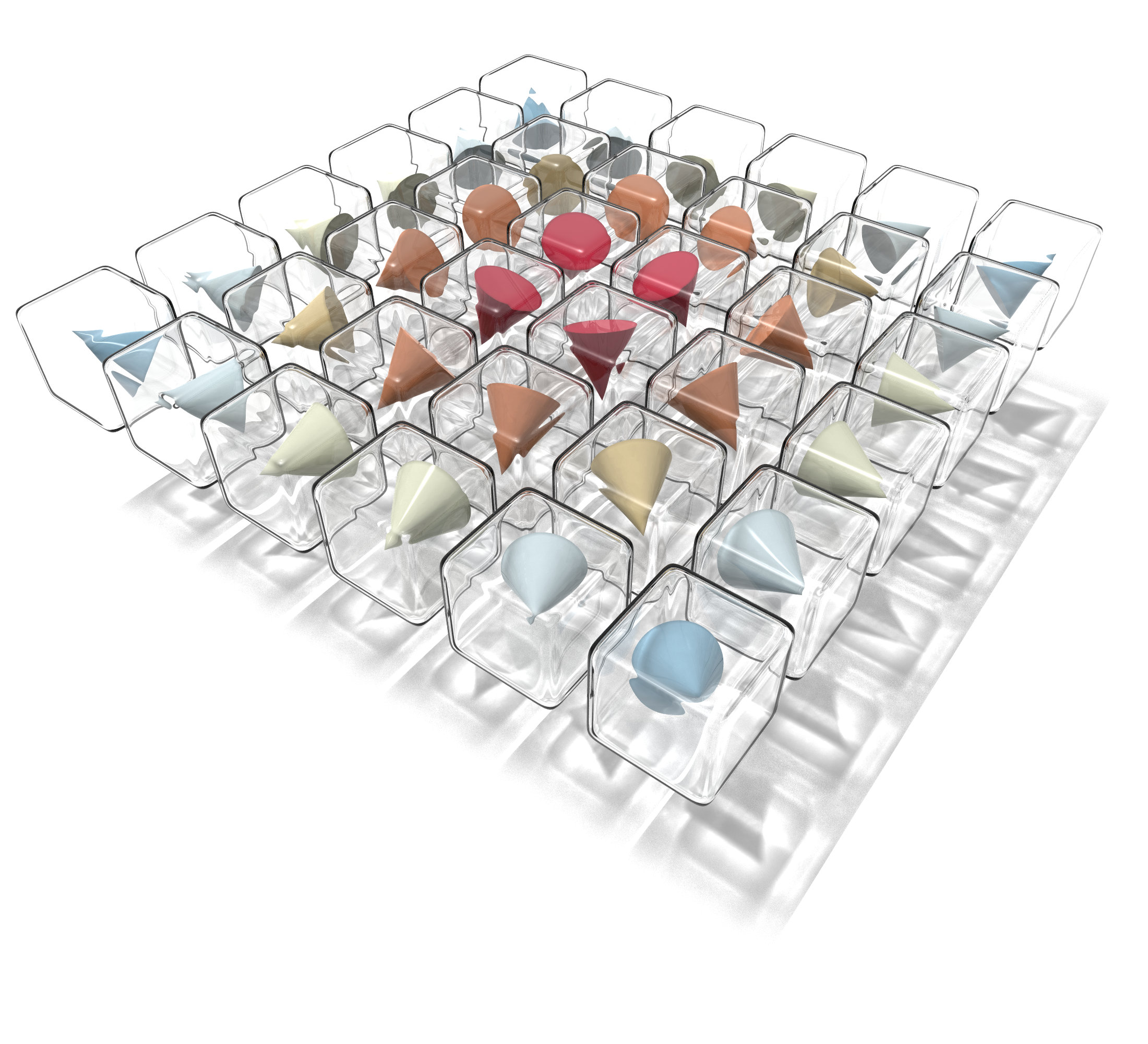
Fidimag solves finite-difference micromagnetic problems and supports atomistic simulations, using Python interface. The interface to both types of simulation is similar.
### Install
See: [https://fidimag.readthedocs.io/en/latest/install.html](https://fidimag.readthedocs.io/en/latest/install.html)
### Features
* Optimal LLG equation integration using modern [Sundial's v6](https://github.com/LLNL/sundials/) CVODE solver
* Offers LLG and LLG with spin torque terms (Zhang-Li and Sloncewski)
* Calculations using the Geodesic-Nudged-Elastic-Band and String methods to compute energy barriers.
* Exchange, Zeeman, Demagnetising, Uniaxial Anisotropy energy classes.
* Parallelised using OpenMP.
* Easily extensible to add new features.
* Cubic and Hexagonal Meshes in atomistic simulations.
* Open-source under the 2-clause BSD Licence.
### Example
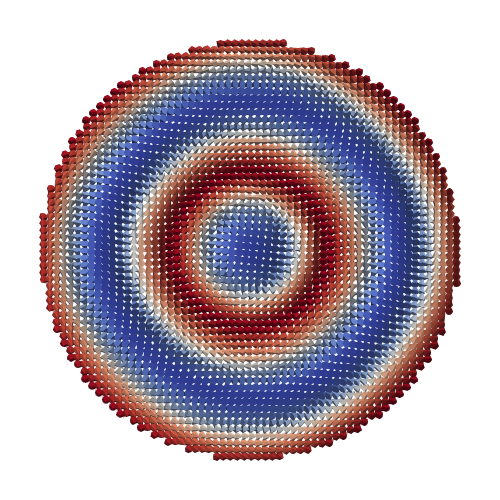
Here we show how to relax a nanodisk system from an initial state. We have many more examples in the [documentation](http://fidimag.readthedocs.io/en/latest/?badge=latest)!
```python
import fidimag
from fidimag.common import CuboidMesh
from fidimag.micro import Sim, UniformExchange, Demag, DMI, UniaxialAnisotropy
mesh = CuboidMesh(nx=60, ny=60, nz=1, dx=2.0, dy=2.0, dz=2.0, unit_length=1e-9)
def Ms_init(position):
"""
Set where the system has magnetic material
Form a nanodisk shape
"""
Ms = 8.6e5
x, y, z = position
if (x - 60)**2 + (y - 60)**2 < 60**2:
return Ms
else:
return 0
def m_init(position):
"""
Approximate skyrmion profile
"""
x, y, z = position
if (x - 60)**2 + (y - 60)**2 < 40**2:
return (0, 0, 1)
else:
return (0, 0, -1)
sim = Sim(mesh, name='target_skyrmion')
sim.set_Ms(Ms_init)
sim.set_m(m_init)
sim.add(Demag())
sim.add(UniformExchange(A=1e-11))
sim.add(DMI(D=3e-3))
sim.add(UniaxialAnisotropy(Ku=4e5, axis=(0, 0, 1)))
sim.relax()
sim.save_vtk()
```
The results can be straightforwardly visualised from the outputted VTK files using programs such as Paraview:
### Publications
A list tracking publications that cite FIDIMAG can be found in the [Publications](PUBLICATIONS.md) document.
### Attributions
The code is currently developed by Weiwei Wang, David Cortes, Ryan Pepper and Hans Fangohr at Anhui University, University of Southampton and European XFEL. Previous developers who have worked on Fidimag are Marc-Antonio Bisotti, Thomas Kluyver, Mark Vousden, Oliver Laslett and Rebecca Carey.
Contributions and pull requests to both the code and documentation are welcome.
If you use Fidimag, please cite as:
Bisotti, M.-A., Cortés-Ortuño, D., Pepper, R., Wang, W., Beg, M., Kluyver, T. and Fangohr, H., 2018. Fidimag – A Finite Difference Atomistic and Micromagnetic Simulation Package. Journal of Open Research Software, 6(1), p.22. DOI: http://doi.org/10.5334/jors.223
### Acknowledgements
We acknowledge financial support from EPSRC’s Centre for Doctoral Training in Next Generation Computational Modelling (EP/L015382/1), EPSRC’s Doctoral Training Centre in Complex System Simulation (EP/G03690X/1), EPSRC Programme grant on Skyrmionics (EP/N032128/1) and OpenDreamKitHorizon 2020 European Research Infrastructure project (676541).