https://github.com/d-sketon/hexo-theme-reimu
一款博丽灵梦风格的Hexo主题 | A Hakurei Reimu style Hexo theme. 💘Touhou💘
https://github.com/d-sketon/hexo-theme-reimu
blog giscus gitalk hexo hexo-theme pjax reimu touhou twikoo valine waline
Last synced: 6 months ago
JSON representation
一款博丽灵梦风格的Hexo主题 | A Hakurei Reimu style Hexo theme. 💘Touhou💘
- Host: GitHub
- URL: https://github.com/d-sketon/hexo-theme-reimu
- Owner: D-Sketon
- License: mit
- Created: 2023-01-02T02:09:44.000Z (over 3 years ago)
- Default Branch: main
- Last Pushed: 2025-05-11T04:20:20.000Z (about 1 year ago)
- Last Synced: 2025-05-15T17:05:16.395Z (about 1 year ago)
- Topics: blog, giscus, gitalk, hexo, hexo-theme, pjax, reimu, touhou, twikoo, valine, waline
- Language: JavaScript
- Homepage: https://d-sketon.github.io
- Size: 4.9 MB
- Stars: 296
- Watchers: 3
- Forks: 28
- Open Issues: 1
-
Metadata Files:
- Readme: README.en.md
- License: LICENSE
- Code of conduct: CODE_OF_CONDUCT.md
Awesome Lists containing this project
README

hexo-theme-reimu




💘 Hakurei Reimu 💘
[Demo](https://d-sketon.github.io)
[简体中文](https://github.com/D-Sketon/hexo-theme-reimu/blob/main/README.md) | English
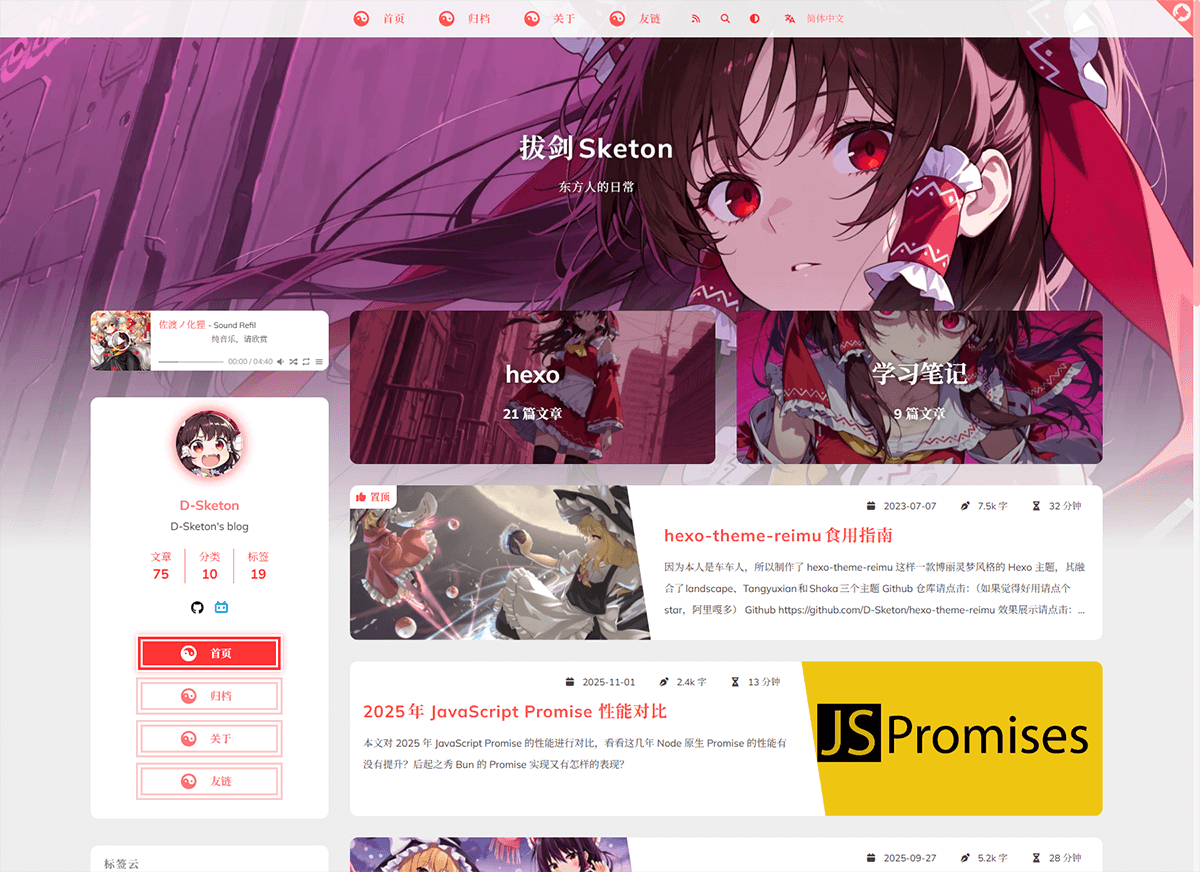
---
> [!WARNING]
> Versions below v1.0.0 have been deprecated. Please upgrade to version v1.0.0 or above as soon as possible.
A Hakurei Reimu style Hexo theme.
A combination of [landscape](https://github.com/hexojs/hexo-theme-landscape)、[Tangyuxian](https://github.com/tangyuxian/hexo-theme-tangyuxian) and [Shoka](https://github.com/amehime/hexo-theme-shoka) themes.
| framework | repository | version | stars |
| ---------------------------- | ------------------------------------------------------------------ | ------------------------------------------------------------------------------------------------------------------------------------------------------------------------------------------- | -------------------------------------------------------------------------------------------------- |
| [Hexo](https://hexo.io/) | [hexo-theme-reimu](https://github.com/D-Sketon/hexo-theme-reimu) |  | |
| |
| [Hugo](https://gohugo.io) | [hugo-theme-reimu](https://github.com/D-Sketon/hugo-theme-reimu) |  |
|  |
|
| [Astro](https://astro.build) | [astro-theme-reimu](https://github.com/D-Sketon/astro-theme-reimu) |  |
|  |
|
**ISSUE and PR Welcome!**
## Features
### Basic Features
- ✨ Full blog functionality
- 🔄 Compatible with Hexo 6+
- 📱 Responsive layout
- 🌙 Dark mode support
- 🅰️ i18n support
### Code & Math
- 🖥️ Code highlighting & copying
- ➗ KaTeX / MathJax3 math formula support
- 📊 Mermaid flowchart support
### Search & Comments
- 🔍 Algolia search integration
- 🔍 Local search integration
- 💬 Multiple comment systems support:
- Valine
- Waline
- Twikoo
- Gitalk
- Giscus
- Disqus
- Utterances
### Statistics & Analytics
- 📊 Article reading statistics (Valine / Waline)
- 👥 Visitor statistics (Busuanzi)
### Media & Interactive Features
- 🎵 Music player support:
- Aplayer
- Meting
- 🖼️ Lazy loading for images
- ⚡ Loading animations
- 🖱️ Mouse effects:
- Animation effects
- Reimu cursor style
- 👾 Live2D / Live2D-widgets integration
### Navigation & Structure
- 📑 Table of Contents
- 🔄 PJAX support
- 🔧 ServiceWorker implementation
- 📰 RSS feed
### Design & Customization
- 🎨 Icon support:
- Iconfont
- FontAwesome7
- 🔗 Built-in tag plugins:
- Internal links
- External links
- Friend links
- Heatmap
- Tag Roulette
- Tabs
- Gallery
- 🎨 Dynamic theme color adaptation
- 🎨 Custom Containers
- ©️ Article copyright declaration
- 🌐 Custom CDN source configuration
- 📜 Custom Font Family
- 🎨 Share card functionality
## Installation
> For beginners, you can directly use [reimu-template](https://github.com/D-Sketon/reimu-template). It comes pre-installed with hexo, hexo-theme-reimu and other functional packages. You only need to clone the repository, install dependencies, and modify the configuration to get a basic blog!
Using npm
```bash
npm install hexo-theme-reimu --save
```
Or clone this repository directly to the `/themes` folder and rename it to `reimu`
```bash
git clone https://github.com/D-Sketon/hexo-theme-reimu.git
```
And modify the theme in `_config.yml`
```yaml
theme: reimu
```
## Usage
Basic structure
### Basic structure
To ensure correct display, please refer to `_example` and create `_data`, `about`, and `friend` folders in `source` (Note: This is the `source` folder in your blog's root directory, not the one in the theme!)
**Directory Structure Example:**
```
source/
├── images/
│ └── favicon.ico # Website favicon
├── _data/
│ ├── avatar/
│ │ └── avatar.webp # Avatar file
│ ├── covers.yml # Article cover URL list
│ └── covers/ # Article cover folder
├── about/ # About page
│ └── index.md
├── friend/ # Friend links page
│ ├── index.md
│ └── _data.yml # Friend links data
└── _posts/ # Posts folder
└── xxxx.md
```
#### \_data
- The `avatar` folder stores the author's avatar, default named `avatar.webp`. You can configure it in the inner `_config.yml` as follows:
```yaml
avatar: "avatar.webp" # By default, it looks for the avatar in the avatar folder. Do not include the path, or it will result in a 404 error
```
- The `covers` folder stores article cover images
- The `covers.yml` stores article cover URLs
#### about
`index.md` serves as the **About** page
#### friend
`index.md` serves as the **Friends** page. Fill in friend link information in `_data.yml` to display corresponding friend cards on the page
Cover Images, Banner and Favicon
### Cover Images, Banner, and Favicon
#### Cover Images
The cover image display logic is as follows:
- If the article's Front matter contains a cover URL, both the article header image and homepage thumbnail will display this URL
```yaml
---
title: Hello World
cover: https://example.com
---
```
- If the article's Front matter contains cover: `false`, no header image will be displayed for that article (the homepage thumbnail will still show a random image)
```yaml
---
title: Hello World
cover: false
---
```
- If the article's Front matter contains cover: `rgb(xxx,xxx,xxx)`, the article's header image will be a gradient of that solid color (the homepage thumbnail will still show a random image)
```yaml
---
title: Hello World
cover: rgb(255,117,117)
---
```
- Otherwise, the homepage thumbnail will search for images in the `covers` folder and `covers.yml` and randomly select one; the in-article header image will look for the `cover` configuration in the inner `_config.yml`
- If none of the above files/configurations exist, it will display the `banner` header image as a fallback
#### banner
The banner image is stored at `themes/reimu/source/images/banner.webp`, and can be modified in the inner `_config.yml`:
```yaml
banner: "/images/banner.webp"
```
#### favicon
The favicon is stored at `themes/reimu/source/images/favicon.ico`, and can be modified in the inner `_config.yml`:
```yaml
favicon: "/images/favicon.ico"
```
#### Pinned Posts
Add `sticky: true` to the article's Front-matter to pin it:
```yaml
---
title: Hello World
sticky: true
---
```
#### Article Summary
Disabled by default. You can choose to display the article summary in the subtitle or at the beginning of the article.
```yaml
summary:
enable: false
style: 'subtitle' # 'subtitle' or 'blockquote'
```
Sidebar
### Sidebar
#### Sidebar Position
Default on the right. You can modify it in the inner `_config.yml`.
```yaml
sidebar:
position: right # left | right | false
menu: true # whether to show the sidebar menu button, ignored on mobile devices
article:
show_common: true # whether to show common sidebar on article pages, ignored on mobile devices
```
Additionally, you can control it through the article's front-matter, which takes precedence over the global configuration.
```yaml
---
sidebar: left # left | right | false
---
```
> When sidebar is set to false, the sidebar will be hidden, and the aplayer player and widgets will not be displayed at the same time.
#### TOC
Default enabled. You can modify it in the inner `_config.yml`.
```yaml
toc: true # true | false
```
Additionally, you can control it through the article's front-matter, which takes precedence over the global configuration.
```yaml
---
toc: true # true | false
---
```
You can also configure the behavior of the TOC through the following configuration:
```yaml
toc_options:
list_number: true # Whether to display the list number
min_depth: 1 # Minimum depth
max_depth: 6 # Maximum depth
```
#### Social Links
You can configure the social links in the sidebar in the inner `_config.yml`.
```yaml
social:
# github: https://github.com/yourname
# bilibili: https://space.bilibili.com/yourname
# ...
```
#### Widgets
You can configure the widgets in the sidebar in the inner `_config.yml`.
```yaml
widgets:
# - category
# - tag
# - tagcloud
# - archive
# - recent_posts
```
You can also configure the behavior of the widgets through the following configuration:
```yaml
archive_type: "monthly" # monthly | yearly, archive type
show_count: false # whether to show count in archive
tag_limits:
recent_posts_limits: 5
tagcloud_limits:
```
Footer
### Footer
#### Basic Information
The footer section allows you to configure basic display information and statistics.
```yaml
footer:
since: 2020 # The starting year displayed in the copyright information (e.g., 2020-current year)
powered: true # Whether to display copyright information
count: true # Whether to display word count and reading time statistics
busuanzi: true # Whether to enable Busuanzi visitor counting statistics
```
#### ICP Filing
For websites hosted in mainland China, you can display ICP filing information as required by regulations.
```yaml
icp:
icpnumber: # ICP filing number
beian: # Public Security Bureau filing number
recordcode: # Record code parameter from the Public Security Bureau filing link
```
#### Moe ICP Filing (v1.9.1+)
[Moe ICP Filing](https://icp.gov.moe/)
```yaml
moe_icp:
icpnumber: # Moe ICP filing number
```
Code Blocks
### Code Blocks
To ensure proper display of code blocks, make sure your outer `_config.yml` has the following configuration:
(Hexo <7.0.0)
```yaml
highlight:
enable: true
wrap: true
hljs: false
prismjs:
enable: false
```
(Hexo >=7.0.0)
```yaml
syntax_highlighter: highlight.js
highlight:
wrap: true
hljs: false
```
Code blocks also provide a code copying feature - click the copy button in the top right corner of the code block to copy the code. You can configure the copy functionality in the inner `_config.yml`.
`success` is the prompt shown when copying is successful, `fail` is shown when copying fails. Additionally, you can configure copyright notices - when the copied text exceeds `count` characters, the copyright notice will be added after the copied content.
```yaml
clipboard:
success:
en: Copy successfully (*^▽^*)
zh-CN: 复制成功 (*^▽^*)
zh-TW: 複製成功 (*^▽^*)
ja: コピー成功 (*^▽^*)
fail:
en: Copy failed (゚⊿゚)ツ
zh-CN: 复制失败 (゚⊿゚)ツ
zh-TW: 複製失敗 (゚⊿゚)ツ
ja: コピー失敗 (゚⊿゚)ツ
copyright:
enable: false
count: 50 # Add copyright notice when character count exceeds this number
license_type: by-nc-sa # https://creativecommons.org/licenses
```
v1.1.0 added configuration to control the default expansion state of code blocks. `expand` can be set to `true`, `false`, or a number - the number indicates that code blocks will be collapsed by default when the number of lines exceeds this value.
```yaml
code_block:
expand: true # true | false | number
```
Site comments
### Site comments
> Site comments can be individually controlled for each article using `comments` in the Front matter.
> When `comments` is `false`, comments won't be displayed. When it's `true` or not specified, the display will be determined by the `_config.yml` configuration.
> Support for multiple comment systems simultaneously after version 1.7.0+
Global comment system configuration:
```yaml
comment:
title: Say something! # Title of the comment box
default: waline # Default comment system used when multiple are enabled
```
If using [Valine](https://valine.js.org/)
Please refer to their official documentation to complete the `LeanCloud` configuration, then set `valine.enable` to `true` in the inner `_config.yml` and fill in your `appId` and `appKey`
```yaml
valine:
enable: true
appId: "your appId"
appKey: "your appKey"
pageSize: 10 # comment list page size
avatar: mp # gravatar style https://valine.js.org/#/avatar
# lang: zh-cn # deprecated, use html.lang instead
placeholder: Just go go # valine comment input placeholder(like: Please leave your footprints )
guest_info: nick,mail,link #valine comment header info
recordIP: true # whether to record the IP address of the commenters
highlight: true # whether to highlight the code blocks
visitor: false # whether to display the number of visitors
serverURLs: # leancloud server url
```
If using [Waline](https://waline.js.org/)
Please refer to their [official documentation](https://waline.js.org/guide/get-started/) to complete the `LeanCloud` configuration, then set `waline.enable` to `true` in the inner `_config.yml` and fill in your `serverURL`
```yaml
waline:
enable: true
serverURL: "your server url"
locale: {} # https://waline.js.org/guide/features/i18n.html#%E8%87%AA%E5%AE%9A%E4%B9%89%E8%AF%AD%E8%A8%80
emoji:
- https://unpkg.com/@waline/emojis@1.2.0/weibo
- https://unpkg.com/@waline/emojis@1.2.0/alus
- https://unpkg.com/@waline/emojis@1.2.0/bilibili
- https://unpkg.com/@waline/emojis@1.2.0/qq
- https://unpkg.com/@waline/emojis@1.2.0/tieba
- https://unpkg.com/@waline/emojis@1.2.0/tw-emoji
meta:
- nick
- mail
- link
requiredMeta:
- nick
- mail
wordLimit: 0
pageSize: 10
pageview: true
```
If using [twikoo](https://twikoo.js.org)
Please refer to their [official documentation](https://twikoo.js.org/quick-start.html) to complete Tencent Cloud or Vercel deployment, then set `twikoo.enable` to `true` in the inner `_config.yml` and fill in your `envId`
```yml
twikoo:
enable: true
envId: # For Tencent Cloud environment, fill in envId; For Vercel environment, fill in the URL (https://xxx.vercel.app)
region:
```
If using [giscus](https://giscus.app/)
Please refer to the documentation to complete repository configuration, then set `giscus.enable` to `true` in the inner `_config.yml` and fill in the corresponding data
```yml
giscus:
enable: true
repo: "your repo"
repoId: "your repoId"
category: "your category"
categoryId: "your categoryId"
mapping: mapping
strict: 0
reactionsEnabled: 1
emitMetadata: 0
inputPosition: bottom
```
If using [gitalk](https://gitalk.github.io/)
Please refer to their [official documentation](https://github.com/gitalk/gitalk?tab=readme-ov-file#usage) to complete repository configuration, then set `gitalk.enable` to `true` in the inner `_config.yml` and fill in the corresponding data
```yml
gitalk:
enable: true
clientID: "your application client ID"
clientSecret: "your application client secret"
repo: "your repo"
owner: "repo owner"
admin: "repo owner and collaborators"
md5: false # Whether to use md5 to encrypt the path
```
If using [Disqus](https://disqus.com/)
Please set `disqus.enable` to `true` in the inner `_config.yml`, and fill in your `shortname`
```yml
disqus:
enable: true
shortname: "your shortname"
count: true # Whether to enable comment count statistics
```
If using utterance [utterances](https://utteranc.es/)
Please set `utterances.enable` to `true `in your theme's `_config.yml` and fill in your own `repo`
```yml
utterances:
enable: true
repo: owner/repo # Change this to "Your GitHub Username/The Repository Name" used for storing blog comments
issue_term: title
theme: github-light # You can use auto to automatically adapt to dark and light themes
```
Site search
### Site search
> Note: Do not enable both Algolia search and local search at the same time.
If choosing [Algolia](https://www.algolia.com/), please install [@reimujs/hexo-algoliasearch](https://github.com/D-Sketon/hexo-algoliasearch)
```bash
npm install @reimujs/hexo-algoliasearch --save
```
Then refer to its [README](https://github.com/D-Sketon/hexo-algoliasearch#readme) to complete the `Algolia` account configuration, and add the following configuration to the outer `_config.yml`
> Note: The search redirect link is a permanent link, so please ensure the `url` in the outer `_config.yml` is filled in correctly.
```yml
algolia:
appId: "your applicationID"
apiKey: "your apiKey"
adminApiKey: "your adminApiKey"
indexName: "your indexName"
chunkSize: 5000
fields:
- content:strip:truncate,0,500
- excerpt:strip
- gallery
- permalink
- photos
- slug
- tags
- title
```
In the inner `_config.yml`, set `algolia_search.enable` to `true`
```yaml
algolia_search:
enable: true
```
And run the following command to generate the search index
```bash
hexo algolia
```
> After version 1.5.0, the theme has built-in `hexo-generator-search`, so there is no need to install `hexo-generator-search` separately.
This theme comes with `hexo-generator-search` built-in. If you choose to use local search, please set `generator_search.enable` to `true` in the inner `_config.yml`. For other configurations, refer to [hexo-generator-search](https://github.com/wzpan/hexo-generator-search).
```yaml
generator_search:
enable: true
field: post
content: true
```
Mathematical formulas
### Mathematical formulas
please install [@reimujs/hexo-renderer-markdown-it-plus](https://github.com/D-Sketon/hexo-renderer-markdown-it-plus)
```bash
npm uninstall hexo-renderer-marked --save
npm install @reimujs/hexo-renderer-markdown-it-plus --save
```
Mathematical formula support is disabled by default. To enable it, set `math.enable` to `true` in the inner `_config.yml`
> Note: Do not enable both KaTeX and MathJax3 at the same time.
#### KaTeX
For server-side rendering, set `math.katex.enable` to `true` in the inner `_config.yml`
```yaml
math:
enable: true
katex:
enable: true
autoRender: false
```
For client-side rendering, set both `math.katex.enable` and `autoRender` to `true` in the inner `_config.yml`
```yaml
math:
enable: true
katex:
enable: true
autoRender: true
```
Add the following configuration to the outer `_config.yml`
```yaml
markdown_it_plus:
rawLaTeX: true
```
#### MathJax3
To use MathJax3, set `math.mathjax.enable` to `true` in the inner `_config.yml`
```yaml
math:
enable: true
mathjax:
enable: true
options: # MathJax3 Options
```
Add the following configuration to the outer `_config.yml`
```yaml
markdown_it_plus:
rawLaTeX: true
```
Mermaid Diagrams
### Mermaid Diagrams
Please install [hexo-filter-mermaid-diagrams](https://github.com/webappdevelp/hexo-filter-mermaid-diagrams)
```bash
npm install hexo-filter-mermaid-diagrams --save
```
Set `mermaid.enable` to `true` in the inner `_config.yml`
```yaml
mermaid:
enable: true
zoom: false # whether to enable zoom
```
And add `mermaid: true` to the front-matter of any article where you want to use mermaid diagrams
```yaml
---
title: Hello World
mermaid: true
---
```
RSS
### RSS
Please install [hexo-generator-feed](https://github.com/hexojs/hexo-generator-feed)
```bash
npm install hexo-generator-feed --save
```
Refer to its [README](https://github.com/hexojs/hexo-generator-feed#readme) to complete the `feed` configuration in the outer `_config.yml`
Then add the generated `xml` path to the inner `_config.yml`
```yaml
rss: atom.xml
```
i18n
### i18n
This theme provides five languages by default: `en`, `zh-CN`, `zh-TW`, `ja` and `pt-BR`. You can switch the language by modifying the `language` in the outer `_config.yml`.
```yaml
language: zh-CN
```
> The following is an experimental feature and may contain bugs.
v1.4.0+ experimentally introduced `hexo-generator-i18n` and added multi-language switching functionality. You can configure `i18n` in the inner `_config.yml` to add custom languages. The configuration can be referenced from [hexo-generator-i18n](https://github.com/Jamling/hexo-generator-i18n):
```yaml
i18n:
enable: false # false | true
type: [page, post]
generator: [archive, category, tag, index]
languages: [zh-CN, en] # List of languages, the first one is the default language
```
For multilingual support in posts, you can add `lang` in the Front-matter to specify languages **other than the default language** (the default language does not need to be added).
```yaml
lang: en
```
The above will generate a page at `/en/:permalink`.
For multilingual support in pages, you can directly create a folder for the corresponding language in the `source` directory and place an `index.md` file inside it, such as `source/en/about/index.md`. This will generate a page at `/en/about`.
For more information, please refer to [How to add multi-language support to Hexo](https://d-sketon.github.io/en/20250223/hexo-theme-reimu-i18n/)
Icon
### Icon
By default, this theme uses its own provided iconfont (v0.1.3+)
```yml
icon_font: 4552607_0khxww3tj3q9
```
If you want to continue using fontawesome icons, set `icon_font` to `false`. This will use the corresponding fontawesome from the `vendor`
```yml
fontawesome:
high_priority:
- src: webcache|@fortawesome/fontawesome-free@7.1.0/css/regular.min.css
integrity: sha384-4qYppzjH8EiA+cGdaubu2vL7Rk8WGiqCSj7oRuP1uwtFWkfKNHD20lPfcrbQc8dU
- src: webcache|@fortawesome/fontawesome-free@7.1.0/css/solid.min.css
integrity: sha384-wbMWab3UDSPm2kvIgVOn/d9KPTecgPU1+Nb3zoQrm/oVu0EkPL6IaKinjbwW0rum
low_priority:
- src: webcache|@fortawesome/fontawesome-free@7.1.0/css/brands.min.css
integrity: sha384-KTGeC2hIMzpeQakhsmzB9bZfhCD5xZZCgI1iZH6f/O457SxzlkzTQg/WXFNoi3ih
- src: webcache|@fortawesome/fontawesome-free@7.1.0/css/v5-font-face.min.css
integrity: sha384-nJ1ThfldViXoLpJ6jlKcP2beas8BMbYq26SG9Hi8cH89bZi4RZ644v7helMCqJxd
- src: webcache|@fortawesome/fontawesome-free@7.1.0/css/v4-font-face.min.css
integrity: sha384-UlkrhOIvZxJFd4MElSUp7ow6/RUeYKi/orfCZIRRiOENFuQPIAA3T3HjYfmBRhNq
```
Extended features
### Extended features
#### Back to Top
Enabled by default
```yaml
top:
enable: true
position: right # left | right
```
#### Dark Mode
The default setting is `auto`, which automatically switches based on the user's system settings. It can be set to `true` or `false` to change the default state.
```yaml
dark_mode:
# true means that the dark mode is enabled by default
# false means that the dark mode is disabled by default
# auto means that the dark mode is automatically switched according to the system settings
enable: auto # true | false | auto
```
#### Analytics
Disabled by default, supports Baidu Analytics, Google Analytics and Microsoft Clarity
```yaml
baidu_analytics: false
google_analytics: false
clarity: false
```
#### Pace Progress Bar
Enabled by default
```yaml
pace:
enable: true
```
#### Firework
Enabled by default
```yaml
firework:
enable: true
disable_on_mobile: false # whether to disable on mobile devices, which can improve performance
options: # mouse-firework options
```
For detailed configuration, please check [mouse-firework](https://github.com/D-Sketon/mouse-firework)
#### PJAX
Disabled by default
```yaml
pjax:
enable: false
```
> PJAX cannot be used with `relative_link: true`!
#### ServiceWorker
Disabled by default
```yaml
service_worker:
enable: false
```
#### Live2D
Disabled by default
```yaml
live2d:
enable: false
position: left # left | right
```
#### Live2D Widgets
Disabled by default
```yaml
live2d_widgets:
enable: false
position: left # left | right
```
#### Reimu Cursor
Enabled by default
```yml
reimu_cursor:
enable: true
cursor:
default: ../images/cursor/reimu-cursor-default.png
pointer: ../images/cursor/reimu-cursor-pointer.png
text: ../images/cursor/reimu-cursor-text.png
```
#### Responsive Banner (v0.2.0+)
Disabled by default. When enabled and provided with corresponding image sizes and media queries, it can improve mobile LCP performance
```yml
banner_srcset:
enable: false
srcset:
- src: "/images/banner-600w.webp"
media: "(max-width: 479px)"
- src: "/images/banner-800w.webp"
media: "(max-width: 799px)"
- src:
- "/images/banner.avif"
- "/images/banner.webp" # support array format
media: "(min-width: 800px)"
```
#### Article Copyright Notice (v0.2.0+)
Disabled by default
``` yml
article_copyright:
enable: false # Display copyright card?
content:
author: # true | false Show author in copyright card?
link: # true | false Show link in copyright card?
title: # true | false Show title in copyright card?
date: # true | false Show creation date in copyright card?
updated: # true | false Show update date in copyright card?
license: # true | false Show license in copyright card?
license_type: by-nc-sa # https://creativecommons.org/licenses
```
Additionally, this can be controlled through article front-matter, which takes precedence over global configuration
```yaml
---
copyright: true # Display copyright card?
---
```
#### Quicklink (v0.2.3+)
Disabled by default. When enabled, it preloads links while users stay on the page to improve user experience
```yaml
quicklink:
enable: false
timeout: 3000 # Preload timeout
priority: true # Whether to prioritize loading the page
ignores: [] # Ignore the specified link, supports string array only
```
#### Outdate Content Warning (v0.2.4+)
Disabled by default
```yaml
outdate:
enable: false
daysAgo: 180 # How many days old before an article is considered outdated
message:
en: This article was last updated on {time}. Please note that the content may no longer be applicable.
zh-CN: 本文最后更新于 {time},请注意文中内容可能已不适用。
zh-TW: 本文最後更新於 {time},請注意文中內容可能已不適用。
ja: この記事は最終更新日:{time}。記載内容が現在有効でない可能性がありますのでご注意ください。
```
#### Sponsorship (v0.3.2+)
Disabled by default
```yaml
sponsor:
enable: false # Display sponsorship QR code?
tip: # Sponsorship prompt
zh-CN: 请作者喝杯咖啡吧
zh-TW: 請作者喝杯咖啡吧
en: Buy me a coffee
ja: コーヒーを買ってください
icon:
url: "../images/taichi.png" # Sponsorship icon, path relative to css/style.css, so need to go up one level to find images folder
rotate: true # Rotate icon?
mask: true # Use image as mask (only show PNG image outline)?
qr:
- name: Alipay # QR code name
src: "/sponsor/alipay.jpg" # QR code path, please fill in yourself
```
Additionally, this can be controlled through article front-matter, which takes precedence over global configuration
```yaml
---
sponsor: true # Display sponsorship QR code?
---
```
#### Home Categories Card (v1.0.0+)
Disabled by default. When enabled, displays category cards on homepage as an alternative to widget categories
```yaml
home_categories:
enable: false # Display home categories card?
content:
- categories: # Category name, format matches categories in front-matter, can be string (single-level) or array (multi-level)
cover: # Card cover, uses random cover if not specified
- categories:
cover:
```
#### Music Player (v1.2.0+)
> It's recommended to enable Pjax first, otherwise the player may auto-pause
Uses Aplayer + Meting (optional), disabled by default
##### Music Player Position (v1.9.1+)
Default is after sidebar
```yml
player:
position: before_sidebar # before_sidebar / after_sidebar / after_widget
```
##### Pure Aplayer
Set `player.aplayer.enable` to `true` and configure `player.aplayer.options` according to [Aplayer Docs](https://aplayer.js.org/#/home?id=options)
```yaml
player:
aplayer:
enable: true
options:
audio: [] # audio list
fixed:
autoplay:
loop:
order:
preload:
volume:
mutex:
listFolded:
lrcType:
```
##### Aplayer + Meting
Set both `player.aplayer.enable` and `player.meting.enable` to `true`, configure `player.meting.options` according to [Meting Docs](https://github.com/metowolf/MetingJS?tab=readme-ov-file#option), `player.aplayer.options` is for Aplayer configuration
```yaml
player:
aplayer:
enable: true
options:
audio: [] # this option will be overwritten by meting
fixed:
autoplay:
loop:
order:
preload:
volume:
mutex:
listFolded:
lrcType:
meting:
enable: true
meting_api: # custom api
options:
id:
server:
type:
auto:
```
#### Share Link / Card (v1.3.0+)
Disabled by default, currently supports `facebook`, `twitter`, `linkedin`, `reddit`, `weibo`, `qq`, `weixin`.
```yaml
share:
# - facebook
# - twitter
# - linkedin
# - reddit
# - weibo
# - qq
# - weixin
```
For `weixin`, it generates a share card with QR code that can be saved locally and shared to WeChat Moments (Note: when the article cover has cross-origin issues, snapdom cannot correctly generate cards with images!)
#### Injector (v1.5.1+)
Used to inject custom code, similar to [Hexo#Injector](https://hexo.io/api/injector), supports `head`, `body` and `sidebar` injection
```yaml
injector:
head_begin: # Inject code snippet right after
head_end: # Inject code snippet right before
body_begin: # Inject code snippet right after
body_end: # Inject code snippet right before
sidebar_begin: # Inject code snippet right after
sidebar_end: # Inject code snippet right before
```
#### Triangle Badge (v1.10.2+)
Disabled by default. When enabled, it will display a triangle badge in the upper right corner, supporting custom links and icons.
```yaml
triangle_badge:
enable: false
icon: github # Same as the icon in the social config
link: https://github.com/D-Sketon/hexo-theme-reimu
```
Built-in Tag Plugins
### Built-in Tag Plugins
#### friendLink - Friend Link Card
```markdown
{% friendsLink path %}
```
The first parameter `path` indicates the path to the friend links yaml file
#### postLinkCard - Internal Link Card (Not recommended, use `link` instead)
```markdown
{% postLinkCard slug [cover]|"auto" [escape] %}
```
Not recommended to use this tag. It is advised to use the `link` tag instead.
The first parameter is the article's `slug`; the second parameter (optional) is the cover image displayed on the card, if set to `auto` it will automatically use the blog's `banner`; the third parameter (optional) indicates whether the article title should be escaped
> Slug generation algorithm: https://github.com/hexojs/hexo-util/blob/master/lib/slugize.ts
> In simple terms, it removes invisible characters from the article title and replaces special characters `\s~!@#$%^&*()\-_+=[]{}|\;:"'<>,.?/` with the separator `-`, merges consecutive separators and removes leading/trailing separators
#### externalLinkCard - External Link Card (Not recommended, use `link` instead)
```markdown
{% externalLinkCard title link [cover]|"auto" %}
```
Not recommended to use this tag. It is advised to use the `link` tag instead.
The first parameter is the article title; the second parameter is the external link to the article; the third parameter (optional) is the cover image displayed on the card, if set to `auto` it will automatically use the default cover
#### Heat Map Card Article Heatmap (v1.7.0+)
```markdown
{% heatMapCard levelStandard %}
```
The first parameter is the level standard for the heatmap (graded based on the word count of the articles), with the default value being `"1000,5000,10000"`.
#### tagRoulette (v1.9.0+)
```markdown
{% heatMapCard tags icon %}
```
tagRoulette is an interactive element that provides a random tag display feature. When the button is clicked, a tag is randomly selected and displayed from a predefined pool of tags.
- tags: Optional parameter specifying the tag pool. Multiple tags should be separated by English commas (,). If not provided, a few example tags will be used by default. Example: `tags="memory decline, loss of expression, increased laziness, numbness, so sleepy"`
- icon: Optional parameter to customize the trigger button's icon. Default: 🕹️ (game controller emoji). Can be replaced with any emoji or text, such as 🎲, 🎯, 🔄, etc.
#### link (v1.11.0+)
```markdown
{% link slug|title [title] [cover]|"auto" [escape] %}
```
Upgraded version of `externalLinkCard` and `postLinkCard`. It is recommended to use this tag.
The first parameter is the `slug` of the article or the `title` of the external link;
The second parameter (optional) is the title displayed on the card;
The third parameter (optional) is the cover image displayed on the card. If set to `auto`, the blog's `banner` or default cover will be used automatically;
The fourth parameter (optional) indicates whether the article title is escaped.
#### tabs (v1.11.0+)
```markdown
{% tabs [activeTab] ["center"] %}
Tab content
Tab content
{% endtabs %}
```
Adapted from the next, volantis, and stellar themes, this feature supports creating tabbed switching effects within articles.
- activeTab: Optional parameter, specifies the default active tab index (counting starts from 1). Default is 1.
- "center": Optional parameter, specifies that tab titles should be center-aligned. Default is left-aligned.
- tabName: The title of each tab, must be wrapped in ``. Supports displaying icons using `@` + icon hexadecimal code. Examples:
- Title only: ``
- Icon only: ``
- Icon + Title: ``
#### Gallery Photo Wall (v1.11.0+)
```markdown
{% gallery %}


...
{% endgallery %}
```
Display multiple images in a photo wall format, supporting automatic arrangement and responsive layout.
#### grid Grid Layout (v1.11.1+)
```markdown
{% grid [width] [col] %}
Content 1
Content 2
Content 3
{% endgrid %}
```
Display content in a grid layout with responsive design.
- width: Optional parameter, sets the minimum column width, e.g., `300` means a minimum column width of 300px. Default is `240`
- col: Optional parameter, sets a fixed number of columns, e.g., `col:3` means a fixed 3-column layout. Default is auto column count
- Use `` to separate each grid cell, and each cell's content will be rendered independently
#### alertBlockquote Warning Quote Block (v1.11.1+)
```markdown
{% alertBlockquote [type] [title] %}
Quote content
{% endalertBlockquote %}
```
Fallback version of the custom container, suitable for renderers that do not support custom containers.
- type: Optional parameter, specifies the warning type, optional values are `info`, `tip`, `important`, `warning`, `danger`, default is `info`
- title: Optional parameter, specifies the warning title, if not provided, the default title will be used
#### details Collapsible Details Block (v1.11.1+)
```markdown
{% details [summary] %}
Details content
{% enddetails %}
```
Fallback version of the custom container, suitable for renderers that do not support custom containers.
- summary: Optional parameter, specifies the details title, if not provided, the default title will be used
Custom Containers
### Custom Containers
This theme provides custom container functionality similar to Vitepress. Before using it, you need to install [@reimujs/hexo-renderer-markdown-it-plus](https://github.com/D-Sketon/hexo-renderer-markdown-it-plus).
Usage is as follows:
```markdown
::: info
This is an info box.
:::
::: tip
This is a tip.
:::
::: important
This is an important box.
:::
::: warning
This is a warning.
:::
::: danger
This is a dangerous warning.
:::
::: danger STOP
Danger zone, do not proceed
:::
::: details INFO
This is a details block.
:::
```
Customize theme
### Customize theme
The hexo-theme-reimu theme supports extensive customization. You can customize your theme by modifying `_config.yml`.
#### Dynamic Theme Color Adaptation (Experimental Feature in v1.7.0+)
Disabled by default. When enabled, it dynamically generates theme colors based on the dominant color of the article's banner image, following Google's Material You design guidelines.
```yml
material_theme:
enable: false # true | false
```
> Note: When this feature is enabled, the `crossorigin="anonymous"` attribute will be added to the `img` element of the banner to fetch the dominant color of the image. Please ensure your image server supports cross-origin access or use a third-party image proxy.
#### Manual Customizing Theme Colors
The hexo-theme-reimu theme supports theme color customization through CSS variables. You can customize your theme colors by modifying CSS variables under the `:root` pseudo-class.
v1.8.0 added `internal_theme` configuration to customize theme colors. You can change the theme colors by modifying the `internal_theme` configuration in `params.yml`. The default theme colors are as follows:
```yaml
internal_theme:
light:
--red-0: "#ff0000"
--red-1: "#ff5252"
--red-2: "#ff7c7c"
--red-3: "#ffafaf"
--red-4: "#ffd0d0"
--red-5: "#ffecec"
--red-5-5: "#fff3f3"
--red-6: "#fff7f7"
--color-red-6-shadow: "rgba(255, 78, 78, 0.6)"
--color-red-3-shadow: "rgba(255, 78, 78, 0.3)"
--highlight-nav: "#f5f5f5"
--highlight-scrollbar: "#d6d6d6"
--highlight-background: "#fdfdfd"
--highlight-selection: "#e9e9e988"
--highlight-foreground: "#24292e"
--highlight-comment: "#7d7d7d"
--highlight-red: "#d73a49"
--highlight-orange: "#e36209"
--highlight-yellow: "#cb911d"
--highlight-green: "#22863a"
--highlight-aqua: "#005cc5"
--highlight-blue: "#032f62"
--highlight-purple: "#6f42c1"
--highlight-deletion: "#b31d28"
--highlight-deletion-bg: "#ffeef0"
--highlight-addition: "#22863a"
--highlight-addition-bg: "#f0fff4"
dark:
--red-4: "rgba(255, 208, 208, 0.5)"
--red-5: "rgba(255,228,228,0.15)"
--red-5-5: "rgba(255,236,236,0.05)"
--red-6: "rgba(255, 243, 243, 0.2)"
--highlight-nav: "#222830"
--highlight-scrollbar: "#454d59"
--highlight-background: "#1e2027"
--highlight-selection: "#51515155"
--highlight-foreground: "#c9d1d9"
--highlight-comment: "#8b949e"
--highlight-red: "#ff7b72"
--highlight-orange: "#ffa657"
--highlight-yellow: "#ffcc66"
--highlight-green: "#7ee787"
--highlight-aqua: "#a5d6ff"
--highlight-blue: "#79c0ff"
--highlight-purple: "#d2a8ff"
--highlight-deletion: "#ffa198"
--highlight-deletion-bg: "#490202"
--highlight-addition: "#7ee787"
--highlight-addition-bg: "#04260f"
```
#### Custom Fonts
You can define Google Fonts through the following configuration:
```yaml
# https://fonts.google.com/
font:
enable: true # Enable Google Fonts
article:
- Mulish
- Noto Serif SC
code:
# - Ubuntu Mono
# - Source Code Pro
# - JetBrains Mono
```
v1.1.0 added `local_font` configuration for defining local fonts, which has lower priority than Google Fonts:
```yaml
local_font:
article:
- "-apple-system"
- PingFang SC
- Microsoft YaHei
- sans-serif
code:
- Menlo
- Monaco
- Consolas
- monospace
```
v1.8.0 added `custom_font` configuration for defining custom fonts, which has the highest priority:
```yaml
custom_font:
enable: true
article:
- css: https://fontsapi.zeoseven.com/292/main/result.css # font css
name: LXGW WenKai # font css
code:
```
#### Customizing Icons
v1.0.0 underwent significant refactoring and exposed many configurations for changing the original icons
##### Header / Sidebar Icons
The `menu` configuration structure changed in v1.0.0, allowing users to customize icons. When icon is empty, it defaults to the Taichi icon. You can fill in a hexadecimal number to customize the icon, supporting both FontAwesome, icon font and `false`.
v1.8.4 icon supports image path, such as `/avatar/avatar.webp`.
```yaml
menu:
- name: home
url: /
icon: # Defaults to Taichi icon when empty
- name: archives
url: /archives
icon: f0c1 # You can fill in a hexadecimal number to customize the icon, supports FontAwesome and icon font. If set to false, no icon will be displayed.
- name: about
url: /about
icon:
- name: friend
url: /friend
icon:
```
##### Footer / Back to Top / Sponsor Icons
v1.0.0 added `icon` configuration to `footer`, `top`, and `sponsor` configurations for customizing icons.
- `url` is the path to the icon, relative to `css/style.css`, so you need to go up one level to find the images folder.
- `rotate` determines whether to rotate the icon, defaults to `true`.
- `mask` determines whether to use the image as a mask (only showing PNG image outline), defaults to `true`.
```yaml
footer:
icon:
url: "../images/taichi.png" # If set to false, no icon will be displayed
rotate: true
mask: true
top:
icon:
url: "../images/taichi.png"
rotate: true
mask: true
sponsor:
icon:
url: "../images/taichi.png" # If set to false, no icon will be displayed
rotate: true
mask: true
```
##### Loading Icon
v1.0.0 added `icon` configuration to `preloader` for customizing the loading icon. When icon is empty, it defaults to using inline SVG (ensuring first-screen loading speed). You can enter a link to customize the loading icon.
It's not recommended to use oversized icons to avoid affecting loading speed.
```yaml
preloader:
enable: true
text:
zh-CN: 少女祈祷中...
zh-TW: 少女祈禱中...
en: Loading...
ja: 少女祈祷中...
icon: # if the icon is empty, the default svg is used, which is inlined to ensure the loading speed of the first screen. You can fill in a link to customize the loading icon, such as '/images/taichi.png'
rotate: true
```
##### Anchor Icon
v1.0.0 added `anchor_icon` configuration for customizing anchor icons, defaults to using the `#` icon. You can fill in a hexadecimal number to customize the icon, supporting both FontAwesome and icon font.
```yaml
anchor_icon: # if the icon is empty, the default # icon is used
```
v1.8.5 `anchor_icon` supports passing `false` to hide anchor icon.
##### Cursor Icon (v1.3.0+)
v1.3.0 added `reimu_cursor.cursor` configuration for customizing cursor icons. You can fill in a path relative to `css/style.css` to customize cursor icons.
```yaml
reimu_cursor:
enable: true
cursor:
default: ../images/cursor/reimu-cursor-default.png
pointer: ../images/cursor/reimu-cursor-pointer.png
text: ../images/cursor/reimu-cursor-text.png
```
#### Custom Scroll Animation
Based on [AOS.js](https://github.com/D-Sketon/aos.js) scroll animation effects, default is `true`, you can enable or disable through the following configuration, and set different animation effects for different pages.
```yaml
animation:
enable: true
options:
header:
home:
article:
archive:
```
**Available Animation Effects:**
- **Fade**: fade, fade-up, fade-down, fade-left, fade-right, fade-up-right, fade-up-left, fade-down-right, fade-down-left
- **Flip**: flip-up, flip-down, flip-left, flip-right
- **Slide**: slide-up, slide-down, slide-left, slide-right
- **Zoom**: zoom-in, zoom-in-up, zoom-in-down, zoom-in-left, zoom-in-right, zoom-out, zoom-out-up, zoom-out-down, zoom-out-left, zoom-out-right
#### Custom Styles
You can customize the maximum width of the main content area by modifying `layout.max_width`, default is `1350px`.
```yaml
layout:
max_width: 1350px # Maximum width of the main content area
```
Vendor
### Vendor
`vendor` is used to store third-party resources such as fontawesome, iconfont, katex, mathjax, etc.
The `vendor` structure in hexo-theme-reimu is very flexible and supports the following formats:
- `:cdn|:package@:version/:file`: Uses CDN acceleration, for example `cdn_jsdelivr_gh|katex@0.13.11/dist/katex.min.css`. The `:cdn` can be configured in `vendor`. Currently includes the following CDN sources:
```yaml
cdn_jsdelivr_gh: https://cdn.jsdelivr.net/gh/ # GitHub acceleration only
cdn_jsdelivr_npm: https://cdn.jsdelivr.net/npm/ # NPM acceleration only
fastly_jsdelivr_gh: https://fastly.jsdelivr.net/gh/ # GitHub acceleration only
fastly_jsdelivr_npm: https://fastly.jsdelivr.net/npm/ # NPM acceleration only
unpkg: https://unpkg.com/ # NPM acceleration only
webcache: https://npm.webcache.cn/ # NPM acceleration only
```
Users can switch CDN sources based on their network conditions.
- Starting with `https://`: Uses absolute links directly, such as `https://cdn.jsdelivr.net/npm/katex@0.13.11/dist/katex.min.css`
- Starting with `/`: Local resources. You can place resources in the `source` folder at the same level as `_posts`, then reference them using paths like `/katex.min.css`
Additionally, `vendor` supports SRI (Subresource Integrity) verification. You can use `SHA-384` in `vendor` to verify resource integrity, for example:
```yaml
js:
clipboard: # Using SRI verification
src: webcache|clipboard@2.0.11/dist/clipboard.min.js
integrity: sha384-J08i8An/QeARD9ExYpvphB8BsyOj3Gh2TSh1aLINKO3L0cMSH2dN3E22zFoXEi0Q
lazysizes: webcache|lazysizes@5.3.2/lazysizes.min.js # Without SRI verification
```
Both formats are supported. It's recommended to use SRI verification for external CDN resources to ensure resource integrity.
Front-matter Fields
### Front-matter Fields
| meta | Description | Type | Value Logic | Version |
| ----------- | ------------------------------------------------------------------------ | -------------------------------------------------- | ----------------------------------------- | ------------- |
| title | Title | `string` | Article file name | Hexo Built-in |
| date | Creation Date | `date` | File creation date | Hexo Built-in |
| updated | Update Date | `date` | File update date | Hexo Built-in |
| tags | Tags | `string[] \| string[][]` | - | Hexo Built-in |
| categories | Categories | `string[] \| string[][]` | - | Hexo Built-in |
| permalink | Override the article's permanent link | `string` | - | Hexo Built-in |
| excerpt | Article Excerpt | `string` | - | Hexo Built-in |
| description | Article Description | `string` | - | 0.0.1 |
| link | Directs the article to an external link | `string` | - | 0.0.1 |
| sticky | Whether to pin the article | `boolean` | `false` | 0.0.1 |
| photos | Article photo gallery | `string[]` | - | 0.0.1 |
| mermaid | Whether to enable mermaid (requires configuration with `mermaid` config) | `boolean` | `false` | 0.2.0 |
| copyright | Whether to enable article copyright notice | `boolean` | Defaults to global config if not provided | 0.3.1 |
| sponsor | Whether to enable article sponsorship | `boolean` | Defaults to global config if not provided | 0.3.2 |
| comments | Whether to enable article comments | `boolean` | Defaults to global config if not provided | 0.3.2 |
| cover | Article cover | `https://example.com \| false \| rgb(255,117,117)` | Defaults to global config if not provided | 0.0.7 |
| sidebar | Article sidebar position | `false \| 'left' \| 'right'` | Defaults to global config if not provided | 1.3.0 |
| lang | Article language (requires configuration with `i18n` config) | `string` | - | 1.4.0 |
| toc | Whether to enable article table of contents | `boolean` | Defaults to global config if not provided | 1.6.0 |
| outdated | Whether the article is outdated | `boolean` | Defaults to global config if not provided | 1.10.1 |
| author | Article author (used for article copyright and sharing cards) | `string` | Defaults to global config if not provided | 1.10.2 |
| keywords | Article keywords for SEO | `string[] \| string` | Defaults to global config if not provided | 1.10.4 |
## Contributors
[](https://github.com/D-Sketon/hexo-theme-reimu/graphs/contributors)
## Related Projects
| package name | version | npm | jsdelivr |
| ----------------------------------------------------------------------------------------------------- | ------------------------------------------------------------------------------------ | --------------------------------------------------------------------------------------- | ------------------------------------------------------------------------------------------------ |
| [hexo-theme-reimu](https://github.com/D-Sketon/hexo-theme-reimu) |  |  |  |
| [theme-shokax-pjax](https://github.com/theme-shoka-x/theme-shokax-pjax) |  |  |  |
| [theme-shokax-anime](https://github.com/theme-shoka-x/theme-shokax-anime) |  |  |  |
| [mouse-firework](https://github.com/D-Sketon/mouse-firework) |  |  |  |
| [@reimujs/aos](https://github.com/D-Sketon/aos.js) |  |  |  |
| [@reimujs/hexo-algoliasearch](https://github.com/D-Sketon/hexo-algoliasearch) |  |  |  |
| [@reimujs/hexo-renderer-markdown-it-plus](https://github.com/D-Sketon/hexo-renderer-markdown-it-plus) |  |  |  |
| [@reimujs/instantsearch.js](https://github.com/D-Sketon/instantsearch) |  |  |  |
| [plugin-live2d](https://github.com/D-Sketon/plugin-live2d) | - | - |  |
## Star History
[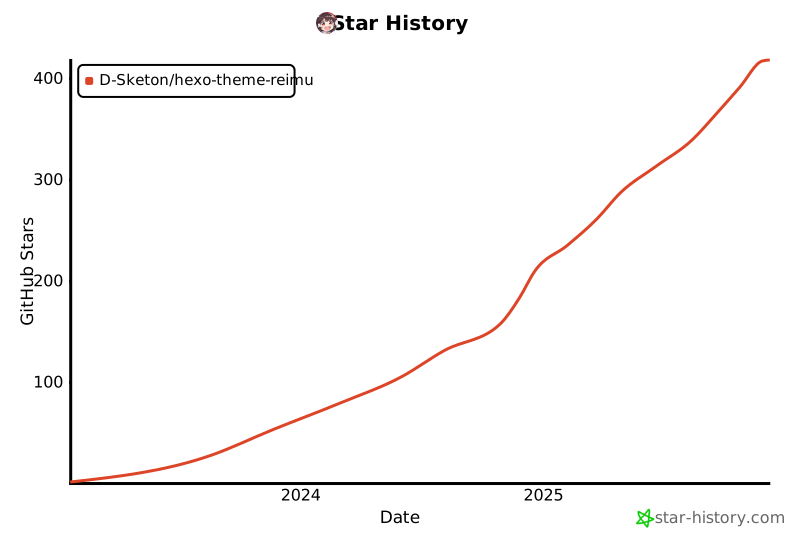](https://www.star-history.com/#D-Sketon/hexo-theme-reimu&type=date&legend=top-left)
## License
MIT