https://github.com/davidyslu/grpc-practice
This repository is used to practice some basic operations gRPC.
https://github.com/davidyslu/grpc-practice
grpc protobuf python
Last synced: 3 months ago
JSON representation
This repository is used to practice some basic operations gRPC.
- Host: GitHub
- URL: https://github.com/davidyslu/grpc-practice
- Owner: davidyslu
- License: apache-2.0
- Created: 2018-12-15T14:43:33.000Z (over 7 years ago)
- Default Branch: master
- Last Pushed: 2018-12-16T10:07:57.000Z (over 7 years ago)
- Last Synced: 2025-08-29T13:47:02.730Z (11 months ago)
- Topics: grpc, protobuf, python
- Language: Python
- Homepage: https://grpc.io/
- Size: 45.9 KB
- Stars: 0
- Watchers: 0
- Forks: 0
- Open Issues: 0
-
Metadata Files:
- Readme: README.md
- Contributing: CONTRIBUTING.md
- License: LICENSE
Awesome Lists containing this project
README
# gRPC Practice
This repository is used to practice some basic operations in **gRPC** and the original repository is [here](https://github.com/grpc/grpc).
> The following opreations are used in **Ubuntu Linux 16.04 LTS**.
---
## Introduction
> The following descriptions are from [here](https://grpc.io/docs/guides/index.html).
### What is "gRPC"?
In **gRPC** a client application can directly call methods on a server application on a different machine as if it was a local object, making it easier for you to create distributed applications and services.
As in many RPC systems, gRPC is based around the idea of defining a service, specifying the methods that can be called remotely with their parameters and return types.
* The server implements this interface and runs a gRPC server to handle client calls.
* The client has a **stub** (referred to as just a client in some languages) that provides the same methods as the server.
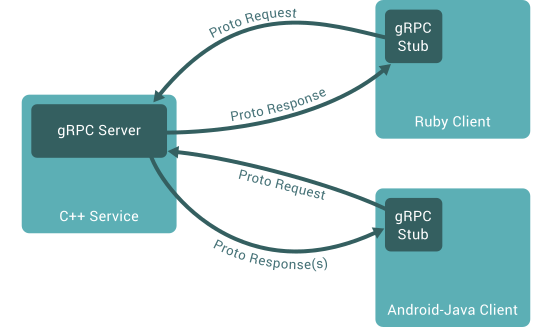
gRPC clients and servers can run and talk to each other in a variety of environments and can be written in any of gRPC’s supported languages.
### Working with Protocol Buffers
By default gRPC uses "[Protocol Buffers](https://developers.google.com/protocol-buffers/docs/overview)", Google’s mature open source mechanism for serializing structured data. Here’s a quick intro to how it works.
1. **Define the structure for the data**
* The first step when working with protocol buffers is to **define the structure for the data** you want to serialize in a *proto file* (`.proto`).
* Protocol buffer data is structured as messages, where each message contains a series of name-value pairs called **fields**.
```cpp
message Person {
string name = 1;
int32 id = 2;
bool has_ponycopter = 3;
}
```
2. **Compile the proto file**
* You use the protocol buffer compiler `protoc` to generate data access classes in your preferred language(s) from your *proto* definition.
* These provide simple accessors for each field (like `name()` and `set_name()`) as well as methods to serialize/parse the whole structure to/from raw bytes.
* If your chosen language is C++, running the compiler on the above example will generate a class called `Person`.
* You can then use this class in your application to populate, serialize, and retrieve Person protocol buffer messages.
* As you’ll see in more detail in our examples, you define gRPC services in ordinary *proto* files, with RPC method parameters and return types specified as protocol buffer messages:
```cpp
// The greeter service definition.
service Greeter {
// Sends a greeting
rpc SayHello (HelloRequest) returns (HelloReply) {}
}
// The request message containing the user's name.
message HelloRequest {
string name = 1;
}
// The response message containing the greetings
message HelloReply {
string message = 1;
}
```
---
## Contents
* [Tutorials](src/tutorials)
---
## Contributing
To know how to contribute this repository, please refer to this [document](CONTRIBUTING.md) first. Thanks for your cooperation.
---
## References
* [gRPC Official Website](https://grpc.io/)
* [Protocol Buffers Documentation](https://developers.google.com/protocol-buffers/docs/overview)
* [Protocol Buffers 3 Language Guide](https://developers.google.com/protocol-buffers/docs/proto3)
* [GitHub - grpc/grpc](https://github.com/grpc/grpc)
* [GitHub - google/protobuf](https://github.com/google/protobuf/releases)
---
## Contributor
In order to protect both you and ourselves, you will need to sign the [Contributor License Agreement](https://identity.linuxfoundation.org/projects/cncf).
* [David Lu](https://github.com/yungshenglu)
---
## License
[Apache License 2.0](LICENSE)