https://github.com/dbidwell94/rtc.io
A simple, easy-to-use abstraction of the WebRTC library
https://github.com/dbidwell94/rtc.io
rtcpeerconnection socket-io webrtc
Last synced: about 2 months ago
JSON representation
A simple, easy-to-use abstraction of the WebRTC library
- Host: GitHub
- URL: https://github.com/dbidwell94/rtc.io
- Owner: dbidwell94
- License: mit
- Created: 2022-02-06T01:00:08.000Z (over 4 years ago)
- Default Branch: master
- Last Pushed: 2022-02-09T11:07:02.000Z (over 4 years ago)
- Last Synced: 2023-04-17T20:28:44.192Z (about 3 years ago)
- Topics: rtcpeerconnection, socket-io, webrtc
- Language: TypeScript
- Homepage:
- Size: 321 KB
- Stars: 1
- Watchers: 1
- Forks: 0
- Open Issues: 0
-
Metadata Files:
- Readme: README.md
- License: LICENSE
Awesome Lists containing this project
README
# rtcio
- [rtcio](#rtcio)
- [Features](#features)
- [Roadmap](#roadmap)
- [Usage/Examples](#usageexamples)
- [Testing](#testing)
- [API Documentation](#api-documentation)
> [!WARNING]
> This package is under heavy development. Expect API to change
> with minor version bumps until a major version of > 0 gets
> published. While the core library API is relatively stable,
> other addons such as `@rtcio/react` will change quickly
Inspired by socket.io, rtcio is an easier to use way of dealing with WebRTC.
It wraps the logic of creating RTCPeerConnections in easy-to-use callback
chaining.
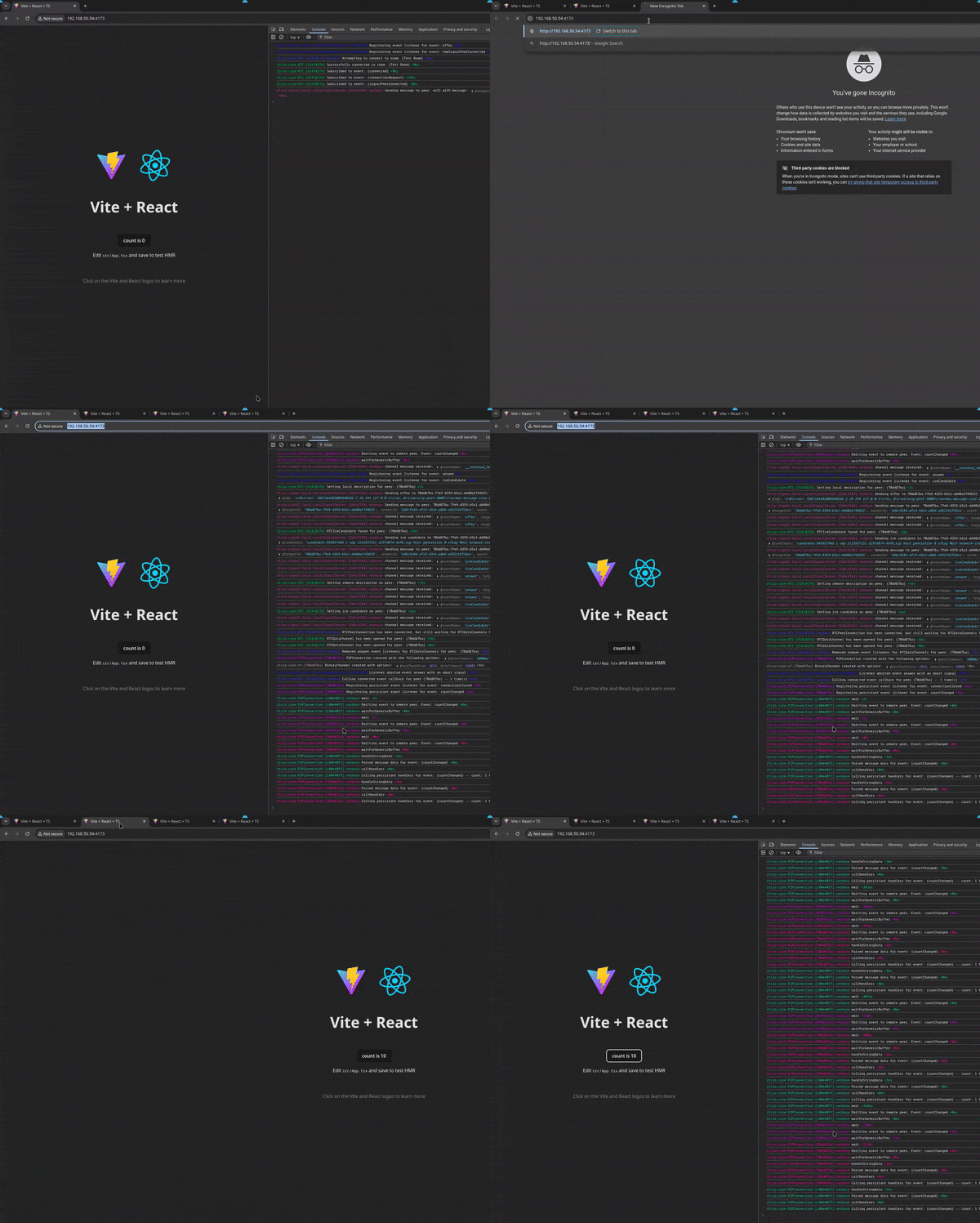
The GIF below highlights the use of the `@rtcio/signal-local`, the debug features,
and the `@rtcio/react` wrapper to get working peer to peer connections for
local development. The demo is currently a work in progress, but can be viewed
in the `demo` package in the GitHub repository.
## Features
- Built in TypeScript and is fully typed
- Works with your custom signal server via an implemented interface
- Also has pre-built client-side signal server implementations
- @rtcio/socket-io-client
- @rtcio/signal-local
- Default server side signaler implementation available at:
- @rtcio/socket-io-server
- Binary data handling
- Automatic data chunking with configurable chunk sizes
- Support for out-of-order binary data receiving
- Native support for sending `File`s
- Uses `ReadableStream` under the hood to reduce memory allocations
for both sending and receiving large data files
- Binary data is handled on a completely different data channel so as
not to clog up real time messaging events
- Generic typed parameters for custom events listeners and emitters
- Logging available via the [debug](https://www.npmjs.com/package/debug) library
- All packages are scoped to their npm name -- `rtcio:{pkg-name}:{class-name}:[instanceId]{:logLevel?}`
- Log Levels:
- warn
- error
- verbose
- log (will not include a log level)
- eg. `rtcio:core:RTC:[1a2b3c4d]:warn This is a warning level`
- eg. `rtcio:signal-local:LocalSignalServer:[1a2b3c4d] This is a standard log`
- Create your own signaler by extending `ClientSignaler` in `@rtcio/signaling`
- A React wrapper via the `@rtcio/react` package.
## Roadmap
- Handle audio and visual streams
- Custom signaler with raw websockets
- Custom signaler with raw Server Sent Events (SSE)
## Usage/Examples
```typescript
import { RTC } from "@rtcio/core";
import { SocketIoSignaler } from "@rtcio/socket-io-client";
const ROOM_NAME = "signalerRoom1";
interface MyCustomEvents {
message: (messageText: string) => void;
}
// There is a default server implementation for socket.io at
// `@rtcio/socket-io-server`
const io = new RTC(new SocketIoSignaler(socketArgs), ROOM_NAME);
const idResult = await io.connectToRoom();
if (idResult.isError()) {
// Unable to connect to the signal server
console.error(idResult.error);
return;
}
const myLocalId = idResult.value;
// Here we are 100% sure we have a valid connection AND a data channel
// This event is fired when a new remote peer has a direct connection to you.
// You can subscribe, unsubscribe, and emit events directly to the peer
io.on("connected", (newPeer) => {
newPeer.emit("message", "Hello, and welcome to rtcio!");
newPeer.on("message", (messageText) => {
console.log(`New message from ${newPeer.id}: ${messageText}`);
});
});
const roomPeers = io.getRoomPeers();
for (const peerId of roomPeers) {
// awaiting here doesn't actually wait for the connection.
// it's purely for the RTCPeerConnection to acquire all the
// data it needs to send to the signal server.
// You do _not_ have to await this for the connection to process.
await io.connectToPeer(peerId);
}
```
## Testing
rtcio provides a local signaler as well which is useful for testing.
The package is `@rtcio/signal-local`. Just remember that because
signalers should happen on each client, and here you are emulating 2
clients, you need 2 signal servers.
```typescript
import { RTC } from "@rtcio/core";
import { LocalSignalServer } from "@rtcio/signal-local";
const ROOM_NAME = "TEST_ROOM";
const client1 = new RTC(new LocalSignalServer(), ROOM_NAME);
const client2 = new RTC(new LocalSignalServer(), ROOM_NAME);
// This should not be done in production, but the LocalSignalServer will
// not fail to connect as it uses BroadcastChannel behind the scenes.
const client2Id = (await client2.connectToRoom()).unwrap();
const client1Id = (await client1.connectToRoom()).unwrap();
client2.on("connectionRequest", async (req) => {
if (req.remoteId === client1Id) {
await req.accept();
} else {
req.reject();
}
});
client2.on("connected", (peer1) => {
console.log(`Peer1 connected with id ${peer1.id}`);
});
await client1.connectToPeer(client2Id);
```
> [!IMPORTANT]
> If testing locally on Firefox, you MUST use your local IP instead of `localhost`.
> This is a known issue in Firefox and cannot be fixed.
### Example with `vite`
- locahost:5173 for localdev would be 192.168.xx.x:5173
- This can be easily done using vite --host as seen in the
`demo` package in this repository
>
## API Documentation
API documentation is coming in the near future, implemented via `typedoc`,
and will be available on GitHub Pages once the integration is complete.