https://github.com/devolo/dlan-greenphy-sdk
The devolo dLAN Green PHY module is ideal for installation in all IoT-devices. Includes QCA7000 chipset and LPC1758 host processor.
https://github.com/devolo/dlan-greenphy-sdk
Last synced: 5 months ago
JSON representation
The devolo dLAN Green PHY module is ideal for installation in all IoT-devices. Includes QCA7000 chipset and LPC1758 host processor.
- Host: GitHub
- URL: https://github.com/devolo/dlan-greenphy-sdk
- Owner: devolo
- License: other
- Created: 2016-12-13T12:17:42.000Z (over 9 years ago)
- Default Branch: master
- Last Pushed: 2024-10-14T08:26:44.000Z (over 1 year ago)
- Last Synced: 2025-06-01T12:45:51.750Z (about 1 year ago)
- Language: C
- Size: 19.4 MB
- Stars: 6
- Watchers: 5
- Forks: 0
- Open Issues: 4
-
Metadata Files:
- Readme: README.md
- License: LICENSE
Awesome Lists containing this project
README
# devolo dLAN® Green PHY Module SDK
This project contains the SDK for the devolo [dLAN® Green PHY module](https://www.devolo.de/dlan-green-phy-module).
It is ideal for installation in all electrical devices of a smart home. From the heating system to the refrigerator - Green PHY enables seamless
integration into the networked home. The open standard makes smart energy applications, sensor solutions and automation systems efficient to set up and
use. Another advantage: The dLAN® Green PHY module is particularly energy-saving and - compared to conventional HomePlug solutions - has reduced energy
consumption.
## QCA7000 Firmware
The module contains a QCA7000 GreenPHY processor and a LPC1758 MCU. This project mainly covers the SDK for the MCU. The firmware for the GreenPHY is not part of this repository and must be obtained via another source (e.g. [devolo support](mailto:support@devolo.de?subject=Firmware%20GreenPHY)).
The following options are available within the QCA7000 devolo firmware package:
* iot-generic IoT generic, optimized for performance: 50561 off (SLAC off)
* iot-conform IoT over mains, optimized for conformity: 50561 on (SLAC off)
* emob-charger e-mobility use as charging station: SLAC in EVSE mode (50561 off)
* emob-vehicle e-mobility use as vehicle: SLAC in PEV mode (50561 off)
## LPC1758 Firmware
The SDK is based on [LPCOpen
v2.10](https://www.nxp.com/products/developer-resources/software-development-tools/developer-resources-/lpcopen-libraries-and-examples/lpcopen-software-development-platform-lpc17xx:LPCOPEN-SOFTWARE-FOR-LPC17XX)
and [FreeRTOS v10.4.1](http://www.freertos.org/).
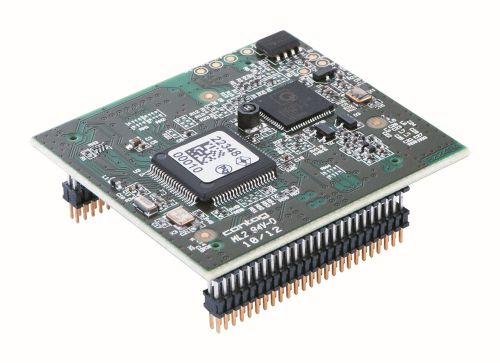
*The dLAN® Green PHY module*
This repository contains two FirmwareStandalone projects.
The *FirmwareStandalone* projekt which starts at baseaddress 0x0 and the *FirmwareStandaloneTFTP* project which starts at baseaddress 0x10000 to leave space for the bootloader on 0x0 to 0x10000.
The FirmwareStandalone therefor will *override(!)* an existing Bootloader while flashing.
If you know about an existing bootloader on your Green PHY module and you want to keep the TFTP update function, the StandaloneFirmwareTFTP should be used.
There are also binaries of the stock-firmware (v1.0.16) with the bootloader and FirmwareStandaloneTFTP included in the releases, which can be flashed via MCUXpressos *GUI Flash Tool*.
## Features
* HTTP server with webinterface
* TCP/IP stack with many protocols ready to use, e.g. DNS, DHCP, ICMP
* Green PHY and fast ethernet controller
* Many interfaces, e.g. SPI, GPIO, I²C, UART, USB and CAN
* Compatible to [microBUS™ socket](https://www.mikroe.com/mikrobus/) and MikroElektronika [Click Boards](https://shop.mikroe.com/click)
## Requirements
* [dLAN® Green PHY module](https://www.devolo.de/dlan-green-phy-module) with a development board, e.g. the [dLAN®
Green PHY eval board II](https://www.devolo.de/dlan-green-phy-eval-board-ii), or your own design
* [MCUXpresso IDE](https://www.nxp.com/design/software/development-software/mcuxpresso-software-and-tools-/mcuxpresso-integrated-development-environment-ide:MCUXpresso-IDE)
* JTAG-Debugger, recommended [LPC-Link
2](https://www.nxp.com/products/developer-resources/software-development-tools/developer-resources-/lpcopen-libraries-and-examples/lpc-link2:OM13054)
with [ARM-JTAG-20-10 Adapter](https://www.olimex.com/Products/ARM/JTAG/ARM-JTAG-20-10/)
* Python3 (make sure *py* command is configured, e.g. linked to *python3*)
* [beautifulsoup4](https://pypi.python.org/pypi/beautifulsoup4) (use *pip3* for installation)
* [css-html-js-minify](https://pypi.org/project/css-html-js-minify/2.2.2/) *(tested for v2.2.2, not working with v2.5.5) (to
convert HTML files for the WebUI)* (use *pip3* for installation)
## Usage
1. Download the repository, following the *Clone or download* button's instructions above.
2. Import the project into MCUXpresso:
* In MCUXpresso create a new workspace and open the *File->Import* dialogue.
* Select *General/Existing Projects into Workspace* import wizard and click next.
* If you downloaded the SDK as .zip, select it in the *Select archive file* input,
if you got it by *git clone* use the *Select root directory* input.
* Leave all projects marked for import and click *Finish*.
3. Now you should be able to see the SDK's folders in the Project Explorer.
Select the *wanted project (FirmwareStandalone or FirmwareStandaloneTFTP)* and click on the blue debug icon or use *Debug 'FirmwareStandalone(TFTP)' [Debug]* in the Quickstart Panel and click the *Resume* button to start.
4. Get the GreenPHY module's IP address from your local DHCP server and access it's WebUI in your Browser.
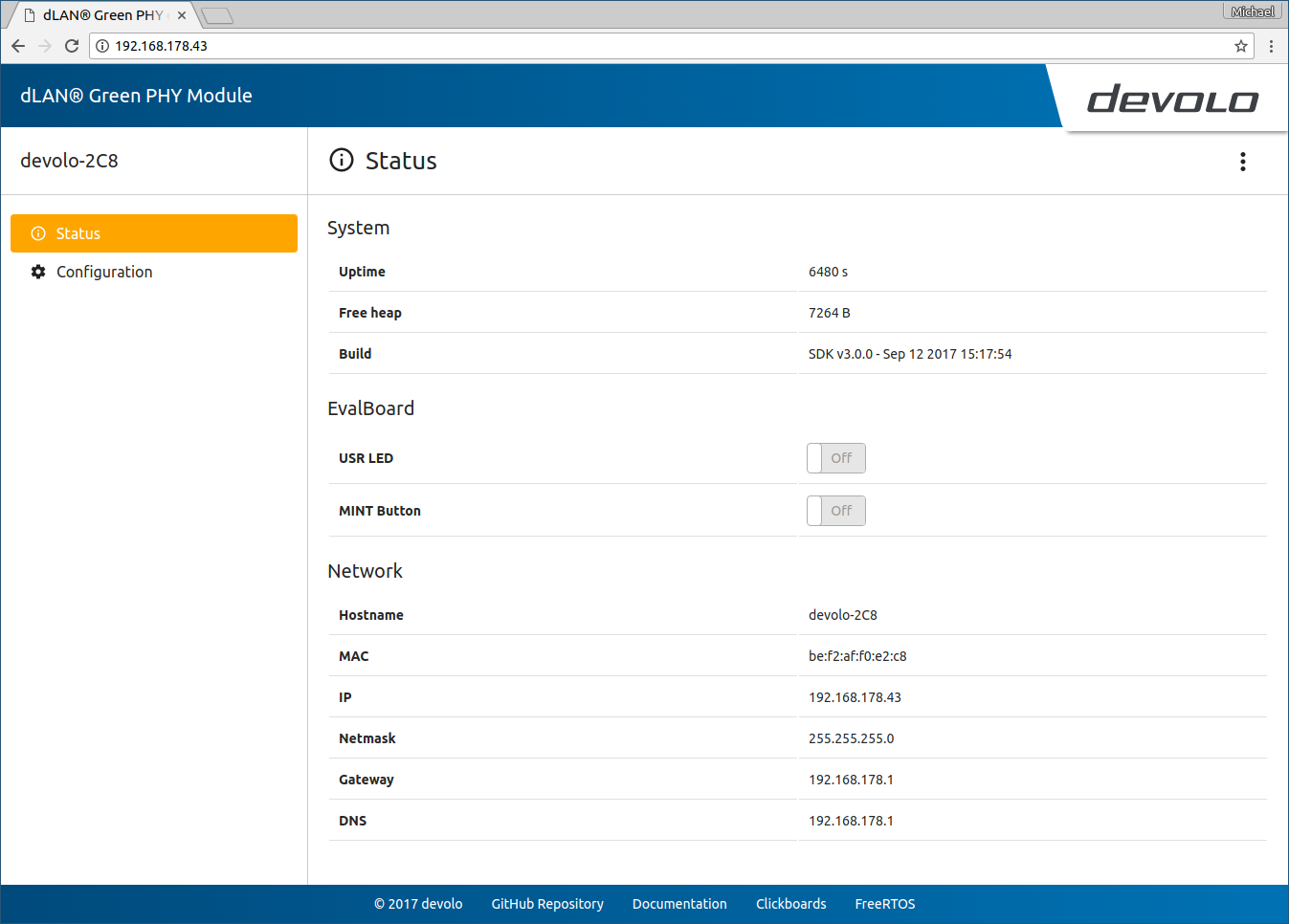
*Example of the dLAN® Green PHY Module SDK's webinterface's status page*
### Webinterface
The webinterface is automatically generated by *makefsdata.py* (located in: Applications\HTTP\bin).
If you want to regenerate the webinterface, get the requirements described above (Python3, beautifulsoup4, css-html-js->This will result in an updated/new *httpd-fsdata.c* file (located in: Applications\HTTP\src).