https://github.com/earthcitizen/escape-artist
A Haskell library for text decoration with ANSI escape sequences made easy
https://github.com/earthcitizen/escape-artist
ansi-colors ansi-escape-sequences haskell haskell-library text-decoration
Last synced: 8 months ago
JSON representation
A Haskell library for text decoration with ANSI escape sequences made easy
- Host: GitHub
- URL: https://github.com/earthcitizen/escape-artist
- Owner: EarthCitizen
- License: bsd-3-clause
- Created: 2016-09-06T06:12:23.000Z (almost 10 years ago)
- Default Branch: master
- Last Pushed: 2020-01-28T00:07:06.000Z (over 6 years ago)
- Last Synced: 2025-10-21T13:53:23.620Z (8 months ago)
- Topics: ansi-colors, ansi-escape-sequences, haskell, haskell-library, text-decoration
- Language: Haskell
- Homepage:
- Size: 332 KB
- Stars: 10
- Watchers: 1
- Forks: 1
- Open Issues: 4
-
Metadata Files:
- Readme: README.md
- Changelog: CHANGELOG.md
- License: LICENSE
Awesome Lists containing this project
README
# escape-artist
[](https://travis-ci.org/EarthCitizen/escape-artist)
[](https://coveralls.io/github/EarthCitizen/escape-artist?branch=master)
A Haskell library for text decoration with ANSI escape sequences made easy. Decorate your terminal text easily and expressively.
## Getting Started
### Building from Source
#### Prerequisites
To build this project from source, you will need to install stack. See https://docs.haskellstack.org/en/stable/README/#how-to-install for detailed installation instructions for your operating system.
#### Building
```
git clone https://github.com/EarthCitizen/escape-artist
cd escape-artist
stack setup
stack build
```
### Using
The data type used to perform text decoration is `Escapable`. This defines the constructors for the decoration. Each constructor takes a single argument. It can be any type that has implemented the `ToEscapable` class. This means that all of the following are perfectly valid:
```haskell
{-# LANGUAGE ExtendedDefaultRules #-}
FgRed 6
FgRed "6"
FgRed '6'
FgRed (6 :: Float)
FgRed (6 :: Double)
```
And can all dwell in the same list:
```haskell
{-# LANGUAGE ExtendedDefaultRules #-}
import Data.List (intersperse)
import Text.EscapeArtist
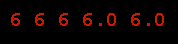
let redList = [FgRed 6, FgRed "6", FgRed '6', FgRed (6 :: Float), FgRed (6 :: Double)]
putEscLn $ mconcat $ intersperse (Inherit " ") redList
```
The following data types already come with an implementation of `ToEscapable`:
* `Char`
* `ByteString of Data.ByteString`
* `ByteString of Data.ByteString.Lazy`
* `Text of Data.Text`
* `Text of Data.Text.Lazy`
* `Double`
* `Float`
* `Int`
* `Integer`
* `String`
* `Word`
* `Word8`
* `Word16`
* `Word32`
* `Word64`
Implementing `ToEscapable` for other data types is fairly simple:
```haskell
import Data.Monoid ((<>))
import Text.EscapeArtist
data ABC = A | B deriving (Show, Eq)
instance ToEscapable ABC where
toEscapable (A) = FgRed $ show A
toEscapable (B) = FgGreen $ show B
instance (ToEscapable a) => ToEscapable (Maybe a) where
toEscapable (Just a) = FgGreen "Just" <> Inherit " " <> FgYellow a
toEscapable a = FgRed $ show a
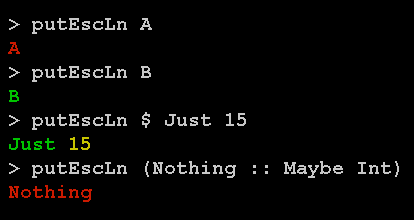
putEscLn A
putEscLn B
putEscLn $ Just 15
putEscLn (Nothing :: Maybe Int)
```
When constructors are combined with the application operator (`$`), the effects accumulate and wrap around the applied value:
```haskell
import Text.EscapeArtist
let combined = FgRed $ Underline $ Blink "Hello World!"
```
would be equivalent to the following in XML:
```xml
Hello World!
```
**NOTE**: _This library does not produce nor interact with XML. This example is just for the purpose of explanation_.
`Escapable` is an instance of `Monoid`, so a series of `Escapable`s can be appended together into a single value:
```haskell
{-# LANGUAGE ExtendedDefaultRules #-}
import Data.Monoid ((<>))
import Text.EscapeArtist
let series = FgYellow 5 <> FgWhite 6
putEscLn series
```
When a constructor is applied to a series of appended `Escapable`s using the `$`, the constructor will be applied to each member of the series.
```haskell
{-# LANGUAGE ExtendedDefaultRules #-}
import Data.Monoid ((<>))
import Text.EscapeArtist
let result = Underline $ FgYellow 5 <> FgWhite 6
putEscLn result
```

XML equivalent:
```XML
5
6
```
**NOTE**: _The `Underline` is re-applied to each member of the series, and not once for all of them_.
## Constructors
### Foreground Color
`FgBlack FgRed FgGreen FgYellow FgBlue FgMagenta FgCyan FgWhite`
### Background Color
`BgBlack BgRed BgGreen BgYellow BgBlue BgMagenta BgCyan BgWhite`
### Other Types
Name | Effect on Applied Value
-------------- | -----------------------
`FgDefault` | Default foreground color of the terminal.
`BgDefault` | Default background color of the terminal.
`Inherit` | Applies attributes of parent constructors. Useful for a value interspersed in a series with other `Escapable`s. See examples below.
`Default` | Even when other constructors are applied, the contained value will have the default attributes of the terminal.
`Blink` | Output blinks in terminal.
`BlinkOff` | NOT to end a blinking series, but rather to nest a non-blinking segment inside a series of blinking outputs.
`Bright` | Enables bright output for foreground colors.
`BrightOff` | NOT to end a bright series, but rather to nest a non-bright segment inside a series of bright outputs.
`Underline` | Underlines the output.
`UnderlineOff` | NOT to end an underlined series, but rather to nest a non-underlined segment inside a series of underlined outputs.
`Inverse` | Switches the foreground and background colors.
`InverseOff` | NOT to end an inverse series, but rather to nest a non-inverse segment inside a series of inverse outputs.
## Functions
Name | Description
------------- | -----------
`escToString` | Renders anything implementing `ToEscapable` to a `String`.
`putEsc` | Renders anything implementing `ToEscapable` to a `String`, then writes it to standard out.
`putEscLn` | Renders anything implementing `ToEscapable` to a `String`, then writes it to standard out followed by a newline.
## Operators
Symbol | Purpose
------ | -------
`^$` | Same as `$`, but one level of precedence higher than `<>` for avoiding the use of parentheses when needing to use `$` in the same expression as `<>`. See examples below.
`/<>/` | The same as `<>`, except that any argument that is not of type `Escapable` will be wrapped in `Inherit` before being combined with the other argument via `<>`.
## Examples
### Inherit
```haskell
import Data.Monoid ((<>))
import Text.EscapeArtist
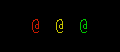
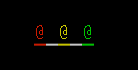
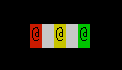
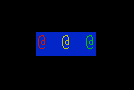
spacesInherit = FgRed '@' <> Inherit ' ' <> FgYellow '@' <> Inherit ' ' <> FgGreen '@'
putEscLn spacesInherit
```
```haskell
putEscLn $ Underline spacesInherit
```
```haskell
putEscLn $ Inverse spacesInherit
```
```haskell
putEscLn $ BgBlue spacesInherit
```
### UnderlineOff
```haskell
import Data.Monoid ((<>))
import Text.EscapeArtist
underlines = Underline $ FgCyan "I am underlined" <> UnderlineOff " but I am not " <> FgMagenta "and I am over here"
putEscLn underlines
```

The same type of functionality applies as well to `BlinkOff`, `BrightOff` and `InverseOff`.
### Operator `^$`
This operator allows you to avoid parentheses in cases where you need to use `$` and `<>` in he same expression.
```haskell
import Data.Monoid ((<>))
import Text.EscapeArtist
op1 = Underline $ Bright ^$ FgGreen "GREEN" <> Default " " <> FgYellow "YELLOW"
putEscLn op1
```

Without `^$`, this would have to be written as:
```haskell
Underline $ (Bright $ FgGreen "GREEN") <> Default " " <> FgYellow "YELLOW"
```
### Operator `/<>/`
This operator allows `Inherit` to be omitted.
```haskell
BgRed $ Inherit 4 <> BgCyan " " <> Inherit 5 <> BgGreen " " <> Inherit 9
```
can simply be written as:
```haskell
BgRed $ 4 /<>/ BgCyan " " /<>/ 5 /<>/ BgGreen " " /<>/ 9
```
## Advanced Examples
### Fun with Colors
```haskell
import Data.Monoid (mempty, (<>))
import Text.EscapeArtist
rainbowString :: String -> Escapable
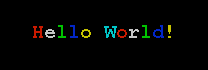
rainbowString s = fn s (cycle [FgRed, FgWhite, FgGreen, FgBlue, FgYellow, FgCyan])
where fn [] _ = mempty
fn _ [] = mempty
fn (s:ss) ca@(c:cs)
| s `elem` " \t\n\r" = Inherit s <> fn ss ca
| otherwise = c s <> fn ss cs
putEscLn $ rainbowString "Hello World!"
```
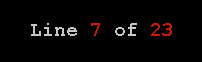
### Colorize Sections of a String
```haskell
import Text.EscapeArtist
import Text.Regex
replaceNumbers :: String -> String
replaceNumbers searchIn = subRegex (mkRegex "([0-9]+)") searchIn (escToString $ FgRed "\\1")
putStrLn $ replaceNumbers "Line 7 of 23"
```
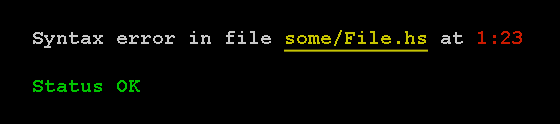
### Implement `ToEscapable` for Custom and Existing Data Types
```haskell
{-# LANGUAGE FlexibleInstances #-}
import Data.Monoid ((<>))
import Text.EscapeArtist
type FileName = String
type LineNumber = Integer
type ColumnNumber = Integer
data ErrorType = SyntaxError FileName LineNumber ColumnNumber deriving (Show)
instance ToEscapable ErrorType where
toEscapable (SyntaxError fn ln cn) = Default "Syntax error in file "
<> FgYellow ^$ Underline fn
<> Default " at "
<> FgRed (show ln ++ ":" ++ show cn)
instance ToEscapable (Either ErrorType String) where
toEscapable (Left e) = toEscapable e
toEscapable (Right m) = FgGreen m
mkSyntaxError :: FileName -> LineNumber -> ColumnNumber -> Either ErrorType String
mkSyntaxError fn ln cn = Left $ SyntaxError fn ln cn
mkStatusOK :: Either ErrorType String
mkStatusOK = Right "Status OK"
putEscLn $ mkSyntaxError "some/File.hs" 1 23
putEscLn mkStatusOK
```