https://github.com/enescang/linear-feedback-shift-register
Base logic of LFSR. Simulated with an array to better understanding
https://github.com/enescang/linear-feedback-shift-register
javascript lfsr random-number
Last synced: 8 months ago
JSON representation
Base logic of LFSR. Simulated with an array to better understanding
- Host: GitHub
- URL: https://github.com/enescang/linear-feedback-shift-register
- Owner: enescang
- Created: 2022-06-03T21:54:17.000Z (about 4 years ago)
- Default Branch: main
- Last Pushed: 2022-06-03T22:05:02.000Z (about 4 years ago)
- Last Synced: 2025-07-02T17:06:06.757Z (12 months ago)
- Topics: javascript, lfsr, random-number
- Language: JavaScript
- Homepage:
- Size: 39.1 KB
- Stars: 1
- Watchers: 1
- Forks: 0
- Open Issues: 0
-
Metadata Files:
- Readme: README.md
Awesome Lists containing this project
README
## Getting Started
My aim was just simulating the LFSR logic with flip-flops. So, i didn't use any operator other than ^ (XOR) operator.
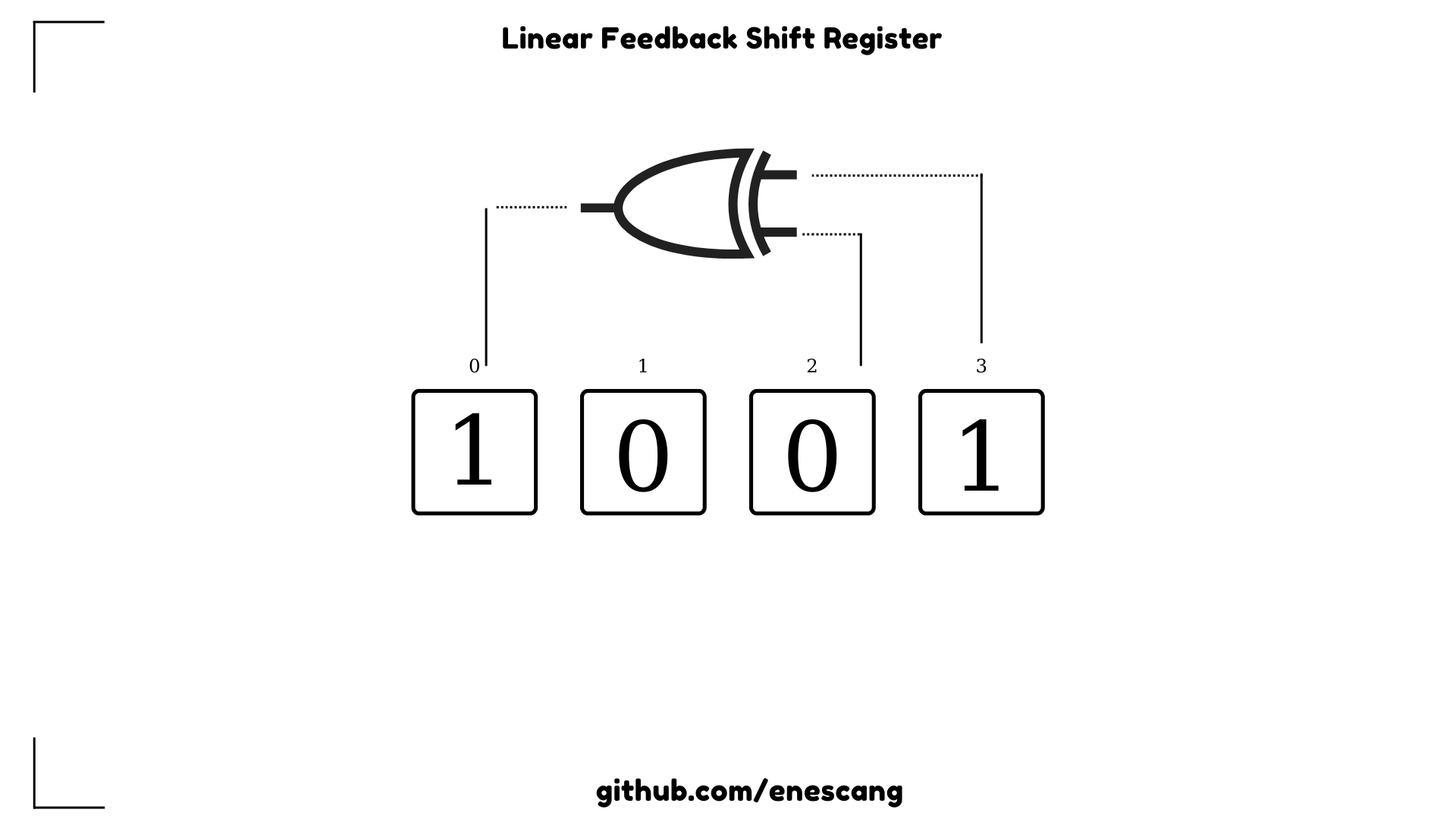
I am using a basic array to represent flip-flops. After clock tick we are pop out the last element from array and adding new bit to that array.
> In real we don't need array. Actually we shouldn't use. We are using bitwise operator to shifting bits. That's why bitwise are there.
## What is LFSR?
"(LFSR) is a shift register whose input bit is a linear function of its previous state." And XOR is a most commonly used linear function in LFSR. In theory we have several flip-flops and as known as every flip-flop has 1 bit. In every clock tick we are shifting whole bits. Then calculating the new bit based on some math function. Generally irreducible polynomials are using.
> There are different types of implementation. In this repo i am using
> Many-to-One type.
## Example Output
Flip-flops: [1, 0, 1, 1, 1, 0, 1, 1]
Taps: [1, 2, 3, 7]
| (index) | 0 | 1 | 2 | 3 | 4 | 5 | 6 | 7 | 8 | 9 |
|---------|-----|-----|-----|----|-----|----|-----|----|-----|----|
| 0 | 221 | 238 | 119 | 59 | 157 | 78 | 167 | 83 | 169 | 84 |
## Basic Steps
1. Seed Flip-flops and set taps
2. Calculate new bit using XOR
3. Pop-out the last element from array
4. Add the new bit to beginning of array
## XOR Table
| F1 | F2 | XOR |
|--|--|--|
| 0|1 | 1 |
| 1|0 | 1 |
| 0|0 | 0 |
| 1|1 | 0 |
## Conclusion
There are many applications of LFSR. I think LFSR is a great approach to create pseduo numbers. In this example i tried to simulate how LFSR works.
> Written with [StackEdit](https://stackedit.io/).