https://github.com/erdo/fore-full-example-02-kotlin
androidx, kotlin, koin. barebones example for a more complex app incl. structure, networking, permissions
https://github.com/erdo/fore-full-example-02-kotlin
Last synced: about 1 year ago
JSON representation
androidx, kotlin, koin. barebones example for a more complex app incl. structure, networking, permissions
- Host: GitHub
- URL: https://github.com/erdo/fore-full-example-02-kotlin
- Owner: erdo
- License: apache-2.0
- Created: 2019-09-09T10:09:35.000Z (over 6 years ago)
- Default Branch: master
- Last Pushed: 2021-10-13T18:09:20.000Z (over 4 years ago)
- Last Synced: 2025-02-06T13:51:43.744Z (over 1 year ago)
- Language: Kotlin
- Homepage:
- Size: 411 KB
- Stars: 0
- Watchers: 3
- Forks: 0
- Open Issues: 0
-
Metadata Files:
- Readme: README.md
- License: LICENSE
Awesome Lists containing this project
README
# Full MVO app example using [fore](https://erdo.github.io/android-fore/) - (kotlin version)
[video](https://www.youtube.com/watch?v=t35CmCNYsyM) \| [source code](https://github.com/erdo/fore-full-example-02-kotlin)
A larger multi-page app written in Kotlin that demonstrates the use of the android fore library. The source includes details that are not present in the example apps bundled with the library, but would be necessary for a real app - one way of handling user messaging for example.
**NB: I feel this sample is getting a bit long in the tooth, mainly because of the recent fashion for clean architecture apps arranged in modules rather than in packages. Clean architecture is a summary of ideas that most architectures aim for in any case - so you'll notice the package structure of this sample can be mapped quite easily to one that is more recognisably "Clean", this sample also separates the view layer (of course, because it's based on _fore_), it's highly testable etc. Anyway, it still all works, but I will most likely be publishing another sample shortly that is explicitly Clean and structured with kotlin modules. I'll update the main _fore_ docs once that is released.**
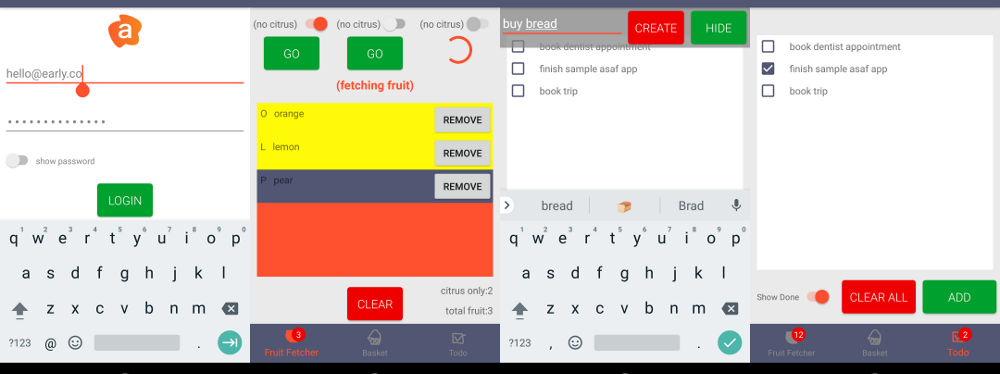
There is a lot going on in the UI of this app, the point is to demonstrate how you can support complex UIs whilst still maintaining a tight and robust code base underneath.
- Once you've logged in (with a fake email address and password, but the app still connects to an "authentication" server over the network), you are presented with three tabs.
- The first is a **fruit collector** where you click Go to retrieve fruit over a network connection, this ridiculous example lets us demonstrate how to make multiple network connections and handle adapter updates even when a user is: mashing the buttons; rotating the device; and three different network connections can return to update the list at the same time.
- The second tab is a simple shopping **basket** similar to the one discussed in this [dev.to tutorial](https://dev.to/erdo/tutorial-spot-the-deliberate-bug-165k). The model driving the basket view is locally scoped (using a androidx.lifecycle.ViewModel). As such, rotating the screen won't destroy the model, but navigating away from it will.
- The third tab is a **todo** list which lets you add todo items and check them off as done.
- The **bottom navigation bar** in this app has badges added to it so that we can demonstrate how the observer pattern can be used to automatically update parts of the UI as appropriate. For example, try fetching some fruit, then change tabs, then rotate the device - fore Observers will ensure that the badge number remains consistent, even after the fruit network request has returned with new fruit.
- There is a permissions implementation you might want to steal, that pushes a lot of the boiler plate code out of the UI layer (using kotlin delegation)
- The DI is straight forwardly implemented with Koin
- The app uses a mix of techniques at the UI layer. eg: putting most of the view code in the Activity class, putting most of it in the Fragment class, and putting most of it in a custom View class, so you can compare the different ways of achieving the same thing.
> "fore Observers will ensure that the badge number remains consistent"
## Main Library Choices
Networking - Retrofit and OKHttp
DI - Koin
ViewModels - androidx.lifecycle.ViewModel
reactive UI - early.fore
## Testing
For examples of testing, please see the [sample apps](https://erdo.github.io/android-fore/#sample-apps) included with the fore library which are tested to within an inch of their lives.
## License
Copyright 2017-2021 early.co
Licensed under the Apache License, Version 2.0 (the "License");
you may not use this file except in compliance with the License.
You may obtain a copy of the License at
http://www.apache.org/licenses/LICENSE-2.0
Unless required by applicable law or agreed to in writing, software
distributed under the License is distributed on an "AS IS" BASIS,
WITHOUT WARRANTIES OR CONDITIONS OF ANY KIND, either express or implied.
See the License for the specific language governing permissions and
limitations under the License.