https://github.com/erf/mu_state
Minimal Cubit-inspired state management using Flutter's built-in primitives.
https://github.com/erf/mu_state
cubit dart flutter flutter-state-management state state-management valuelistenablebuilder valuenotifier
Last synced: 2 months ago
JSON representation
Minimal Cubit-inspired state management using Flutter's built-in primitives.
- Host: GitHub
- URL: https://github.com/erf/mu_state
- Owner: erf
- License: mit
- Created: 2022-03-14T21:09:23.000Z (over 4 years ago)
- Default Branch: main
- Last Pushed: 2025-07-02T00:18:17.000Z (12 months ago)
- Last Synced: 2026-03-29T21:06:09.959Z (3 months ago)
- Topics: cubit, dart, flutter, flutter-state-management, state, state-management, valuelistenablebuilder, valuenotifier
- Language: Dart
- Homepage: https://pub.dev/packages/mu_state
- Size: 1.1 MB
- Stars: 1
- Watchers: 1
- Forks: 0
- Open Issues: 0
-
Metadata Files:
- Readme: README.md
- Changelog: CHANGELOG.md
- License: LICENSE
Awesome Lists containing this project
README
# mu_state
Minimal Cubit-inspired state management using Flutter's built-in primitives. No external dependencies.
> See my article [From ValueNotifier to Cubit-inspired state management](https://medium.com/@erlendf/from-valuenotifier-to-cubit-inspired-a-pragmatic-evolution-80eea6dba605) for more info
## Overview
`mu_state` provides a lightweight alternative to Bloc/Cubit using Flutter's built-in `ValueNotifier`, `ValueListenableBuilder` and `InheritedWidget`. It follows the same patterns you know from Bloc but with zero dependencies and minimal boilerplate.
**Key concepts:**
- **`MuLogic`** - Your business logic (like `Cubit`)
- **`MuBuilder`** - Rebuilds UI on state changes (like `BlocBuilder`)
- **`MuListener`** - Performs side effects (like `BlocListener`)
- **`MuConsumer`** - Combines builder and listener (like `BlocConsumer`)
- **`MuProvider`** - Provides values down the widget tree (like `Provider` or `BlocProvider`)
Additional widgets are available for handling multiple states or providers: `MuMultiBuilder`, `MuMultiListener`, and `MuMultiProvider`. The `MuComparable` mixin is also available for state equality comparison. See the [Components](#components) section for details.
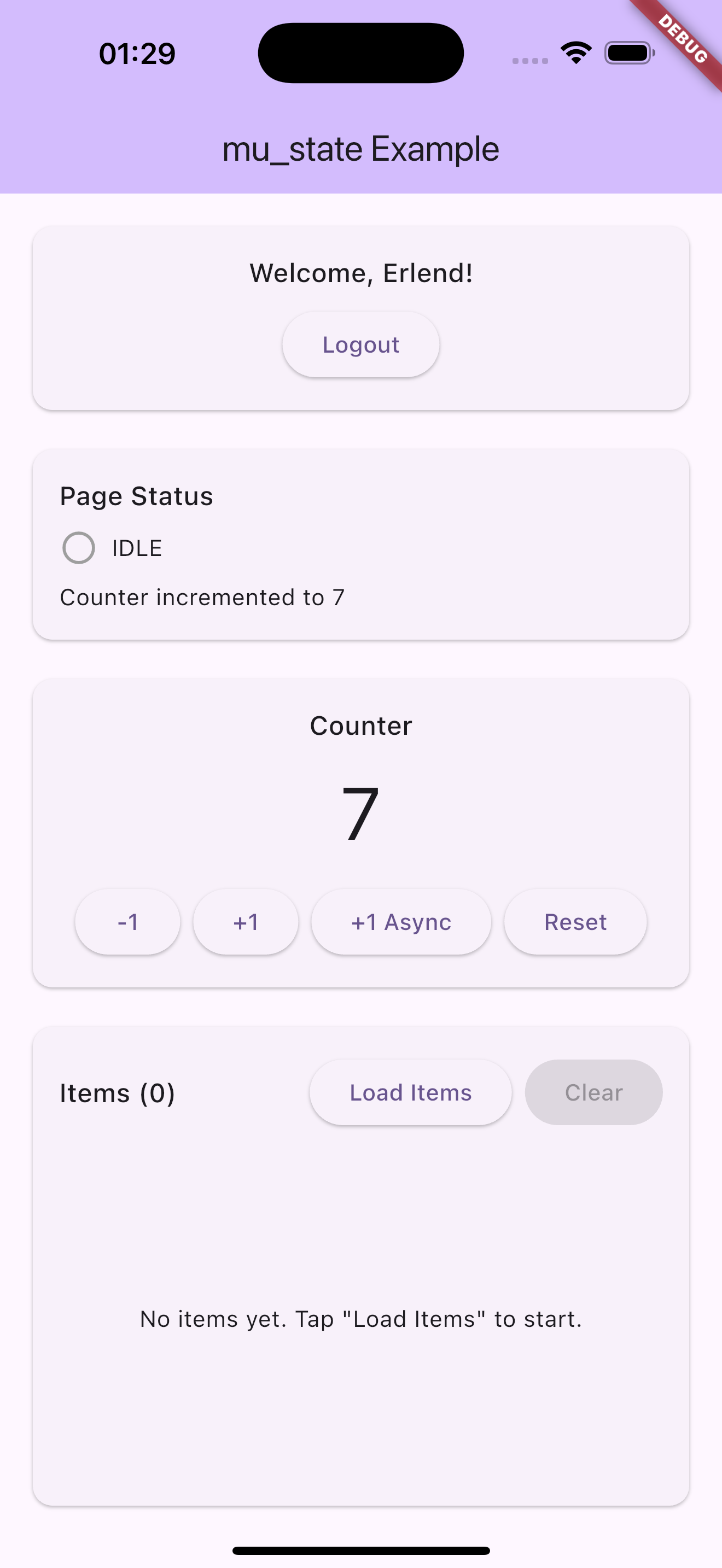
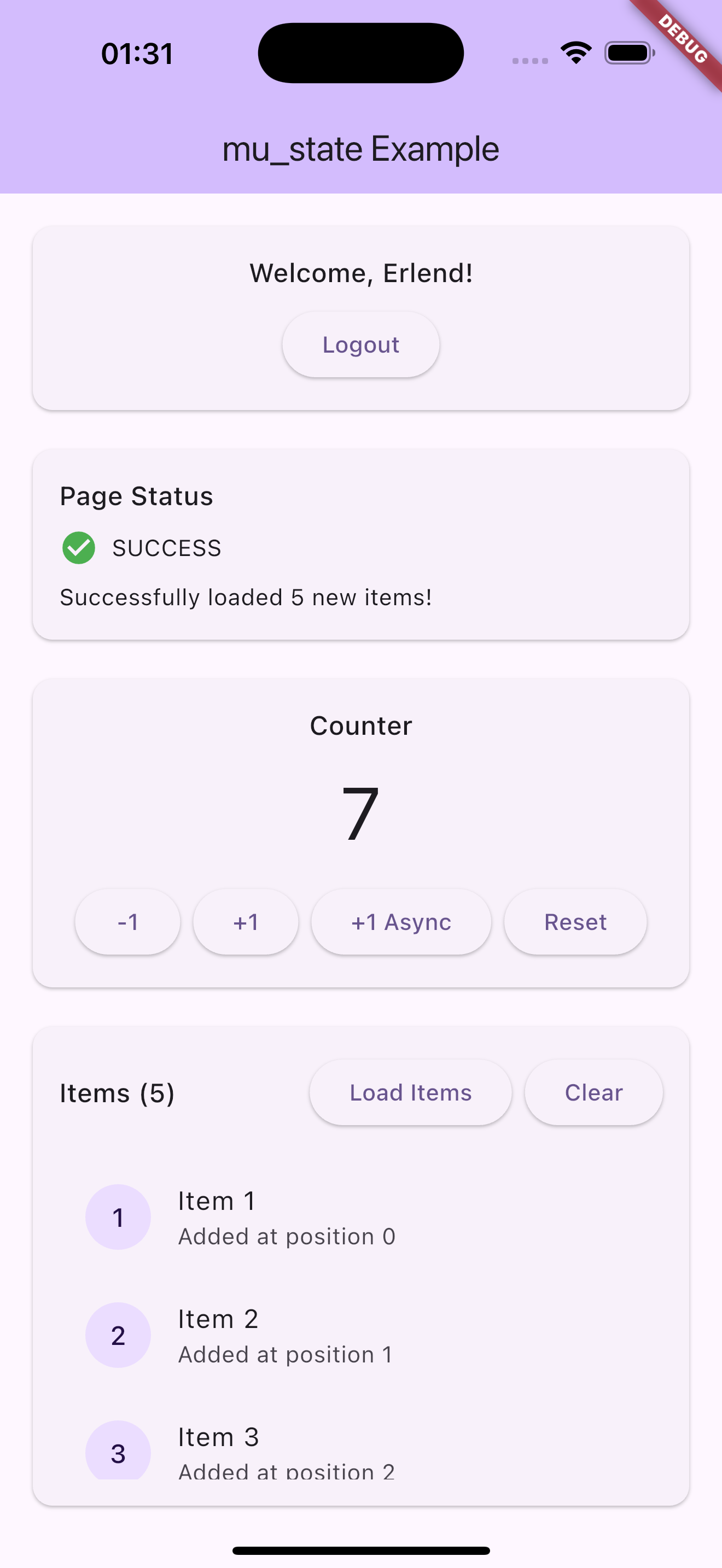
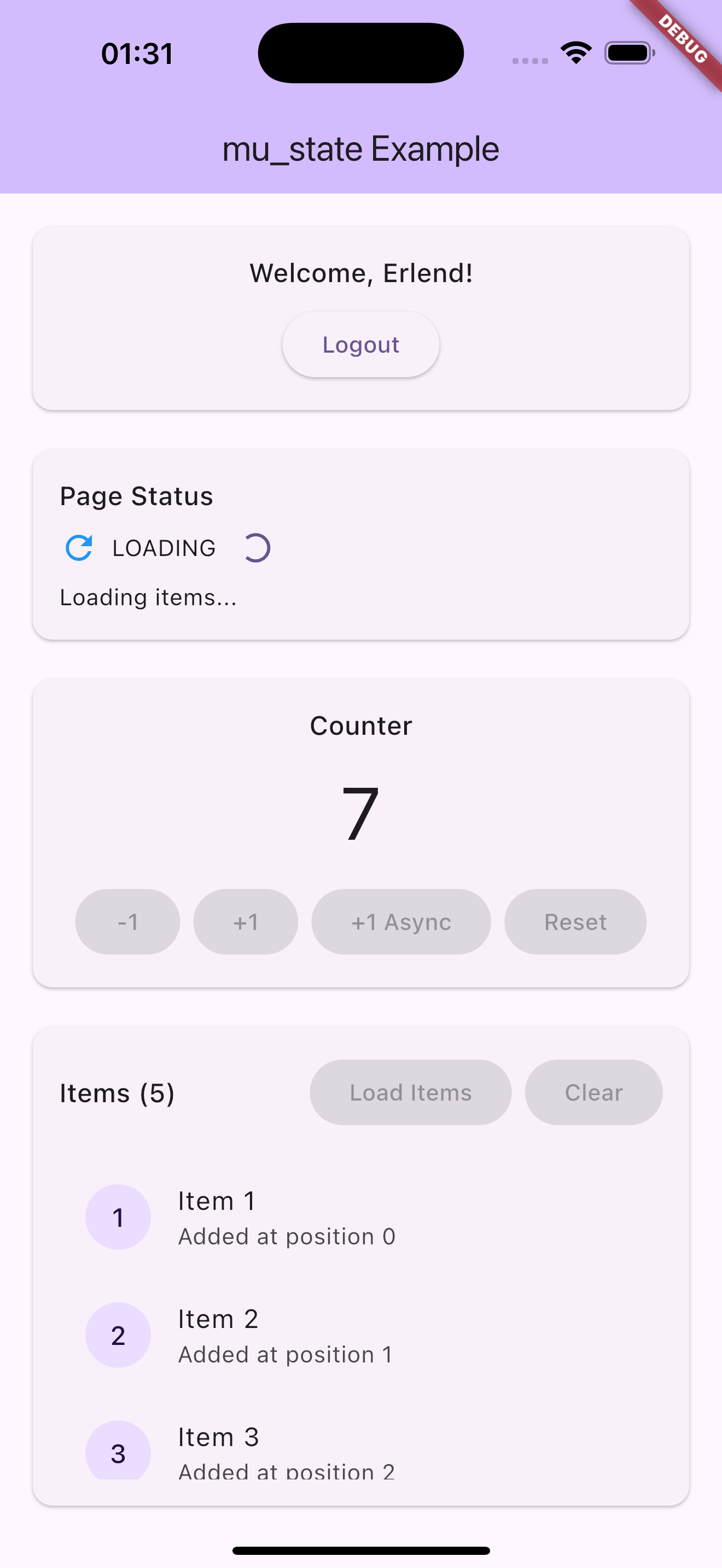
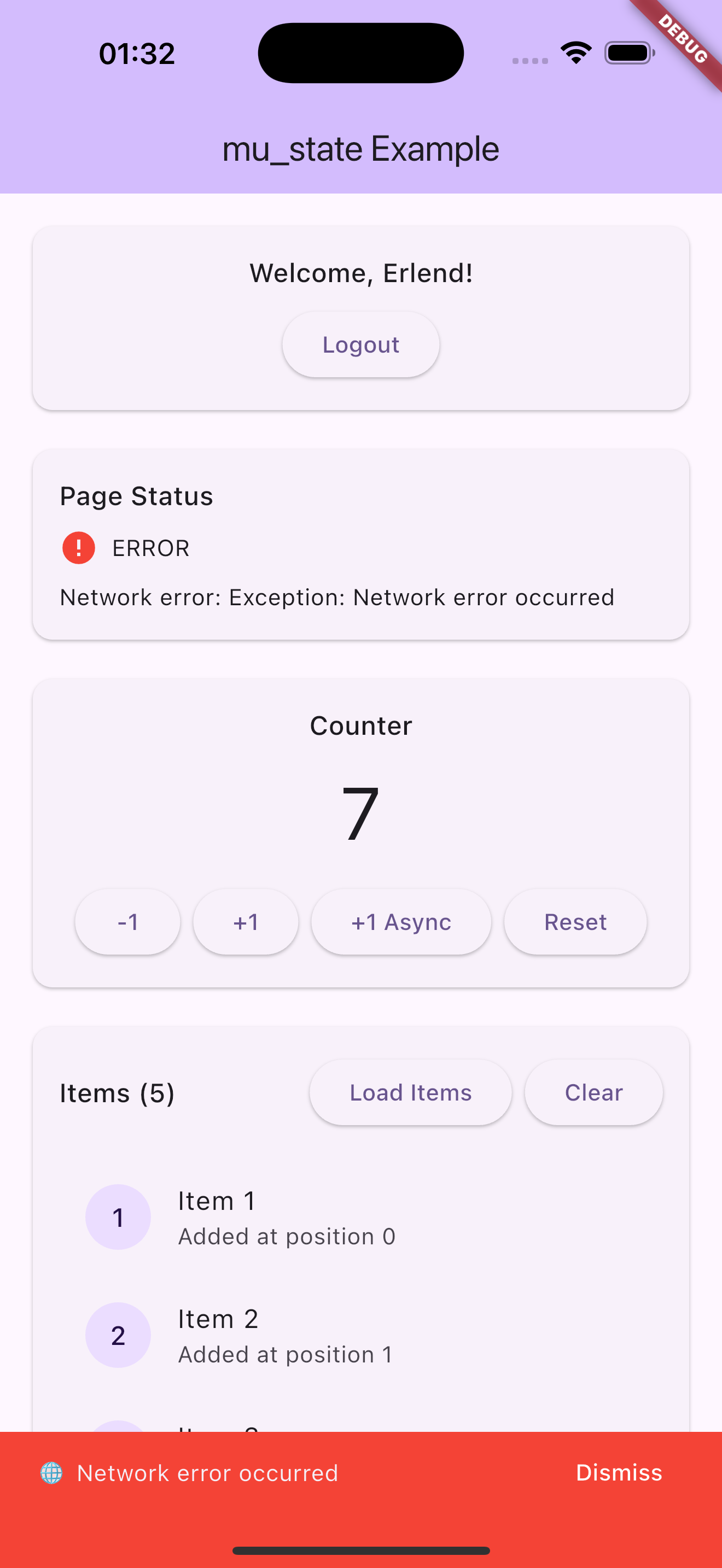
## Screenshots
## Usage
Let's create a simple counter to see how `mu_state` works:
### counter_logic.dart
```dart
import 'package:mu_state/mu_state.dart';
class CounterState with MuComparable {
final int counter;
final bool isLoading;
final String? error;
const CounterState({required this.counter, required this.isLoading, this.error});
CounterState copyWith({int? counter, bool? isLoading, String? error}) {
return CounterState(
counter: counter ?? this.counter,
isLoading: isLoading ?? this.isLoading,
error: error ?? this.error,
);
}
@override
List get props => [counter, isLoading, error];
}
class CounterLogic extends MuLogic {
CounterLogic() : super(const CounterState(counter: 0, isLoading: false));
void increment() {
value = value.copyWith(counter: value.counter + 1);
}
Future incrementAsync() async {
value = value.copyWith(isLoading: true, error: null);
await Future.delayed(const Duration(seconds: 1));
// Simulate random error
if (DateTime.now().millisecondsSinceEpoch % 3 == 0) {
value = value.copyWith(isLoading: false, error: 'Failed to increment');
} else {
value = value.copyWith(counter: value.counter + 1, isLoading: false);
}
}
}
```
### main.dart
```dart
import 'package:flutter/material.dart';
import 'package:mu_state/mu_state.dart';
import 'counter_logic.dart';
void main() => runApp(CounterApp());
class CounterApp extends StatelessWidget {
@override
Widget build(BuildContext context) {
return MaterialApp(
home: MuProvider(
value: CounterLogic(),
child: CounterPage(),
),
);
}
}
```
### counter_page.dart
```dart
class CounterPage extends StatelessWidget {
@override
Widget build(BuildContext context) {
final logic = context.logic();
return Scaffold(
appBar: AppBar(title: Text('Counter')),
body: MuListener(
logic: logic,
listener: (context, state) {
if (state.error != null) {
ScaffoldMessenger.of(context).showSnackBar(
SnackBar(content: Text('⚠️ ${state.error}')),
);
}
},
listenWhen: (prev, curr) => prev.error != curr.error && curr.error != null,
child: Center(
child: Column(
mainAxisAlignment: MainAxisAlignment.center,
children: [
MuBuilder(
valueListenable: logic,
builder: (context, state, child) {
return Column(
children: [
Text('Counter: ${state.counter}', style: Theme.of(context).textTheme.headlineMedium),
if (state.isLoading) CircularProgressIndicator(),
],
);
},
),
SizedBox(height: 20),
ElevatedButton(
onPressed: () => logic.increment(),
child: Text('Increment'),
),
SizedBox(height: 8),
ElevatedButton(
onPressed: () => logic.incrementAsync(),
child: Text('Async Increment'),
),
],
),
),
),
);
}
}
```
At this point we have successfully separated our presentational layer from our business logic layer. Notice that `CounterPage` knows nothing about what happens when a user taps the buttons. The widget simply notifies the `CounterLogic` that the user has pressed increment.
> **Alternative:** You could also use `MuConsumer` to combine the listener and builder functionality in a single widget. See the [MuConsumer](#muconsumer) section below for details.
## Components
### MuLogic
`MuLogic` is a typedef for `ValueNotifier` that serves as the foundation for your business logic. It manages state and notifies listeners when the state changes. `MuLogic` is essentially an alias that makes the code more semantic for state management purposes.
```dart
class CounterLogic extends MuLogic {
CounterLogic() : super(const CounterState(counter: 0, isLoading: false));
void increment() {
value = value.copyWith(counter: value.counter + 1);
}
}
```
Since `MuLogic` extends `ValueNotifier`, you get all the familiar methods like `addListener`, `removeListener`, and the `value` property for getting and setting state.
### MuBuilder
`MuBuilder` is a typedef for `ValueListenableBuilder` that rebuilds the widget when the state changes. It's essentially an alias that makes the code more semantic for state management, but underneath it's just Flutter's built-in `ValueListenableBuilder`.
See `MuListener` if you want to "do" anything in response to state changes such as navigation, showing a dialog, etc...
```dart
MuBuilder(
valueListenable: logic,
builder: (context, state, child) {
return Text('Counter: ${state.counter}');
}
)
```
### MuComparable
`MuComparable` is a mixin that provides equality comparison for state classes. It's a lightweight alternative to packages like Equatable and helps `MuBuilder` and other listeners determine when to rebuild.
```dart
class CounterState with MuComparable {
final int counter;
final String? error;
const CounterState({required this.counter, this.error});
@override
List get props => [counter, error];
}
```
The `props` list should include all properties that determine equality. When state changes, widgets will only rebuild if the new state is different from the previous state based on these properties.
### MuListener
`MuListener` performs side effects in response to state changes - navigation, showing dialogs, etc. The `listener` is called once per state change and by default NOT on initial state (`lazy: true`). Set `lazy: false` to call the listener immediately with the current state.
```dart
MuListener(
logic: logic,
listener: (context, state) {
if (state.error != null) {
ScaffoldMessenger.of(context).showSnackBar(
SnackBar(content: Text('Error: ${state.error}')),
);
}
},
listenWhen: (prev, curr) => prev.error != curr.error,
child: Container(),
)
```
### MuProvider
`MuProvider` is a Flutter widget which provides any value to its children via dependency injection. While originally designed for `MuLogic` instances, it's now fully generic and can provide any type - making it perfect for injecting repositories, services, or other dependencies throughout your widget tree.
You provide the instance to `MuProvider` via the `value` parameter. `MuProvider` will automatically handle disposing the value when the provider is disposed (if it implements `ChangeNotifier`, which `MuLogic` does).
```dart
MuProvider(
value: CounterLogic(),
child: CounterPage(),
);
```
Access from anywhere in the subtree:
```dart
// For MuLogic instances
final logic = context.logic();
// For any type
final repo = context.read();
```
### MuMultiProvider
`MuMultiProvider` is a Flutter widget that merges multiple `MuProvider` widgets into one. `MuMultiProvider` improves the readability and eliminates the need to nest multiple `MuProviders`. By using `MuMultiProvider` we can go from:
```dart
MuProvider(
value: LogicA(),
child: MuProvider(
value: LogicB(),
child: MuProvider(
value: LogicC(),
child: ChildA(),
)
)
)
```
to:
```dart
MuMultiProvider([
(child) => MuProvider(value: LogicA(), child: child),
(child) => MuProvider(value: LogicB(), child: child),
(child) => MuProvider(value: LogicC(), child: child),
], child: ChildA())
```
### MuMultiBuilder
`MuMultiBuilder` is a Flutter widget which listens to multiple `MuLogic` instances and rebuilds when any of them change. This is useful when you need to build UI that depends on multiple state sources.
```dart
MuMultiBuilder(
listenables: [logicA, logicB],
builder: (context, values, child) {
final stateA = values[0] as StateA;
final stateB = values[1] as StateB;
return Text('A: ${stateA.value}, B: ${stateB.value}');
},
)
```
### MuMultiListener
`MuMultiListener` is a Flutter widget that merges multiple `MuListener` widgets into one. `MuMultiListener` improves the readability and eliminates the need to nest multiple `MuListener`s. By using `MuMultiListener` we can go from:
```dart
MuListener(
logic: logicA,
listener: (context, state) {
// handle state A changes
},
child: MuListener(
logic: logicB,
listener: (context, state) {
// handle state B changes
},
child: ChildWidget(),
),
)
```
to:
```dart
MuMultiListener(
listeners: [
(child) => MuListener(
logic: logicA,
listener: (context, state) {
// handle state A changes
},
child: child,
),
(child) => MuListener(
logic: logicB,
listener: (context, state) {
// handle state B changes
},
child: child,
),
],
child: ChildWidget(),
)
```
### MuConsumer
`MuConsumer` combines `MuBuilder` and `MuListener` functionality in a single widget.
```dart
MuConsumer(
logic: logic,
listener: (context, state) {
if (state.error != null) {
ScaffoldMessenger.of(context).showSnackBar(
SnackBar(content: Text('Error: ${state.error}')),
);
}
},
builder: (context, state, child) {
return Text('Counter: ${state.counter}');
},
)
```
An optional `listenWhen` and `buildWhen` can be implemented for more granular control over when `listener` and `builder` are called. The `listenWhen` and `buildWhen` functions take the previous state and the current state and return a `bool` which determines whether or not the `listener` or `builder` function will be invoked.
```dart
MuConsumer(
logic: logic,
listenWhen: (previous, current) {
// return true/false to determine whether or not
// to invoke listener with state
return previous.error != current.error;
},
listener: (context, state) {
// do stuff here based on state
},
buildWhen: (previous, current) {
// return true/false to determine whether or not
// to rebuild the widget with state
return previous.counter != current.counter;
},
builder: (context, state, child) {
// return widget here based on state
return Text('Counter: ${state.counter}');
}
)
```
See the [example project](example/) for a complete implementation with more features.