https://github.com/explyt/spring-plugin
Explyt Spring is a free, source-available plugin for IntelliJ IDEA Community Edition, designed to simplify and improve development with the Spring Framework.
https://github.com/explyt/spring-plugin
ide intelij jav kotlin plugin spring spring-boot springframework
Last synced: 5 months ago
JSON representation
Explyt Spring is a free, source-available plugin for IntelliJ IDEA Community Edition, designed to simplify and improve development with the Spring Framework.
- Host: GitHub
- URL: https://github.com/explyt/spring-plugin
- Owner: explyt
- License: other
- Created: 2023-11-19T17:00:23.000Z (over 2 years ago)
- Default Branch: main
- Last Pushed: 2024-11-19T11:18:32.000Z (over 1 year ago)
- Last Synced: 2024-11-19T11:20:01.970Z (over 1 year ago)
- Topics: ide, intelij, jav, kotlin, plugin, spring, spring-boot, springframework
- Language: Kotlin
- Homepage: https://explyt.com/spring
- Size: 1.68 MB
- Stars: 37
- Watchers: 10
- Forks: 4
- Open Issues: 1
-
Metadata Files:
- Readme: README.md
- Changelog: CHANGELOG.md
- Contributing: CONTRIBUTING.md
- License: LICENSE.md
Awesome Lists containing this project
README
# Explyt Spring Plugin for IntelliJ IDEA Community Edition


[](https://plugins.jetbrains.com/plugin/28675-spring-explyt)
[](https://plugins.jetbrains.com/plugin/28675-spring-explyt/versions)
[](https://t.me/explytspring)
Available on JetBrains Marketplace: https://plugins.jetbrains.com/plugin/28675-spring-explyt
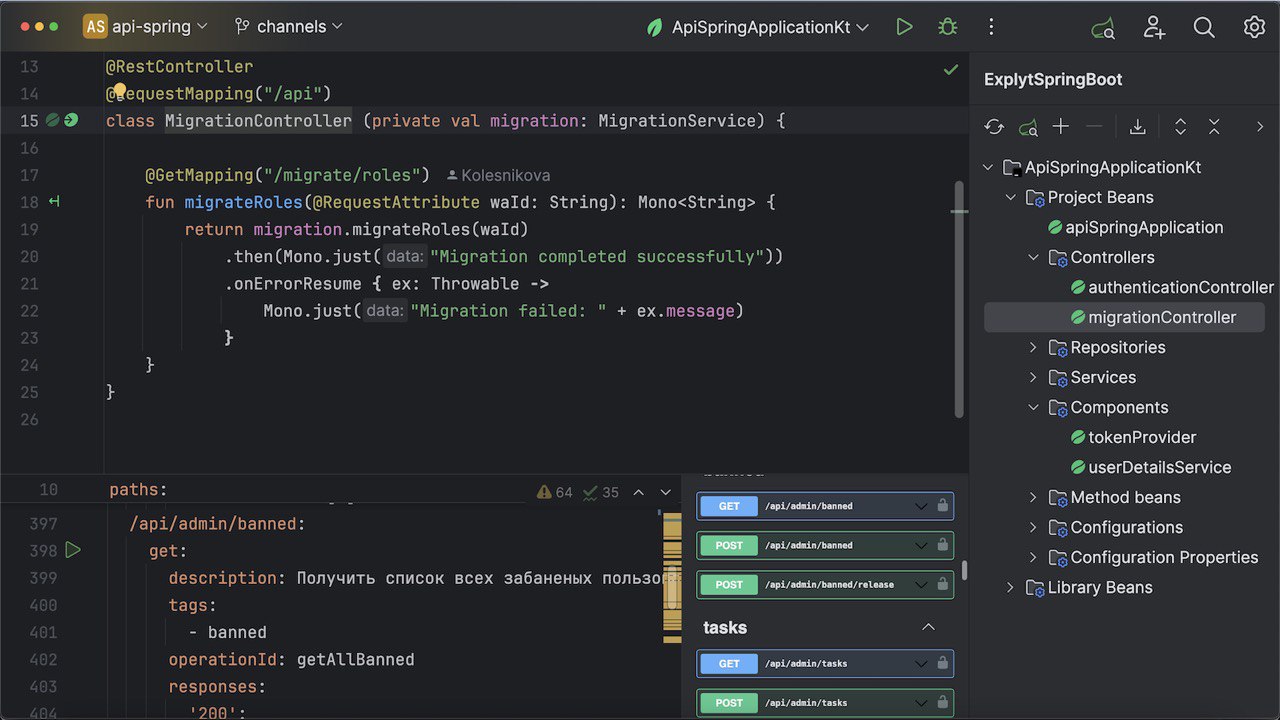
**Explyt Spring Plugin** supercharges your IntelliJ IDEA Community Edition with advanced Spring Framework features—usually only available in the Ultimate Edition. Develop Spring applications faster and smarter with enhanced tools for beans, configurations, endpoints, and more.
---
**Plugin Status**: The plugin is completely **FREE** for both non-commercial and commercial use.
---
👉 Visit the [official Explyt website](https://explyt.ai/docs/category/explyt-spring).
## Table of Contents
- [Features](#features)
- [Key Features](#key-features)
- [Our Innovative Approach](#our-innovative-approach)
- [Built-in HTTP Client Using Swagger UI](#built-in-http-client-using-swagger-ui)
- [Spring Core and Boot Enhancements](#spring-core-and-boot-enhancements)
- [Spring Web Enhancements](#spring-web-enhancements)
- [Spring Debugger](#spring-debugger)
- [Quarkus Support](#quarkus-support)
- [Spring Data Support](#spring-data-support)
- [Spring AOP Enhancements](#spring-aop-enhancements)
- [Spring Initializr](#spring-initializr)
- [Docker Compose](#docker-compose)
- [Spring AI](#spring-ai)
- [Additional Inspections and Features](#additional-inspections-and-features)
- [Installation](#installation)
- [Installing Explyt Spring Plugin from Custom Repository](#installing-explyt-spring-plugin-from-custom-repository)
- [Usage](#usage)
- [Learn More](#learn-more)
- [Integrations](#integrations)
- [Contributing](#contributing)
- [Community and Support](#community-and-support)
- [License](#license)
- [Acknowledgments](#acknowledgments)
## Features
### Key Features
- **Accurate Bean Detection**: Understand your Spring application with real bean data, even for complex configurations.
- **Built-in HTTP Client**: Test APIs using Swagger UI directly in your IDE.
- **Advanced Inspections**: Detect and fix issues in Spring configurations, beans, and annotations.
- **Spring Boot & Web Support**: Enhanced tools for Spring Boot, MVC, WebFlux, and more.
- **Kotlin-Friendly**: Full support for Kotlin Spring applications.
- **Lightweight & Fast**: Runs a lightweight version of your app for accurate insights without slowing down your IDE.
- **Quarkus Support**: CDI/DI navigation and inspections, JAX-RS web endpoints, AOP (interceptors/decorators), Endpoints tool window, and a Swagger UI–based HTTP client.
### Our Innovative Approach
**Explyt Spring Plugin** uses a unique method to understand your Spring application thoroughly. Instead of analyzing only the source code, our plugin runs a lightweight version of your application to get accurate information about your Spring beans. This means:
Note: Behind the scenes, we use a javaagent and declarative bytecode patching to hook into Spring’s startup and extract bean metadata early, without fully starting the app. Read more:
- [Stop playing catch-up with Spring — Explyt Spring plugin for IDEA Community (EN)](https://medium.com/@explytspring/stop-playing-catch-up-with-spring-introducing-the-explyt-spring-plugin-for-idea-community-0be380b36a75)
- [Patching Spring bytecode to enhance application context recognition (EN)](https://medium.com/@explytspring/explyt-spring-plugin-patching-spring-bytecode-to-enhance-application-context-recognition-0817fb52b056)
- **Accurate Bean Detection**: We can detect beans that are conditionally loaded or defined through complex configurations.
- **Better Inspections**: By having real bean data, we reduce false warnings and provide more precise code inspections.
- **Improved Navigation and Completion**: Navigate to beans and get code completion suggestions based on actual bean definitions.
This approach ensures that even if your application uses advanced Spring features like `@Conditional`, complex `@ComponentScan` configurations, or custom conditions, the plugin understands them correctly.
### Built-in HTTP Client Using Swagger UI
We are excited to introduce our **built-in HTTP client** for IntelliJ IDEA Community Edition,
integrated directly into the Explyt Spring Plugin.
This feature allows you to test and interact with HTTP APIs seamlessly within your IDE.
#### Key Advantages
- **No Custom DSL Needed**: Use familiar **Spring Web annotations** to define HTTP requests instead of learning a new domain-specific language (DSL).
- **Leverage Swagger UI**: We utilize **Swagger UI** to provide a rich interface for executing and analyzing HTTP requests.
- **Quick Setup**: Write methods with Spring annotations, and the plugin generates OpenAPI specifications automatically.
- **Familiar Tools**: Benefit from well-known technologies like Spring Web, OpenAPI, and Swagger UI.
#### How It Works
1. **Define HTTP Methods Using Spring Annotations**
Write methods in Java or Kotlin using standard Spring Web annotations to describe the HTTP requests you want to make.
```java
@GetMapping("https://api.openweathermap.org/data/2.5/weather")
public String getWeather() {
// Implementation is not important
}
```
2. **Generate OpenAPI Specification**
The plugin analyzes your annotated methods and generates an OpenAPI file representing the API definitions.
3. **Launch Swagger UI in IntelliJ IDEA**
With a simple click on the **Run** icon next to your method, the plugin opens Swagger UI inside the IDE using the generated OpenAPI file.
4. **Execute HTTP Requests**
Use Swagger UI to fill in parameters, execute the requests, and view the responses—all within the IDE.
#### Benefits
- **Simplifies API Testing**: Quickly test external services or APIs without leaving your development environment.
- **No Extra UI Development**: By using Swagger UI, we avoid the need to create and maintain a custom user interface.
- **Familiar Workflow**: Developers comfortable with Spring and Swagger will find this approach intuitive.
#### Additional Features
- **Code Generators**
- **Generate Methods from URLs or cURL Commands**: Use the **Generate** menu (`Alt+Ins`) inside a Java class or Kotlin file to create Spring Web methods based on a given URL or cURL command.
- **Supports Java and Kotlin**: Works seamlessly with both languages.
- **Supports OpenAPI Editing**
- **Edit OpenAPI Files**: If needed, you can directly edit the generated OpenAPI files. The plugin provides code completion and validation support for OpenAPI specifications.
- **Handles Common Issues**
- **CORS Handling**: We implemented a custom request handler to bypass CORS issues when making web requests from the embedded browser.
#### Use Cases
- **Testing External APIs**: Ideal for experimenting with third-party services like weather APIs, payment gateways, etc.
- **Quick Prototyping**: Easily create and test API calls during development without switching tools.
- **Learning and Documentation**: Helps new team members understand API interactions by providing a visual interface.
### Two Ways to Test HTTP Requests
1. **Swagger UI Integration** (recommended for Spring annotation workflows).
2. **`.http`/`.rest` File Execution** (ideal for users familiar with IntelliJ HTTP Client or HttpYac).
Choose the method that best fits your workflow!
### Quarkus Support
Explyt Spring Plugin now brings first-class Quarkus support to IntelliJ IDEA Community Edition out of the box.
- Dependency Injection (CDI):
- Detect and navigate injections via @Inject, qualifiers, scopes.
- Supports producers (@Produces) on fields and methods with navigation both ways.
- AOP:
- Interceptors and decorators with gutter markers and navigation to/from advised targets.
- Web (JAX-RS):
- Endpoints tool window for REST resources, navigation to handlers, duplicate-path checks.
- Swagger UI–based HTTP client for methods with absolute Path URLs; OpenAPI generation and execution inside the IDE.
- Works by static code analysis, so most features are available just by opening a Quarkus project—no app run required.
If you see issues or edge cases, please open an issue in GitHub.
### Spring Core and Boot Enhancements
- **Advanced Inspections and Quick Fixes**:
- **Property Key Validations**: Detects unused properties, duplicate keys, and keys that don't follow the kebab-case convention.
- **Configuration Properties Support**: Navigate, complete, and validate `@ConfigurationProperties` classes.
- **Nullable Parameters Check**: Warns if constructor parameters in `@ConfigurationProperties` classes are not nullable.
- **Invalid Prefix Detection**: Finds empty, duplicate, or incorrectly formatted prefixes in `@ConfigurationProperties`.
- **Configuration Verification**: Ensures `@ConfigurationProperties` classes are correctly registered with Spring.
- **Quick-Fix Improvements**: Smarter suggestions and corrections for common configuration property mistakes (see changelog for demo videos).
- **Bean Autowiring Checks**:
- Reports if no beans are found for autowiring.
- Alerts if multiple candidate beans cause ambiguity.
- Checks for invalid use of `@Autowired` annotations.
- **Proxy Method Usage Inspection**: Warns about incorrect use of proxy methods when `proxyBeanMethods` is set to false.
- **Resource Reference Validation**: Validates file and classpath resource references in annotations like `@Value`.
- **AOP Method Call Inspection**: Alerts if AOP-advised methods are called within the same class, which may not work as expected.
- **Meta-Annotation Checks**: Ensures custom annotations used as meta-annotations have the correct settings.
- **Code Completion and Navigation**:
- **Property Files**: Enhanced suggestions for properties, including relaxed binding and nested properties.
- **Annotation Attributes**: Completion and navigation for package names in annotations like `@ComponentScan`.
- **Bean Methods**: Navigate from bean usage to their definitions, even across different configuration classes.
- **Query Languages**: JPQL plus basic SQL DML out of the box (no external plugin). Works in `JdbcTemplate`, `@Query(nativeQuery = true)`, `@NamedNativeQuery`, and inline strings; `JdbcClient` parameter inspections and navigation.
- **Line Markers and Gutter Icons**:
- Visual markers for beans, configurations, and `@Scheduled` methods.
- Easily navigate between bean definitions and their usages.
- **Other Enhancements**:
- XML configuration support when using native context mode (no extra setup required).
- SPI bean navigation and line markers for SPI-produced beans.
- Search Everywhere integration: quickly find beans by name.
- One-click converter between `.properties` and `.yml` Spring configuration files.
### Spring Web Enhancements
- **Endpoints Tool Window**: Access all your Spring MVC, WebFlux, and message broker endpoints in one place.
View, navigate, and analyze your controllers, router functions, and messaging listeners.
- **Inspections and Quick Fixes**:
- **Duplicate Endpoint Detection**: Warns about duplicate `@RequestMapping` paths.
- **Controller Method Checks**: Finds missing `@PathVariable`s, unsupported method signatures, and more.
- **OpenAPI Specification Support**:
- Validates OpenAPI files (JSON and YAML).
- Provides navigation and completion for `$ref` references.
- Checks OpenAPI version compatibility.
- **Code Completion and Navigation**:
- **WebClient and WebTestClient**: Enhanced suggestions for methods, including parameters and URI templates.
- **Router Functions**: Support for `RouterFunctions` and Kotlin `coRouter`.
- **MockMvc Integration**: Improved handling of multipart requests and parameter checks.
- **Line Markers and Gutter Icons**:
- Visual indicators for controller methods and router functions.
- Navigate between HTTP requests and their handling methods.
- **Execute HTTP Requests via `.http` or `.rest` Files**
#### Execute HTTP Requests via `.http` or `.rest` Files
Explyt Spring Plugin now supports **`.http`** and **`.rest`** files with seamless integration for both:
- **JetBrains HttpClient CLI**
- **HttpYac** (open-source alternative)
**Key Features**:
- **Run Line Markers**: Click the **▶️ Run icon** next to request sections in `.http`/`.rest` files to execute them using your configured runner.
- **Minimal Setup**: No complex configuration needed—just choose your preferred runner.
- **Flexible Execution**: Works with both JetBrains’ HttpClient (Ultimate) and HttpYac.
**Example**:
```http
### Get a sample
GET https://httpbin.org/anything
Accept: application/json
```
Click the **▶️ Run icon** next to the request to execute it.
#### Configure Your Runner
1. **JetBrains HttpClient CLI** (Recommended for Community Edition):
- Go to **Settings > Tools > Explyt Spring**.
- Click **Download HttpClient CLI** – the plugin handles installation and path configuration automatically.
- Done! The CLI is now ready to execute `.http`/`.rest` files.
2. **HttpYac** (Alternative):
- Install globally via npm:
```bash
npm install -g httpyac
```
- Ensure `httpyac` is in your system PATH.
- Setup in **Settings > Tools > Explyt Spring** runner executable path `httpyac`
To switch runners, go to **Settings > Tools > Explyt Spring** and select your preferred tool.
#### HTTP Client Options
- Swagger UI integration using Spring annotations (Run icon on endpoints) – details: [HTTP client via annotations and Swagger UI](https://habr.com/ru/companies/explyt/articles/874236/)
- Execute `.http`/`.rest` files via HttpYac or JetBrains HttpClient – details: [HTTP client via HttpYac and JetBrains HttpClient](https://habr.com/ru/companies/explyt/articles/884280/)
### Spring Debugger
- Remote Debugger: attach to a running JVM (started with JDWP) and the Explyt javaagent; full support for breakpoints, runtime PropertySource resolution, BeanDefinition view, transaction info, and auto Web URL detection. [Agent source](https://github.com/explyt/spring-plugin/blob/main/explyt-spring-boot-bean-reader/java-agent/src/main/java/com/explyt/spring/boot/bean/reader/InternalHolderContext.java) · [agent JAR](https://github.com/explyt/spring-plugin/blob/main/modules/spring-core/libs/explyt-java-agent-0.1.jar)
- Debug Spring applications with the Explyt Spring Debugger run configuration.
- Automatically patches build/run to attach a lightweight javaagent and reverts Gradle configuration after debug.
- Dedicated nodes and improved presentation in the debugger tree for Spring beans, including Explyt: Spring Context and Active Transaction variables.
- Evaluate Spring context directly in the debugger via `Explyt.context` and helpers (`getBeanFactory()`, `getEnvironment()`); call any bean methods at breakpoints.
- Inline run markers on Spring Data repository methods during debug to auto‑populate Evaluate Expression and run queries.
- Inactive beans are visually indicated during debug to highlight context membership.
- Compatible with IntelliJ IDEA 2024.1 / 2024.2 (builds 241 / 242) via legacy debug mode ([demo video](https://storage.yandexcloud.net/explyt-web/videos/spring-wiki/debugger/spring-debug-old.mp4)).
- [Learn more about Explyt Spring Debugger](https://habr.com/ru/companies/explyt/articles/933158/)
### Spring Data Support
- **Repository Method Name Validation**: Ensures your repository methods follow naming conventions and match actual entity properties.
- **Return Type and Parameter Checks**: Validates that repository methods have correct return types and parameters that match the query.
- **Language Injection**: Offers JPQL and SQL syntax support within repository query methods.
- **Bean Recognition**: Detects Spring Data repositories as beans, helping with navigation and autowiring checks.
- **Repository Method Autocomplete**: Offers autocompletion for new Repository methods using method naming conventions and entity properties.
- **Generate equals/hashCode for JPA entities**: based on best practices (Code → Generate) per Vlad Mihalcea’s guidance.
- **Spring Data 4.0 AOT Navigation**: Jump from repository methods to AOT-generated artifacts and back, to better understand what Spring Data executes at runtime.
### Spring AOP Enhancements
- **AOP Method Call Inspection**: Warns when methods with annotations like `@Transactional` or `@Async` are called from within the same class.
- **Line Markers**: Visual markers for aspects, pointcuts, and advice methods, making navigation easier.
### Spring Initializr
- Create new Spring projects directly from the IDE with enhanced error reporting and compatibility fixes.
- Works in Community Edition; supports Kotlin and Java templates.
### Docker Compose
- Completion for Spring properties and environment variables in docker-compose files.
- Go to declaration for property keys to jump into application properties/yaml.
### Spring AI
- Optional integration with the Explyt AI platform to assist with Spring tasks inside the IDE.
- The AI agent can read/modify project files, explore code, run non-destructive terminal commands, and analyze compilation errors.
- Works with OpenAI‑compatible providers and can be configured to use local or cloud models.
- Requires IntelliJ Platform at least 2025.1 (251+) for AI integrations.
- [Overview of Explyt AI and integrated agents](https://habr.com/ru/companies/explyt/articles/936992/).
- New: AI-augmented Spring actions — details in our article [Neural Networks in Spring Development: Eliminating Routine, Not Intelligence (RU)](https://habr.com/ru/companies/explyt/articles/944266/)
#### AI-augmented Spring actions (when Explyt AI plugin is also installed)
- Convert DB schema to JPA Entity: Right-click Liquibase/Flyway/SQL file → Explyt Spring AI Actions → Convert Liquibase/Flyway File to Entity.
- Entity ↔ DTO conversion: Right-click entity/DTO → Explyt AI Actions → Convert Entity to DTO (and reverse). Supports multiple files, field exclusions, and validation annotations.
- Controller ↔ OpenAPI round-trip: Convert Spring RestController to OpenAPI, and generate controllers from OpenAPI for integrations.
- Generate Spring configs: Boilerplate Kafka and Security configurations via AI for Spring Boot projects (intended as a starting point).
- HTTP format conversions: Convert curl/Postman collections to RFC 7230 .http/.rest files supported by our HTTP client runners.
- Properties ↔ YAML: Convert Spring configuration between properties and YAML formats.
### Additional Inspections and Features
- **Kotlin Support**:
- Handles Spring-specific features in Kotlin code, such as `internal` modifier usages and constructor validations.
- Warns against using `object` components as Spring beans.
- Alerts when internal bean methods need explicit bean names.
- **Configuration Metadata Support**:
- Completion and validation in `additional-spring-configuration-metadata.json`.
- Schema support for additional configuration metadata files.
- **Profile Validation**:
- Checks `@Profile` annotations for errors, empty profiles, and misuse of operators.
- **Async Method Return Type Inspection**:
- Ensures methods annotated with `@Async` have valid return types (`void` or `Future` inheritors).
- **Cache Annotation Inspection**:
- Reports incorrect usage of cache annotations on interfaces and suggests using them on classes or methods instead.
- **Dependency Analyzer**:
- Analyze bean dependencies and navigate through their relationships.
- Helps understand complex bean interactions and resolve issues.
- **Experimental Scala Support**:
- Allows to create and develop projects using Scala lang.
## Installation
### Option 1: JetBrains Marketplace (recommended)
- Open IntelliJ IDEA → Settings → Plugins → Marketplace, search for "Spring Explyt" and click Install.
- Or install from the web: https://plugins.jetbrains.com/plugin/28675-spring-explyt
### Option 2: Install from Custom Repository

1. Open IntelliJ IDEA and go to **Settings** > **Plugins**.
2. Click the ⚙️ icon and select **Manage Plugin Repositories**.
3. Add the Explyt repository: [https://repository.explyt.dev/](https://repository.explyt.dev/).
4. Search for **Explyt Spring Plugin** in **Marketplace** tab and click **Install**.

5. Restart the IDE.
### Option 3: Manual Installation
> *(Note: In this case, you will not receive automatic updates.)*
1. Download the plugin from the [Releases Page](https://github.com/explyt/spring-plugin/releases).
2. Go to **Settings** > **Plugins** > ⚙️ > **Install Plugin from Disk**.
3. Select the downloaded `.zip` file and restart the IDE.
For additional details, go to [Installation Guide](https://github.com/explyt/spring-plugin/wiki/Installation-Guide).
Useful links: [Changelog](./CHANGELOG.md) · [Plugin description](./PLUGIN-DESCRIPTION.md)
---
## Usage
- **Endpoints Tool Window**
Access the **Explyt Endpoints** tool window from the right sidebar to see all endpoints in your project, including controllers and REST endpoints.
- **Native Bean Loading**
Use the **Explyt Spring Run Configuration** to load bean definitions directly from your Spring application. This process compiles your project and runs it in a special mode to get bean information without fully starting the application.
- Click on the **Load Beans** icon (a Spring Boot icon with a magnifying glass) to start loading.
- After loading, a panel showing all beans in your application will appear. Double-click any bean to navigate to it.
- **Built-in HTTP Client with Swagger UI**
- **Create HTTP Methods Using Spring Annotations**
Write methods in Java or Kotlin using Spring Web annotations to define HTTP requests. These methods can be placed in any class.
```java
@GetMapping("https://api.openweathermap.org/data/2.5/weather")
public void getWeather() {
// Implementation is not necessary
}
```
- **Run HTTP Requests**
A **Run** icon will appear next to methods with absolute URLs. Clicking this icon opens Swagger UI within IntelliJ IDEA.
- **Use Swagger UI**
- Fill in parameters and execute the HTTP request directly from the Swagger UI interface.
- View the response, headers, and other details.
- Copy the cURL command generated by Swagger UI for use elsewhere if needed.
- **Edit OpenAPI Files**
- Switch to the OpenAPI definition if you need to make manual adjustments.
- The plugin provides code completion and validation for OpenAPI files.
- **Generate Methods from URLs or cURL Commands**
- Use the **Generate** menu (`Alt+Ins`) inside a Java class or Kotlin file.
- Choose **"Spring Web Method from URL"** or **"Spring Web Method from cURL"**.
- This helps you quickly create methods without manually typing code.
- **Inspections and Quick Fixes**
The plugin automatically detects potential issues in your Spring application. Use `Alt+Enter` when an issue is highlighted to see quick fixes.
- **Code Completion and Navigation**
Enjoy improved code completion throughout your Spring application, including in properties files and annotations. Navigate easily between beans, configurations, and endpoints.
- **Line Markers and Gutter Icons**
Visual markers appear in the gutter to help you identify Spring components, endpoints, scheduled tasks, and more. Click these icons to navigate directly to related code.
- **Dependency Analyzer**
Analyze bean dependencies and navigate through their relationships. This is useful for understanding complex interactions and solving dependency issues.
- **Kotlin Support**
Take advantage of specialized features and inspections designed for Kotlin Spring applications.
- **Execute `.http` or `.rest` Files with JetBrains HttpClient**
1. **Create a `.http` file**:
- Right-click your project > **New** > **File**
- Name it with extension `.http`
2. **Write requests**:
```http
### Get weather data
GET https://api.openweathermap.org/data/2.5/weather?q=London
Accept: application/json
```
3. Run requests:
- Click the ▶️ Run icon next to a request section.
- View responses directly in the IDE’s Run Tool Window.
## Learn More
For a detailed overview of the plugin's features and how it can improve your development experience, check out our articles:
- **[Explyt Spring Release: SQL, Docker-Compose, Debugger (RU)](https://habr.com/ru/companies/explyt/articles/962536/)** — overview SQL DML, Docker Compose completions, and Remote Debugger.
- **[Neural Networks in Spring Development: Eliminating Routine, Not Intelligence (RU)](https://habr.com/ru/companies/explyt/articles/944266/)**
- **[Explyt AI Platform and integrated agents (RU)](https://habr.com/ru/companies/explyt/articles/936992/)**
- **[Explyt Spring Plugin: Quarkus support (RU)](https://habr.com/ru/companies/explyt/articles/926484/)**
- **[Explyt Spring Debugger (RU)](https://habr.com/ru/companies/explyt/articles/933158/)**
- **[Explyt Spring plugin: *.http files support in IntelliJ IDEA Community (RU)](https://habr.com/ru/companies/explyt/articles/884280/)**
- **[Explyt Spring Plugin — our take on the HTTP client for IntelliJ IDEA (RU)](https://habr.com/ru/companies/explyt/articles/874236/)**
- **[Patching Spring bytecode to enhance application context recognition (EN)](https://medium.com/@explytspring/explyt-spring-plugin-patching-spring-bytecode-to-enhance-application-context-recognition-0817fb52b056)** — deep dive into our javaagent and declarative bytecode patching.
- **[Stop playing catch-up with Spring — Explyt Spring plugin for IDEA Community (EN)](https://medium.com/@explytspring/stop-playing-catch-up-with-spring-introducing-the-explyt-spring-plugin-for-idea-community-0be380b36a75)** — background and approach to using native Spring logic for accurate context.
The articles include explanations, screenshots, and examples showing how the Explyt Spring Plugin can boost your productivity.
## Integrations
- Lombok support for Java projects
- JSR-330 annotations (jakarta.inject / javax.inject)
- JAX-RS annotations (jakarta.ws.rs / javax.ws.rs)
- Retrofit and OpenFeign annotations
- JPA/JPQL support (query language inspections and highlighting)
- Spring Security, Spring Cloud, Spring Integration, Spring Messaging modules
- Quarkus support: CDI, JAX-RS, interceptors, decorators, Endpoints tool window, Swagger UI–based HTTP client
- IntelliJ IDEA Ultimate: if you use Ultimate, disable the built‑in Spring plugin to avoid conflicts.
## Contributing
We welcome contributions! If you'd like to contribute to this project, please follow these steps:
1. **Fork the Repository**
Click the **Fork** button at the top of the [GitHub repository](https://github.com/explyt/spring-plugin) page to create your own copy.
2. **Clone Your Fork**
```bash
git clone https://github.com/your-username/spring-plugin.git
```
3. **Create a Feature Branch**
```bash
git checkout -b feature/your-feature-name
```
4. **Make Changes**
Implement your feature or fix a bug.
5. **Commit and Push**
```bash
git add .
git commit -m "Description of your changes"
git push origin feature/your-feature-name
```
6. **Create a Pull Request**
Open a pull request against the `main` branch of the original repository.
Thank you for helping us make Explyt Spring Plugin better! ⭐
## Community and Support
- **GitHub Issues**: Found a bug or have a feature request? [Open an issue](https://github.com/explyt/spring-plugin/issues).
- **Telegram**: Join our [Telegram channel](https://t.me/explytspring_en) for real-time support and discussions.
- *RU*: [Channel](https://t.me/explytspring), [Chat](https://t.me/explytspringchat)
- **Contributing**: Want to contribute? Check out our [Contributing Guide](https://github.com/explyt/spring-plugin/blob/main/CONTRIBUTING.md).
## License
Explyt Spring Plugin is **free for both commercial and non-commercial use**. However, redistribution or modification of the plugin is not allowed without explicit permission. For details, see the [Explyt License](https://github.com/explyt/spring-plugin/blob/main/LICENSE.md).
And if you want to utilise the source code of the plugin, you must read and accept our [Explyt Source License](https://github.com/explyt/spring-plugin/blob/main/EXPLYT-SOURCE-LICENSE.md).
## Acknowledgments
- **Inspiration**: Created to enhance Spring development in the IntelliJ IDEA Community Edition.
- **Contributors**: Thank you to all contributors who have helped improve this plugin. Your efforts are greatly appreciated.
---
For more information, issues, or to contribute, please visit the [GitHub repository](https://github.com/explyt/spring-plugin).
---
*Made with ❤️ by the Explyt Team.*