https://github.com/fab2s/flodl
rust recursive deep learning framework
https://github.com/fab2s/flodl
deep-learning graph machine-learning rust
Last synced: 2 months ago
JSON representation
rust recursive deep learning framework
- Host: GitHub
- URL: https://github.com/fab2s/flodl
- Owner: fab2s
- License: mit
- Created: 2026-03-09T23:15:59.000Z (4 months ago)
- Default Branch: main
- Last Pushed: 2026-04-13T16:53:15.000Z (3 months ago)
- Last Synced: 2026-04-13T18:30:53.435Z (3 months ago)
- Topics: deep-learning, graph, machine-learning, rust
- Language: Rust
- Homepage: https://flodl.dev
- Size: 18 MB
- Stars: 36
- Watchers: 1
- Forks: 1
- Open Issues: 1
-
Metadata Files:
- Readme: README.md
- Changelog: CHANGELOG.md
- Contributing: CONTRIBUTING.md
- License: LICENSE
- Code of conduct: CODE_OF_CONDUCT.md
- Security: SECURITY.md
Awesome Lists containing this project
README

floDl
A Rust-native deep learning framework built on libtorch.
Same GPU kernels as PyTorch. No Python. No GIL. No GC. Just Rust.





PyTorch Users •
Thesis •
Getting Started •
Graph Builder •
Graph Tree •
Training •
Multi-GPU •
Parity •
Benchmarks •
Roadmap •
Migration Guide •
Data Loading
---
> **What's new in 0.5.0** -- the `fdl` CLI maturity pass. New proc-macro
> crate [`flodl-cli-macros`](https://crates.io/crates/flodl-cli-macros)
> adds `#[derive(FdlArgs)]` -- any Rust binary gets typed argv parsing,
> JSON schema, shell completions, and env-var fallback for free.
> `fdl.yml` consolidates to a single `commands:` map with three clean
> kinds (`run:` / `path:` / preset). New
> [`--env` overlays](docs/cli.md#environment-overlays) and
> [`fdl config show`](docs/cli.md#fdl-config) surface per-environment
> config with per-field origin annotations, so you can see the
> resolved YAML before running a two-hour job. Migration from 0.4.0:
> see [UPGRADE.md](UPGRADE.md).
---
## If You Know PyTorch, You Know floDl
PyTorchfloDl
```python
model = nn.Sequential(
nn.Linear(2, 16),
nn.GELU(),
nn.LayerNorm(16),
nn.Linear(16, 2),
)
pred = model(x)
loss = F.mse_loss(pred, target)
loss.backward()
optimizer.step()
```
```rust
let model = FlowBuilder::from(Linear::new(2, 16)?)
.through(GELU)
.through(LayerNorm::new(16)?)
.through(Linear::new(16, 2)?)
.build()?;
let pred = model.forward(&x)?;
let loss = mse_loss(&pred, &target)?;
loss.backward()?;
optimizer.step()?;
```
Same concepts, same names, same GPU kernels underneath. The `?` operator
replaces silent failures with compile-time error handling. `Drop` replaces the
garbage collector. The [full migration guide](https://github.com/fab2s/floDl/blob/main/docs/pytorch_migration.md) covers
every op, module, and pattern.
> **New to Rust?** Read [Rust for PyTorch Users](https://github.com/fab2s/floDl/blob/main/docs/tutorials/00-rust-primer.md) — 10 patterns in 15 minutes.
## Getting Started
**With the CLI** (recommended, no Rust needed):
```bash
curl -sL https://flodl.dev/fdl -o fdl && chmod +x fdl
./fdl setup # detect hardware, download libtorch, configure build environment
./fdl init my-proj # scaffold a new project with training template
```
The `fdl` script auto-downloads a pre-compiled CLI binary (~750KB, pure Rust,
no libtorch dependency). It detects your GPUs, downloads the right libtorch
variant, and configures Docker or native builds. See the [full CLI
reference](docs/cli.md) for all commands.
**One-liner with Docker** (no Rust, no setup):
```bash
curl -sL https://flodl.dev/init.sh | sh -s my-project
cd my-project
./fdl build # first build (~5 min, downloads libtorch)
./fdl run # train the model
```
**Native** -- [Rust](https://rustup.rs/) 1.85+ and libtorch:
```bash
./fdl libtorch download # auto-detects CPU or CUDA
cargo add flodl && cargo build
```
For CUDA: `cargo add flodl --features cuda` + [CUDA toolkit](https://developer.nvidia.com/cuda-downloads).
> **Using tch-rs or PyTorch C++?** `fdl` also works as a standalone
> libtorch manager outside of flodl: download any CPU/CUDA variant,
> switch between installs, compile from source for mixed GPU
> architectures (e.g. sm_61 + sm_120 in one build), and emit a
> machine-readable diagnostics report. No flodl buy-in required.
> See [docs/cli.md § Standalone](docs/cli.md#1-standalone-no-project-required)
> and the [`flodl-cli` crate](https://crates.io/crates/flodl-cli).
Both paths generate an annotated training template. Edit `src/main.rs` to
build your model:
```rust
use flodl::*;
let model = FlowBuilder::from(Linear::new(2, 16)?)
.through(GELU)
.through(LayerNorm::new(16)?)
.also(Linear::new(16, 16)?) // residual connection
.through(Linear::new(16, 2)?)
.build()?;
let params = model.parameters();
let mut optimizer = Adam::new(¶ms, 0.01);
model.train();
for (input_t, target_t) in &batches {
let input = Variable::new(input_t.clone(), true);
let target = Variable::new(target_t.clone(), false);
let pred = model.forward(&input)?;
let loss = mse_loss(&pred, &target)?;
optimizer.zero_grad();
loss.backward()?;
clip_grad_norm(¶ms, 1.0)?;
optimizer.step()?;
}
```
## The Graph Builder
floDl's fluent graph builder lets you describe complex architectures as
readable data flow — no boilerplate, no `nn.Module` subclassing.
```rust
let model = FlowBuilder::from(Linear::new(2, 16)?)
.through(GELU) // activation
.through(LayerNorm::new(16)?) // normalization
.also(Linear::new(16, 16)?) // residual connection
.through(Linear::new(16, 2)?) // output projection
.build()?;
```
`build()` returns a `Graph` that implements `Module` — you can nest it
inside other graphs. Things get interesting when architectures get complex:
```rust
let g = FlowBuilder::from(encoder).tag("encoded")
.split(modules![head_a, head_b, head_c]).merge(MergeOp::Mean)
.loop_body(refinement_block).for_n(3).tag("refined")
.gate(router, modules![expert_a, expert_b]).using(&["encoded"])
.switch(selector, modules![light_path, heavy_path]).using(&["refined"])
.through(StateAdd).using(&["memory"]).tag("memory")
.loop_body(decoder).while_cond(halt_condition, 10)
.through(output_head)
.build()?;
```
Every construct — `split/merge`, `also`, `loop_body`, `gate`, `switch`, `map`,
`tag/using` — composes cleanly. Forward references (`using` before `tag`) carry
state across calls, enabling recurrent architectures without special-casing.
| Method | What it does |
|--------|-------------|
| `from(m).through(m)` | Linear chain |
| `also(m)` | Residual: `input + m(input)` |
| `fork(m)` | Side branch: capture output as tag, stream continues |
| `split(modules![...]).merge(op)` | Parallel branches, merged by `Add` or `Mean` |
| `tag(name)` / `using(refs)` | Named references — backward or forward (across calls) |
| `loop_body(body).for_n(n)` | Fixed iteration with BPTT |
| `loop_body(body).while_cond` / `until_cond` | Conditional loops |
| `gate(router, modules![...])` | Soft routing — weighted combination |
| `switch(selector, modules![...])` | Hard routing — only selected branch |
| `map(body).each()` / `.over(tag)` / `.slices(n)` | Element-wise, tagged, or sliced iteration |
| `input(names)` | Auxiliary graph inputs for multi-input architectures |
See the **[Graph Builder Tutorial](https://github.com/fab2s/floDl/blob/main/docs/tutorials/05-graph-builder.md)** and
the [full showcase](https://github.com/fab2s/floDl/tree/main/flodl/examples/showcase/).
## Graph Tree: Hierarchical Composition
This is where floDl goes beyond PyTorch. Graphs nest inside graphs with
**label-path addressing** — dot-separated paths that let you reach into any
subgraph from the root. Train components independently, compose them into
larger architectures, and control training phases declaratively.
```rust
// Build components independently
let scan = FlowBuilder::from(scan_net).tag("hidden")
.label("scan").build()?;
let read = FlowBuilder::from(read_net).tag("confidence")
.label("read").build()?;
let encoder = FlowBuilder::from(scan)
.through(read)
.label("encoder").build()?;
// Compose into full model
let model = FlowBuilder::from(encoder)
.through(classifier)
.build()?;
```
### Dotted paths reach anywhere
Every tag and subgraph is addressable through dotted paths from the root:
```rust
model.validate_path("encoder")?; // -> Subgraph
model.validate_path("encoder.scan.hidden")?; // -> Tag (three levels deep)
model.validate_path("encoder.read.confidence")?; // -> Tag
```
### Declarative training phases
Freeze and thaw entire subtrees by path — no manual parameter iteration:
```rust
// Phase 1: train only the classifier, encoder is frozen
model.freeze("encoder")?;
let fresh_params = model.parameters(); // only unfrozen params
let mut opt = Adam::new(&fresh_params, 1e-3);
// ... train ...
// Phase 2: thaw scan, keep read frozen (it's proven)
model.thaw("encoder.scan")?;
let mut opt = Adam::with_groups()
.group(&model.parameters_at("encoder.scan")?, 1e-4) // low LR
.group(&model.parameters_at("classifier")?, 1e-3)
.build();
```
### Subgraph checkpoints
Train a component standalone, save it, load it into a larger model:
```rust
// Pre-trained encoder saved earlier
encoder.save_checkpoint("encoder_v1.fdl.gz")?;
// Load into the composed model — namespace + hash validated
model.load_subgraph_checkpoint("encoder", "encoder_v1.fdl.gz")?;
model.freeze("encoder.read")?; // lock what's proven
```
### Cross-boundary observation
Metrics flow up through the tree automatically:
```rust
model.record_at("encoder.scan.loss", scan_loss)?;
model.record_at("encoder.read.accuracy", read_acc)?;
model.record_scalar("total_loss", total)?;
model.flush(&[]); // single call flushes the entire tree
// Trends across boundaries — drive training decisions
if model.trend_at("encoder.scan.loss")?.stalled(10, 1e-4) {
model.thaw("encoder.read")?; // scan stalled, unfreeze read
}
// Monitor sees all metrics with dotted names automatically
monitor.log(epoch, elapsed, &model);
// -> total_loss, encoder.scan.loss, encoder.read.accuracy
```
This is progressive model composition: each component is trained and
validated independently before becoming a building block in a larger
architecture. Checkpoints, metrics, and training phases compose just like
the graphs themselves.
See the full **[Graph Tree Tutorial](https://github.com/fab2s/floDl/blob/main/docs/tutorials/10-graph-tree.md)**.
## The Training Experience
### Training Monitor
Drop-in monitor with adaptive ETA, resource tracking, and a live web
dashboard — no external dependencies, no separate process.
```rust
use flodl::monitor::Monitor;
let mut monitor = Monitor::new(num_epochs);
monitor.serve(3000)?; // optional: live dashboard at http://localhost:3000
for epoch in 0..num_epochs {
let t = std::time::Instant::now();
// ... training ...
monitor.log(epoch, t.elapsed(), &model); // sees entire graph tree
}
monitor.finish();
```
```
epoch 1/100 loss=1.5264 [49ms ETA 4.8s]
epoch 10/100 loss=0.3817 [25ms ETA 2.2s] VRAM: 2.1/6.0 GB (82%)
epoch 50/100 loss=0.0023 [24ms ETA 1.2s] VRAM: 2.1/6.0 GB (82%)
epoch 100/100 loss=0.0012 [23ms] VRAM: 2.1/6.0 GB (82%)
training complete in 2.8s | loss: 0.0012
```
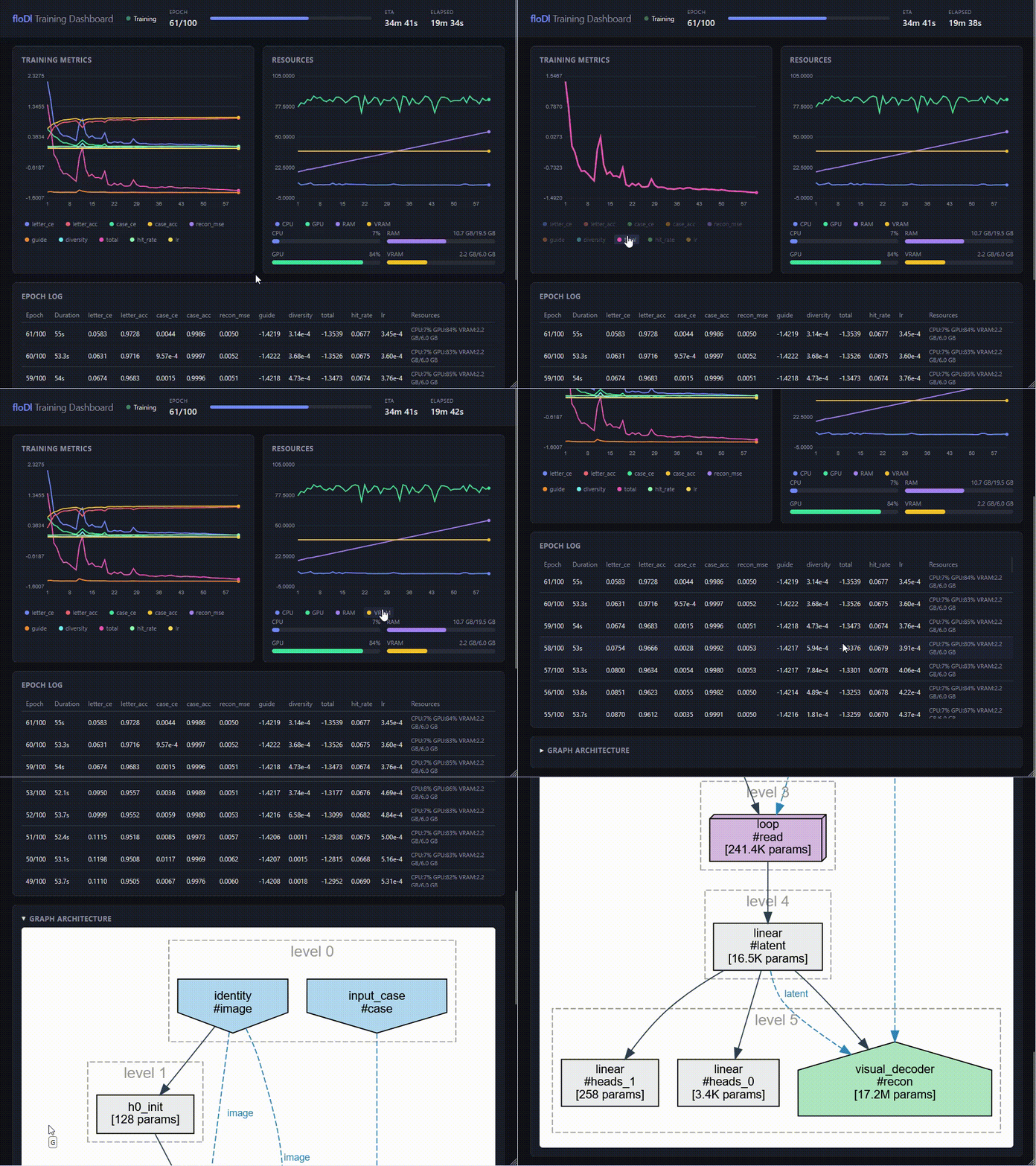
Interactive benchmark dashboard — real data from a 100-epoch training run
The live dashboard updates via Server-Sent Events (no WebSocket, no npm),
tracks CPU/GPU/RAM/VRAM, and supports late join — open it mid-training and
all past epochs backfill instantly.
```rust
monitor.save_html("training_report.html"); // self-contained archive
monitor.export_csv("training.csv")?; // for external analysis
```
### Observation and Trend Queries
Tags double as observation points. Collect metrics during training and use
trend queries to make programmatic training decisions:
```rust
for epoch in 0..num_epochs {
for (input, target) in &batches {
let pred = graph.forward(&input)?;
graph.collect(&["hidden"])?; // from graph tag
graph.record_scalar("loss", loss.item()?); // external metric
}
graph.flush(&["hidden", "loss"]);
// Programmatic training control
if graph.trend("loss").stalled(5, 1e-4) {
optimizer.set_lr(optimizer.lr() * 0.5); // decay LR
}
if graph.trend("loss").converged(5, 1e-5) {
break; // early stopping
}
}
```
| Method | What it does |
|--------|-------------|
| `g.collect(tags)` / `g.flush(tags)` | Batch -> epoch metric aggregation |
| `g.record_scalar(tag, value)` | Inject external metrics (loss, accuracy) |
| `g.trend(tag).slope(n)` | OLS slope over last n epochs |
| `g.trend(tag).stalled(n, tol)` | Is \|slope\| below tolerance? |
| `g.trend(tag).improving(n)` | Is loss decreasing? |
| `g.trend(tag).converged(n, tol)` | Is variance below tolerance? |
| `g.trends(tags).all_improving(n)` | Group queries across branches |
### Visualization
```rust
let svg = g.svg(Some("model.svg"))?; // architecture diagram
g.svg_with_profile(Some("profile.svg"))?; // timing heatmap
g.plot_html("training.html", &["loss", "head"])?; // interactive curves
```
See the **[Training Monitor Tutorial](https://github.com/fab2s/floDl/blob/main/docs/tutorials/09-monitor.md)** and
the **[Observation example](https://github.com/fab2s/floDl/tree/main/flodl/examples/observation/)**.
## Multi-GPU Training
`Ddp::setup()` gives you transparent heterogeneous multi-GPU training with
zero changes to your training loop. floDl detects your GPUs, picks the best
strategy, and balances work automatically: the slowest GPU anchors the pace
while faster ones run ahead intelligently.
**Graph DDP** -- one line to go from single-GPU to multi-GPU:
```rust
// Detect GPUs, replicate model, set optimizer, enable training
Ddp::setup(&model, &builder, |p| Adam::new(p, 0.001))?;
// Training loop is IDENTICAL for 1 or N GPUs
for batch in model.epoch(0) {
let loss = model.forward_batch(&batch?)?;
model.step()?; // AllReduce + sync + optimizer + zero_grad
}
```
**DDP Builder** -- thread-per-GPU, works with any `Module`:
```rust
let state = Ddp::builder(model_factory, optim_factory, train_fn)
.dataset(dataset)
.batch_size(32)
.num_epochs(10)
.policy(ApplyPolicy::Cadence) // ElChe for mixed GPUs
.backend(AverageBackend::Nccl) // or Cpu for A/B testing
.run()?
.join()?;
```
| | Graph DDP | DDP Builder |
|---|---|---|
| **Works with** | `Graph` builder | Any `Module` |
| **GPU model** | Scatter per batch | Thread per GPU (Local SGD) |
| **Mixed GPUs** | El Che auto-enabled | `ApplyPolicy` x `AverageBackend` |
| **Setup** | One line (`Ddp::setup`) | Builder pattern |
| **Dashboard** | Integrated | Stderr logging |
**A/B testing**: swap `AverageBackend::Nccl` for `AverageBackend::Cpu`
with one line. If loss curves match, you have validated the cheaper
backend for your workload.
See the **[Multi-GPU Tutorial](https://github.com/fab2s/floDl/blob/main/docs/tutorials/11-multi-gpu.md)**,
**[DDP Builder Tutorial](https://github.com/fab2s/floDl/blob/main/docs/tutorials/12-async-ddp.md)**,
**[Data Loading Tutorial](https://github.com/fab2s/floDl/blob/main/docs/tutorials/13-data-loading.md)**, and
**[DDP Reference](https://github.com/fab2s/floDl/blob/main/docs/ddp.md)**.
### Validation suite — `ddp-bench`
The repo ships with [`ddp-bench/`](https://github.com/fab2s/floDl/tree/main/ddp-bench),
a workspace member that reproduces published training setups (Logistic /
MLP / LeNet-5 / ResNet-20 / Char-RNN / GPT-nano / Conv-AE on MNIST,
CIFAR-10, Shakespeare) to build scientifically valid solo baselines, then
measures DDP/ElChe convergence quality against them across all 8
backend × policy combinations:
```bash
fdl ddp-bench --list # list models and modes
fdl ddp-bench quick # 1-epoch smoke test
fdl ddp-bench validate # full sweep vs structured baselines
fdl ddp-bench --model gpt-nano --mode nccl-cadence --epochs 50 --lr-scale 2
fdl ddp-bench --report runs/report.md # convergence report from saved runs
```
Every run produces a high-frequency `Timeline` (CPU/GPU utilization, sync
events, anchor changes, idle gaps) saved as JSON / CSV / interactive HTML
under `runs///`.
### Built-in datasets
The framework ships ready-to-use parsers for common benchmarks (all
implement `BatchDataSet`, plug straight into `DataLoader::builder`):
```rust
use flodl::data::datasets::{Cifar10, Mnist, Shakespeare};
let mnist = Mnist::parse(&images_gz, &labels_gz)?;
let cifar = Cifar10::parse(&[&batch1, &batch2, /* ... */])?;
let text = Shakespeare::parse(&corpus, /*seq_len=*/ 128)?;
```
`ddp-bench` downloads and caches the underlying files on first run.
## PyTorch Parity
floDl covers the modules, losses, and optimizers you actually use:
| Category | Count | Highlights |
|----------|------:|-----------|
| **NN Modules** | 30+ | `Linear`, `Conv1d`/`2d`/`3d` + transpose, `GRU`/`LSTM`, `MultiheadAttention`, `Bilinear`, all norms (`Layer`/`RMS`/`Group`/`Batch`/`Instance`), all pooling, `Embedding`/`EmbeddingBag`, `PixelShuffle`, `Upsample`, `Unfold`/`Fold` |
| **Activations** | 17 | `ReLU`, `LeakyReLU`, `ELU`, `GELU`, `SiLU`, `Mish`, `SELU`, `Softplus`, `Hardswish`, `PReLU`, `Softmax`, ... |
| **Losses** | 15 | MSE, CrossEntropy, BCE, NLL, CTC, Focal, Triplet, KLDiv, SmoothL1, Cosine, Hinge, Margin, Poisson, ... |
| **Optimizers** | 7 | `SGD`, `Adam`, `AdamW`, `RMSprop`, `Adagrad`, `RAdam`, `NAdam` — all with parameter groups |
| **Schedulers** | 8 | Step, Cosine, Exponential, MultiStep, OneCycle, Cyclic, Warmup (composable), Plateau |
| **Init** | 9 | Xavier, Kaiming, orthogonal, truncated normal, uniform, normal |
| **Tensor Ops** | 100+ | Full arithmetic, trig, reductions, shape, indexing, comparisons, fused ops |
| **Autograd** | 90+ | Differentiable backward for every op above |
Fused Adam/AdamW on CUDA (single kernel for all parameters). Fused gradient
clipping via foreach ops. Mixed precision with `AutocastGuard` + `GradScaler`.
CUDA Graphs for replay-based training.
The [full migration guide](https://github.com/fab2s/floDl/blob/main/docs/pytorch_migration.md) has side-by-side
code for every op, module, and pattern.
## Performance
Same CUDA kernels as PyTorch — the difference comes from what happens
*between* kernel launches. Ten models, ten interleaved rounds, locked GPU
clocks (RTX 5060 Ti, v0.3.0 vs PyTorch 2.10.0):
| Model | PyTorch | flodl | Delta |
|---|---:|---:|---:|
| transformer | 3183.0 ms | 2199.8 ms | **-31%** |
| mlp | 291.1 ms | 207.0 ms | **-29%** |
| residual_tower | 406.9 ms | 309.7 ms | **-24%** |
| feedback_fixed | 275.3 ms | 231.3 ms | **-16%** |
| gated_routing | 248.0 ms | 217.3 ms | **-12%** |
| iterative_refine | 230.7 ms | 206.0 ms | **-11%** |
| gru_seq | 1105.1 ms | 1057.5 ms | **-4%** |
| conv_autoenc | 398.2 ms | 395.3 ms | -1% |
| lstm_seq | 692.3 ms | 692.3 ms | 0% |
| convnet | 1298.0 ms | 1298.2 ms | 0% |
Wins 8 of 10, ties 2, zero regressions. The ties (convnet, lstm_seq) are
compute-bound -- both frameworks saturate the GPU, confirming identical
CUDA kernels. The gap appears where framework overhead matters:
dispatch-bound architectures (transformer -31%, mlp -29%), graph routing
(residual_tower -24%), and recurrent loops (feedback_fixed -16%).
**[Benchmark Report](https://github.com/fab2s/floDl/blob/main/docs/benchmark.md)** |
[Interactive dashboard](https://flodl.dev/benchmark)
### Multi-GPU (DDP)
ResNet-20 on CIFAR-10, 200 epochs -- heterogeneous GPUs (RTX 5060 Ti +
GTX 1060, 2.5x speed ratio). Published reference: 91.25%
([He et al. 2015](https://arxiv.org/abs/1512.03385), Table 6):
| Mode | Eval | vs Published | Time | vs Solo-0 |
|---|---:|---:|---:|---:|
| solo-0 (fast GPU only) | 91.66% | +0.41% | 3127s | -- |
| nccl-async | **92.44%** | **+1.19%** | 2697s | 1.2x |
| nccl-cadence | **92.42%** | **+1.17%** | 2650s | 1.2x |
| cpu-async | **92.43%** | **+1.18%** | 2614s | 1.2x |
| cpu-cadence | **92.04%** | **+0.79%** | 2670s | 1.2x |
Every ElChe mode surpasses published accuracy while finishing faster
than the fast GPU alone. 200 epochs is where ElChe's proportional
scheduling has room to calibrate and shine -- shorter models (logistic
through gpt-nano) confirm DDP convergence across architectures.
**[DDP Benchmark Report](https://github.com/fab2s/floDl/blob/main/docs/ddp-benchmark.md)** --
full results for 8 models across 9 DDP modes
## Why Rust for Deep Learning?
**Deterministic memory.** Python adds ~3-5 us of framework overhead per GPU
op. Go's GC can't manage VRAM — an [earlier Go implementation](https://github.com/fab2s/goDl)
required 5 phases of lifecycle management (refcounting, GC callbacks, VRAM
budgets, pending-free queues). Rust replaces all of that with
`impl Drop for Tensor`. Memory is freed the instant a tensor leaves scope.
**Zero-cost safety.** Every op returns `Result` — no silent failures.
Ownership ensures tensors are freed exactly once. The borrow checker
prevents data races at compile time.
**Same GPU kernels.** floDl binds libtorch — the C++ library under
PyTorch. CUDA, cuBLAS, cuDNN are identical. floDl replaces the dispatch
path, autograd tracking, and graph execution.
## Features Reference
Training Tools
| Tool | What it does |
|------|-------------|
| `clip_grad_norm` / `clip_grad_value` | Fused gradient clipping (2 kernels total via foreach ops) |
| `save_checkpoint` / `load_checkpoint` | Named `.fdl` checkpoints, structural hash, partial loading, `LoadReport` |
| `migrate_checkpoint` | Remap parameter names across versions |
| `Parameter::freeze` / `unfreeze` | Per-parameter gradient control |
| `GradScaler` | Dynamic loss scaling for fp16 training |
| `cast_parameters` | Cast model parameters to any dtype |
| `CpuWorker` / `ModelSnapshot` | Background checkpoint saving |
| `CudaGraph` | Capture/replay training steps for fixed-shape models |
Module Traits
Beyond `forward`/`parameters`, `Module` provides optional methods the graph
recognizes automatically:
| Method | What happens |
|--------|-------------|
| `as_named_input()` | `using()` refs arrive as a named map |
| `reset()` | Loops auto-call before iterating — clears per-forward state |
| `detach_state()` | Break gradient chains on retained state |
| `sub_modules()` | Recursive device placement, training mode, parameter collection |
Build Profiles
```toml
# Optimize floDl in dev builds — your code stays fast to compile.
[profile.dev.package.flodl]
opt-level = 3
[profile.dev.package.flodl-sys]
opt-level = 3
# Release: cross-crate optimization for maximum throughput.
[profile.release]
lto = "thin"
codegen-units = 1
```
| Profile | flodl | Your code | Typical rebuild |
|---------|-------|-----------|-----------------|
| `cargo build` | `-O3` (cached) | `-O0` (fast) | < 2s |
| `cargo build --release` | `-O3` + LTO | `-O3` + LTO | full link |
Multi-GPU (DDP)
| Component | What it does |
|-----------|-------------|
| `Ddp::setup` | One-liner: detect GPUs, distribute, set optimizer, train |
| `Ddp::builder` | Thread-per-GPU with Local SGD, any Module |
| `ApplyPolicy` | Sync / Cadence / Async (when to average) |
| `AverageBackend` | Nccl / Cpu (how to average, A/B testable) |
| `ElChe` | Heterogeneous GPU cadence strategy |
| `NcclComms` / `NcclRankComm` | NCCL AllReduce, Broadcast, abort handles |
| `CudaEvent` / `CudaStream` | Async GPU-CPU pipeline, timing |
| `DataLoader` | Resident/streaming/distributed, VRAM-aware prefetch, auto OOM fallback |
### Numerical Verification
Every differentiable path is verified against finite-difference gradients:
- 117 autograd op-level checks (every op + compositions)
- Module-level checks (every NN module, input + parameter gradients)
- Exact optimizer step verifications (SGD, Adam, AdamW, RMSprop, Adagrad, RAdam, NAdam)
- 1027 library tests, zero clippy warnings — all tests run on both CPU and CUDA
### Hardware Compatibility
Developed and tested from NVIDIA Pascal (GTX 1060 6GB) to Blackwell
(RTX 5060 Ti 16GB). PyTorch dropped Pascal support after 2.5.1 — floDl
links libtorch's stable C API, which supports every architecture the driver
supports. If `nvidia-smi` works, floDl trains on it.
## Documentation
### Choose your path
| Background | Start here |
|-----------|-----------|
| **New to Rust** | [Rust for PyTorch Users](https://github.com/fab2s/floDl/blob/main/docs/tutorials/00-rust-primer.md) — 10 patterns in 15 minutes |
| **Know Rust, new to DL** | [Tensors](https://github.com/fab2s/floDl/blob/main/docs/tutorials/01-tensors.md) then [Training](https://github.com/fab2s/floDl/blob/main/docs/tutorials/04-training.md) |
| **Know PyTorch** | [Porting Guide](https://github.com/fab2s/floDl/blob/main/docs/porting.md) (or `/port` with AI) then [Graph Builder](https://github.com/fab2s/floDl/blob/main/docs/tutorials/05-graph-builder.md) |
| **Scaling to multi-GPU** | [Multi-GPU Training](https://github.com/fab2s/floDl/blob/main/docs/tutorials/11-multi-gpu.md) then [DDP Builder](https://github.com/fab2s/floDl/blob/main/docs/tutorials/12-async-ddp.md) |
| **Just show me code** | [`quickstart`](https://github.com/fab2s/floDl/tree/main/flodl/examples/quickstart/) or [`showcase`](https://github.com/fab2s/floDl/tree/main/flodl/examples/showcase/) |
### Tutorials
0. **[Rust for PyTorch Users](https://github.com/fab2s/floDl/blob/main/docs/tutorials/00-rust-primer.md)** — 10 Rust patterns in 15 minutes
1. **[Tensors](https://github.com/fab2s/floDl/blob/main/docs/tutorials/01-tensors.md)** — creation, ops, memory, CUDA
2. **[Autograd](https://github.com/fab2s/floDl/blob/main/docs/tutorials/02-autograd.md)** — variables, gradients, backward
3. **[Modules](https://github.com/fab2s/floDl/blob/main/docs/tutorials/03-modules.md)** — all layers, convolutions, RNNs, attention, normalization
4. **[Training](https://github.com/fab2s/floDl/blob/main/docs/tutorials/04-training.md)** — losses, optimizers, mixed precision, full loop
5. **[Graph Builder](https://github.com/fab2s/floDl/blob/main/docs/tutorials/05-graph-builder.md)** — fluent API from simple to complex
6. **[Advanced Graphs](https://github.com/fab2s/floDl/blob/main/docs/tutorials/06-advanced-graphs.md)** — forward refs, loops, gates, switches
7. **[Visualization](https://github.com/fab2s/floDl/blob/main/docs/tutorials/07-visualization.md)** — DOT/SVG, profiling heatmaps
8. **[Utilities](https://github.com/fab2s/floDl/blob/main/docs/tutorials/08-utilities.md)** — checkpoints, clipping, freezing, initialization, scheduling, verbosity-gated logging
9. **[Training Monitor](https://github.com/fab2s/floDl/blob/main/docs/tutorials/09-monitor.md)** — ETA, resource tracking, live dashboard
10. **[Graph Tree](https://github.com/fab2s/floDl/blob/main/docs/tutorials/10-graph-tree.md)** — hierarchical composition, freeze/thaw, subgraph checkpoints
11. **[Multi-GPU Training](https://github.com/fab2s/floDl/blob/main/docs/tutorials/11-multi-gpu.md)** — Ddp::setup, El Che, auto-balancing, DataLoader integration
12. **[DDP Builder](https://github.com/fab2s/floDl/blob/main/docs/tutorials/12-async-ddp.md)** — thread-per-GPU, Local SGD, A/B testable backends
13. **[Data Loading](https://github.com/fab2s/floDl/blob/main/docs/tutorials/13-data-loading.md)** — DataLoader, resident/streaming modes, VRAM-aware prefetch, DDP integration
### Examples
- [`quickstart`](https://github.com/fab2s/floDl/tree/main/flodl/examples/quickstart/) — build, train, and monitor a model with residual connections
- [`sine_wave`](https://github.com/fab2s/floDl/tree/main/flodl/examples/sine_wave/) — sine regression with monitor, checkpoint round-trip
- [`mixed_precision`](https://github.com/fab2s/floDl/tree/main/flodl/examples/mixed_precision/) — float16 training with `GradScaler`
- [`transfer_learning`](https://github.com/fab2s/floDl/tree/main/flodl/examples/transfer_learning/) — checkpoint, partial load, freeze, fine-tune
- [`schedulers`](https://github.com/fab2s/floDl/tree/main/flodl/examples/schedulers/) — warmup + cosine + plateau composition
- [`observation`](https://github.com/fab2s/floDl/tree/main/flodl/examples/observation/) — collect, flush, trend queries, early stopping
- [`showcase`](https://github.com/fab2s/floDl/tree/main/flodl/examples/showcase/) — every graph builder method in one graph
### Porting from PyTorch
- **[Porting Guide](https://github.com/fab2s/floDl/blob/main/docs/porting.md)** — module mapping, FlowBuilder patterns, training loop translation
- **[AI-assisted porting](https://github.com/fab2s/floDl/tree/main/ai/skills/port/)** — point any AI coding assistant at the skill guide for automated translation. With Claude Code: `/port my_model.py`
- **`fdl api-ref`** — generate a structured API reference for your flodl version. Used by AI tools and useful on its own.
### Architecture
```
+-----------------------------------------------------------+
| User Code / Model Definitions |
+-----------------------------------------------------------+
| monitor/ ETA, resource tracking, live web dashboard |
+-----------------------------------------------------------+
| graph/ Fluent builder, graph tree, execution, DOT/SVG |
+-----------------------------------------------------------+
| data/ DataLoader, resident/streaming, prefetch |
+-----------------------------------------------------------+
| nn/ Modules, losses, optimizers, DDP, NCCL |
+-----------------------------------------------------------+
| autograd/ Reverse-mode AD, gradient tracking |
+-----------------------------------------------------------+
| tensor/ Owned tensors with Drop, CPU + CUDA |
+-----------------------------------------------------------+
| flodl-sys FFI bindings to libtorch C++ shim |
+-----------------------------------------------------------+
| libtorch / CUDA / NCCL |
+-----------------------------------------------------------+
```
## Story
floDl started as a question: what would a deep learning framework look like
if you designed it around Rust's ownership model instead of fighting a garbage
collector?
An [earlier attempt in Go](https://github.com/fab2s/goDl) proved the
architecture — the graph builder, the module system, the observation engine —
but hit a wall: Go's GC cannot manage GPU memory deterministically. That
required building five layers of memory management infrastructure on top of
the language, not with it.
Rust solved this at the language level. `impl Drop for Tensor` replaced
hundreds of lines of lifecycle management. The graph builder, module
composition, and design philosophy carried forward; the memory fights didn't.
## License
floDl is open-sourced software licensed under the [MIT license](https://github.com/fab2s/floDl/blob/main/LICENSE).