https://github.com/fabilab/cell_atlas_approximations_api
APIs for cell atlas approximations
https://github.com/fabilab/cell_atlas_approximations_api
Last synced: 5 months ago
JSON representation
APIs for cell atlas approximations
- Host: GitHub
- URL: https://github.com/fabilab/cell_atlas_approximations_api
- Owner: fabilab
- License: mit
- Created: 2023-03-19T22:48:58.000Z (over 3 years ago)
- Default Branch: main
- Last Pushed: 2025-02-28T04:01:47.000Z (over 1 year ago)
- Last Synced: 2025-10-22T04:49:05.508Z (9 months ago)
- Language: HTML
- Size: 644 KB
- Stars: 0
- Watchers: 1
- Forks: 2
- Open Issues: 10
-
Metadata Files:
- Readme: README.md
- License: LICENSE
Awesome Lists containing this project
README
REST
Python
R
JavaScript
Shell
Build


Release
(N.A.)



here
Docs

# Cell Atlas Approximations - API
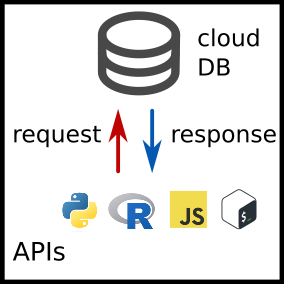
Cell atlases such as Tabula Muris and Tabula Sapiens are multi-organ single cell omics data sets describing entire organisms. A cell atlas approximation is a lossy and lightweight compression of a cell atlas that can be streamed via the internet.
This project enables biologists, doctors, and data scientist to quickly find answers for questions such as:
- *What types of cells populate the human heart?*
- *What is the expression of a specific gene across cell types in C elegans?*
- *What are the marker genes of a specific cell type in mouse pancreas*?
- *What fraction of cells (of a specific type) express a gene of interest?*
These questions can be asked in Python or R using the provided packages (see below), or in a language agnostic manner using the REST API. We even made a shell script for Linux and Mac that calls the API from your terminal! - check out [shell/atlasapprox](https://github.com/fabilab/cell_atlas_approximations_API/blob/main/shell/atlasapprox)!
## Version
The latest API version is `v1`.
We support several organs and organisms: human, mouse, lemur (a type of monkey), zebrafish, C. elegans. More organisms and organs are planned for the near future.
## Documentation
Tutorial and reference documentation is available at [https://atlasapprox.readthedocs.io](https://atlasapprox.readthedocs.io).
## Usage
REST
### REST
The REST interface is language-agnostic and can be queried using any HTTP request handler, e.g. in JavaScript:
```javascript
(async () => {
let response = await fetch("http://api.atlasapprox.org/v1/organisms");
if (response.ok) {
let data = await response.json();
console.log(data);
}
})();
```
Similar results can be obtained via Python's `requests`, R's `httr`, etc. If you are using Python or R, however, please consider using the dedicated interfaces below, as they are more efficient and easier on our servers thanks to caching.
Python
### Python
The Python interface uses a central `API` class. Its methods implement the REST endpoints:
```python
import atlasapprox
api = atlasapprox.API()
print(api.organisms())
print(api.celltypes(organism="c_elegans", organ="whole"))
```
R
### R
The R interface includes a number of `GetXXX` functions connected to the REST endpoints:
```R
library("atlasapprox")
organisms <- GetOrganisms()
print(organisms)
```
JavaScript
### JavaScript/nodejs
An object containing one function for each API endpoint is exported by the `atlasapprox` npm package:
```javascript
let atlasapprox = require('atlasapprox');
(async () => {
let data = await atlasapprox.organisms();
console.log(data);
}
})();
```
Shell
### Shell (bash, zsh, et similia)
A single script is provided in this repo under `shell/atlasapprox`. Usage instructions are included, but as a quick example:
```bash
atlasapprox average --organism=m_musculus --organ=Lung --features=Col1a1,Ptprc
```
Note that the output is a serialized JSON string: you'll probably need some kind of parser to interpret the results.
## Repo contents
- `web`: webserver code in Flask that implements the RESTful API
- `rest`: testing code for the RESTful API
- `Python`: package code providing a Python interface
- `R`: package code providing an R interface
- `js`: package code providing a JavaScript interface
- `shell`: shell script
- `docs`: user documentation
## Authors
- [Fabio Zanini @ fabilab](https://fabilab.org)