https://github.com/factorhouse/factorhouse-local
Docker Compose environments for developing modern data platform architectures using Kafka, Flink, Spark, Iceberg, OpenLineage, OpenMetadata, Pinot, ClickHouse, StarRocks + Kpow & Flex by Factor House
https://github.com/factorhouse/factorhouse-local
clickhouse data-streaming developer-tools docker docker-compose flex flink flink-streaming grafana iceberg kafka kpow lakehouse monitoring openlineage openmetadata pinot postgresql prometheus spark
Last synced: 4 months ago
JSON representation
Docker Compose environments for developing modern data platform architectures using Kafka, Flink, Spark, Iceberg, OpenLineage, OpenMetadata, Pinot, ClickHouse, StarRocks + Kpow & Flex by Factor House
- Host: GitHub
- URL: https://github.com/factorhouse/factorhouse-local
- Owner: factorhouse
- License: apache-2.0
- Created: 2025-04-22T23:47:17.000Z (over 1 year ago)
- Default Branch: main
- Last Pushed: 2026-01-30T05:17:26.000Z (6 months ago)
- Last Synced: 2026-02-02T04:08:05.589Z (6 months ago)
- Topics: clickhouse, data-streaming, developer-tools, docker, docker-compose, flex, flink, flink-streaming, grafana, iceberg, kafka, kpow, lakehouse, monitoring, openlineage, openmetadata, pinot, postgresql, prometheus, spark
- Language: Shell
- Homepage:
- Size: 34.9 MB
- Stars: 51
- Watchers: 4
- Forks: 6
- Open Issues: 3
-
Metadata Files:
- Readme: README.md
- License: LICENSE
- Security: SECURITY.md
Awesome Lists containing this project
README

# Factor House Local

## Introduction
We provide several pre-configured Docker Compose environments to showcase different data platform setups. The summaries below offer a quick overview of each:
Kafka Development & Monitoring with Kpow
This stack provides a complete **Apache Kafka development and monitoring environment**, built using Confluent Platform components and enhanced with [**Kpow**](https://factorhouse.io/kpow) for enterprise-grade observability and management. It includes a 3-node, Zookeeper-less Kafka cluster running in KRaft mode, Schema Registry, Kafka Connect, and Kpow itself.
### 📌 Description
This architecture is designed for developers and operations teams who need a **robust, local Kafka ecosystem** for building, testing, and managing Kafka-based applications. By leveraging Kafka's KRaft mode, it offers a simplified, more efficient, and modern setup without the dependency on ZooKeeper. It features high availability (3 brokers), schema management for data governance, a data integration framework (Kafka Connect), and a powerful UI (Kpow) for monitoring cluster health, inspecting data, managing topics, and troubleshooting.
It's ideal for scenarios involving **event-driven architectures, microservices communication, data integration pipelines**, and situations requiring deep visibility into Kafka internals.
---
### 🔑 Key Components
#### 🚀 Kpow (Kafka Management & Monitoring Toolkit)
- **Container**: `kpow` from (`factorhouse/kpow:latest`)
- An engineering toolkit providing a rich web UI for comprehensive Kafka monitoring, management, and data inspection. Kpow gathers Kafka resource information, stores it locally in internal topics, and delivers custom telemetry and insights. Features include:
- **Comprehensive Real-time Kafka Resource Monitoring**: Instant visibility of brokers, topics, consumer groups, partitions, offsets, and more. It gathers data every minute, with a "Live mode" for real-time updates and requires no JMX access.
- **Advanced Consumer and Streams Monitoring**: Visualize message throughput and lag for consumers with multi-dimensional insights.
- **Deep Data Inspection with kJQ**: A powerful JQ-like query language to search messages at high speed, supporting JSON, Avro, Protobuf, and more.
- **Schema Registry & Kafka Connect Integration**: Full support for controlling and monitoring Schema Registries and Kafka Connect clusters.
- **Enterprise-Grade Security & Governance**: Supports Authentication (LDAP, SAML, OpenID), role-based access controls (RBAC), data masking policies, and a full audit log.
- **Key Integrations**: Includes Slack integration, Prometheus endpoints, and multi-cluster management capabilities.
- **Exposes UI at** `http://localhost:3000`
#### 🧠 KRaft-based Kafka Cluster (3 Brokers)
- **Kafka Brokers (`confluentinc/cp-kafka:8.1.1` x3)**: Form the core message bus, now operating in **KRaft (Kafka Raft Metadata) mode**.
- **Zookeeper-less Architecture**: This setup removes the need for a separate Zookeeper cluster. The brokers themselves handle metadata management and controller election through an internal consensus mechanism.
- Configured with distinct internal (`1909x`) and external (`909x`, `2909x`) listeners for flexible Docker and Minikube networking.
- Provides high availability and fault tolerance with a 3-node quorum.
- Accessible externally via ports `9092`, `9093`, `9094`.
#### 📜 Schema Registry (`confluentinc/cp-schema-registry:8.1.1`)
- Manages schemas (Avro, Protobuf, JSON Schema) for Kafka topics, ensuring data consistency and enabling schema evolution.
- **Accessible at** `http://localhost:8081`.
- Configured with Basic Authentication.
- Stores its schemas within the Kafka cluster itself.
#### 🔌 Kafka Connect (`confluentinc/cp-kafka-connect:8.1.1`)
- Framework for reliably streaming data between Apache Kafka and other systems.
- **Accessible via REST API at** `http://localhost:8083`.
- Configured to use JSON converters by default.
- **Custom Connector Support**: Volume mounts allow adding third-party connectors (e.g., JDBC, S3, Iceberg).
- **OpenLineage Integration**: Configured to send lineage metadata to a Marquez API, enabling data lineage tracking.
- Manages its configuration, offsets, and status in dedicated Kafka topics.
---
### 🧰 Use Cases
#### Local Kafka Development & Testing
- Build and test Kafka producers, consumers, and Kafka Streams applications against a realistic, multi-broker KRaft cluster.
- Validate application behavior during broker failures (by stopping/starting broker containers).
#### Data Integration Pipelines
- Utilize Kafka Connect to ingest data into Kafka from various sources or stream data out to data lakes, warehouses, and other systems.
- Test and manage connector configurations via the Connect REST API or Kpow UI.
#### Schema Management & Evolution
- Define, register, and evolve schemas using Schema Registry to enforce data contracts and prevent breaking changes in data pipelines.
#### Real-Time Monitoring & Operations Simulation
- Use Kpow to monitor cluster health, track topic/partition metrics, identify consumer lag, and inspect messages in real-time.
- Understand Kafka performance characteristics and troubleshoot issues within a controlled environment.
#### Learning & Exploring Modern Kafka
- Provides a self-contained environment to learn modern Kafka concepts, experiment with a Zookeeper-less configuration, and explore the capabilities of the Confluent Platform and Kpow.
Unified Analytics Platform with Flex, Flink, Spark, Iceberg & Hive Metastore
This stack builds a **comprehensive analytics platform** that erases the line between real-time stream analytics and large-scale batch processing. It achieves this by combining the power of **Apache Flink**, enhanced by [**Flex**](https://factorhouse.io/flex) for enterprise-grade management and monitoring, with **Apache Spark** on a unified data lakehouse, enabling you to work with a single source of truth for all your data workloads.
### 📌 Description
This architecture is designed around a modern data lakehouse that serves both streaming and batch jobs from the same data. At its foundation, data is stored in Apache Iceberg tables on MinIO, an S3-compatible object store. This provides powerful features like ACID transactions, schema evolution, and time travel for your data.
A central **Hive Metastore** serves as a unified metadata catalog for the entire data ecosystem. By using a robust **PostgreSQL** database as its backend, the metastore reliably tracks all table schemas and metadata. This central catalog allows both **Apache Flink** (for low-latency streaming) and **Apache Spark** (for batch ETL and interactive analytics) to discover, query, and write to the same tables seamlessly, eliminating data silos. The platform also includes **Redis**, an in-memory data store, to facilitate high-speed data lookups and caching for real-time enrichment tasks.
The role of PostgreSQL is twofold: in addition to providing a durable backend for the metastore, it is configured as a high-performance transactional database ready for **Change Data Capture (CDC)**. This design allows you to stream every `INSERT`, `UPDATE`, and `DELETE` from your operational data directly into the lakehouse, keeping it perfectly synchronized in near real-time.
The platform is rounded out by enterprise-grade tooling: **Flex** simplifies Flink management, a **Flink SQL Gateway** enables interactive queries, and a single node **Spark cluster** supports complex data transformations. This integrated environment is ideal for building sophisticated solutions for fraud detection, operational intelligence, and unified business analytics.
---
### 🔑 Key Components
#### 🚀 Flex (Enterprise Flink Runtime)
- **Container**: `flex` from (`factorhouse/flex:latest`)
- Provides an enterprise-ready tooling solution to streamline and simplify Apache Flink management. It gathers Flink resource information, offering custom telemetry, insights, and a rich data-oriented UI. Key features include:
- **Comprehensive Flink Monitoring & Insights**: Offers fully integrated metrics, long-term history, and aggregated consumption/production data, from cluster-level down to individual job-level details.
- **Enterprise-Grade Security & Governance**: Supports versatile Authentication (LDAP, SAML, OpenID), robust Role-Based Access Controls (RBAC), data masking policies, and a full audit log.
- **Powerful Flink Enhancements**: Includes multi-tenancy and multi-cluster monitoring capabilities.
- **Key Integrations**: Exposes Prometheus endpoints and allows for Slack notifications.
- **Exposes UI at** `http://localhost:3001`
#### 🧠 Flink Cluster (Real-Time Engine)
- **JobManager** (`jobmanager`) coordinates all tasks, handles scheduling, checkpoints, and failover. Flink UI is exposed at `http://localhost:8082`.
- **TaskManagers** (`taskmanager-1`, `-2`, `-3`) run user code and perform actual stream processing.
- The cluster is configured to use the central **Hive Metastore** for catalog services and includes a rich set of connectors for Kafka, Iceberg, and more.
#### 🛠 Flink SQL Gateway
- **Container**: `sql-gateway`
- A REST-accessible endpoint (`http://localhost:9090`) for **interactive Flink SQL queries** against the unified catalog.
#### 🚀 Spark Compute Engine (Batch Engine)
- **Container**: `spark-iceberg`
- Provides an **Apache Spark** environment pre-configured with **Apache Iceberg** and OpenLineage support, connected to the central **Hive Metastore**.
- **Spark Web UI** for monitoring running jobs (`http://localhost:4040`).
- **Spark History Server** for reviewing completed jobs (`http://localhost:18080`).
#### 📚 Hive Metastore (Unified Catalog)
- **Container**: `hive-metastore`
- A central **metadata service** that allows both Flink and Spark to interact with the same Iceberg tables consistently.
- Uses the **PostgreSQL** database as its backend to durably store all metadata.
- **Accessible internally at** `thrift://hive-metastore:9083`.
#### 🐘 PostgreSQL (Transactional Hub & Metastore Backend)
- **Container**: `postgres`
- Serves two critical functions:
1. **Durable Metastore Backend**: Provides persistent storage for the **Hive Metastore**.
2. **Transactional Workload & CDC Hub**: Functions as a relational database for application workloads, with `wal_level=logical` enabled for seamless Change Data Capture.
- **Accessible at** `localhost:5432`.
#### 💾 S3-Compatible Object Storage (MinIO)
- **MinIO** provides **S3-compatible object storage**, acting as the data lake storage layer for Iceberg tables and Flink checkpoints.
- **MinIO API** at `http://localhost:9000` | **MinIO Console UI** at `http://localhost:9001` (`admin`/`password`).
- **MinIO Client** (`mc`) initializes MinIO by creating necessary buckets (`warehouse`, `flink-checkpoints`, etc.).
#### ⚡ Redis (In-Memory Data Store)
- **Container**: `redis`
- A high-performance **in-memory key-value store** that adds a low-latency data access layer to the platform.
- **Purpose**: Ideal for caching frequently accessed data, serving as a high-speed lookup table for stream enrichment in Flink, or acting as a serving layer for real-time application results.
- **Configuration**: Configured for persistence (`appendonly yes`) and secured with a password.
- **Accessible at** `localhost:6379`.
---
### 🧰 Use Cases
#### Unified Data Lakehouse
- Create, manage, and query Iceberg tables using both Flink SQL for real-time writes and Spark for batch updates, all through the central Hive Metastore.
- Perform ACID-compliant operations from either engine on the same datasets.
#### Real-Time Ingestion from Transactional Systems (CDC)
- The architecture is **purpose-built to support CDC pipelines**. The `wal_level=logical` setting in PostgreSQL allows tools like Debezium to capture every row-level change and stream it into the data lakehouse in near real-time.
#### Batch ETL/ELT Pipelines
- Use Spark to perform large-scale transformations on data within the lakehouse for reporting or machine learning.
#### Real-Time ETL & Stream Enrichment
- Ingest data from Kafka or CDC streams with Flink.
- Join streaming data with lookup tables in **Redis** for millisecond-latency enrichment.
- Write enriched, structured data directly into Iceberg tables, making it immediately available for Spark to query.
#### Interactive & Self-Service Analytics
- Empower analysts to query **live, streaming data** via the Flink SQL Gateway and **historical, large-scale data** using Spark—all with familiar SQL pointed at the same tables.
Real-time Data Stores: Pinot, ClickHouse & StarRocks
This stack provides a flexible development environment featuring a choice of three powerful, **high-performance data stores**: Apache Pinot, ClickHouse, and StarRocks. Designed to be a showcase of modern data storage solutions, this configuration uses Docker Compose `profiles` to allow you to select and launch only the specific system you need for your real-time analytics workloads.
### 📌 Description
This architecture is designed for developers and engineers to explore and build applications on top of leading data technologies. The name `compose-store.yml` reflects its purpose as a catalog of specialized storage systems for enabling low-latency analytical queries on large datasets.
- **Apache Pinot** is purpose-built for user-facing, real-time analytics requiring sub-second query latency.
- **ClickHouse** is a general-purpose, high-performance OLAP database, deployed here with the HyperDX stack which provides a convenient web UI and ingestion endpoint to accelerate development.
- **StarRocks** delivers a modern, high-concurrency OLAP experience for a wide range of analytical workloads.
A standalone **ZooKeeper** service is included to provide the necessary coordination for the Apache Pinot cluster.
---
### 🔑 Key Components
This stack is organized into three independent profiles. To launch a specific system, use the `--profile` flag (e.g., `docker compose --profile pinot -f ./compose-store.yml up`).
#### 🔵 Apache Pinot (`--profile pinot`)
A distributed, real-time OLAP data store designed for ultra-low-latency analytics at scale.
- **ZooKeeper (`zookeeper`)**: Manages cluster state and coordination for Pinot.
- **Pinot Controller (`pinot-controller`)**: The brain of the cluster, handling administration and schema management.
- **Admin UI/API**: `http://localhost:19000`
- **Pinot Broker (`pinot-broker`)**: The query gateway for clients.
- **Query Endpoint**: `http://localhost:18099`
- **Pinot Server (`pinot-server`)**: Hosts data segments and executes query fragments.
#### 🟡 ClickHouse for Real-Time Analytics (`--profile clickhouse`)
Deploys the powerful **ClickHouse OLAP engine** with a convenient UI and ingestion layer for building analytics applications.
- **ClickHouse Server (`ch-server`)**: The core of this profile. A high-performance, column-oriented DBMS designed for real-time analytical queries on massive datasets.
- **HTTP API**: `http://localhost:8123`
- **HyperDX App (`ch-app`)**: Provides a **web UI and exploration tool** for interacting with ClickHouse. Use it to run SQL queries, visualize results, and manage your analytics environment.
- **UI**: `http://localhost:8081`
- **HyperDX OTEL Collector (`ch-otel-collector`)**: An example of a high-performance data ingestion endpoint (OpenTelemetry Collector) capable of feeding real-time data into ClickHouse.
- **MongoDB (`ch-db`)**: A necessary dependency that acts as a metadata store for the HyperDX UI.
#### 🟢 StarRocks (`--profile starrocks`)
A next-generation, high-performance analytical data store designed for a wide range of low-latency OLAP scenarios.
- **StarRocks Frontend (FE) (`starrocks-fe`)**: Manages metadata, query planning, and client connections.
- **Admin UI**: `http://localhost:8030`
- **MySQL-compatible SQL Endpoint**: `localhost:9030`
- **StarRocks Backend (BE) (`starrocks-be`)**: Responsible for storing data and executing the physical query plans with high performance.
---
### 🧰 Use Cases
#### For Apache Pinot
- **Real-Time Dashboards**: Power interactive dashboards requiring millisecond query latency on constantly updating datasets.
- **User-Facing Analytics**: Embed analytics directly into applications where users can explore data with immediate feedback.
- **Anomaly & Threat Detection**: Query streaming event data in near real-time to identify patterns and outliers quickly.
#### For ClickHouse
- **Real-Time Business Intelligence (BI)**: Power interactive dashboards and reports directly on raw, large-scale data without pre-aggregation.
- **Interactive Big Data Analytics**: Run complex, ad-hoc analytical queries on terabytes of data (e.g., web clickstreams, IoT sensor data, financial transactions) and get results in seconds.
- **Log and Event Data Analysis**: Build powerful search and aggregation systems on machine-generated data for operational intelligence or security analytics.
- **Streaming Data Analytics**: Ingest data from real-time sources like Kafka and make it available for immediate querying.
#### For StarRocks
- **Modern Data Warehousing**: Serve as a high-performance core for a modern data warehouse, enabling fast BI reporting and low-latency dashboards.
- **Ad-Hoc & Interactive Analytics**: Empower analysts to run complex, exploratory queries on large datasets without long wait times.
- **Unified Analytics**: Query data from various sources, including data lakes, from a single, fast engine.
Data Lineage & Observability with OpenLineage and Prometheus
This Docker Compose stack provides two independent but complementary environments: a **data lineage service** powered by Marquez, and a complete **telemetry and observability suite** featuring Prometheus, Grafana, and Alertmanager. Through the use of Docker Compose `profiles`, you can launch either stack on its own, allowing you to use only the resources you need.
### 📌 Description
This architecture is designed for data professionals who need to understand their data's journey (`lineage`) and monitor the health of their systems (`telemetry`). It separates these concerns into two distinct profiles:
- The **`lineage`** profile deploys **Marquez**, the reference implementation of the **OpenLineage** standard. It collects metadata to build a living map of how datasets are produced and consumed, which is invaluable for impact analysis, data governance, and debugging complex data pipelines.
- The **`telemetry`** profile deploys the industry-standard Prometheus/Grafana stack for comprehensive metrics, visualization, and alerting, ensuring the reliability and performance of your entire platform.
---
### 🔑 Key Components
This stack is organized into two independent profiles. To launch a specific stack, use the `--profile` flag.
#### 🧬 Data Lineage Stack (`--profile lineage`)
Launch this stack with `docker compose --profile lineage -f ./compose-obsv.yml up -d`.
- **`marquez-api` (`marquezproject/marquez:0.51.1`)**: The core Marquez backend service. It provides a RESTful API compliant with the OpenLineage standard, allowing it to receive metadata from integrated tools like Flink, Spark, and Airflow.
- **`marquez-web` (`marquezproject/marquez-web:0.51.1`)**: The web interface for Marquez, which visualizes the collected OpenLineage data. It allows users to explore interactive data lineage graphs and trace the journey of their data.
- **UI is exposed on port**: `3003`
- **`marquez-db` (`postgres:14`)**: A PostgreSQL database that serves as the backend for Marquez, storing all metadata on jobs, datasets, historical runs, and their relationships.
#### 📊 Telemetry & Observability Stack (`--profile telemetry`)
Launch this stack with `docker compose --profile telemetry -f ./compose-obsv.yml up -d`.
- **`prometheus` (`prom/prometheus:v3.5.0`)**: A time-series database that collects and stores metrics by scraping configured endpoints. It's configured to scrape metrics from other services in the ecosystem (like Kpow or Flink).
- **UI is exposed on port**: `19090`
- **`grafana` (`grafana/grafana:12.1.1`)**: A leading visualization platform for creating dashboards from the metrics stored in Prometheus. This service is pre-configured to automatically provision datasources and dashboards.
- **UI is exposed on port**: `3004` (admin/admin)
- **`alertmanager` (`prom/alertmanager:v0.28.1`)**: Manages alerts sent by Prometheus. It handles deduplicating, grouping, and routing alerts to notification channels like email or Slack.
- **UI is exposed on port**: `19093`
💡 **Note:** You can launch both stacks using:
```bash
docker compose --profile lineage --profile telemetry -f ./compose-obsv.yml up -d
```
---
### 🧰 Use Cases
#### For the Data Lineage Stack
- **Automated Data Lineage & Provenance Tracking**: Use OpenLineage integrations to automatically capture lineage metadata from your data pipelines. Visualize the origin, movement, and transformations of data across your ecosystem in the Marquez UI.
- **Impact and Root Cause Analysis**: When a pipeline fails or data quality issues arise, use the lineage graph in Marquez to quickly identify the upstream root cause and assess the downstream impact.
- **Data Governance and Compliance**: Maintain a detailed, historical record of dataset versions, schema changes, and job execution history, which is essential for auditing and understanding the data lifecycle.
#### For the Telemetry Stack (Prometheus & Grafana)
- **Centralized System Health Monitoring**: Utilize Prometheus and Grafana to monitor the performance and health of your data services. Create dashboards to track API latency, database connections, and resource utilization.
- **Proactive Alerting on System Issues**: Configure alerts in Prometheus and Alertmanager to be notified of potential problems, such as high CPU usage, low disk space, or failed service health checks, before they impact your data consumers.
- **Performance Analysis**: Dive deep into time-series metrics to understand the performance characteristics of your data platform, identify bottlenecks, and optimize resource allocation.
Unified Data Discovery & Governance with OpenMetadata
This stack deploys **OpenMetadata**, an all-in-one open-source platform for data discovery, data lineage, data quality, observability, and governance. It provides a centralized metadata store, enabling teams to get a comprehensive view of their data assets. This entire environment is deployed under the `omt` profile.
### 📌 Description
This architecture is designed to create a single source of truth for all your data. OpenMetadata actively pulls metadata from a vast ecosystem of connectors (databases, data warehouses, BI tools, etc.) to build a rich, interconnected map of your data landscape.
Unlike systems that focus purely on lineage, OpenMetadata is a comprehensive data workspace. It allows users to not only see how data is created and used (lineage) but also to search for data across the entire organization (discovery), understand its meaning through a business glossary (governance), and verify its trustworthiness through data quality tests. It's the central hub for collaboration and understanding around data.
---
### 🔑 Key Components
This stack is organized under a single profile. To launch it, use the command `docker compose --profile omt -f ./compose-metadata.yml up -d`.
#### 🔵 OpenMetadata Platform (`--profile omt`)
- **`omt-server` (`openmetadata/server`)**: The heart of the platform. This service hosts the OpenMetadata UI, the central metadata API, and all the core logic for managing data assets.
- **UI is exposed on port**: `8585`
- **`omt-ingestion` (`openmetadata/ingestion`)**: An Airflow-based service dedicated to running metadata ingestion workflows. You configure and trigger these workflows from the OpenMetadata UI to connect to your data sources (like databases, dashboards, or messaging systems) and pull their metadata into the platform.
- **Airflow UI (for ingestion debugging) is on port**: `8080`
- **`omt-db` (`postgresql`)**: The primary metadata store. This PostgreSQL database persists all the metadata for your data assets, including schemas, descriptions, tags, ownership, lineage information, and data quality test results.
- **`omt-es` (`elasticsearch`)**: The search engine that powers OpenMetadata's discovery features. It indexes all metadata to provide a fast, powerful search experience, allowing users to quickly find relevant data assets.
- **`omt-migrate` (`openmetadata/server`)**: An initialization container that runs once upon the first startup. Its job is to prepare and migrate the PostgreSQL database schema to the version required by the `omt-server`, ensuring the application starts correctly.
---
### 🧰 Use Cases
#### Centralized Data Discovery
- Empower data consumers (analysts, scientists, etc.) to find relevant and trusted data assets through a powerful, user-friendly search interface, regardless of where the data is physically located.
#### End-to-End Data Lineage
- Automatically ingest and visualize lineage from a wide range of sources (e.g., Flink, Spark, dbt, BI tools). This allows you to understand data dependencies, perform impact analysis for changes, and debug data issues from source to destination.
#### Data Governance and Collaboration
- Establish a **Business Glossary** with standardized definitions for key business terms.
- Assign clear **ownership** to data assets to promote accountability.
- Use **Tags and Classifications** to categorize data, identify sensitive information (PII), and enforce access policies.
#### Data Quality Monitoring
- Define and schedule data quality tests directly within the OpenMetadata UI. Monitor the health and reliability of your most critical datasets over time and build trust in your data.
#### Enhanced Data Documentation
- Create a collaborative environment where users can enrich metadata with descriptions, comments, and documentation, turning tribal knowledge into a shared, durable asset for the entire organization.
---
## 🚀 Hands-On Labs & Projects 🚀
Factor House Local Labs
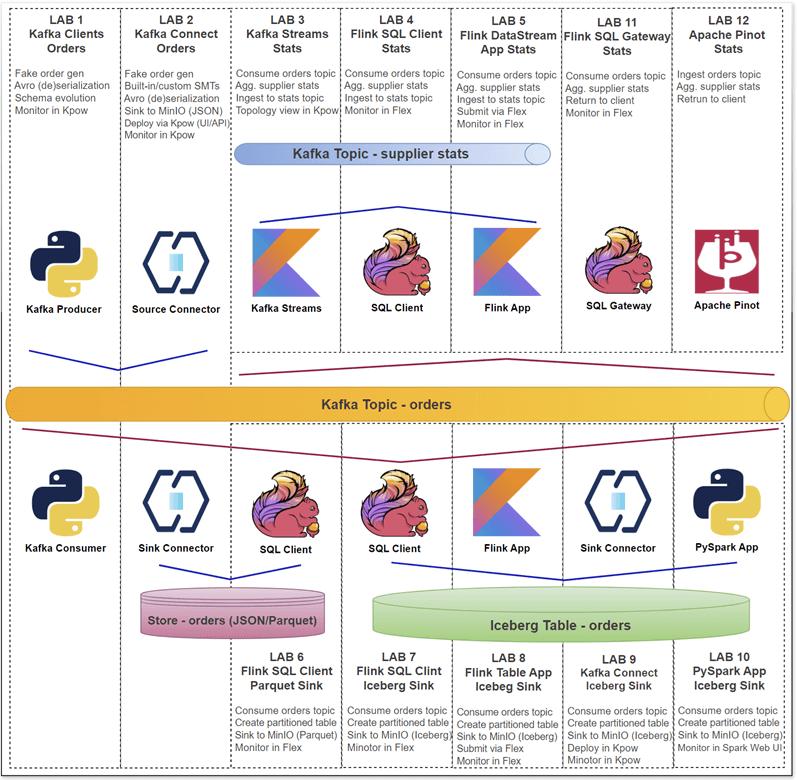
Get a fast and practical start with our new **Factor House Local labs**. These hands-on labs provide detailed walkthroughs for building real-time data pipelines using **Kafka**, **Flink**, **Spark**, **Iceberg**, and **Pinot**.
Each lab is designed to be modular, hands-on, and production-inspired, helping you learn, prototype, and extend your data platform skills.
[**➡️ Click Here to Explore the Labs**](https://github.com/factorhouse/examples/tree/main/fh-local-labs)
Mobile Game Top K Analytics
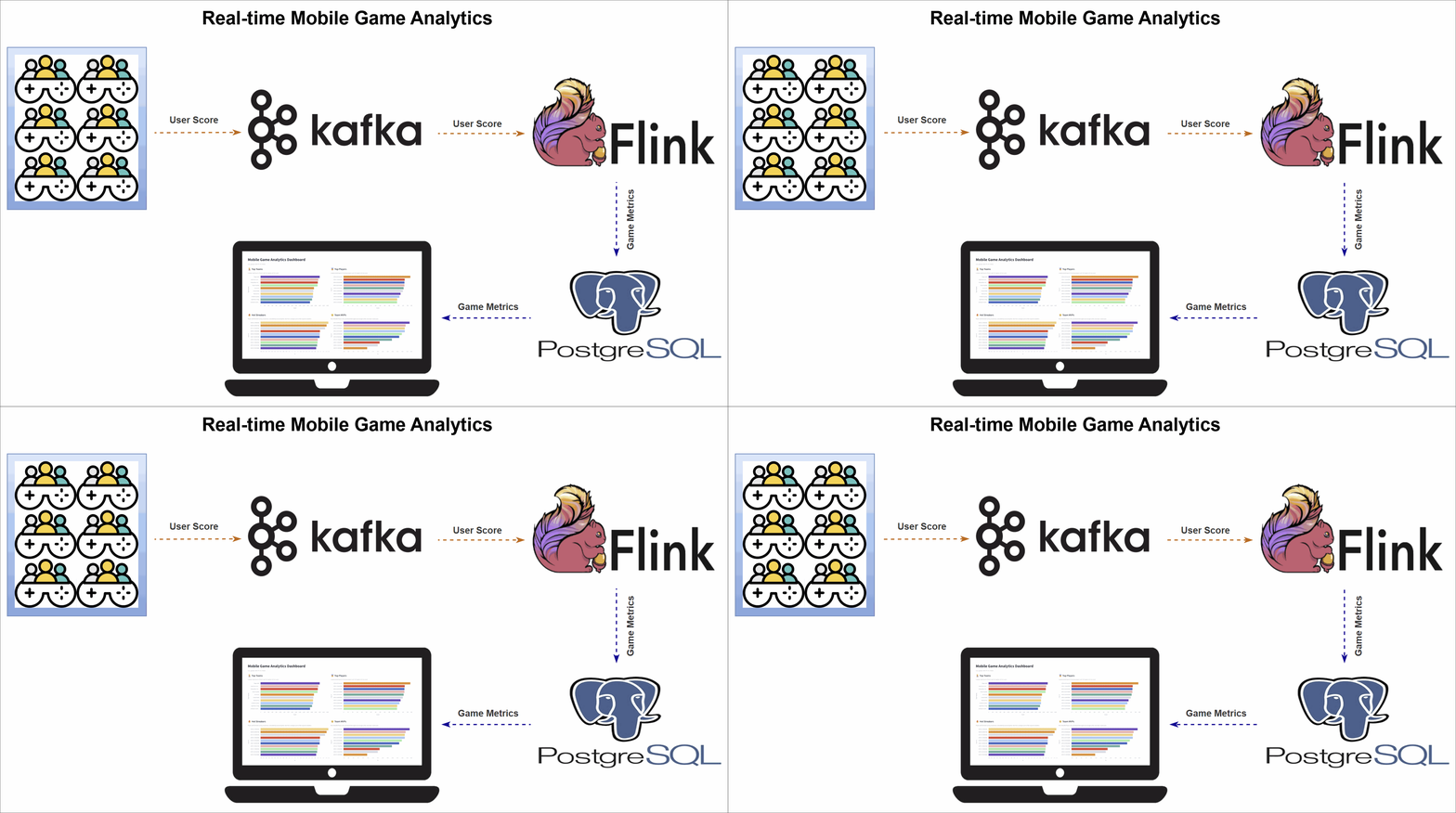
This project walks through how to build a complete real-time analytics pipeline for a mobile game using a modern data stack. It simulates live gameplay data, processes it in real time to calculate performance metrics, and displays the results on an interactive dashboard.
[**➡️ Click Here to Explore the Project**](https://github.com/factorhouse/examples/tree/main/projects/mobile-game-top-k-analytics)
CDC with Debezium on Real-Time theLook eCommerce Data
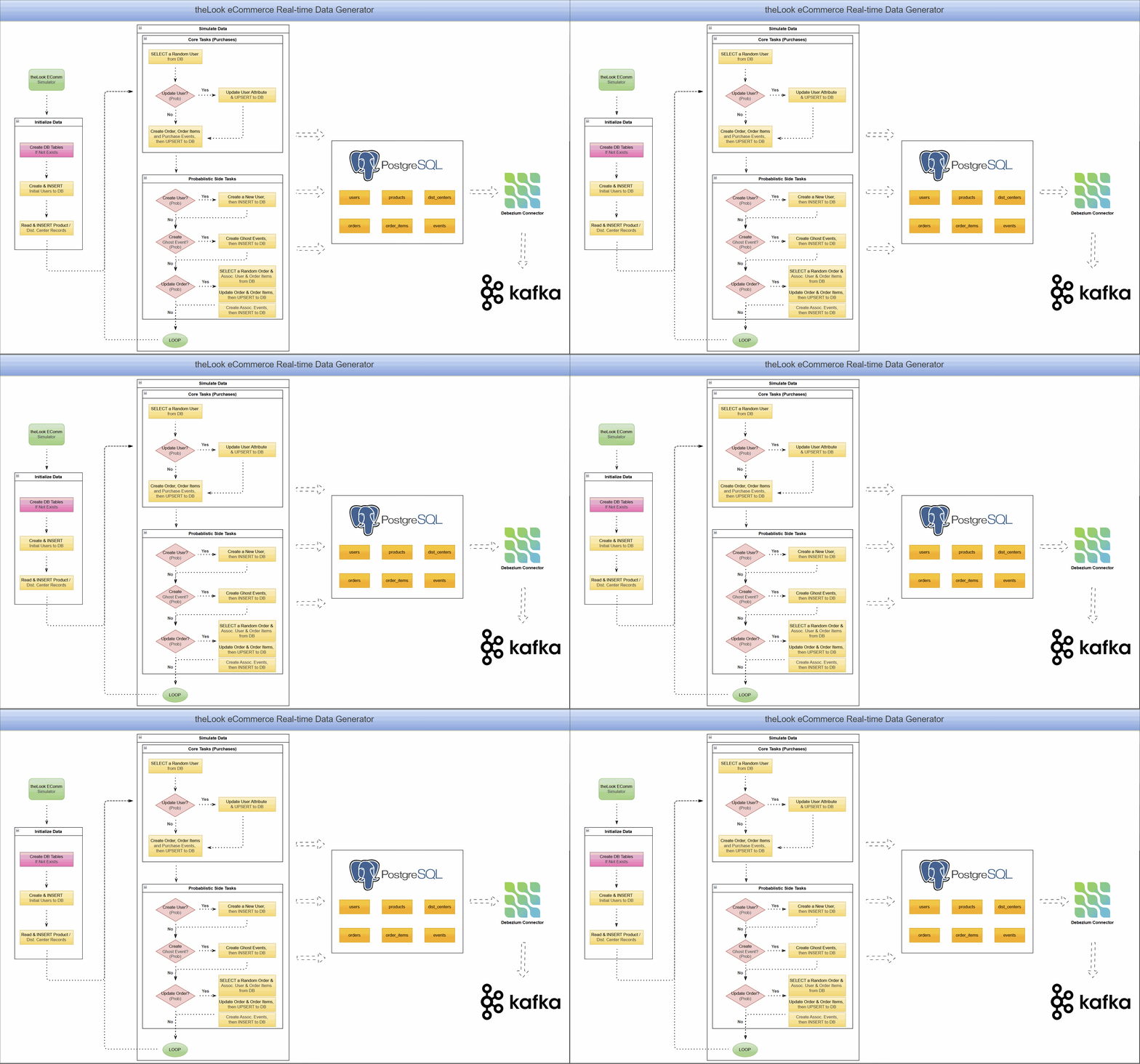
This project unlocks the power of the popular [theLook eCommerce dataset](https://console.cloud.google.com/marketplace/product/bigquery-public-data/thelook-ecommerce) for modern event-driven applications. It uses a re-engineered [real-time data generator](https://github.com/factorhouse/examples/tree/main/datagen/thelook-ecomm) that transforms the original static dataset into a continuous stream of simulated user activity, writing directly to a PostgreSQL database.
[**➡️ Click Here to Explore the Project**](https://github.com/factorhouse/examples/tree/main/projects/thelook-ecomm-cdc)
A Practical Guide to Data Lineage on Kafka Connect with OpenLineage
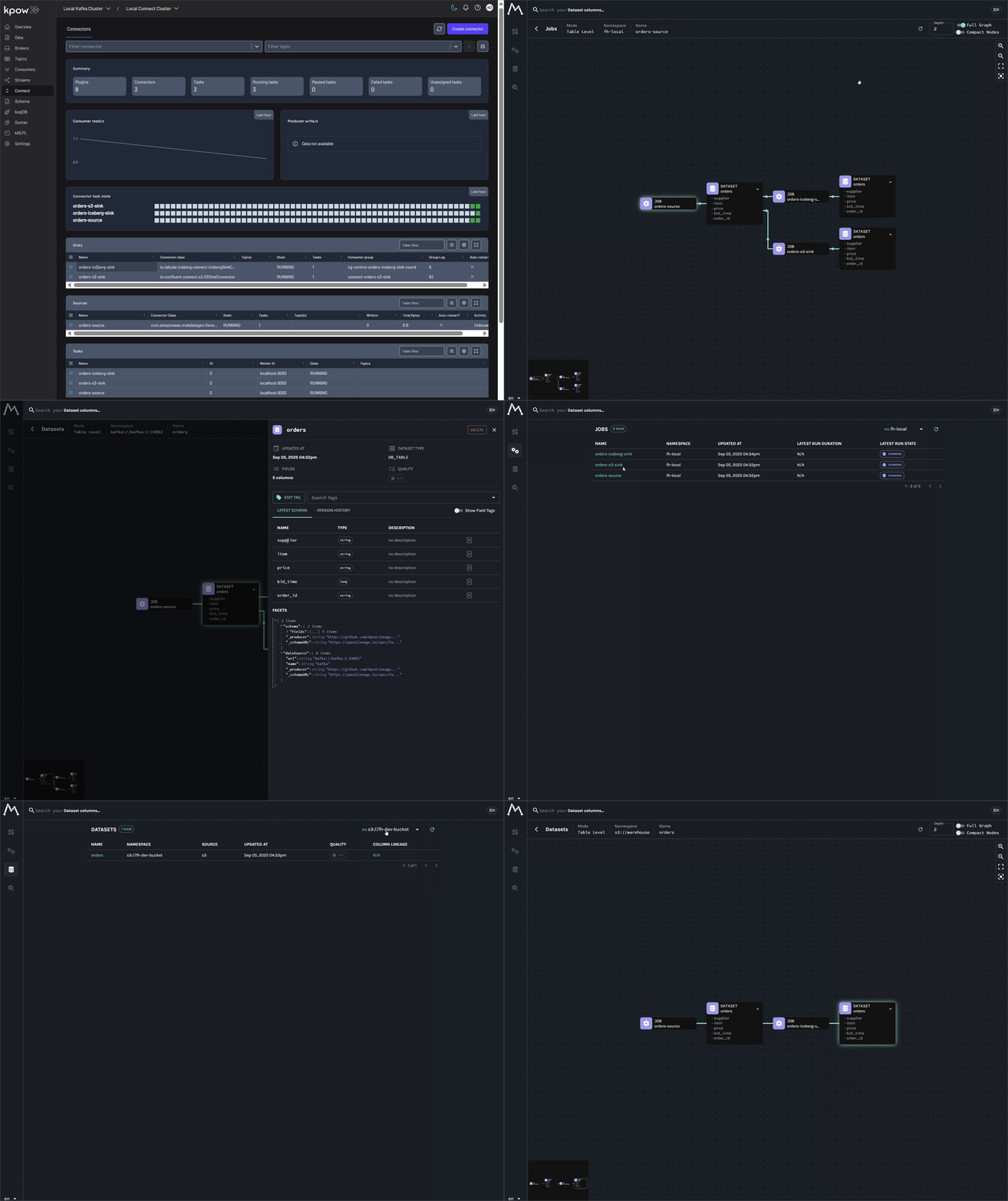
The lab demonstrates how to capture real-time data lineage from Kafka Connect using a custom Single Message Transform (SMT) - `OpenLineageLifecycleSmt`. It builds a complete pipeline that tracks data from a source connector to S3 and Iceberg sinks, with the full lineage graph visualized in Marquez.
[**➡️ Click Here to Explore the Lab**](https://github.com/factorhouse/examples/blob/main/projects/data-lineage-labs/lab1_kafka-connect.md)
End-to-End Data Lineage from Kafka to Flink and Spark
An end-to-end tutorial for establishing data lineage across Kafka, Flink, Spark, and Iceberg. This lab begins by tracking data from a single Kafka topic through parallel pipelines: a Kafka S3 sink connector for raw data archival, a Flink job for real-time analytics, another Flink job for Iceberg ingestion, and a downstream Spark batch job that reads from the Iceberg table.
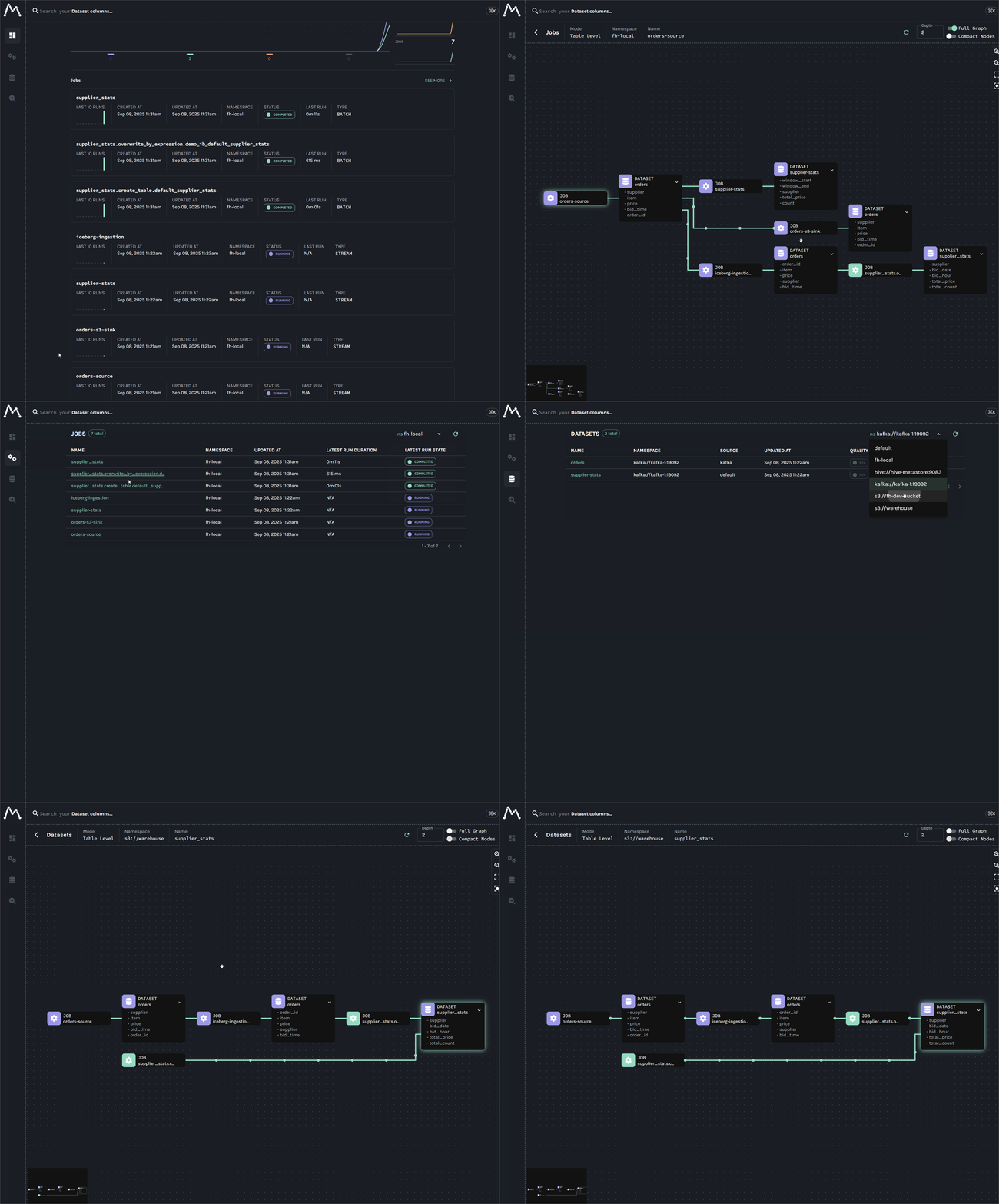
[**➡️ Click Here to Explore the Lab**](https://github.com/factorhouse/examples/blob/main/projects/data-lineage-labs/lab2_end-to-end.md)
_Stay tuned—more labs and projects are on the way!_
## Prerequisites
### Install Docker
The local cluster runs with Docker Compose, so you will need to [install Docker](https://www.docker.com/).
Once Docker is installed, clone this repository and run the following commands from the base path.
### Clone this repository
```
git clone git@github.com:factorhouse/factorhouse-local.git
```
### Change into the repository directory
```
cd factorhouse-local
```
### Downloading Dependencies
Core services like Flink, Spark, and Kafka Connect are designed to be modular and do not come bundled with the specific connectors and libraries needed to communicate with other systems like the Hive Metastore, Apache Iceberg, or S3.
`setup-env.sh` automates the process of downloading all the required dependencies and organizing them into a local `deps` directory. When the services are started with docker-compose, this directory is mounted as a volume, injecting the libraries directly into each container's classpath.
View all downloaded dependencies
#### Kafka Connectors
- **Confluent S3 Connector:** For streaming data from Kafka to S3.
- **Debezium PostgreSQL Connector:** For capturing row-level changes from a PostgreSQL database.
- **Amazon MSK Data Generator:** A tool for generating sample data for testing.
- **Iceberg Kafka Connect:** For sinking Kafka records into Apache Iceberg tables.
#### Flink Connectors
- **Kafka SQL Connector:** Enables Flink to read from and write to Kafka topics using SQL.
- **Avro Confluent Registry:** Allows Flink to work with Avro schemas stored in Confluent Schema Registry.
- **JDBC SQL Connector:** A connector for reading data from and writing data into any relational databases with a JDBC driver.
- **PostgreSQL JDBC Driver:** A driver to connect to a PostgreSQL database.
#### Flink Hive Dependencies
- **Hive SQL Connector:** Allows Flink to connect to a Hive Metastore and query Hive tables.
- **Supporting Libraries:** Includes `Hive Exec`, `Antlr`, and `Thrift` libraries necessary for the Hive integration to function.
#### Flink Iceberg/Parquet Dependencies
- **Iceberg Flink Runtime:** The core library for Flink to read from and write to Apache Iceberg tables.
- **Iceberg AWS Bundle:** Provides AWS-specific integrations for Iceberg, like S3 file I/O.
- **Parquet SQL Formatter:** Enables Flink to handle the Parquet file format.
#### Hadoop/Hive Metastore Dependencies
- **Hadoop Libraries:** A collection of core Hadoop modules (`hadoop-common`, `hadoop-aws`, `hadoop-auth`) and their dependencies (`aws-java-sdk-bundle`, `guava`, etc.) required for interacting with HDFS-compatible file systems like S3.
- **PostgreSQL JDBC Driver:** Required for the Hive Metastore to communicate with its PostgreSQL backend database.
#### Spark Iceberg Dependencies
- **Iceberg Spark Runtime:** The core library for Spark to read from and write to Apache Iceberg tables.
- **Iceberg AWS Bundle:** Provides AWS-specific integrations for Spark, enabling it to work with Iceberg tables on S3.
```bash
./resources/setup-env.sh
▶️ Downloading Kafka connectors...
⏳ Progress : [##################################################] 100%
✅ Download complete in 0m 27s!
▶️ Downloading Flink connectors...
⏳ Progress : [##################################################] 100%
✅ Download complete in 0m 4s!
▶️ Downloading Flink Hive dependencies...
⏳ Progress : [##################################################] 100%
✅ Download complete in 0m 11s!
▶️ Downloading Flink Iceberg/Parquet dependencies...
⏳ Progress : [##################################################] 100%
✅ Download complete in 0m 12s!
▶️ Downloading Hadoop/Hive Metastore dependencies...
⏳ Progress : [##################################################] 100%
✅ Download complete in 0m 36s!
▶️ Downloading Spark Iceberg/OpenLineage dependencies...
⏳ Progress : [##################################################] 100%
✅ Download complete in 0m 14s!
```
### Update Kpow and Flex Licenses
Both **Kpow** and **Flex** require valid licenses. Licenses can be obtained from the Factor House License Portal. Visit [https://account.factorhouse.io/auth/getting_started](https://account.factorhouse.io/auth/getting_started) to generate your license.
You can begin with either of the following options:
- Request a free **Community License** for non-commercial use. A single community license now covers both Kpow and Flex.
- Request a **30-day Trial License** for commercial evaluation, providing full access to all enterprise features.
For managing Kpow and Flex licenses effectively, it's strongly recommended to store the license files **externally** from your main configuration or version control system (like Git). This approach prevents accidental exposure of sensitive license details and makes updating or swapping licenses much simpler.
The Docker Compose files facilitates this by allowing you to specify the path to your license file using **environment variables** on your host machine _before_ launching the services. Specifically, they are configured to look for these variables and use their values to locate the appropriate license file via the `env_file` directive. If an environment variable is not set, a default path (usually within the `resources` directory) is used as a fallback.
Factor House Community licenses can be used across both Flex and Kpow, however individual trial licenses are required for evaluation. To enforce consistency, Kpow and Flex both require the license variable to be set on a product-by-product basis, regardless of which license you're using (this also applies to enterprise license configurations).
Therefore, you should specify the path to your license file for both environment variables:
- **`KPOW_LICENSE`**: Specifies the path to the Kpow license file.
- **`FLEX_LICENSE`**: Specifies the path to the Flex license file.
**Example Usage:**
Imagine your Kpow license is stored at `/home//.factorhouse/kpow-license.env`. To instruct Docker Compose to use this specific file, you would set the environment variable on your host _before_ running the compose command:
```bash
# Set the environment variable (syntax may vary slightly depending on your shell)
export KPOW_LICENSE=/home//.factorhouse/kpow-license.env
# Now run Docker Compose - it will use the path set above
docker compose -p kpow -f compose-kpow.yml up -d
```
> By default, it is configured to deploy the Enterprise edition. See below for instructions on how to configure it to run the Community edition instead.
License file example
```
LICENSE_ID=
LICENSE_CODE=
LICENSEE=
LICENSE_EXPIRY=
LICENSE_SIGNATURE=
```
License mapping details
```yaml
# compose-kpow.yml
services:
kpow:
...
env_file:
- resources/kpow/config/trial.env
- ${KPOW_LICENSE:-resources/kpow/config/license.env}
# compose-flex.yml
services:
flex:
...
env_file:
- resources/flex/config/trial.env
- ${FLEX_LICENSE:-resources/flex/config/license.env}
```
## Running the Platform
To get the platform running, you first need to configure your local environment. This involves setting environment variables to select the edition you want to run (Community or Enterprise) and providing the file paths to your licenses. Once these prerequisites are set, you can launch the services using `docker compose`. You have two primary options: you can start all services (Kpow, Flex, and Pinot) together for a fully integrated experience, or you can run Kpow and Flex independently for more focused use cases. When you are finished, remember to run the corresponding `down` command to stop and remove the containers, and unset the environment variables to clean up your session.
### Prerequisite: Configure Your Environment
Before running any commands, configure your shell environment by uncommenting and setting the following variables in your terminal.
```bash
# --- Configuration ---
# Edition (choose one by uncommenting the lines)
# For Enterprise Edition:
# unset KPOW_SUFFIX
# unset FLEX_SUFFIX
# For Community Edition:
# export KPOW_SUFFIX="-ce"
# export FLEX_SUFFIX="-ce"
# Licenses (provide the path to your license .env files)
# export KPOW_LICENSE="/path/to/your/kpow-license.env"
# export FLEX_LICENSE="/path/to/your/flex-license.env"
```
### Run the Stacks
This platform is designed to be modular. You can run each stack individually or combine them to create a complete, integrated environment.
#### **Key Concepts**
Before you start, understand these three concepts:
1. **Project Isolation (`-p `)**: We use the `-p` flag (e.g., `-p kpow`) to give each stack a unique project name. This prevents Docker from getting confused if multiple files define a service with the same name (like a database).
2. **Stack Profiles (`--profile`)**: Files like `compose-store.yml` and `compose-obsv.yml` contain multiple, independent services. The `--profile` flag lets you choose which one to activate (e.g., `--profile pinot`).
3. **Shared Network (`USE_EXT`)**: By default, the `compose-kpow.yml` stack creates a shared Docker network called `factorhouse`. Other stacks are designed to connect to this network so services can communicate.
- If you run a stack **without** the `kpow` stack, you must tell it to create its own network. This is done by setting `USE_EXT=false`.
---
#### **Usage Examples**
While you can launch all services together, the most common and resource-friendly approach is to launch only the stacks you need.
**1. Kafka & Kpow Stack**
This is the foundational stack. It creates the shared `factorhouse` network that other stacks can connect to.
```bash
# Start
docker compose -p kpow -f ./compose-kpow.yml up -d
# Stop
docker compose -p kpow -f ./compose-kpow.yml down
```
**2. Flink & Flex Stack**
- To run **with** the Kafka stack (recommended):
```bash
docker compose -p flex -f ./compose-flex.yml up -d
```
- To run **standalone** (creates its own network):
```bash
USE_EXT=false docker compose -p flex -f ./compose-flex.yml up -d
```
- To stop:
```bash
# Note: Use USE_EXT=false here as well if you started it standalone
docker compose -p flex -f ./compose-flex.yml down
```
**3. Real-Time Data Stores (Pinot, ClickHouse, StarRocks)**
These are selected from `compose-store.yml` via profiles.
> 💡 You can specify multiple profiles to launch more than one data store at once, e.g., `--profile pinot --profile clickhouse`.
```bash
# Start Apache Pinot (connected to the factorhouse network)
docker compose -p store --profile pinot -f ./compose-store.yml up -d
# Stop Apache Pinot
docker compose -p store --profile pinot -f ./compose-store.yml down
# Start ClickHouse (connected to the factorhouse network)
docker compose -p store --profile clickhouse -f ./compose-store.yml up -d
# Stop ClickHouse
docker compose -p store --profile clickhouse -f ./compose-store.yml down
# Start StarRocks (connected to the factorhouse network)
docker compose -p store --profile starrocks -f ./compose-store.yml up -d
# Stop StarRocks
docker compose -p store --profile starrocks -f ./compose-store.yml down
```
**4. Observability Stacks (Lineage & Telemetry)**
These are selected from `compose-obsv.yml` using profiles.
```bash
# Start Marquez for data lineage (connected to the factorhouse network)
docker compose -p obsv --profile lineage -f ./compose-obsv.yml up -d
# Stop Marquez
docker compose -p obsv --profile lineage -f ./compose-obsv.yml down
# Start all observability services (Lineage + Telemetry)
docker compose -p obsv --profile lineage --profile telemetry -f ./compose-obsv.yml up -d
# Stop all observability services
docker compose -p obsv --profile lineage --profile telemetry -f ./compose-obsv.yml down
```
**5. Metadata Stack**
This is selected from `compose-metadata.yml`.
```bash
# Start OpenMetadata (connected to the factorhouse network)
docker compose -p metadata --profile omt -f ./compose-metadata.yml up -d
# Stop OpenMetadata
docker compose -p metadata --profile omt -f ./compose-metadata.yml down
```
### Clean Up Your Environment
After stopping the services, run this command to unset the environment variables from your terminal session.
```bash
unset KPOW_SUFFIX FLEX_SUFFIX KPOW_LICENSE FLEX_LICENSE
```
## Main Services
The enterprise editions of **Kpow** and **Flex** support multiple authentication providers, as outlined in the documentation below:
- [Kpow Authentication Overview](https://docs.factorhouse.io/kpow-ee/authentication/overview/)
- [Flex Authentication Overview](https://docs.factorhouse.io/flex-ee/authentication/)
Among those, this project includes file-based authentication, and user credentials can be found in the following locations:
- **Kpow**: [resources/kpow/config/trial.env](./resources/kpow/config/trial.env)
- **Flex**: [resources/flex/config/trial.env](./resources/flex/config/trial.env)
For demonstration purposes, **Kpow** and **Flex** can be accessed using `admin` as both the username and password.

After successful authentication, users are redirected to the **Overview** page.

The following sections show key services and their associated port mappings.
### Kafka with Kpow (KRaft Mode)
| Service Name | Port(s) (Host:Container) | Description |
| :----------- | :------------------------- | :--------------------------------------------------------- |
| `kpow` | `3000:3000`
`4000:4000` | Kpow Web UI (`3000`)
Kpow API (`4000`) |
| `schema` | `8081:8081` | Confluent Schema Registry (manages Kafka message schemas). |
| `connect` | `8083:8083` | Kafka Connect (framework for Kafka connectors). |
| `kafka-1` | `9092:9092` | Kafka Broker 1 (primary listener). |
| `kafka-2` | `9093:9093` | Kafka Broker 2 (primary listener). |
| `kafka-3` | `9094:9094` | Kafka Broker 3 (primary listener). |
### Unified Analytics with Flex
| Service Name | Port(s) (Host:Container) | Description |
| :--------------- | :--------------------------- | :--------------------------------------------------------------- |
| `flex` | `3001:3000` | Flex UI for enterprise Flink management and monitoring. |
| `jobmanager` | `8082:8081` | Apache Flink JobManager UI & REST API. |
| `sql-gateway` | `9090:9090` | Apache Flink SQL Gateway for submitting interactive SQL queries. |
| `spark` | `4040:4040`
`18080:18080` | Spark Web UI (`4040`).
Spark History Server (`18080`). |
| `minio` | `9001:9001`
`9000:9000` | MinIO Console UI (`9001`).
MinIO S3-compatible API (`9000`). |
| `postgres` | `5432:5432` | PostgreSQL database, used as the Hive Metastore backend. |
| `hive-metastore` | `9083:9083` | Apache Hive Metastore service. |
| `redis` | `6379:6379` | Redis in-memory data store. |
_\_(**Note:** Services like `taskmanager-_`and`mc` run in the background and do not expose ports to the host.)\_\*
### Real-time Data Stores
These services are launched from `compose-store.yml` using profiles.
#### Pinot (`--profile pinot`)
| Service Name | Port(s) (Host:Container) | Description |
| :----------------- | :----------------------- | :------------------------------------------------------- |
| `zookeeper` | `2181:2181` | ZooKeeper (coordination service, required for Pinot). |
| `pinot-controller` | `19000:9000` | Apache Pinot Controller (manages cluster state, UI/API). |
| `pinot-broker` | `18099:8099` | Apache Pinot Broker (handles query routing). |
| `pinot-server` | `18098:8098` | Apache Pinot Server (hosts data and executes queries). |
#### ClickHouse (`--profile clickhouse`)
| Service Name | Port(s) (Host:Container) | Description |
| :----------- | :-------------------------- | :------------------------------------------------------------------- |
| `ch-app` | `8000:8000`
`8084:8080` | HyperDX API (`8000`).
HyperDX Web UI (`8084`). |
| `ch-server` | `8123:8123`
`29000:9000` | ClickHouse Server HTTP API (`8123`).
Native TCP client (`29000`). |
#### StarRocks (`--profile starrocks`)
| Service Name | Port(s) (Host:Container) | Description |
| :------------- | :------------------------- | :----------------------------------------------------------- |
| `starrocks-fe` | `8030:8030`
`9030:9030` | StarRocks Frontend UI (`8030`)
MySQL SQL client (`9030`). |
### Observability Stacks
These services are launched from `compose-obsv.yml` using profiles.
#### Lineage (`--profile lineage`)
| Service Name | Port(s) (Host:Container) | Description |
| :------------ | :----------------------- | :-------------------------------------------- |
| `marquez-web` | `3003:3000` | Marquez Web UI (visualizes OpenLineage data). |
| `marquez-api` | `5002:5000` | Marquez backend and OpenLineage API endpoint. |
| `marquez-db` | `5433:5432` | PostgreSQL database for Marquez metadata. |
#### Telemetry (`--profile telemetry`)
| Service Name | Port(s) (Host:Container) | Description |
| :------------- | :----------------------- | :--------------------------------------------------------- |
| `prometheus` | `19090:9090` | Prometheus (metrics collection and database). |
| `alertmanager` | `19093:9093` | Alertmanager (handles alerts from Prometheus). |
| `grafana` | `3004:3000` | Grafana (platform for metrics visualization & dashboards). |
### Data Discovery & Governance (OpenMetadata)
These services are launched from `compose-metadata.yml` using the `--profile omt` flag.
| Service Name | Port(s) (Host:Container) | Description |
| :-------------- | :----------------------- | :-------------------------------------------------------- |
| `omt-server` | `8585:8585` | OpenMetadata Web UI and central API. |
| `omt-ingestion` | `8080:8080` | Airflow UI for managing metadata ingestion workflows. |
| `omt-es` | `9200:9200` | Elasticsearch (powers the search and discovery features). |
| `omt-db` | `5434:5432` | PostgreSQL database for the OpenMetadata backend. |
## 📌 Further Configuration
### Custom Dependency Loading
The Flink services (`jobmanager`, `taskmanager`, and `sql-gateway`) do not have their dependencies baked into the Docker image. Instead, all required JAR files are dynamically loaded at runtime using a combination of Docker volume mounts and a Flink classpath discovery mechanism.
Dependencies for Hadoop, Hive, Iceberg, and Parquet are first downloaded to the local `./resources/deps` directory on the host machine. These directories are then mounted as volumes directly into the Flink containers at specific paths (e.g., `/tmp/hadoop`, `/tmp/iceberg`).
The Flink runtime is then instructed to scan these directories by the `CUSTOM_JARS_DIRS` environment variable. This variable contains a semicolon-separated list of paths (`"/tmp/hadoop;/tmp/hive;/tmp/iceberg;/tmp/parquet"`) that Flink will automatically search for JARs to add to its classpath upon startup.
However, the **SQL Gateway** has a special requirement. In addition to the standard dependencies, it needs access to specific Flink SQL connectors (like Kafka, Avro, etc.) which are mounted into the `/tmp/connector` directory. Since the SQL Gateway does not support custom JAR loading through its own configuration, the `CUSTOM_JARS_DIRS` environment variable for this specific service must be updated to include this path. This ensures the Gateway can successfully load the connectors required to execute SQL queries against external systems.
```yaml
...
x-common-environment: &flink_common_env_vars
AWS_REGION: us-east-1
HADOOP_CONF_DIR: /opt/flink/conf
HIVE_CONF_DIR: /opt/flink/conf
CUSTOM_JARS_DIRS: "/tmp/hadoop;/tmp/hive;/tmp/iceberg;/tmp/parquet" # <-- Add ;/tmp/connector for SQL Gateway
x-common-flink-volumes: &flink_common_volumes
...
- ./resources/deps/hadoop:/tmp/hadoop
- ./resources/deps/flink/hive/flink-sql-connector-hive-3.1.3_2.12-1.20.1.jar:/tmp/hive/flink-sql-connector-hive-3.1.3_2.12-1.20.1.jar
- ./resources/deps/flink/hive/antlr-runtime-3.5.2.jar:/tmp/hive/antlr-runtime-3.5.2.jar
- ./resources/deps/flink/iceberg:/tmp/iceberg
- ./resources/deps/flink/parquet:/tmp/parquet
- ./resources/deps/flink/connector:/tmp/connector
services:
...
jobmanager:
<<: *flink_image_pull_policy_config
container_name: jobmanager
command: jobmanager
...
environment:
<<: *flink_common_env_vars
volumes: *flink_common_volumes
```
### PyFlink Support
PyFlink is supported by setting the `FLINK_SUFFIX` environment variable before launching the services.
By exporting `export FLINK_SUFFIX="-py"`, you instruct Docker Compose to modify its build process for the Flink services. This change directs it to use the `resources/flink/Dockerfile-py` file instead of the default one. During the image build, this specific Dockerfile extends the base Flink image by installing Python, `pip`, and the `apache-flink` Python package.
As a result, the `jobmanager` and `taskmanager` containers will be fully equipped with the necessary environment to develop and execute PyFlink jobs. You can inspect the `Dockerfile-py` for the exact commands used.
> You can also build the image before starting the Docker service by `docker build -t fh-flink-1.20.1${FLINK_SUFFIX:-} ./resources/flink`
```yaml
x-common-flink-config: &flink_image_pull_policy_config
image: fh-flink-1.20.1${FLINK_SUFFIX:-} # ${FLINK_SUFFIX} is either unset (blank) or -py
build:
context: ./resources/flink/
dockerfile: Dockerfile${FLINK_SUFFIX:-}
pull_policy: never
...
services:
...
jobmanager:
<<: *flink_image_pull_policy_config
container_name: jobmanager
command: jobmanager
...
environment:
<<: *flink_common_env_vars
volumes: *flink_common_volumes
```
Alternatively, you can build the image manually before starting the services. This gives you more control and can speed up subsequent launches. To do this, run the `docker build` command from your terminal, making sure the tag (`-t`) exactly matches the image name specified in the `docker-compose.yml` file.
**To build the PyFlink image:**
```bash
# Set the suffix for the tag and Dockerfile name
export FLINK_SUFFIX="-py"
# Build the image
docker build \
-t fh-flink-1.20.1${FLINK_SUFFIX} \
-f ./resources/flink/Dockerfile${FLINK_SUFFIX} \
./resources/flink
```
Because the image is now built and tagged locally, `docker compose up` will use it directly instead of attempting to build it again.
## Support
Any issues? Contact [support](https://factorhouse.io/support/) or view our [docs](https://docs.factorhouse.io/).
## License
This repository is released under the Apache 2.0 License.
Copyright © Factor House.