https://github.com/fatbobman/coredataevolution
SwiftData-style actor isolation, Swift-first NSManagedObject macros, and typed mapping for modern Core Data projects.
https://github.com/fatbobman/coredataevolution
core-data coredata nsmanagedobject predicate sqlite swift swift-concurrency swift-macros swiftdata
Last synced: about 2 months ago
JSON representation
SwiftData-style actor isolation, Swift-first NSManagedObject macros, and typed mapping for modern Core Data projects.
- Host: GitHub
- URL: https://github.com/fatbobman/coredataevolution
- Owner: fatbobman
- License: mit
- Created: 2024-04-09T10:53:49.000Z (over 2 years ago)
- Default Branch: main
- Last Pushed: 2026-05-30T00:10:14.000Z (about 2 months ago)
- Last Synced: 2026-05-30T02:10:31.790Z (about 2 months ago)
- Topics: core-data, coredata, nsmanagedobject, predicate, sqlite, swift, swift-concurrency, swift-macros, swiftdata
- Language: Swift
- Homepage: https://fatbobman.com/en/posts/why-i-am-still-thinking-about-core-data-in-2026/
- Size: 709 KB
- Stars: 128
- Watchers: 3
- Forks: 5
- Open Issues: 0
-
Metadata Files:
- Readme: README.md
- Funding: .github/FUNDING.yml
- License: LICENSE
- Agents: AGENTS.md
Awesome Lists containing this project
README
# CoreDataEvolution
      [](LICENSE) [](https://deepwiki.com/fatbobman/CoreDataEvolution)
CoreDataEvolution **does not** replace Core Data. It modernizes how Core Data is expressed, isolated, and maintained in Swift codebases.
CoreDataEvolution brings four ideas together for Core Data projects:
- SwiftData-style actor isolation for Core Data
- a Swift-first source representation for `NSManagedObject` models
- a typed mapping layer for sort and predicate code that improves naming flexibility and type
safety without forcing changes to the underlying model
- tooling that keeps source declarations aligned with the real Core Data model
This document focuses on the user-facing story:
- what the library is for
- which pain points it solves
- what the major features are
- how the pieces fit together
- where to go next in the detailed guides
## What Problem This Library Solves
Core Data is no longer the newest persistence option in Apple's ecosystem.
SwiftData offers a more modern declaration style. GRDB, SQLiteData, and other approaches give many
teams more direct database control.
And yet Core Data is still a pragmatic choice for many production apps because it offers:
- broad platform support
- mature migration and store behavior
- an object-graph model many teams still prefer
- existing schemas that teams cannot easily replace
So the question this library starts from is not:
- "Should everyone still choose Core Data?"
It is:
- "If a project is still using Core Data, how can it fit modern Swift more naturally?"
That is where the real friction shows up today.
### Pain Point 1: The model declaration layer no longer feels native to modern Swift
The problem is not that Core Data cannot model data.
The problem is that the default `NSManagedObject` source layer becomes awkward when you want
today's Swift code to express intent clearly.
Typical pressure points include:
- better Swift-facing names than the stored schema names
- enums instead of raw values
- Codable payloads
- transformable values
- structured composition values
- predictable generated boilerplate instead of repeated hand-written bridging
Without help, teams often end up writing a thick layer of computed properties and bridging code
just to make the model feel natural in Swift.
CoreDataEvolution adds a Swift-first declaration layer around `NSManagedObject` while keeping the
real Core Data runtime underneath.
### Pain Point 2: The concurrency model still feels older than the rest of the codebase
Core Data can absolutely be used safely with concurrency, but its default workflow still tends to
pull developers back toward `perform`, context passing, and ad hoc thread-confinement discipline.
Compared with the actor-isolated style many Swift developers now expect, traditional Core Data code
often falls back to:
- manually passing contexts around
- remembering thread confinement rules
- reloading objects by `NSManagedObjectID`
- building one-off background helpers
CoreDataEvolution brings a SwiftData-style actor-isolated workflow to Core Data.
### Pain Point 3: SwiftUI often has to stop thinking in the Core Data object graph
Many Core Data apps are still shaped around relationships: projects contain tasks, notes belong to
folders, messages point to authors, and detail views naturally follow those chains.
With the traditional `ObservableObject` path, immediate SwiftUI refresh is usually tied to a view
boundary that owns the observed object. That works for simple rows, but relationship-chain screens
quickly become awkward. A view that wants to read a path such as `item.itemData.memo` often has to be
split into several smaller view structs so each related object can be carried by its own observed
wrapper.
That cost is not only boilerplate. It pushes UI structure toward observation mechanics instead of the
shape the screen actually wants:
- relationship-chain reads need extra view boundaries or forwarding glue
- local view extraction becomes less flexible because observation ownership leaks into layout choices
- the UI drifts away from the direct model-graph style that SwiftData encourages
CoreDataEvolution's MainActor Observation support lets SwiftUI read generated Core Data accessors
directly, including across relationship chains. The first goal is cognitive clarity: keep the view
close to the persisted object graph and make a future SwiftData migration conceptually easier.
Field-level precision helps, but it is an implementation benefit, not the primary reason for the
feature.
### Pain Point 4: Naming flexibility, type safety, and schema stability pull against each other
Once a Core Data model ships, schema names often become hard to change safely.
That creates pressure to keep old persistent names while still wanting better Swift-facing names in
application code.
The usual result is some combination of:
- hand-written mapping code
- stringly-typed sort and predicate keys
- growing drift between `.xcdatamodeld`, Swift source, and query code
CoreDataEvolution adds a typed mapping layer for sort and predicate construction so you can improve
Swift naming and type safety without being forced to rename the underlying schema.
### Pain Point 5: Experience and convention are not enough anymore
Many teams already know how to work around these issues.
The harder problem is that the workarounds often live as:
- tribal knowledge
- local conventions
- discipline that must be remembered in code review
That gets less reliable as projects grow, teams change, and AI-assisted coding becomes part of the
day-to-day workflow.
CoreDataEvolution tries to turn those conventions into clearer APIs, generated structure, and an
optional toolchain that can verify alignment over time.
Background article:
- [Why I'm Still Thinking About Core Data in 2026](https://fatbobman.com/en/posts/why-i-am-still-thinking-about-core-data-in-2026/)
## Mental Model
The project is built around one central idea:
> `@PersistentModel` is a source-level representation of a Core Data model, not a replacement for Core Data itself.
That distinction matters.
### What `@PersistentModel` is
It is a Swift-facing declaration layer for:
- attributes
- relationships
- composition values
- generated typed path metadata
- generated runtime schema metadata for test/debug use
### What `@PersistentModel` is not
It is not:
- a replacement for `.xcdatamodeld` in production
- a migration system
- a different persistence engine
- a runtime reflection layer
The production source of truth is still your Core Data model.
The macro layer gives you a better, more explicit, more toolable representation of that model in Swift source.
This is the most important mental model for new users:
- keep building the real schema in Xcode
- use `@PersistentModel` to describe that schema in Swift
- use `cde-tool` (optional) to keep the two layers aligned
## The Three Main Parts of the Package
### 1. Actor isolation for Core Data
Use:
- `@NSModelActor`
- `@NSMainModelActor`
These macros generate the boilerplate needed to safely work with Core Data through actor isolation or main-actor isolation.
Good fit:
- background write handlers
- UI-facing main-thread coordinators
- tests that need explicit isolation boundaries
Guide:
- [Docs/NSModelActorGuide.md](./Docs/NSModelActorGuide.md)
Background article:
- [Core Data Reform: Achieving Elegant Concurrency Operations Like SwiftData](https://fatbobman.com/en/posts/core-data-reform-achieving-elegant-concurrency-operations-like-swiftdata/)
### 2. `@PersistentModel` and related macros
Use:
- `@PersistentModel`
- `@Attribute`
- `@Relationship`
- `@Ignore`
- `@Composition`
- `@CompositionField`
This is the model declaration layer.
It gives you:
- explicit attribute/relationship metadata
- generated Core Data accessors
- lightweight `relationshipNameCount` accessors for to-many relationships
- generated to-many relationship helper APIs
- typed key/path metadata for sort and predicate construction
- runtime schema metadata for tests and debug workflows
- optional MainActor Observation for generated accessors on iOS 17+ / macOS 14+
Guide:
- [Docs/PersistentModelGuide.md](./Docs/PersistentModelGuide.md)
- [Docs/ObservationGuide.md](./Docs/ObservationGuide.md)
Observation opt-in:
```swift
@objc(Item)
@PersistentModel(observation: .mainActor)
final class Item: NSManagedObject {
var title: String = ""
var summary: String = ""
}
@NSModelActor
actor ItemWriter {
func rename(
id: NSManagedObjectID,
to title: String
) async throws {
guard let item = self[id, as: Item.self] else { return }
item.title = title
try await saveObservedChanges()
}
}
@MainActor
final class Store {
let container: NSPersistentContainer
let observation: CDEObservationDomain
let writer: ItemWriter
init(container: NSPersistentContainer) {
self.container = container
let observation = CDEObservationDomain(container: container)
self.observation = observation
writer = ItemWriter(observationDomain: observation)
}
}
```
This activates MainActor Swift Observation for CDE-generated accessors on the container's
`viewContext`, so SwiftUI can read managed objects directly without a separate projection model.
`ItemWriter` is a background actor; creating it with `init(observationDomain:)` registers its actor
context as an Observation producer and keeps the domain setup alive. Successful
`saveObservedChanges()` calls from that actor provide property-level Observation response for updated
objects. Direct `modelContext.save()` calls from the same registered context can also carry metadata,
but `saveObservedChanges()` is the actor-facing API that makes the property-level Observation
contract explicit. If save fails, CDE clears its own staged Observation metadata and rethrows without
rolling back your context. Insert and delete operations do not need a property-level save wrapper; use
ordinary Core Data saves for those. Refresh is save-gated and can be field-precise when the save
source provides enough metadata. See the guide for producer routes, fallback rules, and re-merge
behavior.
### 3. `cde-tool`
Use `cde-tool` when you want a repeatable model-to-source workflow.
It is intentionally optional.
The core value of CoreDataEvolution lives in the actor-isolation macros and the macro-based model
declaration layer. You can use those directly without adopting the tool at all.
`cde-tool` exists as an extra layer for teams that want stronger workflow guarantees, especially
for CI/CD, drift detection, and existing-project migration.
It helps with:
- generating `@PersistentModel` source from an existing Core Data model
- validating drift between `.xcdatamodeld` and source declarations
- inspecting the resolved schema view used by the toolchain
- applying safe autofix for deterministic issues
That first point is especially useful when adopting the package in an existing Core Data project:
the tool can quickly turn a legacy `.xcdatamodeld` into a usable `@PersistentModel` starting point,
similar in spirit to Xcode's model code generation, but aligned with CoreDataEvolution's macro
layer.
Guide:
- [Docs/CDEToolGuide.md](./Docs/CDEToolGuide.md)
## Core Features
### SwiftData-style actor isolation for Core Data
```swift
import CoreDataEvolution
@NSModelActor
actor ItemStore {
func renameItem(id: NSManagedObjectID, to newTitle: String) throws {
guard let item = self[id, as: Item.self] else { return }
item.title = newTitle
try modelContext.save()
}
}
```
This lets you keep Core Data while moving to a much cleaner isolation model.
### Swift-first model declarations on top of `NSManagedObject`
```swift
@objc(Item)
@PersistentModel
final class Item: NSManagedObject {
@Attribute(persistentName: "name")
var title: String = ""
@Relationship(inverse: "items", deleteRule: .nullify)
var tag: Tag?
}
```
This is the most important thing to understand:
- the source is Swift-first
- the runtime is still Core Data
- the model file is still part of the system
For relationships:
- to-one properties generate a getter and setter
- to-many properties (`Set` / `[T]`) generate a getter only
- mutate to-many relationships through generated helpers such as `addToTags`,
`removeFromTags`, and `insertIntoOrderedTags(_:at:)`
### Typed key/path mapping for sort and predicate code
This is one of the library's distinctive features.
When a Swift-facing property name differs from the stored schema name, the macro-generated typed path layer still resolves sort and predicate keys to the correct persistent field path.
That means you can write:
```swift
let sort = try NSSortDescriptor(
Item.self,
path: Item.path.title,
order: .asc
)
let predicate = NSPredicate(
format: "%K == %@",
Item.path.title.raw,
"hello"
)
```
while the store still uses the original field name.
Guide:
- [Docs/TypedPathGuide.md](./Docs/TypedPathGuide.md)
### Explicit storage strategy selection
The source layer makes storage strategy explicit instead of burying it in hand-written bridging code.
Supported source-level storage choices include:
- `.default`
- `.raw`
- `.codable`
- `.transformed(...)`
- `.composition`
Guide:
- [Docs/StorageMethodGuide.md](./Docs/StorageMethodGuide.md)
## Important Preconditions
These are the points that new users most often need clarified.
### `@PersistentModel` works with Core Data models
For production use, `@PersistentModel` is not a replacement for `.xcdatamodeld`.
You still build and maintain a Core Data model.
The macro layer is the source representation that sits on top of it.
That means:
- you still need a Core Data source model for production workflows
- `cde-tool` reads that model and helps generate/validate the Swift declaration layer
- the macro-generated runtime schema is for test/debug scenarios, not for replacing the production model system
- unsupported runtime primitive types fail generation instead of silently downgrading schema
### Relationship `inverse` uses the persistent relationship name
This is easy to miss.
In:
```swift
@Relationship(
persistentName: "primary_category",
inverse: "items",
deleteRule: .nullify
)
var category: Category?
```
`inverse` refers to the relationship name in the Core Data model on the other side.
It does **not** refer to the other Swift property name.
### `composition` requires Core Data composite attribute support
`@Composition` maps to Core Data composite attributes.
For schema-backed models, this means the Xcode model must declare a real top-level `Composite`
attribute, not a pair of flattened entity fields and not a `Transformable` fallback.
That means it requires platform support for that Core Data feature:
- iOS 17+
- macOS 14+
- tvOS 17+
- watchOS 10+
- visionOS 1+
If your deployment target is below those versions, do not use `composition`.
## Runtime Schema for Tests and Debugging
The package also supports a pure Swift runtime-schema path for tests and debugging.
Example:
```swift
let model = try NSManagedObjectModel.makeRuntimeModel(Item.self, Tag.self)
let container = try NSPersistentContainer.makeRuntimeTest(
modelTypes: Item.self, Tag.self
)
```
This path is intentionally limited.
It is useful when you want:
- test-only model construction
- debug-only schema checks
- non-Xcode workflows for tests
It is not intended to replace `.xcdatamodeld` in production.
## `cde-tool` Workflow
Typical workflow:
1. start from a Core Data source model
2. create a config
3. generate `@PersistentModel` source
4. add hand-written methods and computed properties in separate extension files
5. validate drift over time
Typical first setup:
```bash
cde-tool bootstrap-config \
--model-path Models/AppModel.xcdatamodeld \
--output cde-tool.json
```
Then:
```bash
cde-tool generate --config cde-tool.json
cde-tool validate --config cde-tool.json
```
### Validation modes
`cde-tool validate` supports two mental models:
- `conformance`
- checks whether source follows the rules and matches the schema logically
- `exact`
- additionally requires tool-managed files to match current generated output exactly
`exact` is intentionally stricter and should not be the default workflow for every team.
If you use `exact`, keep these rules in mind:
- do not hand-edit tool-managed files
- do not let format/lint rewrite tool-managed files
- add custom methods and computed properties in separate extension files
## Recommended Project Structure
A practical structure looks like this:
- Core Data model in `Models/`
- generated source in a dedicated generated folder
- hand-written extensions in separate files
- `cde-tool.json` checked into the repository
Example:
- `Models/AppModel.xcdatamodeld`
- `Sources/AppModels/Generated/`
- `Sources/AppModels/Item+Extras.swift`
- `cde-tool.json`
This keeps generated and hand-written code clearly separated.
## Where to Read Next
Start here based on what you want to do.
### If you want actor-isolated Core Data code
- [Docs/NSModelActorGuide.md](./Docs/NSModelActorGuide.md)
- [Core Data Reform: Achieving Elegant Concurrency Operations Like SwiftData](https://fatbobman.com/en/posts/core-data-reform-achieving-elegant-concurrency-operations-like-swiftdata/)
### If you want Swift-first Core Data model declarations
- [Docs/PersistentModelGuide.md](./Docs/PersistentModelGuide.md)
### If you want SwiftUI to observe generated Core Data accessors
- [Docs/ObservationGuide.md](./Docs/ObservationGuide.md)
### If you want remapped fields to still work in sort and predicate code
- [Docs/TypedPathGuide.md](./Docs/TypedPathGuide.md)
### If you want to choose the right storage strategy
- [Docs/StorageMethodGuide.md](./Docs/StorageMethodGuide.md)
### If you want the CLI workflow
- [Docs/CDEToolGuide.md](./Docs/CDEToolGuide.md)
## Summary
CoreDataEvolution is not trying to replace Core Data.
It is trying to make Core Data easier to use in modern Swift codebases by adding:
- better isolation patterns
- better model source declarations
- better MainActor Observation integration for generated model accessors
- better schema-to-source tooling
- better typed mapping for renamed fields
If your project still relies on Core Data, but you want a source model and workflow that feel much
closer to modern Swift, that is the space this library is designed for.
## System Requirements
- iOS 13.0+ / macOS 10.15+ / watchOS 6.0+ / visionOS 1.0+ / tvOS 13.0+
- Swift 6.0
Note: The custom executor uses a compatible `UnownedJob` serial-executor path to support the minimum deployment targets.
## Contributing
We welcome contributions! Whether you want to report issues, propose new features, or contribute to the code, feel free to open issues or pull requests on the GitHub repository.
## License
CoreDataEvolution is available under the MIT license. See the LICENSE file for more information.
## Acknowledgments
Special thanks to the Swift community for their continuous support and contributions.
Thanks to [@rnine](https://github.com/rnine) for sharing and validating the iOS 13+ compatibility approach that inspired this adaptation.
## Support the project
- [🎉 Subscribe to Fatbobman's Swift Weekly](https://weekly.fatbobman.com)
- [☕️ Buy Me A Coffee](https://buymeacoffee.com/fatbobman)
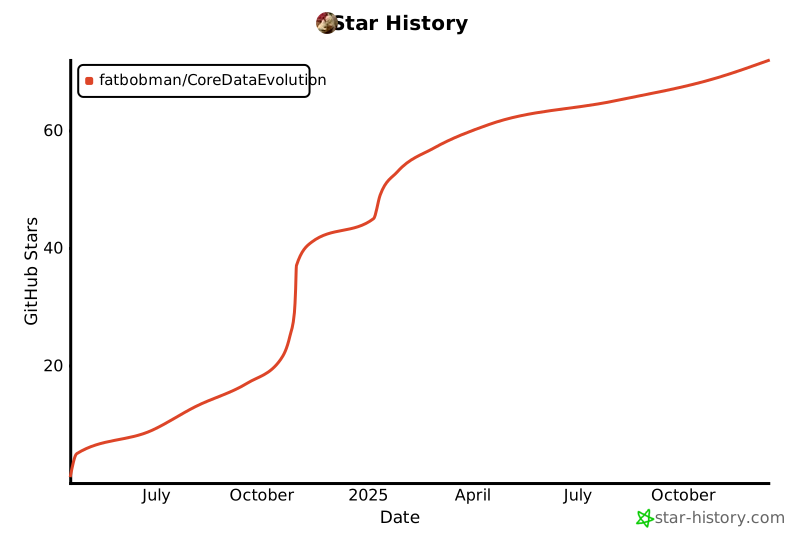
## Star History
[](https://star-history.com/#fatbobman/CoreDataEvolution&Date)