https://github.com/fifis/pnd
R package for accurate and quick numerical derivatives of arbitrary order
https://github.com/fifis/pnd
finite-differences numerical-differentiation parallel-algorithm r-package step-size
Last synced: 8 months ago
JSON representation
R package for accurate and quick numerical derivatives of arbitrary order
- Host: GitHub
- URL: https://github.com/fifis/pnd
- Owner: Fifis
- License: eupl-1.2
- Created: 2023-12-05T23:00:09.000Z (over 2 years ago)
- Default Branch: main
- Last Pushed: 2025-09-17T15:28:07.000Z (9 months ago)
- Last Synced: 2025-10-11T05:13:34.764Z (9 months ago)
- Topics: finite-differences, numerical-differentiation, parallel-algorithm, r-package, step-size
- Language: R
- Homepage:
- Size: 420 KB
- Stars: 6
- Watchers: 2
- Forks: 1
- Open Issues: 0
-
Metadata Files:
- Readme: README.md
- Changelog: NEWS.md
- License: LICENSE.md
Awesome Lists containing this project
README
[](https://www.repostatus.org/#wip)
[](https://github.com/Fifis/pnd/actions/workflows/R-CMD-check.yaml)
[](https://app.codecov.io/gh/Fifis/pnd)
# pnd
An R package for computing fast and accurate numerical derivatives.
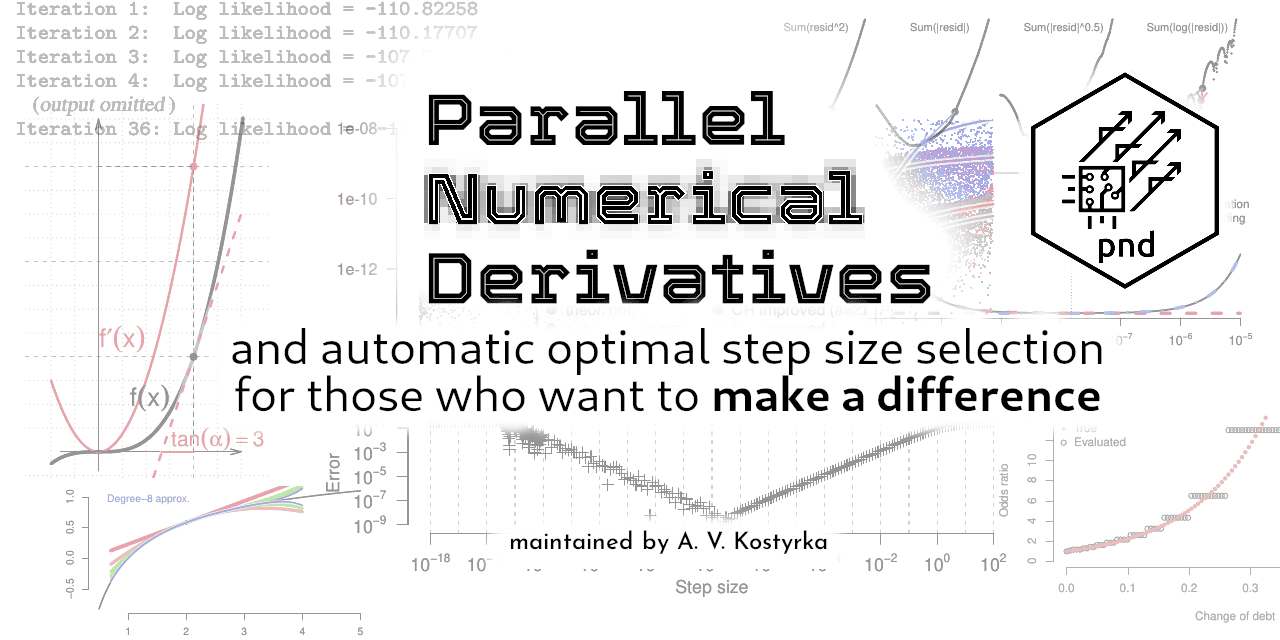
In the past, I was using [numDeriv](https://CRAN.R-project.org/package=numDeriv) to compute numerical gradients.
However, the results were not stable for some function, and I could not investigate the source of this instability.
Different step sizes yielded different results. Small step sizes were sometimes better, sometimes worse.
The `pnd` package was designed to offer a comprehensive tool-kit containing popular algorithms for finite differences, numerical gradients, Jacobians, and Hessians.
Optimal step sizes and parallel evaluation of numerical derivatives translate directly to faster numerical optimisation and statistical inference.
## Features
- **Robust numerical differentiation:** effortlessly compute derivatives while controlling the accuracy-speed trade-off.
- **Gradient and Hessian calculations:** obtain the direction and curvature required by most quasi-Newton optimisation algorithms.
- **Parallel capabilities:** evaluate multiple values under the best parallelisation scheme that reduces overhead. For example, on a 12-core machine, a 4th-order accurate Jacobian of a 3-dimensional function takes almost the same amount of time as one function evaluation.
- **Optimal step size selection:** obtain adaptive step size to ensure the best trade-off between mathematical truncation error and computer floating-point rounding error for the best overall accuracy.
- **Six optimal step selection algorithms:** choose between Curtis–Reid (1974) and its modern (2025) modification, Dumontet–Vignes (1977), Stepleman–Winarsky (1979), Mathur (2012), and Kostyrka (2025) algorithms. Future versions will feature parallelised algorithms.
## Getting started
This package has `numDeriv`-compatible syntax.
Simply replace the first letter of `numDeriv` commands with a capital one to get the improved commands: `Grad`, `Jacobian`, and `Hessian`.
Here is how to compute the gradient of `f(x) = sum(sin(x))` at the point `x = (1, 2, 3, 4)`.
```r
f <- function(x) sum(sin(x))
x <- 1:4
names(x) <- c("Jan", "Feb", "Mar", "Apr")
numDeriv::grad(f, x)
#> 0.5403023 -0.4161468 -0.9899925 -0.6536436
pnd::Grad(f, x)
#> Estimated gradient:
#> Jan Feb Mar Apr
#> 0.5403 -0.4161 -0.9900 -0.6536
#> (default step size: 6.1e-06, 1.2e-05, 1.8e-05, 2.4e-05).
```
The output contains diagnostic information about the chosen step size.
Our function preserved the names of the input argument, unlike `grad`.
The default step size in many implementations is proportional to the argument value, and this is reflected in the default output.
Should the user desire a fixed step size, this can be easily achieved with an extra argument named `h`:
```r
pnd::Grad(f, x, h = c(1e-5, 1e-5, 1e-5, 2e-5))
#> Estimated gradient:
#> Jan Feb Mar Apr
#> 0.5403 -0.4161 -0.9900 -0.6536
#> (user-supplied step size: 1.0e-05, 1.0e-05, 1.0e-05, 2.0e-05).
```
Finally, it is easy to request an algorithmically chosen optimal step size -- here is how to do it with the Stepleman--Winarsky (1979) rule, named `"SW"`, that works well in practice:
```r
pnd::Grad(f, x, h = "SW")
#> Estimated gradient:
#> Jan Feb Mar Apr
#> 0.5403 -0.4161 -0.9900 -0.6536
#> (SW step size: 5.0e-06, 1.0e-05, 7.5e-06, 1.0e-05).
```
Extensive diagnostics requested at any time: the step-search tracing information is saved in the `attr(pnd::Grad(...), "step.search")` attribute that has an `$iterations` element.
The numerical gradients and Jacobian are simple numeric vectors and matrices with attributes that facilitate printing -- feel free to handle them as any other numeric object.
## Learning resources
- [PDF of a 2025 presentation at the University of Luxembourg.](https://kostyrka.lu/en/education/presentations/2025-dem-internal-seminar.pdf)
- [PDF of an early 2024 presentation at the University of Luxembourg.](https://kostyrka.lu/en/education/presentations/2024-brown-bag-seminar.pdf) *(Obsolete – check the one above or the vignettes for up-to-date examples!)*
## Literature
This package is supported by 3 vignettes:
* Kostyrka, A. V. Fast and accurate parallel numerical derivatives in R. *In progress.*
* Kostyrka, A. V. Compatilibility of pnd with the syntax of numDeriv. *In progress.*
* Kostyrka, A. V. Step-size-selection algorithm benchmark. *In progress.*
The following articles provide the theory behind the methods implemented in this package:
* [Kostyrka, A. V. (2025). Step size selection in numerical differences using a regression kink.](https://hdl.handle.net/10993/64958) *Department of Economics and Management discussion paper No. 2025-09, University of Luxembourg.*
* Kostyrka, A. V. (2025). What are you doing, step size: a survey of step-size selection methods for numerical derivatives. *In progress.*
* Kostyrka, A. V. (2025). In the steps of central differences: improved algorithms for numerical derivatives. *In progress.*
## Installation
The stable version is on [CRAN](https://cran.r-project.org/package=pnd).
To install it, run the following line:
```r
install.packages("pnd")
```
The development version is available on GitHub. To install it, run the following two commands:
```r
install.packages("devtools")
devtools::install_github("Fifis/pnd")
```
To load this package, include this line in the code:
```r
library(pnd)
```
This package is almost dependency-free; the `parallel` library belongs to the `base`
group and is included in most R distributions.
## Licence
This software is released under the free/open-source [EUPL 1.2 licence](https://interoperable-europe.ec.europa.eu/collection/eupl/eupl-text-eupl-12).