https://github.com/frouo/promise-lite
Lets chain asynchronous methods. Pure Swift, 100% tested, lightweight with ~150 lines of code only
https://github.com/frouo/promise-lite
async chaining javascript pod promise promises swift
Last synced: 8 months ago
JSON representation
Lets chain asynchronous methods. Pure Swift, 100% tested, lightweight with ~150 lines of code only
- Host: GitHub
- URL: https://github.com/frouo/promise-lite
- Owner: frouo
- License: mit
- Created: 2020-04-26T12:33:04.000Z (about 6 years ago)
- Default Branch: master
- Last Pushed: 2022-07-22T06:25:51.000Z (almost 4 years ago)
- Last Synced: 2025-02-02T05:51:16.513Z (over 1 year ago)
- Topics: async, chaining, javascript, pod, promise, promises, swift
- Language: Swift
- Homepage:
- Size: 366 KB
- Stars: 11
- Watchers: 2
- Forks: 0
- Open Issues: 2
-
Metadata Files:
- Readme: README.md
- Changelog: CHANGELOG.md
- License: LICENSE
Awesome Lists containing this project
README
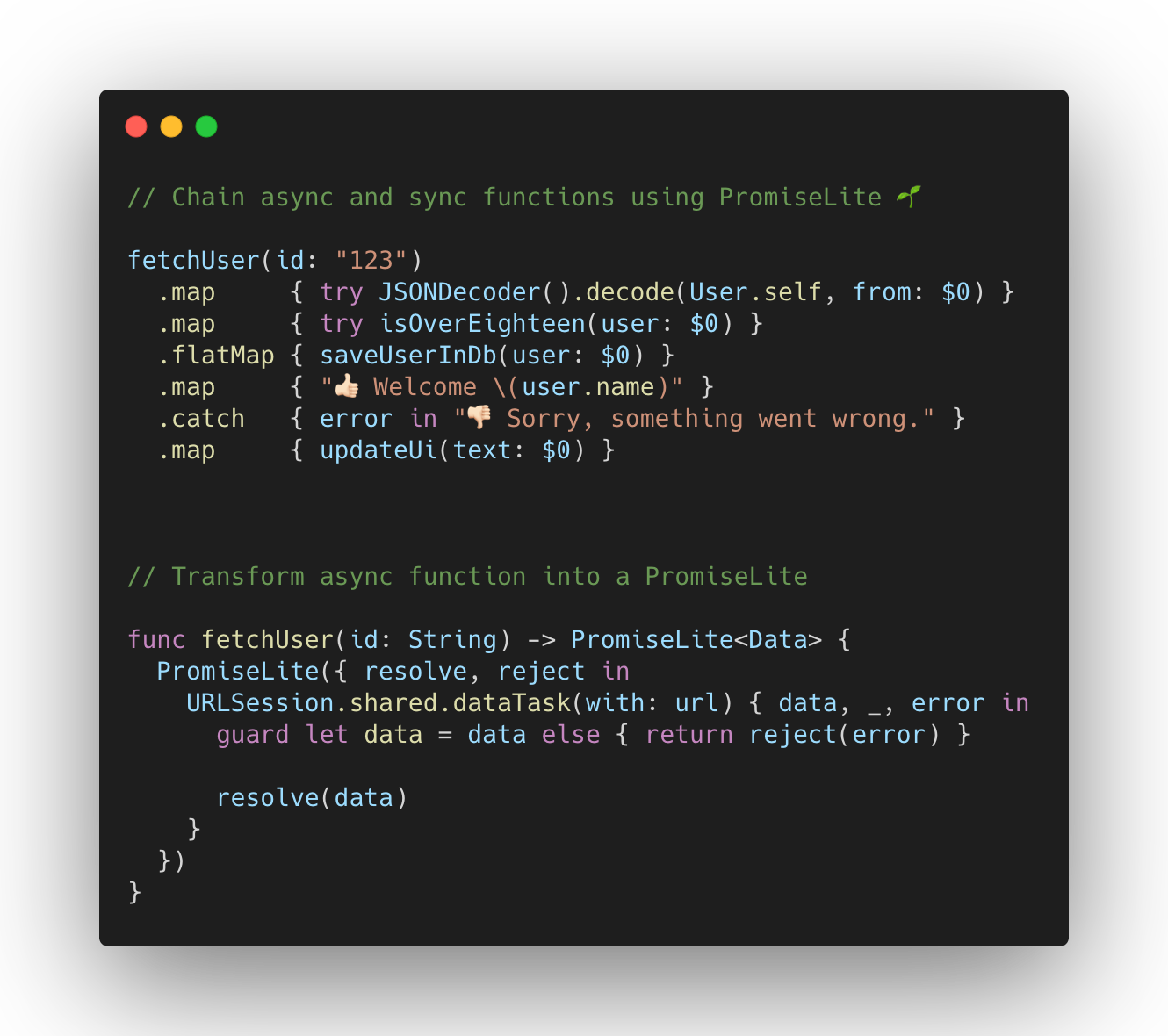
# PromiseLite
**Lets chain async and synch functions**
[](https://travis-ci.com/github/frouo/promise-lite)
[](https://codecov.io/gh/frouo/promise-lite)
[](https://cocoapods.org/pods/PromiseLite)
[](https://cocoapods.org/pods/PromiseLite)
[](https://cocoapods.org/pods/PromiseLite)
PromiseLite is an implementation of [Javascript Promises](https://developer.mozilla.org/en-US/docs/Web/JavaScript/Reference/Global_Objects/Promise) concept, in Swift.
It is pure Swift, 100% tested, and very lightweight, ~150 lines of code.
📜 [Complete Documentation](https://frouo.github.io/promise-lite/)
## Installation
PromiseLite is available through [CocoaPods](https://cocoapods.org). Add the following line to your Podfile:
```ruby
pod 'PromiseLite'
```
Tip: add the line `typealias Promise = PromiseLite` in your `AppDelegate.swift` (or elsewhere), it's shorter. For the rest of the page, I assume you did that.
## Get started
Start using promises in your code and chain async and sync functions within 5 minutes.
Let's say you have the following function that uses completion block to deal with asynchronous operation. You might be familiar with:
```swift
func fetch(url: URL, completion: @escaping (Result) -> Void) {
URLSession.shared.dataTask(with: url) { data, response, error in
if let data = data {
completion(.success(data))
} else {
completion(.failure(AppError.noData))
}
}
}
```
To be able to chain calls, you have to get rid of the completion block. Say hello to plromises!
Create another function that returns the promise of retrieving `Data`. In this new function, you can use the previously defined `fetch(url:completion:)` function within the `Promise`'s closure:
```swift
func fetch(url: URL) -> Promise {
Promise { resolve, reject in
fetch(url: url) { result in
switch result {
case .success(let data): resolve(data)
case .failure(let error): reject(error)
}
}
}
}
```
Now you can use `flatMap` to chain promises together, and `map` to chain a promise to a regular function.
```swift
let url = URL(string: "https://your.endpoint.com/user/36")!
fetch(url: url)
.map { try JSONDecoder().decode(User.self, from: $0) }
.map { $0.age >= 18 ? $0 : try { throw AppError.userIsMinor }() }
.flatMap { fetchContents(user: $0) }
.map { display(contents: $0) }
.catch { display(error: $0) }
```
**That's it!** 🎯
Just for comparison, the above chaining is equivalent to the following code using completion blocks 🤯
```swift
// fetch(url: url) { result in
// switch result {
// case .success(let data):
// do {
// let user = try JSONDecoder().decode(User.self, from: data)
//
// guard user.age >= 18 else {
// display(error: AppError.userIsMinor)
// return
// }
//
// fetchContents(user: user) { result2 in
// switch result2:
// case .success(let contents): display(contents: contents)
// case .failure(let error): display(error: error)
// }
// } catch {
// display(error: error)
// }
// case .failure(let error):
// display(error: error)
// }
// }
```
## Promises
### What is a promise?
A promise represents the eventual result of an operation (async or sync).
Its initialization parameter is called the `executor`. It is a closure that takes two functions as parameters:
- `resolve`: a function that takes a value parameter (the result of the promise)
- `reject`: a funtion that takes an error parameter
For exemple, we can define a promise this way:
```swift
func divide(a: Double, by b: Double) -> Promise {
let executor: ((Double) -> Void, (Error) -> Void) -> Void = { resolve, reject in
b != 0
? resolve(a / b)
: reject(AppError.cannotDivideByZero)
}
return Promise(executor)
}
```
Fortunately Swift offers some syntax shorthand and is able to infer types. The preceding code can therefore be simplified as follows:
```swift
func divide(a: Double, by b: Double) -> Promise {
Promise { resolve, reject in
b != 0
? resolve(a / b)
: reject(AppError.cannotDivideByZero)
}
}
```
### More exemples...
Here is an example of a sync function that takes an string parameter and returns the promise of an URL.
```swift
func url(from urlStr: String) -> Promise {
Promise { resolve, reject in
if let url = URL(string: urlStr) {
resolve(url) // ✅ the url string is valid, call `resolve`
} else {
reject(AppError.invalidUrl) // ❌ the url string is not valid, call `reject`
}
}
}
```
Here is a suggestion for wrapping `dataTask` into a promise that retrieves `Data`:
```swift
func fetch(url: URL) -> Promise {
Promise { resolve, reject in
URLSession.shared.dataTask(with: url) { data, response, error in
if let error = error {
reject(error) // ❌ an error occured, call `reject` or `throw`
return
}
guard let data = data else {
throw AppError.noData // ❌ could not retrieve data, call `reject` or `throw`
return
}
resolve(data) // ✅ data retrieved, call `resolve`
}
}
}
```
### Helpers
```swift
Promise.resolve("foo") // is equivalent to `Promise { resolve, _ in resolve("foo") }`
```
```swift
Promise.reject(AppError.💥) // is equivalent to `Promise { _, reject in reject(AppError.💥) }`
// Note that, in this situation, you must specify the type `` because there is nothing in the executor that can help Swift guess the type.
```
### Good to know
- The executor function, ie. `{ resolve, reject in ... }` is executed right away by the initializer during the process of initializing the promise object.
- the first `resolve`, `reject` or `throw` that is reached **wins** and any further calls will be **ignored**.
## Chaining
Use `map` and `flatMap` to chain promises.
**Tip**: make functions as small as possible so you can compose easily. Example:
```swift
Promise.resolve("https://your.endpoint.com/user/\(id)")
.flatMap { url(from: $0) }
.flatMap { fetch(url: $0) }
.map { try JSONDecoder().decode(User.self, from: $0) }
.map { $0.age >= 18 }
.flatMap { $0 ? fetchContents() : Promise.reject(AppError.userIsUnderage) }
.map { display(contents: $0) }
```
In the above example, we start with a string `https://your.endpoint.com/user/\(id)`, then we call `url(from:)` to transform the `string` into an `URL`, etc...
## Handling errors
An error does propagate until it is catched with `catch` or `flatCatch`. Once catched, the chaining is restored and continues.
```swift
Promise.resolve("not://a.va|id.url")
.flatMap { url(from: $0) } // 💥 this promise rejects because the url is invalid
.flatMap { /* not reached */ }
.map { /* not reached */ }
.map { /* not reached */ }
.flatMap { /* not reached */ }
.map { /* not reached */ }
.catch { /* REACHED! */ }
.map { /* REACHED! */ }
...
```
## How to debug a chaining?
Watch promise lifecycle by setting `PromiseLiteConfiguration.debugger` instance. This instance is called when a promise starts and when it resolves or rejects. `PromiseLite` provides a default implementation of the `PromiseLiteDebugger` protocol: `DefaultPromiseLiteDebugger(output:)`.
```swift
// Do the following to print default debugger output in the console.
PromiseLiteConfiguration.debugger = DefaultPromiseLiteDebugger { print($0) }
```
In addition, a promise can be initialized with a description so it is easier to understand which promise is currently being executed. By default, the description of a promise is `PromiseLite`.
```swift
func fetchUser(id: String) -> PromiseLite {
PromiseLite("fetch user") { resolve, reject in
...
}
}
func saveInDatabase(user: User) -> PromiseLite {
PromiseLite("save in db") { resolve, reject in
...
}
}
fetchUser(id: "123")
.flatMap { saveInDatabase(user: $0) }
.map { [weak self] _ in self?.updateUI() }
.catch { [weak self] err in self?.updateUI(error: err) }
// The above chaining will result in the following logs in the console:
// 🔗 | fetch user resolves ✅ in 1.36 sec
// 🔗 | save in db resolves ✅ in 0.72 sec
// 🔗 | PromiseLite<()> resolves ✅ in 0.00 sec
// 🔗 | PromiseLite<()> resolves ✅ in 0.00 sec
// Note that `map` and `catch` implicitly creates a promise with the default description. Since `updateUI` is a function that returns void, the type's value of the implicity created promise is `()`.
// Note that `catch` actually resolves because it implicitly creates a promise that resolves regardless of whether the previous promise resolved or rejected.
// In case, `fetchUser(id:)` would reject, the above chaining would result in the following logs in the console:
// 🔗 | fetch user rejects ❌ in 1.36 sec
// 🔗 | save in db rejects ❌ in 0.00 sec
// 🔗 | PromiseLite<()> rejects ❌ in 0.00 sec
// 🔗 | PromiseLite<()> resolves ✅ in 0.00 sec
// Note that rejection does propagate until `catch` handle the error returning a promise that resolves.
```
## Changelog
Visit [CHANGELOG.md](https://github.com/frouo/promise-lite/blob/master/CHANGELOG.md)
## Authors
- François Rouault
Feel free to submit merge request.
## License
PromiseLite is available under the MIT license. See the LICENSE file for more info.