https://github.com/genericmappingtools/gshhg-gmt
Scripts and raw data that combine to produce the GSHHG data sets for GMT
https://github.com/genericmappingtools/gshhg-gmt
Last synced: 11 months ago
JSON representation
Scripts and raw data that combine to produce the GSHHG data sets for GMT
- Host: GitHub
- URL: https://github.com/genericmappingtools/gshhg-gmt
- Owner: GenericMappingTools
- License: lgpl-3.0
- Created: 2020-01-03T01:11:53.000Z (over 6 years ago)
- Default Branch: master
- Last Pushed: 2022-06-17T21:42:20.000Z (about 4 years ago)
- Last Synced: 2025-04-05T03:31:50.522Z (about 1 year ago)
- Language: C
- Size: 167 MB
- Stars: 21
- Watchers: 9
- Forks: 3
- Open Issues: 5
-
Metadata Files:
- Readme: README.md
- Changelog: ChangeLog
- License: LICENSE
Awesome Lists containing this project
README
# GSHHG: Global Self-consistent Hierarchical High-resolution Geography


This repository contains the data and scripts that maintain and build
the gmt-gshhg package used by GMT.
GMT uses the [coast](https://docs.generic-mapping-tools.org/latest/coast.html)
utility to access a version of the GSHHG data specially formatted for GMT. The
GSHHG data have strengths and weaknesses. It is global and open source, but is
based on relatively old datasets and hence may not be accurate enough for very
large-scale mapping projects. The current GSHHG version used by GMT is 2.3.7.
Below is a mostly technical description of how the GSHHG data set was assembled,
processed, and formatted to meet the requirements of GMT.
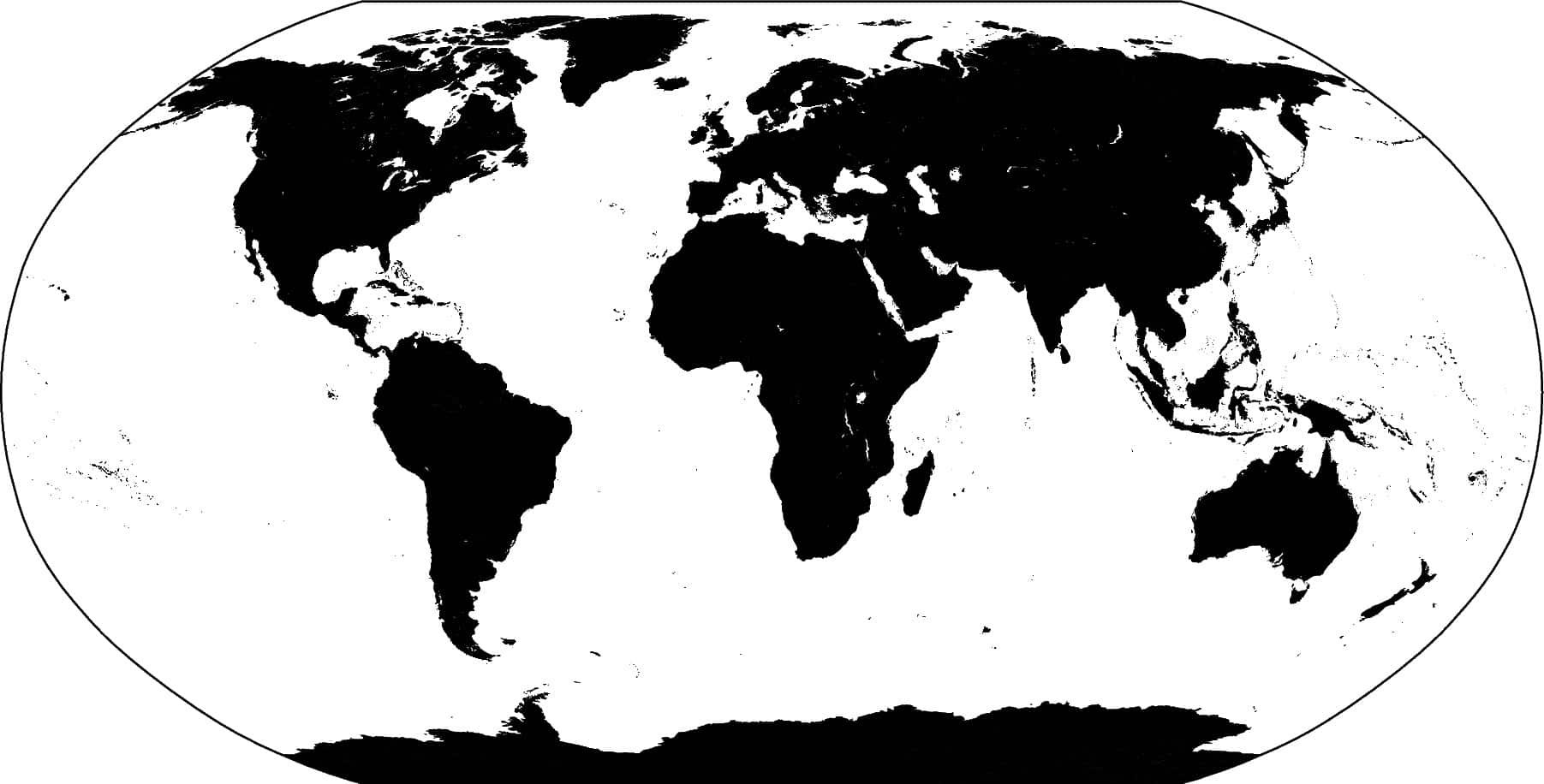
## Download
You can download the latest gshhg-gmt package from
[GitHub releases](https://github.com/GenericMappingTools/gshhg-gmt)
or from the [GMT main site](https://www.generic-mapping-tools.org/download/).
## The five resolutions
We will demonstrate the power of this database by starting with a
regional hemisphere map centered near Papua New Guinea and zoom in on a
specified point. The map regions will be specified in projected km from
the projection center, e.g., we may want the map to go from km to km in
the longitudinal and the latitudinal direction.
Also, as we zoom in on the projection center we want to draw the outline
of the next map region on the plot. To do that we use the **-SJ** option
in [plot](https://docs.generic-mapping-tools.org/latest/plothtml).
### The crude resolution (**-Dc**)
We begin with an azimuthal equidistant map of the hemisphere centered on
130°21'E, 0°12'S, which is slightly west of New Guinea, near the Strait of
Dampier. The edges of the map are all 9000 km true distance from the
projection center. At this scale (and for global maps) the crude
resolution data will usually be adequate to capture the main geographic
features. To avoid cluttering the map with insignificant detail we only
plot features (i.e., polygons) that exceed 500 km2 in area.
Smaller features would only occupy a few pixels on the plot and make the
map look "dirty". We also add national borders to the plot. The crude
database is heavily decimated and simplified by the DP-routine: The
total file size of the coastlines, rivers, and borders database is only
283 kbytes. The plot is produced by the script:
gmt begin GMT_App_K_1
gmt set GMT_THEME cookbook
gmt set MAP_GRID_CROSS_SIZE_PRIMARY 0 MAP_ANNOT_MIN_SPACING 0.3i \
MAP_ANNOT_OBLIQUE lon_parallel,lat_horizontal,tick_normal
gmt coast -R-9000/9000/-9000/9000+uk -JE130.35/-0.2/3.5i -Dc \
-A500 -Gburlywood -Sazure -Wthinnest -N1/thinnest,- -B20g20 -BWSne
echo 130.35 -0.2 | gmt plot -SJ-4000 -Wthicker
gmt end show
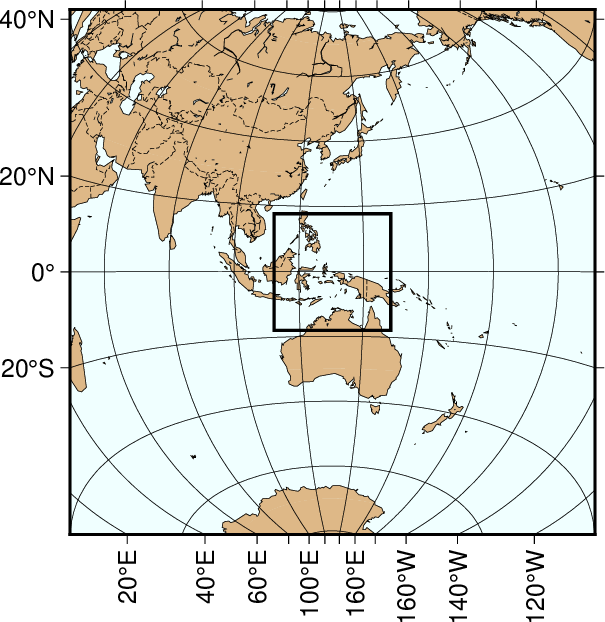
Here, we use the [MAP_ANNOT_OBLIQUE](https://docs.generic-mapping-tools.org/latest/gmt.conf.html#term-MAP_ANNOT_OBLIQUE)
setting to achieve horizontal annotations and set
[MAP_ANNOT_MIN_SPACING](https://docs.generic-mapping-tools.org/latest/gmt.conf.html#term-MAP_ANNOT_MIN_SPACING)
to suppress some longitudinal annotations near the S pole that otherwise would
overprint. The square box indicates the outline of the next map.
### The low resolution (**-Dl**)
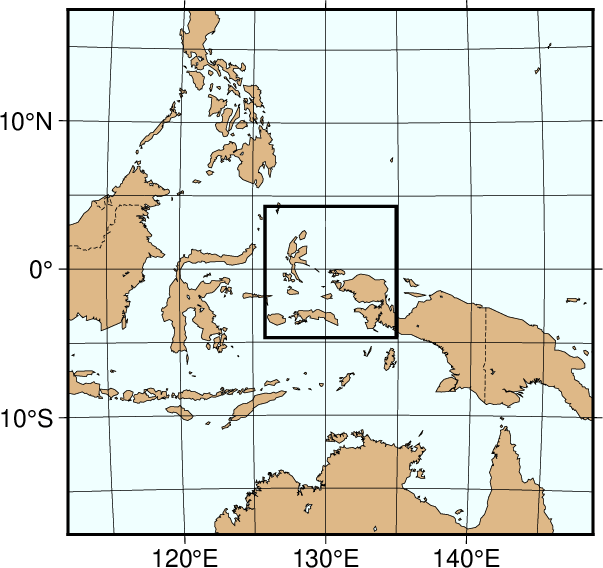
We have now reduced the map area by zooming in on the map center. Now,
the edges of the map are all 2000 km true distance from the projection
center. At this scale we choose the low resolution data that faithfully
reproduce the dominant geographic features in the region. We cut back on
minor features less than 100 km2 in area. We still add
national borders to the plot. The low database is less decimated and
simplified by the DP-routine: The total file size of the coastlines,
rivers, and borders combined grows to 907 kbytes; it is the default
resolution in GMT. The plot is generated by the script:
gmt begin GMT_App_K_2
gmt set GMT_THEME cookbook
gmt coast -R-2000/2000/-2000/2000+uk -JE130.35/-0.2/3.5i -Dl -A100 \
-Gburlywood -Sazure -Wthinnest -N1/thinnest,- -B10g5 -BWSne
echo 130.35 -0.2 | gmt plot -SJ-1000 -Wthicker
gmt end show
### The intermediate resolution (**-Di**)
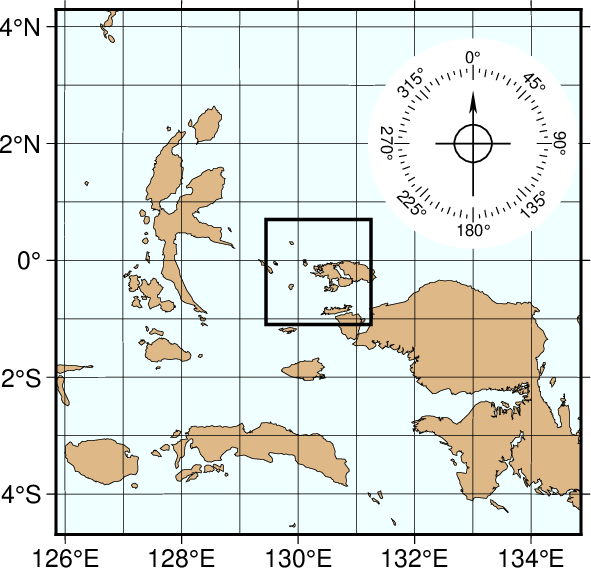
We continue to zoom in on the map center. In this map, the edges of the
map are all 500 km true distance from the projection center. We abandon
the low resolution data set as it would look too jagged at this scale
and instead employ the intermediate resolution data that faithfully
reproduce the dominant geographic features in the region. This time, we
ignore features less than 20 km2 in area. Although the script
still asks for national borders none exist within our region. The
intermediate database is moderately decimated and simplified by the
DP-routine: The combined file size of the coastlines, rivers, and
borders now exceeds 3.35 Mbytes. The plot is generated by the script:
gmt begin GMT_App_K_3
gmt set GMT_THEME cookbook
gmt coast -R-500/500/-500/500+uk -JE130.35/-0.2/3.5i -Di -A20 -Gburlywood -Sazure -Wthinnest -N1/thinnest,- -B2g1 -BWSne
echo 133 2 | gmt plot -Sc1.4i -Gwhite
gmt basemap -Tmg133/2+w1i+t45/10/5+jCM --FONT_TITLE=12p --MAP_TICK_LENGTH_PRIMARY=0.05i --FONT_ANNOT_SECONDARY=8p
echo 130.35 -0.2 | gmt plot -SJ-200 -Wthicker
gmt end show
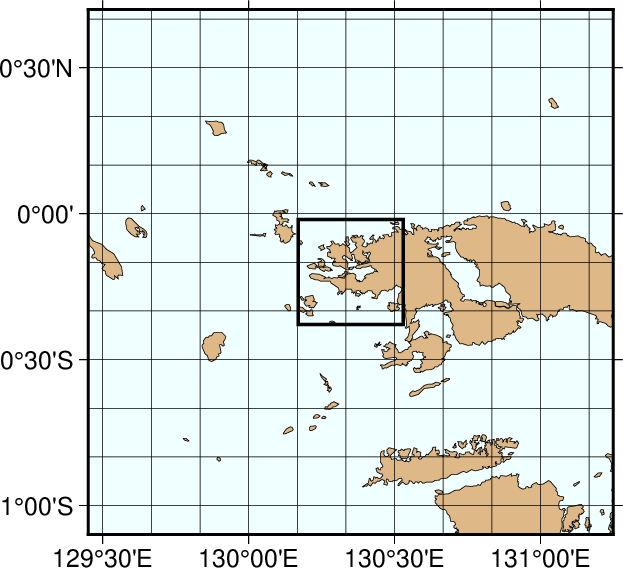
### The high resolution (**-Dh**)
The relentless zooming continues! Now, the edges of the map are all 100
km true distance from the projection center. We step up to the high
resolution data set as it is needed to accurately portray the detailed
geographic features within the region. Because of the small scale we
only ignore features less than 1 km2 in area. The high
resolution database has undergone minor decimation and simplification by
the DP-routine: The combined file size of the coastlines, rivers, and
borders now swells to 12.3 Mbytes. The map and the final outline box are
generated by these commands:
gmt begin GMT_App_K_4
gmt set GMT_THEME cookbook
gmt coast -R-100/100/-100/100+uk -JE130.35/-0.2/3.5i -Dh -A1 \
-Gburlywood -Sazure -Wthinnest -N1/thinnest,- -B30mg10m -BWSne
echo 130.35 -0.2 | gmt plot -SJ-40 -Wthicker
gmt end show
### The full resolution (**-Df**)
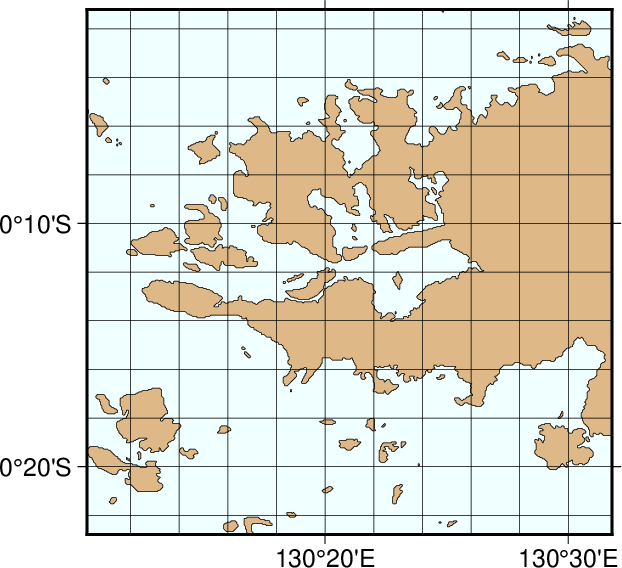
We now arrive at our final plot, which shows a detailed view of the
western side of the small island of Waigeo. The map area is
approximately 40 by 40 km. We call upon the full resolution data set to
portray the richness of geographic detail within this region; no
features are ignored. The full resolution has undergone no decimation
and it shows: The combined file size of the coastlines, rivers, and
borders totals a (once considered hefty) 55.9 Mbytes. Our final map is
reproduced by the single command:
gmt begin GMT_App_K_5
gmt set GMT_THEME cookbook
gmt coast -R-20/20/-20/20+uk -JE130.35/-0.2/3.5i -Df -Gburlywood -Sazure -Wthinnest -N1/thinnest,- -B10mg2m -BWSne
gmt end show
We hope you will study these examples to enable you to make efficient
and wise use of this vast data set.
## Technical Details
### Selecting the right data
There are two well-known public-domain data sets that could be used for
this purpose. Once is known as the World Data Bank II or CIA Data Bank
(WDB) and contains coastlines, lakes, political boundaries, and rivers.
The other, the World Vector Shoreline (WVS) only contains shorelines
between saltwater and land (i.e., no lakes). It turns out that the WVS
data is far superior to the WDB data as far as data quality goes, but as
noted it lacks lakes, not to mention rivers and borders. We decided to
use the WVS whenever possible and supplement it with WDB data. We got
these data over the Internet; they are also available on CD-ROM from the
[National Centers for Environmental Information, Boulder, Colorado](http://www.ncei.noaa.gov/).
### Format required by GMT
In order to paint continents or oceans it is necessary that the
coastline data be organized in polygons that may be filled. Simple line
segments can be used to draw the coastline, but for painting polygons
are required. Both the WVS and WDB data consists of unsorted line
segments: there is no information included that tells you which segments
belong to the same polygon (e.g., Australia should be one large
polygon). In addition, polygons enclosing land must be differentiated
from polygons enclosing lakes since they will need different paint.
Finally, we want [coast](https://docs.generic-mapping-tools.org/latest/coast.html)
to be flexible enough that it can paint the land *or* the oceans *or* both. If
just land (or oceans) is selected we do not want to paint those areas
that are not land (or oceans) since previous plot programs may have
drawn in those areas. Thus, we will need to combine polygons into new
polygons that lend themselves to fill land (or oceans) only (Note that
older versions of [coast](https://docs.generic-mapping-tools.org/latest/coast.html)
always painted lakes and wiped out whatever was plotted beneath).
### The long and winding road
The WVS and WDB together represent more than 100 Mb of binary data and
something like 20 million data points. Hence, it becomes obvious that
any manipulation of these data must be automated. For instance, the
reasonable requirement that no coastline should cross another coastline
becomes a complicated processing step.
* To begin, we first made sure that all data were "clean", i.e., that
there were no outliers and bad points. We had to write several
programs to ensure data consistency and remove "spikes" and bad
points from the raw data. Also, crossing segments were automatically
"trimmed" provided only a few points had to be deleted. A few hundred
more complicated cases had to be examined semi-manually.
* Programs were written to examine all the loose segments and determine
which segments should be joined to produce polygons. Because not all
segments joined exactly (there were non-zero gaps between some
segments) we had to find all possible combinations and choose the
simplest combinations. The WVS segments joined to produce more than
200,000 polygons, the largest being the Africa-Eurasia polygon which
has 1.4 million points. The WDB data resulted in a smaller data base
(~25% of WVS).
* We now needed to combine the WVS and WDB data bases. The main problem
here is that we have duplicates of polygons: most of the features in
WVS are also in WDB. However, because the resolution of the data
differ it is nontrivial to figure out which polygons in WDB to
include and which ones to ignore. We used two techniques to address
this problem. First, we looked for crossovers between all possible
pairs of polygons. Because of the crossover processing in step 1
above we know that there are no remaining crossovers within WVS and
WDB; thus any crossovers would be between WVS and WDB polygons.
Crossovers could mean two things: (1) A slightly misplaced WDB
polygon crosses a more accurate WVS polygon, both representing the
same geographic feature, or (2) a misplaced WDB polygon (e.g., a
small coastal lake) crosses the accurate WVS shoreline. We
distinguished between these cases by comparing the area and centroid
of the two polygons. In almost all cases it was obvious when we had
duplicates; a few cases had to be checked manually. Second, on many
occasions the WDB duplicate polygon did not cross its WVS counterpart
but was either entirely inside or outside the WVS polygon. In those
cases we relied on the area-centroid tests.
* While the largest polygons were easy to identify by visual
inspection, the majority remain unidentified. Since it is important
to know whether a polygon is a continent or a small pond inside an
island inside a lake we wrote programs that would determine the
hierarchical level of each polygon. Here, level = 1 represents
ocean/land boundaries, 2 is land/lakes borders, 3 is
lakes/islands-in-lakes, and 4 is
islands-in-lakes/ponds-in-islands-in-lakes. Level 4 was the highest
level encountered in the data. To automatically determine the
hierarchical levels we wrote programs that would compare all possible
pairs of polygons and find how many polygons a given polygon was
inside. Because of the size and number of the polygons such programs
would typically run for 3 days on a Sparc-2 workstation.
* Once we know what type a polygon is we can enforce a common
"orientation" for all polygons. We arranged them so that when you
move along a polygon from beginning to end, your left hand is
pointing toward "land". At this step we also computed the area of all
polygons since we would like the option to plot only features that
are bigger than a minimum area to be specified by the user.
* Obviously, if you need to make a map of Denmark then you do not want
to read the entire 1.4 million points making up the Africa-Eurasia
polygon. Furthermore, most plotting devices will not let you paint
and fill a polygon of that size due to memory restrictions. Hence, we
need to partition the polygons so that smaller subsets can be
accessed rapidly. Likewise, if you want to plot a world map on a
letter-size paper there is no need to plot 10 million data points as
most of them will plot several times on the same pixel and the
operation would take a very long time to complete. We chose to make 5
versions on the database, corresponding to different resolutions. The
decimation was carried out using the Douglas-Peucker (DP)
line-reduction algorithm (Douglas and Peucker, 1973). We chose the cutoffs so
that each subset was approximately 20% the size of the next higher resolution.
The five resolutions are called **f**ull, **h**igh,
**i**ntermediate, **l**ow, and **c**rude; they are accessed in
[coast](https://docs.generic-mapping-tools.org/latest/coast.html),
[gmtselect](https://docs.generic-mapping-tools.org/latest/gmtselect.html), and
[grdlandmask](https://docs.generic-mapping-tools.org/latest/grdlandmask.html) with the **-D** option.
For each of these 5 data sets (**f**, **h**, **i**,
**l**, **c**) we specified an equidistant grid (1, 2, 5, 10, 20) and
split all polygons into line-segments that each fit inside one of the
many boxes defined by these grid lines. Thus, to paint the entire
continent of Australia we instead paint many smaller polygons made up
of these line segments and gridlines. Some book-keeping has to be
done since we need to know which parent polygon these smaller pieces
came from in order to prescribe the correct paint or ignore if the
feature is smaller than the cutoff specified by the user. The
resulting segment coordinates were then scaled to fit in short
integer format to preserve precision and written in netCDF format for
ultimate portability across hardware platforms (Wessel and Smith, 1996).
* While we are now back to a file of line-segments we are in a much
better position to create smaller polygons for painting. Two problems
must be overcome to correctly paint an area:
- We must be able to join line segments and grid cell borders into
meaningful polygons; how we do this will depend on whether we want
to paint the land or the oceans.
- We want to nest the polygons so that no paint falls on areas that
are "wet" (or "dry"); e.g., if a grid cell completely on land
contains a lake with a small island, we do not want to paint the
lake and then draw the island, but paint the annulus or "donut"
that is represented by the land and lake, and then plot the
island.
GMT uses a polygon-assembly routine that carries out these tasks on the fly.
## References
- Bohlander, J. and T. Scambos. 2007. Antarctic coastlines and grounding line
derived from MODIS Mosaic of Antarctica (MOA), Boulder, Colorado USA:
National Snow and Ice Data Center.
- Douglas, D.H., and T. K. Peucker, 1973, Algorithms for the reduction
of the number of points required to represent a digitized line or its
caricature, *Canadian Cartographer*, 10, 112–122.
- Gorny, A. J. (1977), World Data Bank II General User GuideRep. PB 271869,
10pp, Central Intelligence Agency, Washington, DC.
- Soluri, E. A., and V. A. Woodson (1990), World Vector Shoreline,
Int. Hydrograph. Rev., LXVII(1), 27–35.
- Wessel, P., and W. H. F. Smith (1996), A global, self-consistent, hierarchical,
high-resolution shoreline database, J. Geophys. Res., 101(B4), 8741–8743.
## Authors
- Paul Wessel Primary contact: pwessel@hawaii.edu
- Walter H. F. Smith
## Changelog
The detailed changelog is available [here](ChangeLog).
## License
The project is distributed under the
[GNU Lesser General Public License](http://www.gnu.org/licenses/lgpl-3.0.html).
## Earlier GSHHG Version-specific comments:
Version 2.3.7 June 15, 2017
Updates the Northern Mariana Islands with CUPS data from NOAA, adds
two missing islands to northern Norway, and adds in the missing
Kosovo-Serbia boundary.
Version 2.3.6 August 19, 2016
Fixed 11 crossings in Antarctica grounding line and one in the ice front.
Added missing islands Georgetown and MacMahan, ME, and updated Jan Mayen, Norway
[thanks to Norwegian Polar Institute]
Version 2.3.5 April 12, 2016
Added missing boundary between Sudan and South Sudan.
Fixed non-closure of the Slovenia, Croatia and Hungary borders.
Version 2.3.4 Jan 1, 2015
Corrected formatting error in the binary versions of the borders
and rivers files. Added "Lake" Maelaren (Sweden) to the coastline
which reverted 11 "lakes" to their proper status as islands.
Version 2.3.3 Nov 2014:
Removed the obsolete Saudi-Kuwait Neutral Zone diamond-shaped border
and replaced with something resembling what Google Earth shows.
Version 2.3.2 August 2014:
Removed several internal crossovers for the two new Antarctica
polygons. All other polygons are unchanged.
Version 2.3.1 July 2014:
Updated to include Peter I Island near Antarctica which had gone
missing during the switch to the Antarctica data source for 2.3.0.
Version 2.3.0 Feb 2014:
This data set consists of three related components:
GSHHS: Global Self-consistent Hierarchical High-resolution Shorelines:
These originate as individual polygons at five different
resolutions. The ocean-land shorelines derive from WVS (World
Vector Shoreline project) [Soluri and Woodson, 1990] while the
polygons for lakes, islands-in-lakes, and ponds-in-islands-
in-lakes derive from WDBII [Gorny, 1977], which is a much older
and lower-quality data product. Our compilation combines these
data into a self-consistent product; see Wessel and Smith [1996]
for processing details. Over the years we have manually added
new data in areas that were poorly represented in the original
data set; however, as users zoom in closely they can see that
the old data may in places be mis-registered relative to recent
data such as used in Google Earth.
AC: Starting with release 2.3.0 we have replaced the poor Antarctica
polygon and associated islands with newer and more accurate
data from Bohlander and Scambos (2007) via Atlas of the Cryosphere.
This lets us consider two polygon: ice-line and grounding line.
New processing was needed to allow a run-time switch on which
polygon to use (since it changes how many islands to include).
Antarctic ice-front polygons are given level 5 while Antarctic
grounding-line polygons are given level 6. Non-GMT users of these
data should skip one of these two levels are reset the other one
to level = 1. The next GMT5 release 5.2.0 will allow users to
select their Antarctica coastline while older versions will simply
use the ice-front line as the single Antarctica coastline; the
grounding line data are not visible to those versions.
WDBII: CIA World Data Bank II lineaments for borders and rivers.
Over the years, political boundaries have changed and we have
updated these to reflect realities based on feedback from our
users. As mentioned above, WDBII is also used for lakes.
GSHHG is distributed in several representations:
1. The binary and shapefile distributions provide the complete
GSHHS polygons and WDBII lineaments in their five resolutions
(i.e., after our full processing), and differ only in the
file formats (native binary data files versus standard GIS
shapefiles). These distributions are normally used by
users interested to use these data outside the standard
GMT-based environment, or GMT users who wish to access the
whole GSHHS polygons.
2. The netCDF distribution provides specially processed netCDF
representations of GSHHS and WDBII where the polygons and
lines have been subdivided and indexed to deliver rapid map-
making for GMT. Users who wish to access GSHHG outside of
GMT are advised to use the binary and shapefile version of
the actual polygons as there is no user documentation for
how to access the netCDF files.
Many thanks to Tom Kratzke, Metron Inc., for patiently testing
many draft versions of GSHHS and reporting inconsistencies such as
erratic data points and crossings.
Version 2.2.4 Nov 2013: We added three missing lakes (Mono, Trinity,
and Isabella) in California, plus two islands in Lake Mono. Also found
a bug in polygon_consistency that failed to find some spikes (~20-25
polygons affected), as well as an incorrect lake in Antarctica.
Version 2.2.3 July 2013: We eliminated ~120 spikes (< 2m thick excursions)
from a few dozen full resolution polygons. Also fixed an old mistake
in Baffin Island in all but the crude resolution; this also converted
two mislabeled "lakes" into islands in the full and high resolution data.
Version 2.2.2 January 2013: We have removed Sandy Island, Coral Sea
(non feature), shifted Society Island polygons ~1 arc minute to the west,
and replaced Mehetia Island with better data. Furthermore, 50 islands
that were imprecise duplicates of more accurate WVS features were removed.
Apart from the Agalega islands, these duplicates were mostly found in
the Red Sea, the Persian Gulf, and in the Cook-Austral region. GSHHG is
now released under the lesser GNU License, v3 or any earlier version.
Version 2.2.1 July 2012: We have renamed the product GSHHG since it
contains more than just shorelines (we distribute political boundaries
and rivers as well). The GSHHG building and distribution is now
fully decoupled from GMT. We have also changed the name of the
netCDF files for GMT to use the more standard extension *.nc.
Furthermore, the packages have been renamed for clarity and follow
the form gshhg-{gmt,bin,shp}-.{tar,zip}
There are no significant changes to the actual data features, other
than a glitch in SA-NT border in Australia and removal of 7 zero-length
border segments. Following the rebranding to GSHHG the names of the
distribution files have changed as well.
Version 2.2.0 July 2011: The area of small (< 0.1 km^2) polygons
got truncated to 0. This would cause gshhs to consider them
as lines (borders or rivers) instead of polygons. Furthermore,
the areas were recomputed using the WGS-84 ellipsoid as the previous
area values were based on a spherical calculation. Thanks to
José Luis García Pallero for pointing this out. We now store
the area with a magnitude scale tuned to each polygon. Also, the
greenwich flag is now a 2-bit flag composed of 1 (crosses Greenwich),
2 (crosses Dateline), 3 (both) or 0 (no such crossing). See gshhs.[ch] for
details. Finally, the binary gshhs files now store Antarctica in
-180/+180 range so as to avoid a jump when dumped to ASCII.
Also, the WDBII shapefiles only had the first 3 levels of rivers;
version 2.2.0 has all 11. Finally, to be able to detect the river-lake
features in the WDBII binary files we set the river flag to 1 if a closed feature.
Version 2.1.1 March 2011: Relatively minor fixes to low-resolution
polygons, including editing errors introduced in v 2.1, removing
a few spikes from 4-5 polygons, and fixing Germany-Poland border
near the Baltic Sea.
Version 2.1 July 2010: Fixes lack of river-lake flag in the binary
and shapefile release. Shapefile polygons of level = 2 and with a
negative area are river-lakes. Also include WDBII border and river
data as shapefiles.
version 2.0 July 15, 2009: Differs from the previous version 1.x in
the following ways.
1. Free from internal and external crossings and erratic spikes
at all five resolutions.
2. The original Eurasiafrica polygon has been split into Eurasia
(polygon # 0) and Africa (polygon # 1) along the Suez canal.
3. The original Americas polygon has now been split into North
America (polygon # 2) and South America (polygon # 3) along
the Panama canal.
4. Antarctica is now polygon # 4 and Australia is polygon # 5, in
all the five resolutions.
5. Fixed numerous problems, including missing islands and lakes
in the Amazon and Nile deltas.
6. Flagged "riverlakes" which are the fat part of major rivers so
they may easily be identified by users.
7. Determined container ID for all polygons (== -1 for level 1
polygons) which is the ID of the polygon that contains a smaller
polygon.
8. Determined full-resolution ancestor ID for lower res polygons,
i.e., the ID of the polygon that was reduced to yield the lower-
res version.
9. Ensured consistency across resolutions (i.e., a feature that is
an island at full resolution should not become a lake in low!).
10. Sorted tables on level, then on the area of each feature.
11. Made sure no feature is missing in one resolution but
present in the next lower resolution.
12. Store both the actual area of the lower-res polygons and the
area of the full-resolution ancestor so users may exclude fea-
tures that represent less that a fraction of the original full
area.
There was some duplication and wrong levels assigned to maritime
political boundaries in the Persian Gulf that has been fixed.
These changes required us to enhance the GSHHG C-structure used to
read and write the data. As of version 2.0 the header structure is
```
struct GSHHG { /* Global Self-consistent Hierarchical High-resolution Shorelines */
int id; /* Unique polygon id number, starting at 0 */
int n; /* Number of points in this polygon */
int flag; /* = level + version << 8 + greenwich << 16 + source << 24 + river << 25 */
/* flag contains 5 items, as follows:
* low byte: level = flag & 255: Values: 1 land, 2 lake, 3 island_in_lake, 4 pond_in_island_in_lake
* 2nd byte: version = (flag >> 8) & 255: Values: Should be 12 for GSHHG release 12 (i.e., version 2.2)
* 3rd byte: greenwich = (flag >> 16) & 1: Values: Greenwich is 1 if Greenwich is crossed
* 4th byte: source = (flag >> 24) & 1: Values: 0 = CIA WDBII, 1 = WVS
* 4th byte: river = (flag >> 25) & 1: Values: 0 = not set, 1 = river-lake and level = 2
*/
int west, east, south, north; /* min/max extent in micro-degrees */
int area; /* Area of polygon in 1/10 km^2 */
int area_full; /* Area of original full-resolution polygon in 1/10 km^2 */
int container; /* Id of container polygon that encloses this polygon (-1 if none) */
int ancestor; /* Id of ancestor polygon in the full resolution set that was the source of this polygon (-1 if none) */
};
```
Following each header structure is n structures of coordinates:
```
struct GSHHG_POINT { /* Each lon, lat pair is stored in micro-degrees in 4-byte signed integer format */
int32_t x;
int32_t y;
};
```
Some useful information:
A) To avoid headaches the binary files were written to be big-endian.
If you use the GMT supplement gshhg it will check for endian-ness and if needed will
byte swab the data automatically. If not then you will need to deal with this yourself.
B) In addition to GSHHS we also distribute the files with political boundaries and
river lines. These derive from the WDBII data set.
C) As to the best of our knowledge, the GSHHG data are geodetic longitude, latitude
locations on the WGS-84 ellipsoid. This is certainly true of the WVS data (the coastlines).
Lakes, riverlakes (and river lines and political borders) came from the WDBII data set
which may have been on WGS072. The difference in ellipsoid is way less then the data
uncertainties. Offsets have been noted between GSHHG and modern GPS positions.
D) Originally, the gshhs_dp tool was used on the full resolution data to produce the lower
resolution versions. However, the Douglas-Peucker algorithm often produce polygons with
self-intersections as well as create segments that intersect other polygons. These problems
have been corrected in the GSHHG lower resolutions over the years. If you use gshhs_dp to
generate your own lower-resolution data set you should expect these problems.
E) The shapefiles release was made by formatting the GSHHG data using the extended GMT/GIS
metadata understood by OGR, then using ogr2ogr to build the shapefiles. Each resolution
is stored in its own subdirectory (e.g., f, h, i, l, c) and each level (1-4) appears in
its own shapefile. Thus, GSHHS_h_L3.shp contains islands in lakes for the high res
data. Because of GIS limitations some polygons that straddle the Dateline (including
Antarctica) have been split into two parts (east and west).
F) The netcdf-formatted coastlines distributed with GMT derives directly from GSHHG; however
the polygons have been broken into segments within tiles. These files are not meant
to be used by users other than via GMT tools (pscoast, grdlandmask, etc).