https://github.com/getrailsui/railsui
Professionally designed templates and components for Ruby on Rails.
https://github.com/getrailsui/railsui
rails ruby ruby-on-rails tailwind tailwindcss tailwindui ui
Last synced: 6 months ago
JSON representation
Professionally designed templates and components for Ruby on Rails.
- Host: GitHub
- URL: https://github.com/getrailsui/railsui
- Owner: getrailsui
- License: other
- Created: 2022-02-22T23:27:16.000Z (over 4 years ago)
- Default Branch: main
- Last Pushed: 2026-01-16T16:51:21.000Z (6 months ago)
- Last Synced: 2026-01-17T05:28:02.534Z (6 months ago)
- Topics: rails, ruby, ruby-on-rails, tailwind, tailwindcss, tailwindui, ui
- Language: HTML
- Homepage: https://railsui.com
- Size: 36 MB
- Stars: 484
- Watchers: 8
- Forks: 57
- Open Issues: 1
-
Metadata Files:
- Readme: README.md
- Funding: .github/FUNDING.yml
- License: LICENSE.md
Awesome Lists containing this project
README
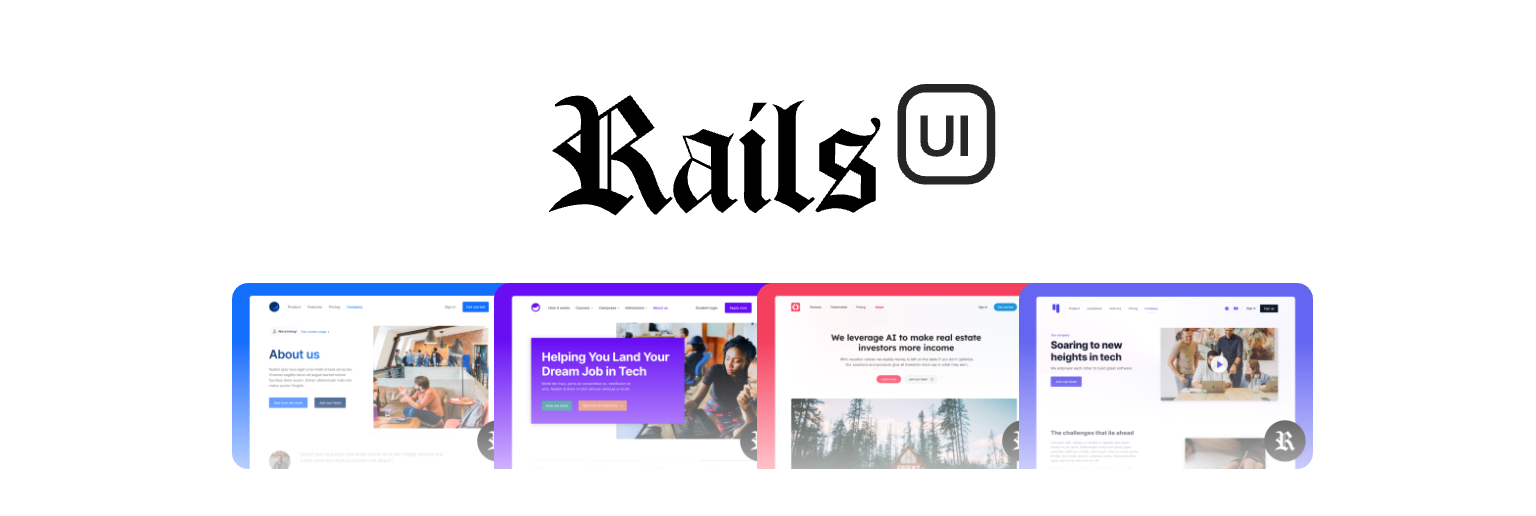
# Rails UI
Professionally designed themes and components for Ruby on Rails. Leverage breath-taking UI to fast-track your next idea.
### Links
- [Installation](#installation)
- [Configuration](guides/CONFIGURATION.md)
- [Migration guide](guides/MIGRATION_GUIDE.md)
- [Extended documentation](https://railsui.com/docs)
- [FAQs](#frequently-asked-questions)
- [Discussions](https://github.com/getrailsui/railsui/discussions)
- [Updates](https://railsui.com/blog)
- [Website](https://railsui.com)
- [Follow on X](https://x.com/railsui_)
- [Migrating from v2](https://railsui.com/docs/updates)
## Installation
Rails UI v3.3+ now works with **both importmap (nobuild) and JS bundler (build) setups**. It uses the `tailwindcss-rails` gem for CSS in both modes so no separate Tailwind installation needed.
### Requirements
- **Rails**: 7.0 or higher
- **CSS**: ✅ Automatically handled via `tailwindcss-rails` gem (included)
- **JS (build mode)**: Node.js, package manager (yarn/npm/pnpm/bun), and jsbundling-rails
- **JS (nobuild mode)**: Nothing extra needed!
### Intalling Rails UI on new applications
#### With importmaps (nobuild) - default
```bash
# Create app (Rails 8 defaults to importmap)
rails new myapp
cd myapp
# Install Rails UI
bundle add railsui
rails railsui:install
# Start server
bin/dev
```
**When to use:** Zero build step, no Node.js required, fast refresh.
#### With JS Bundler (build mode)
```bash
# Create app with JS bundler
rails new myapp -j [bun|esbuild|rollup|webpack]
cd myapp
# Install Rails UI with --build flag
bundle add railsui
rails railsui:install --build
# Start server
bin/dev
```
**When to use:** TypeScript, advanced JS tooling, or complex dependencies.
**Note:** When you run `rails new myapp -j esbuild` (or other bundler), you may see build errors about missing packages. This is expected - the initial build runs before dependencies are installed. These errors are harmless and will be resolved when Rails UI installs the required packages.
> [!IMPORTANT]
> Don't use `-c tailwind` when creating your app like in previous versions of the gem - Rails UI handles Tailwind CSS automatically now using the tailwindcss-rails gem.
### Installing Rails UI on existing applications
#### Importmaps (nobuild)
```bash
bundle add railsui
rails railsui:install
```
#### Apps with a JS Bundler (esbuild, webpack, bun, rollup)
```bash
bundle add railsui
rails railsui:install --build
```
#### Apps without any JavaScript setup
**Importmap:**
```bash
bundle add railsui
rails railsui:install
```
**JS Bundler:**
```bash
# First install jsbundling-rails
bundle add jsbundling-rails
rails javascript:install:[bun|esbuild|rollup|webpack]
# Note: You may see build errors - this is expected and harmless
# Then install Rails UI
bundle add railsui
rails railsui:install --build
```
### Migration scenarios
If you use an older version of Rails UI or have cssbundling-rails gem configured you can move to the new version with our built in migration task.
#### Migrating from cssbundling-rails
If your app uses `cssbundling-rails` for Tailwind (installed with `rails new myapp -c tailwind`):
```bash
# Install Rails UI first
bundle add railsui
rails railsui:install
# Then migrate to tailwindcss-rails
rails railsui:migrate_to_tailwindcss_rails
```
This removes Tailwind from package.json and switches to the faster `tailwindcss-rails` gem.
#### Migrating from importmaps to JS Bundler
If your existing app uses importmap and you want to switch to a JS bundler for Rails UI:
```bash
# First install jsbundling-rails
bundle add jsbundling-rails
rails javascript:install:[bun|esbuild|rollup|webpack]
# Then install Rails UI with --build flag
bundle add railsui
rails railsui:install --build
```
> [!IMPORTANT]
> You'll need to manually migrate your existing JavaScript imports from importmap format to bundler format. Rails UI will handle its own imports, but your app's custom JavaScript may need adjustments. Consider removing `config/importmap.rb` if you're fully migrating to the bundler.
#### Switching between build modes
You can change modes after installation by editing `config/railsui.yml`:
```yaml
build_mode: nobuild # or "build"
```
Then run the appropriate setup:
`rails railsui:update`
### Installation Warnings
Rails UI detects your setup and tries to provide helpful guidance:
- ⚠️ **cssbundling-rails detected** → Suggests migration task
- ⚠️ **Missing jsbundling-rails** (with --build flag) → Shows setup instructions
- ℹ️ **Configuration conflicts** → Provides recommendations
Skip warnings: `RAILSUI_SKIP_WARNINGS=1 rails railsui:install`
## Running Your App
After installing Rails UI, start your server:
```bash
bin/dev
```
Then visit `localhost:3000/railsui` to access the configuration screen and customize your install.
### What `bin/dev` does
- **nobuild mode**: Runs Rails server + Tailwind CSS watcher
- **build mode**: Runs Rails server + Tailwind CSS watcher + JS bundler watcher
Both modes use the same `rails tailwindcss:watch` command for CSS.
## Configuration
Rails UI is configured via `config/railsui.yml` or the admin UI at `/railsui`. The easiest way to configure Rails UI is to visit `localhost:3000/railsui` and follow the prompts.
### Quick Configuration
After installation, visit `localhost:3000/railsui` to configure:
- Application name and support email
- Theme selection
- Preview enabled pages for your theme
- Preview your theme.css file found in `app/assets/stylesheets/railsui/theme.css`
### Configuration Files
- **`config/railsui.yml`** - Main configuration
- **`app/assets/stylesheets/railsui/theme.css`** - Color palette customization and Tailwind CSS configuration.
**📚 For detailed configuration options, read the [configuration guide](CONFIGURATION.md)**
### Important Notes
Each theme comes with pages in `app/views/rui` that are treated as read-only. Updating your configuration will overwrite these files. To customize pages, copy them to your app:
```bash
cp app/views/rui/pages/dashboard.html.erb app/views/pages/dashboard.html.erb
```
## Themes
Themes are the core of Rails UI, combining UI components, pages, assets, JavaScript, and color palettes to help you create a professionally designed, niche application. The UI can adapt based on how you implement it.
Themes serve as a starting point for your app, with reusable components extracted for flexibility. These components are ready for use inside your application when you install Rails UI.
### Pages
A page is a professionaly designed starting point. They are completely optional to use and can save a lot of time if your app uses similar layouts and patterns.
Pages are located in the `app/views/rui` directory and are considered read-only. If you want to keep your changes after modifying your Rails UI configuration and saving changes, you'll need to copy the files to your application in another view directory.
More pages will be added over time.
### Included assets
Each theme comes with a collection of assets to help you get started. Much of these are placeholders and are not meant to be used in production. We strive to still create realistic examples for you to use as a starting point.
### UI components
After installing Rails UI and choosing a theme you'll find a collection of components and best practices for real-world applications at your disposal.
### Color
Each theme comes with a custom color palette built on top of the default Tailwind CSS v4 color palette you can customize in `app/assets/stylesheets/railsui/theme.css`.
### Icons
Bundled with Rails UI is a gem called [railsui_icon](https://github.com/getrailsui/railsui_icon). This gem includes a collection of icons that are used in all themes. Right now it's based soley on [heroicons](https://heroicons.com) and will be expanded to include more icons in the future.
### JavaScript
All Rails UI components are built on top of Stimulus.js. A theme includes custom Stimulus controllers and our own JavaScript library called [railsui-stimulus](https://github.com/getrailsui/railsui-stimulus) which is just an extraction of components we find ourselves using in our own apps and between themes.
## Updates
Run `bundle update railsui` from within your project and it should fetch the most recent version of the gem/engine directly from GitHub.
### Legacy v2
Version 2 of Rails UI has since been sunset. Unfortunately, there is no upgrade path we can share.
Version 3 was a rewrite of the gem and how Rails UI works to enable better flexibility. Version 3 offers the ability to swap themes, install on new and existing rails apps, and countless other smaller features. We chose this direction to enable more efficient development in the future and allow folks with existing apps the ability to use Rails UI.
You can find version 2 on a dedicated branch on the Github repo. If you're an active user of this version be sure to update your Gemfile with the appropriate branch.
```ruby
gem "railsui", github: "getrailsui/railsui", branch: "v2"
```
### v3+
Version 3 now resides on the main branch accessbile via the main branch and/or rubygems.org.
```ruby
gem "railsui"
```
---
## Frequently Asked Questions
### Which build mode should I choose?
**nobuild mode**: Perfect for simpler apps, prototypes, or if you want zero build complexity. JavaScript loads from CDN via importmap.
**build mode**: Best for production apps with complex JavaScript needs, TypeScript, or when you need full control over bundling.
Both modes are equally capable - choose based on your JavaScript requirements.
### Can I switch modes later?
Yes! Update `config/railsui.yml` and regenerate assets:
```bash
# Edit config/railsui.yml: build_mode: nobuild (or build)
build_mode: [nobuild, build]
# run this command to update assets
rails generate railsui:update
```
For more scenarios see the [migration guide](guides/MIGRATION_GUIDE.md) for instructions.
### Do I need Node.js?
- **nobuild mode**: No Node.js required ✅
- **build mode**: Yes, Node.js and a package manager (yarn/npm/pnpm/bun) required
### Where are the CSS files located?
Rails UI uses tailwindcss-rails v4 defaults:
- **Input files**: [`app/assets/tailwind/application.css`, `app/assets/stylesheets/railsui/*.css`]
- **Output file**: `app/assets/builds/tailwind.css`
- **In layouts**: `stylesheet_link_tag "tailwind"`
Both build and nobuild modes use the same CSS paths. The only difference between modes is JavaScript handling (importmap vs bundler).
### More Questions?
[Read the more FAQs](https://railsui.com/docs/faqs) or [submit an issue](https://github.com/getrailsui/railsui/issues).