https://github.com/ghostpack/ragnarok
A Nemesis powered Retrieval-Augmented Generation (RAG) chatbot proof-of-concept.
https://github.com/ghostpack/ragnarok
Last synced: about 1 year ago
JSON representation
A Nemesis powered Retrieval-Augmented Generation (RAG) chatbot proof-of-concept.
- Host: GitHub
- URL: https://github.com/ghostpack/ragnarok
- Owner: GhostPack
- License: bsd-3-clause
- Created: 2024-03-13T00:34:14.000Z (over 2 years ago)
- Default Branch: main
- Last Pushed: 2024-03-13T21:24:55.000Z (over 2 years ago)
- Last Synced: 2025-06-10T09:06:36.076Z (about 1 year ago)
- Language: Python
- Size: 1.66 MB
- Stars: 61
- Watchers: 4
- Forks: 8
- Open Issues: 2
-
Metadata Files:
- Readme: README.md
- License: LICENSE
Awesome Lists containing this project
README
# RAGnarok
RAGnarok is a [Retrieval-Augmented Generation](https://blogs.nvidia.com/blog/what-is-retrieval-augmented-generation/) chatbot frontend for [Nemesis](https://github.com/SpecterOps/Nemesis). It allows you to ask questions about text extracted from compatible documents processed by Nemesis.
## RAG
**Short explanation:** The general idea with Retrieval-Augmented Generation (RAG) is to allow a large language model (LLM) to answer questions about documents you've indexed.
**Medium explanation:** RAG involves processing and turning text inputs into set-length vectors via an embedding model, which are then stored in a backend vector database. Questions to the LLM are then used to look up the "most similiar" chunks of text which are then fed into the context prompt for a LLM.
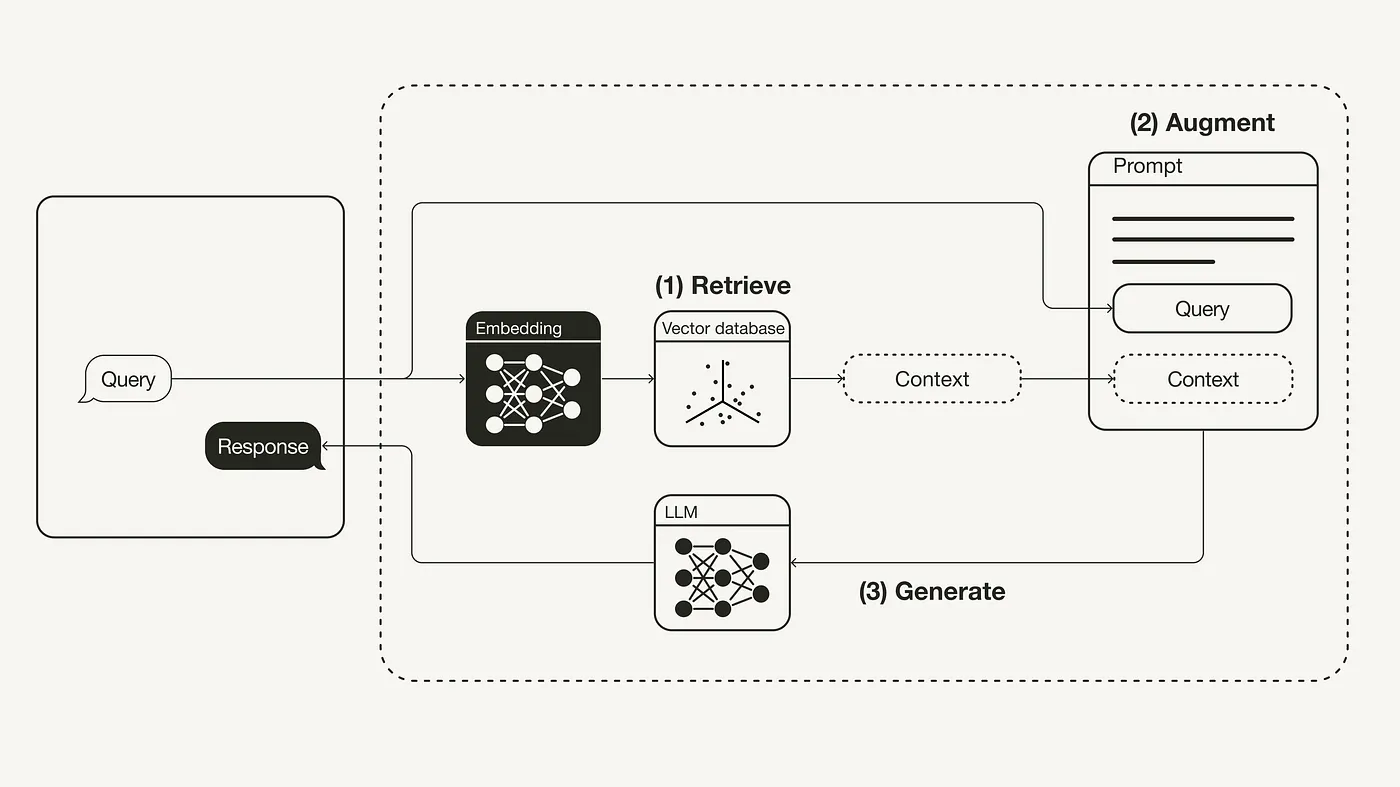
[*Source*](https://towardsdatascience.com/retrieval-augmented-generation-rag-from-theory-to-langchain-implementation-4e9bd5f6a4f2)
***Longer explanation in the rest of the section :)***
***Even Longer explanation in [this blog post](https://posts.specterops.io/summoning-ragnarok-with-your-nemesis-7c4f0577c93b).***
#### Indexing
Retrieval-augumented generation is an architecture where documents being processed undergo the following process:
1. Plaintext is extracted from any incoming documents.
- Nemesis uses [Apache Tika](https://tika.apache.org/) to extract text from compatible documents.
2. The text is tokenized into chunks of up to X tokens, where X depends on the *context window* of the embedding model used.
- Nemesis uses Langchain's [TokenTextSplitter](https://api.python.langchain.com/en/latest/text_splitter/langchain.text_splitter.TokenTextSplitter.html), a chunk size of 510 tokens, and a 15% overlap between chunks.
3. Each chunk of text is processed by an [embedding model](https://huggingface.co/spaces/mteb/leaderboard) which turns the input text into a fixed-length vector of floats.
- As [Pinecone explains](https://www.pinecone.io/learn/vector-embeddings/), what's cool about embedding models is that the vector representations they produce preserve "semantic similiarity", meaning that more similiar chunks of text will have more similiar vectors.
- Nemesis currently uses the [TaylorAI/gte-tiny](https://huggingface.co/TaylorAI/gte-tiny) embedding model as it's fast, but others are possible.
4. Each vector and associated snippet of text is stored in a vector database.
- Nemesis uses Elasticsearch for vector storage.
#### Semantic Search
This is the initial indexing process that Nemesis has been performing for a while. However, in order to complete a RAG-pipeline, the next steps are:
5. Take an input prompt, such as "*What is a certificate?*" and run it through the same embedding model files were indexed with.
6. Query the vector database (e.g., Elasticsearch) for the nearest **k** vectors + associated text chunks that are "closest" to the prompt input vector.
- This will return the **k** chunks of text that are the most similiar to the input query.
7. We also use Elasticsearch's traditional(-ish) BM25 text search over the text for each chunk.
- These two lists of results are combined with [Reciprocal Rank Fusion](https://learn.microsoft.com/en-us/azure/search/hybrid-search-ranking), and the top results from the fused list are returned.
- **Note:** steps 6 and 7 happen in the `nlp` container in Nemesis. This is exposed at http://\/nlp/hybrid_search
#### Reranking
We now have the **k** most chunks of text most simliar to our input query. If we want to get a bit facier, we can execute what's called [reranking](https://www.pinecone.io/learn/series/rag/rerankers/).
7. With reranking, the the prompt question and text results are paired up (question, text) and fed into a more powerful model (well, more powerful than the embedding model) tuned and known as a reranker. The reranker generates a simliarity score of the input prompt and text chunk.
- RAGnarok uses an adapted version of [BAAI/bge-reranker-base](https://huggingface.co/BAAI/bge-reranker-base) for reranking.
8. The results are then **reranked** and the top X number of results are selected.
#### LLM Processing
9. Finally, the resulting texts are combined with a prompt to the (local) LLM. Think something along the lines of "Given these chunks of text {X}, answer this question {Y}".