https://github.com/goktugcy/redisync
High-performance caching middleware for PHP that stores data in Redis while syncing with MySQL or PostgreSQL.
https://github.com/goktugcy/redisync
cache mysql php php8 phpunit postgre redis redis-cache
Last synced: 6 months ago
JSON representation
High-performance caching middleware for PHP that stores data in Redis while syncing with MySQL or PostgreSQL.
- Host: GitHub
- URL: https://github.com/goktugcy/redisync
- Owner: goktugcy
- Created: 2025-08-10T13:37:22.000Z (12 months ago)
- Default Branch: main
- Last Pushed: 2025-08-10T16:30:36.000Z (12 months ago)
- Last Synced: 2025-08-10T16:45:58.850Z (12 months ago)
- Topics: cache, mysql, php, php8, phpunit, postgre, redis, redis-cache
- Language: PHP
- Homepage:
- Size: 47.9 KB
- Stars: 0
- Watchers: 0
- Forks: 0
- Open Issues: 0
-
Metadata Files:
- Readme: README.md
Awesome Lists containing this project
README
# RediSync
High-performance HTTP caching for PHP with Redis storage and optional DB-driven invalidation/write-through (MySQL/PostgreSQL via Doctrine DBAL).




> Zero-friction HTTP caching for PHP apps: PSR-15 middleware, Redis-backed, DB-aware invalidation.
Quick nav: [Install](#install) · [Configuration](#configuration) · [Middleware](#middleware-usage) · [Facade](#facade-usage) · [Logging](#logging-psr-3) · [Write-through](#write-through-db-to-cache) · [Laravel](#laravel-quickstart) · [CLI](#cli) · [Notes](#notes) · [API contracts](#api-contracts-and-errors) · [Troubleshooting](#troubleshooting-installs-laravelcarbon-and-doctrine-dbal) · [Proof](#proof)
## ✨ Features
- PSR-15 middleware: automatic HTTP cache hit/miss flow.
- PSR-7/17 support via nyholm/psr7.
- GET/HEAD-only caching by default, optional bypass with the X-Bypass-Cache header.
- Cache headers: X-RediSync-Cache (HIT/MISS) and Age on hits (PSR-15 and Laravel).
- Conditional requests: automatic ETag generation and If-None-Match → 304.
- Cache-Control aware: respects no-store and private (won't serve/store).
- Vary safety: bypasses cache when Authorization or Cookie exist to avoid leakage.
- Safe caching via status whitelist (default: [200]) and Content-Type allow list.
- TTL map by path pattern/regex for per-endpoint TTL control.
- CLI for cache ops: clear-cache, list-keys, key-info, warmup.
- Doctrine DBAL-based DatabaseManager with invalidation hooks.
- Write-through DB helper: update cache immediately after successful DB writes.
- remember() helper: compute-or-cache convenience API (vanilla and Laravel facades).
- PSR-3 logging hooks: cache hit/miss/store, bypass reasons, DB write-through.
## 🔧 Install
Add to your project:
```bash
composer require redisync/core
```
Requirements: PHP 8.1+, Redis (via Predis 1.x or 2.x). Optional: Doctrine DBAL and DB drivers (pdo_mysql/pdo_pgsql) if you use DatabaseManager.
## ⚙️ Configuration
Configure programmatically (ENV not required):
```php
use RediSync\Cache\CacheManager;
$cache = CacheManager::fromConfig([
'host' => '127.0.0.1',
'port' => 6379,
'database' => 0,
'prefix' => 'redisync:'
]);
```
DatabaseManager (optional):
```php
use RediSync\Database\DatabaseManager;
$db = DatabaseManager::fromDsn('mysql://user:pass@127.0.0.1:3306/app?charset=utf8mb4');
// Cache invalidation after data changes
$db->onInvalidate(function (string $sql, array $params) use ($cache) {
if (str_starts_with(strtoupper(ltrim($sql)), 'UPDATE USERS')
|| str_starts_with(strtoupper(ltrim($sql)), 'DELETE FROM USERS')
|| str_starts_with(strtoupper(ltrim($sql)), 'INSERT INTO USERS')
) {
$cache->clearByPattern('users:*');
}
});
```
## 🧩 Middleware Usage
```php
use Nyholm\Psr7\Factory\Psr17Factory;
use RediSync\Middleware\CacheMiddleware;
use RediSync\Utils\KeyGenerator;
$psr17 = new Psr17Factory();
$middleware = new CacheMiddleware(
cache: $cache,
keys: new KeyGenerator('http', ignoredParams: ['nonce', '_ts']),
ttl: 300,
responseFactory: $psr17,
streamFactory: $psr17,
statusWhitelist: [200],
allowedContentTypes: ['application/json'],
ttlMap: [
'/public/*' => 60,
'#^/users/\\d+$#' => 300,
],
);
// Add it to your PSR-15 stack (Mezzio, Slim, etc.). Middleware caches only GET/HEAD by default.
// Conditional requests: send If-None-Match; 304 is returned when ETag matches (ETag is auto-generated if missing).
// Cache-Control: requests with no-store bypass; responses with no-store/private are not stored.
// Vary safety: Authorization/Cookie on the request bypass the cache to protect user-specific content.
// To force-bypass: send header X-Bypass-Cache: 1. Responses include X-RediSync-Cache: HIT|MISS and Age.
```
### HTTP semantics: ETag, 304, no-store/private, vary
- ETag: If the origin response doesn't include ETag, RediSync computes one from the body. Clients sending `If-None-Match` get `304 Not Modified` when it matches.
- no-store/private: A request with `Cache-Control: no-store` bypasses cache. A response with `no-store` or `private` is not stored by RediSync (shared cache).
- Vary safety: Requests carrying `Authorization` or `Cookie` headers bypass cache to avoid leaking personalized content.
- Headers: On cache HITs RediSync adds `X-RediSync-Cache: HIT` and `Age`. On MISS it sets `X-RediSync-Cache: MISS`.
## 🧩 Facade usage
### Vanilla PHP (framework-agnostic)
```php
use RediSync\Cache\CacheManager;
use RediSync\Facades\RediSync;
$cache = CacheManager::fromConfig(['host' => '127.0.0.1', 'port' => 6379, 'database' => 0, 'prefix' => 'app:']);
RediSync::setInstance($cache);
// get / set
RediSync::set('users:1', ['id' => 1, 'name' => 'Ada'], 300);
$data = RediSync::get('users:1');
// remember (compute-or-cache)
$user = RediSync::remember('users:1', 300, function () {
// expensive work or DB fetch
return ['id' => 1, 'name' => 'Ada'];
});
// Evict: set with null deletes the key (by design)
RediSync::set('users:1', null); // equivalent to delete
// Bulk invalidation example
// $cache->clearByPattern('users:*');
```
## 📜 Logging (PSR-3)
RediSync logs key events with any PSR-3–compatible logger: `cache.hit`, `cache.miss`, `cache.set`, `cache.delete`, `cache.clear_by_pattern`, `httpcache.hit|miss|store|conditional_304|not_cacheable|bypass`, `db.execute`, `db.fetch_*`, `db.write_through.cache_updated`.
Vanilla PHP (Monolog):
```php
use Monolog\Logger;
use Monolog\Handler\StreamHandler;
use RediSync\Cache\CacheManager;
use RediSync\Facades\RediSync;
$logger = new Logger('app');
$logger->pushHandler(new StreamHandler('php://stdout'));
$cache = CacheManager::fromConfig(['host' => '127.0.0.1', 'port' => 6379]);
$cache->setLogger($logger);
RediSync::setInstance($cache);
RediSync::setLogger($logger); // optional facade shortcut
```
Laravel: LoggerInterface is automatically injected from the container. The ServiceProvider forwards the framework logger to CacheManager and DatabaseManager; no extra setup required.
## Write-through DB to Cache
Update cache immediately after a successful DB write (inside a transaction):
```php
use RediSync\Database\DatabaseManager;
use RediSync\Cache\CacheManager;
$db = DatabaseManager::fromDsn('sqlite:///:memory:');
// ... create table/users ...
$affected = $db->writeThrough(
'UPDATE users SET name = :n WHERE id = :id', ['n' => 'alice', 'id' => 1],
$cache,
// Build cache entries from the write result
function (int $affected, array $params, \Doctrine\DBAL\Connection $conn): array {
if ($affected > 0) {
return [ ['key' => "users:{$params['id']}", 'value' => ['id' => $params['id'], 'name' => $params['n']], 'ttl' => 300] ];
}
return [];
}
);
```
Shortcut: you can also pass a simple associative array as the plan and use a default TTL:
```php
$db->writeThrough(
'DELETE FROM users WHERE id = :id', ['id' => 1], $cache,
[ 'users:1' => null ], // set null or use clearByPattern in an onInvalidate callback
60
);
```
## Laravel Quickstart
Auto-discovery registers a Service Provider, Facades, and `redisync.cache` middleware.
- Facade (controller) using remember():
```php
use RediSync\Bridge\Laravel\Facades\RediSync; // static facade
public function show(int $id) {
$user = RediSync::remember("users:$id", 300, fn() => \App\Models\User::findOrFail($id)->toArray());
return response()->json($user);
}
```
- Route cache (GET):
```php
use Illuminate\Support\Facades\Route;
Route::middleware('redisync.cache')->get('/api/users/{id}', [UserController::class, 'show']);
```
- HTML cache (view) via RediSyncCache (array/string payloads):
```php
use Illuminate\Support\Facades\Auth;
use RediSync\Bridge\Laravel\Facades\RediSyncCache as Cache;
public function getProfile() {
$u = Auth::user(); if (! $u) return redirect('404');
$k = "users:profile:{$u->id}"; if ($h = Cache::get($k)) return response($h);
$h = view('profile', ['user' => $u])->render(); Cache::set($k, $h, 300); return response($h);
}
```
- Data cache (array) via RediSyncCache:
```php
use Illuminate\Support\Facades\Auth;
use RediSync\Bridge\Laravel\Facades\RediSyncCache as Cache;
public function getProfileData() {
$u = Auth::user(); if (! $u) return redirect('404');
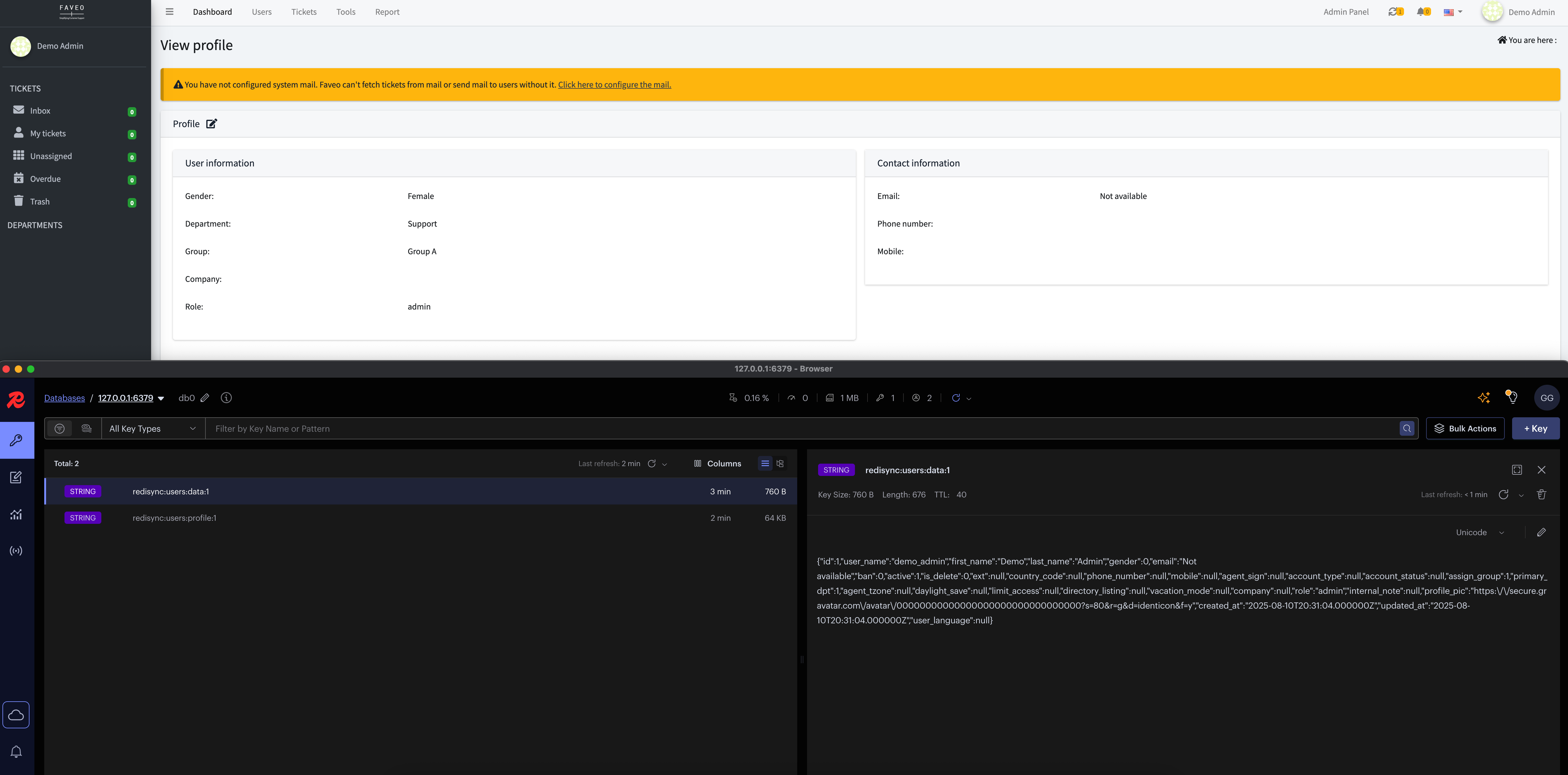
$k = "users:data:{$u->id}"; $d = Cache::get($k) ?: $u->toArray();
if (! Cache::get($k)) Cache::set($k, $d, 300);
return view('profile', ['user' => $u]);
}
```
- Invalidation (events):
```php
// app/Providers/AppServiceProvider.php
public function boot(\RediSync\Cache\CacheManager $cache): void
{
\App\Models\User::saved(fn() => $cache->clearByPattern('users:*'));
\App\Models\User::deleted(fn() => $cache->clearByPattern('users:*'));
}
```
Notes: Uses Laravel Redis config automatically. By default, JSON 200 responses are cached for ~300s. Bypass with header `X-Bypass-Cache: 1`.
HTTP semantics in Laravel middleware:
- GET/HEAD cache with `X-RediSync-Cache` (HIT/MISS) and `Age` on hits.
- `If-None-Match` supported; returns `304 Not Modified` when matching the stored ETag (computed if absent).
- Respects `Cache-Control: no-store` on requests and `no-store`/`private` on responses (won't store).
- Requests containing `Authorization` or cookies bypass the cache for safety.
### Write-through in Laravel
```php
// In a service or controller where you have the DB connection DSN
use RediSync\Bridge\Laravel\Facades\RediSyncCache as Cache;
use RediSync\Database\DatabaseManager;
$db = DatabaseManager::fromDsn(env('DATABASE_URL'));
$db->writeThrough(
'INSERT INTO posts (title) VALUES (:t)', ['t' => $title],
app(\RediSync\Cache\CacheManager::class),
fn(int $affected, array $p, \Doctrine\DBAL\Connection $c) => $affected
? [ ['key' => 'posts:latest', 'value' => /* recompute */ [], 'ttl' => 120] ]
: []
);
```
## 🛠️ CLI
Use the bundled CLI for quick cache operations. The tool reads Redis config from `config/config.php`.
```bash
vendor/bin/redisync help
```
Commands:
- clear-cache [pattern]
- Delete keys by pattern (default: `*`).
- Example: `vendor/bin/redisync clear-cache users:*`
- list-keys [pattern] [limit]
- List keys (default pattern `*`, limit `100`).
- Example: `vendor/bin/redisync list-keys api:* 50`
- key-info
- Show TTL/type/size/exists.
- Example: `vendor/bin/redisync key-info users:1`
- warmup [ttl]
- Read keys from STDIN and set placeholder values with TTL (default 60).
- Example:
```bash
printf "a\nb\n" | vendor/bin/redisync warmup 30
```
## 📷 Proof
## 📝 Notes
- Middleware caches only GET/HEAD requests by default.
- Use status whitelist and Content-Type filters for safe caching.
- TTL map allows per-path TTL control.
### API contracts and errors
- Cache null semantics: `set($key, null)` evicts the key to avoid ambiguity with `get()` returning null.
- Exceptions: Redis/DB errors currently bubble up from underlying libraries. There’s no wrapper exception layer in 1.x; handle with try/catch in your app as needed.
## Troubleshooting installs (Laravel/Carbon and Doctrine DBAL)
If your app uses Laravel 11 + Carbon 3, you may see a conflict involving `doctrine/dbal` and `carbonphp/carbon-doctrine-types` when installing `redisync/core`.
What changed: RediSync no longer hard-requires `doctrine/dbal`. It's optional and only needed if you plan to use `DatabaseManager`.
- Install RediSync first:
```bash
composer require redisync/core
```
- If you need DB features, require a DBAL version compatible with your stack. For example:
```bash
composer require doctrine/dbal:^3.8
```
If Composer still reports conflicts, align DBAL with the versions compatible with your Laravel/Carbon lock (check `composer why doctrine/dbal` and `composer why-not doctrine/dbal:^3.10`).