https://github.com/govctl-org/govctl
Opinionated CLI tool to enforce RFC-driven AI coding
https://github.com/govctl-org/govctl
ai-agent cli flow governance
Last synced: about 2 months ago
JSON representation
Opinionated CLI tool to enforce RFC-driven AI coding
- Host: GitHub
- URL: https://github.com/govctl-org/govctl
- Owner: govctl-org
- License: mit
- Created: 2026-01-17T21:34:01.000Z (6 months ago)
- Default Branch: main
- Last Pushed: 2026-02-24T08:21:14.000Z (5 months ago)
- Last Synced: 2026-02-24T14:49:03.166Z (5 months ago)
- Topics: ai-agent, cli, flow, governance
- Language: Rust
- Homepage: https://govctl-org.github.io/govctl/
- Size: 782 KB
- Stars: 75
- Watchers: 0
- Forks: 5
- Open Issues: 0
-
Metadata Files:
- Readme: README.md
- Changelog: CHANGELOG.md
- License: LICENSE
Awesome Lists containing this project
- awesome-ccamel - govctl-org/govctl - A governance harness for AI coding. (Rust)
README

govctl






A governance harness for AI coding.
Turn prompts and patches into RFCs, ADRs, work items, and guarded delivery.

---
`govctl` is a governance-as-code CLI for teams using AI to build software seriously.
It gives AI-assisted development a control plane that lives in your repo:
- **RFCs** say what must be true
- **ADRs** record why a design was chosen
- **Work items** track execution and acceptance criteria
- **Verification guards** enforce executable completion gates
The point is not bureaucracy. The point is that AI-generated changes become **reviewable, traceable, and phase-gated**.
## Why govctl
Most AI coding tools optimize for generation. `govctl` optimizes for delivery.
Without explicit governance, teams drift into the same pattern:
- ideas jump straight into implementation
- decisions live in chat history instead of artifacts
- code and specs diverge silently
- "done" means "the agent stopped typing", not "the work passed verification"
`govctl` closes that gap by making governed artifacts, lifecycle, and verification part of the normal workflow.
```text
Without govctl:
prompt -> code -> drift -> arguments
With govctl:
RFC / ADR -> work item -> guarded implementation -> stable history
```
## What Makes It Different
### 1. Spec-first by default
`govctl` is built around the idea that implementation follows governed artifacts.
In practice, that means:
- RFCs describe externally relevant behavior and constraints
- ADRs record design choices and trade-offs
- work items execute against those artifacts
- verification guards and lifecycle gates decide when work is actually done
Instead of treating prompts as the source of truth, the source of truth becomes governed artifacts in the repository.
### 2. Artifacts are the control plane
`govctl` does not hide governance behind a web app or an MCP server.
Artifacts live in `gov/` as TOML files with schema headers, references, and stable CLI access. That means:
- changes are diffable
- decisions are reviewable in PRs
- agents can operate against files and commands you already understand
### 3. One CLI agents can reliably operate
The CLI is the operating surface for agents:
- `list`, `show`, `get`, `edit`
- resource-specific lifecycle verbs like `adr accept`, `rfc advance`, `rfc supersede`, and `work move`
- path-first mutation through `edit`
- explicit help text designed to act as a reliable command contract
This matters because agent workflows get better when the interface is stable, local, and inspectable.
### 4. Works in brownfield repositories
This is not only for greenfield projects.
For existing repositories, the `/migrate` workflow helps you adopt governance incrementally: discover undocumented decisions, backfill ADRs, and establish governed artifacts without restarting the project.
## Quick Start
### CLI
```bash
# Install from source
cargo install govctl
# Or install a prebuilt binary (faster, skips compilation)
cargo binstall govctl
govctl init
govctl status
```
To update an existing installation:
```bash
govctl self-update
```
Then create your first governed artifacts:
```bash
govctl rfc new "Caching Strategy"
govctl adr new "Choose cache backend"
govctl work new --active "implement caching"
```
### Agent workflow
Initialize governance, then install or load the agent workflows for your tool:
- `/discuss ` to draft RFCs and ADRs
- `/gov ` to execute governed implementation
- `/quick ` for intentionally small changes
- `/commit` to record work with governance checks
For Claude Code plugin installation:
```bash
/plugin marketplace add govctl-org/govctl
/plugin install govctl@govctl
/govctl:init
```
For a global Codex installation:
```bash
mkdir -p ~/.codex
cd ~/.codex
govctl init
govctl init-skills --format codex --dir .
```
This keeps the govctl-managed workspace, generated skills, and generated agents inside `~/.codex` instead of writing governance files into your home directory.
### A concrete example
```bash
govctl rfc new "Verification Guard Policy"
govctl clause new RFC-0015:C-GUARD-REQUIREMENTS "Required guards" -s "Verification" -k normative
govctl adr new "Require clippy on parser refactors"
govctl work new --active "add parser lint guard"
```
## Core Capabilities
### Canonical artifact operations
Agents and humans work through a stable CLI contract.
Read the exact field you need:
```bash
govctl rfc get RFC-0001 status
```
For precise artifact mutation, `govctl` provides a canonical path-first interface:
```bash
govctl adr edit ADR-0038 content.decision --stdin
govctl work edit WI-2026-01-17-001 content.acceptance_criteria[0] --tick done
govctl clause edit RFC-0002:C-CRUD-VERBS text --stdin
```
This is not the product's identity. It is the low-level tool agents use to update governed artifacts precisely and consistently.
### Verification guards
Guards are executable checks that run when work reaches completion gates.
Define reusable project defaults in `gov/config.toml`:
```toml
[verification]
enabled = true
default_guards = ["GUARD-GOVCTL-CHECK", "GUARD-CARGO-TEST"]
```
You can also require extra guards on a specific work item or waive a guard with an explicit reason. See:
- [Validation & Rendering](https://github.com/govctl-org/govctl/blob/main/docs/guide/validation.md#per-work-item-guards)
- [Working with Work Items](https://github.com/govctl-org/govctl/blob/main/docs/guide/work-items.md#per-work-item-guards)
### Brownfield adoption vs format migration
These are related, but different:
- **`/migrate` workflow** — adopt `govctl` in an existing repository by discovering decisions, backfilling ADRs, and introducing governance incrementally
- **`govctl migrate` command** — upgrade existing `govctl`-managed artifacts to the current on-disk format and schema
For format upgrades:
```bash
govctl migrate
govctl check
```
As of the `0.8.x` line, RFC and clause artifacts are written canonically as TOML. Legacy JSON is supported for migration and compatibility on read, not as an ongoing write format.
### Interactive TUI
```bash
govctl tui
```
Browse RFCs, ADRs, work items, and guards with styled rendering in the terminal.
## Who This Is For
- Teams using Claude Code, Codex, Cursor, or similar agents for real product work
- Projects that want AI assistance without losing reviewability
- Brownfield repositories that need governance without a rewrite
- Engineers who want specs, decisions, and work tracking to live in the repo
## Documentation
- [User Guide](https://govctl-org.github.io/govctl/)
- [Validation & Rendering](https://github.com/govctl-org/govctl/blob/main/docs/guide/validation.md)
- [Working with Work Items](https://github.com/govctl-org/govctl/blob/main/docs/guide/work-items.md)
- [Changelog](https://github.com/govctl-org/govctl/blob/main/CHANGELOG.md)
- [Website](https://govctl.org)
## Community
- [Discord](https://discord.gg/buBB9G8Z6n)
- [GitHub Issues](https://github.com/govctl-org/govctl/issues)
- [GitHub Discussions](https://github.com/govctl-org/govctl/discussions)
## Contributing
`govctl` is intentionally opinionated:
- features start with governed artifacts, not implementation-first
- RFCs and ADRs are part of the product, not side documentation
- verification and lifecycle are core behavior, not optional extras
If that matches how you want AI-assisted development to work, contributions are welcome.
---
## License
MIT
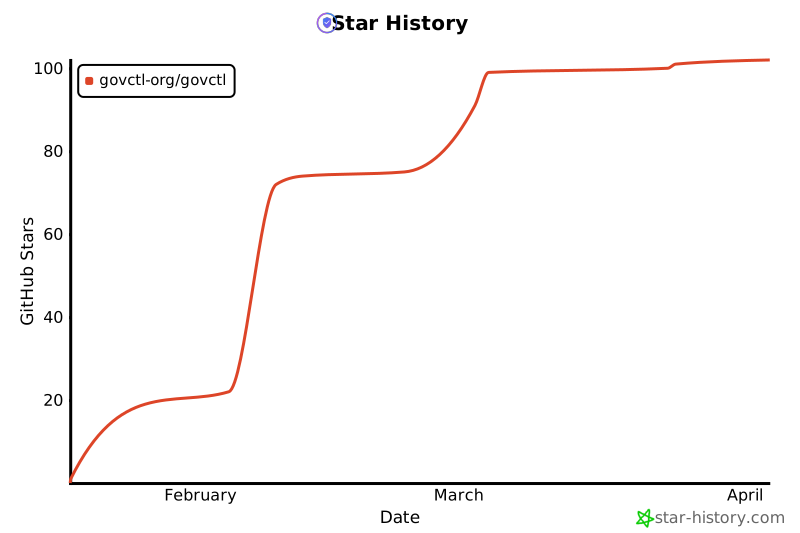
## Star History
---
> _"Discipline is not the opposite of creativity. It is the foundation."_