https://github.com/gvinciguerra/nnweaver
🧠 + 🕸 = Neural Network Weaver. A tiny library to build and train neural networks
https://github.com/gvinciguerra/nnweaver
library machine-learning neural-network python
Last synced: 5 months ago
JSON representation
🧠 + 🕸 = Neural Network Weaver. A tiny library to build and train neural networks
- Host: GitHub
- URL: https://github.com/gvinciguerra/nnweaver
- Owner: gvinciguerra
- License: mit
- Archived: true
- Created: 2018-01-15T17:18:48.000Z (over 8 years ago)
- Default Branch: master
- Last Pushed: 2018-07-16T14:52:56.000Z (almost 8 years ago)
- Last Synced: 2025-09-03T19:34:11.137Z (10 months ago)
- Topics: library, machine-learning, neural-network, python
- Language: Python
- Homepage: https://gvinciguerra.github.io/nnweaver/index.html
- Size: 1.04 MB
- Stars: 8
- Watchers: 3
- Forks: 1
- Open Issues: 0
-
Metadata Files:
- Readme: README.md
- License: LICENSE
Awesome Lists containing this project
README
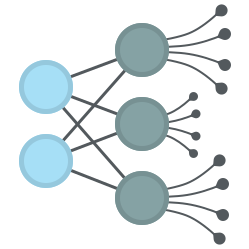
# NNWeaver #
[](https://coveralls.io/github/gvinciguerra/nnweaver?branch=master)
[](https://travis-ci.org/gvinciguerra/nnweaver)
NNWeaver is a *tiny* Python library to create and train feedforward neural networks. We developed this library as a project for a Machine Learning course.
Some of its features are:
1. Simple API, easy to learn.
2. Validation functions included.
3. Lightweight and with few dependencies.
4. Live loss/epoch curve display.
## Installation ##
You can install NNWeaver from the GitHub source with the following commands:
git clone https://github.com/gvinciguerra/nnweaver.git
cd nnweaver
python3 setup.py install
You can also run the test suite with `python3 setup.py test`.
## Getting started ##
### Specify a Neural Network Topology ###
You can create a feedforward neural network specifying the number of inputs as the argument of [`NN`](https://gvinciguerra.github.io/nnweaver/nnweaver.html#nnweaver.nn.NN), and the number of outputs by adding a [`Layer`](https://gvinciguerra.github.io/nnweaver/nnweaver.html#nnweaver.nn.Layer):
from nnweaver import *
nn = NN(3)
nn.add_layer(Layer(5, Linear))
You can always add more layers, specify an activation function and a weights initializer, as the following lines of code show:
nn.add_layer(Layer(7, Sigmoid))
nn.add_layer(Layer(6, Rectifier, uniform(0, 0.05)))
nn.add_layer(Layer(42, TanH, glorot_uniform()))
See [`activations`](https://gvinciguerra.github.io/nnweaver/nnweaver.html#module-nnweaver.activations) for the list of available activation functions.
### Train the Neural Network ###
Now, choose a [`Loss`](https://gvinciguerra.github.io/nnweaver/nnweaver.html#nnweaver.losses.Loss) function, pass it to an [`Optimizer`](https://gvinciguerra.github.io/nnweaver/nnweaver.html#nnweaver.optimizers.Optimizer) (like the stochastic gradient descent) and start the training:
sgd = SGD(MSE)
sgd.train(nn, x, y, learning_rate=0.3)
There are other arguments to pass to the [`SGD.train()`](https://gvinciguerra.github.io/nnweaver/nnweaver.html#nnweaver.optimizers.SGD.train) method, for example:
sgd.train(nn, x_train, y_train,
learning_rate_time_based(0.25, 0.001),
batch_size=10, epochs=100, momentum=0.85)
Also, you may want to control the model complexity. [`SGD.train()`](https://gvinciguerra.github.io/nnweaver/nnweaver.html#nnweaver.optimizers.SGD.train) has a `regularizer` argument, that accepts an instance of the [`L1L2Regularizer`](https://gvinciguerra.github.io/nnweaver/nnweaver.html#nnweaver.regularizers.L1L2Regularizer) class.
### A very, very simple example ###

## Documentation ##
For more information, tutorials, and API reference, please visit [NNweaver's online documentation](https://gvinciguerra.github.io/nnweaver/index.html) or build your own offline copy executing `python3 setup.py docs`.
## License ##
This project is licensed under the terms of the MIT License.