https://github.com/halimath/fixture
A golang micro-framework for writing reusable test fixtures on top of package "testing"
https://github.com/halimath/fixture
golang testing
Last synced: 9 months ago
JSON representation
A golang micro-framework for writing reusable test fixtures on top of package "testing"
- Host: GitHub
- URL: https://github.com/halimath/fixture
- Owner: halimath
- License: apache-2.0
- Created: 2022-12-15T10:47:13.000Z (over 3 years ago)
- Default Branch: main
- Last Pushed: 2023-11-12T11:58:41.000Z (over 2 years ago)
- Last Synced: 2025-01-22T03:27:27.588Z (over 1 year ago)
- Topics: golang, testing
- Language: Go
- Homepage:
- Size: 18.6 KB
- Stars: 0
- Watchers: 1
- Forks: 0
- Open Issues: 0
-
Metadata Files:
- Readme: README.md
- License: LICENSE
Awesome Lists containing this project
README
# fixture
Re-usable test setups und teardowns for go(lang) `testing` tests.
![CI Status][ci-img-url]
[![Go Report Card][go-report-card-img-url]][go-report-card-url]
[![Package Doc][package-doc-img-url]][package-doc-url]
[![Releases][release-img-url]][release-url]
`fixture` implements a micro-framework ontop of the standard library's
`testing` package that allow writing of reusable test setup and teardown code.
# Installation
This module uses golang modules and can be installed with
```shell
go get github.com/halimath/fixture@main
```
# Usage
`fixture` defines a very simple (and assumingly _well-known_) lifecycle for
code to execute before, inbetween and after tests. A _fixture_ may hook into
this lifecycle to setup or teardown resources needed by the tests. As multiple
tests may share some amount of these resources `fixture` provides a simple
_test suite_ functionality that plays well with the resource initialization.
The lifecycle is shown in the following picture:
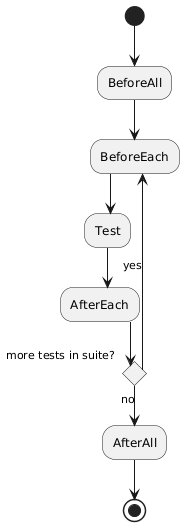
A _fixture_ (in terms of this package) is any go value. A fixture may satisfy
a couple of additional interfaces to execute code at the given lifecycle
phases. The interfaces are named after the lifecycle phases. Each interface
contains a single method (named after the interface) that receives the
`*testing.T` and returns an `error` which will abort the test (calling
`t.Fatal`).
## Using a fixture
Using a fixture is done using the `With` function, which starts a new test
suite. Calling `Run` registers a test to run using this fixture.
```go
With(t, new(myFixture)).
Run("test 1", func(t *testing.T, f *myFixture) {
// Test code
}).
Run("test 2", func(t *testing.T, f *myFixture) {
// Test code
})
```
## Implementing a fixture
To implement a fixture simply create a type to hold all the values your fixture
will provide. You can also add receiver functions to ease interaction with the
fixture. Then, implement the desired hook interfaces.
Typically, a fixture implements the hook methods via a pointer receiver. This
allows using just `new` to create a fixture. Use either `BeforeAll` or
`BeforeEach` to initialize the code.
The following example uses a fixture to spawn a `httptest.Server` with a simple
handler (in a real world the handle would have been some real production code).
It provides a `sendRequest` method to send a simple request, handle errors by
failing the test and returns the `http.Response`.
The `TestExample` executes two tests both using the same running server.
```go
// A simple test fixture holding a httptest.Server.
type httpServerFixture struct {
srv *httptest.Server
}
// BeforeAll hooks into the fixture lifecycle and creates and starts the
// httptest.Server before the first test is executed.
func (f *httpServerFixture) BeforeAll(t *testing.T) error {
f.srv = httptest.NewServer(http.HandlerFunc(func(w http.ResponseWriter, r *http.Request) {
w.Header().Set("X-Tracing-Id", "1")
w.WriteHeader(http.StatusNoContent)
}))
return nil
}
// AfterAll hooks into the fixture lifecycle and disposes the httptest.Server
// after the last test has been executed.
func (f *httpServerFixture) AfterAll(t *testing.T) error {
f.srv.Close()
return nil
}
// sendRequest is a convenience function making it easier to read the test code.
func (f *httpServerFixture) sendRequest(t *testing.T) *http.Response {
r, err := http.Get(f.srv.URL)
if err != nil {
t.Fatal(err)
}
return r
}
func TestExample(t *testing.T) {
fixture.With(t, new(httpServerFixture)).
Run("http status code", func(t *testing.T, f *httpServerFixture) {
got := f.sendRequest(t).StatusCode
if got != http.StatusNoContent {
t.Errorf("expected %d but got %d", http.StatusNoContent, got)
}
}).
Run("tracing header", func(t *testing.T, f *httpServerFixture) {
resp := f.sendRequest(t)
got := resp.Header.Get("X-Tracing-Id")
if got != "1" {
t.Errorf("expected %q but got %q", "1", got)
}
})
}
```
## Fixtures already provided by `fixture`
`fixture` contains some ready to use generic fixtures. All these fixtures
have dependencies only to the standard library and cause no external module to
be required.
### TempDir
Creating and removing a temporary directory for filesystem related tests is
easy with the `TempDirFixture` and the `TempDir` function.
```go
With(t, TempDir("someprefix")).
Run("create file", func(t *testing.T, d *TempDirFixture) {
f, err := os.Create(d.Join("test"))
if err != nil {
t.Fatal(err)
}
defer f.Close()
}).
Run("expect file", func(t *testing.T, d *TempDirFixture) {
_, err := os.Stat(d.Join("test"))
if err != nil {
t.Error(err)
}
})
```
### HTTPServerFixture
The `HTTPServerFixture` creates a HTTP server using `httptest.NewServer` which
will be started on `BeforeAll` and closed on `AfterAll`. The server uses a
`http.ServerMux` as its handler and handler functions can be registered at any
stage. The server uses HTTP/2 but no TLS; both can be changed easily.
```go
f := new(HTTPServerFixture)
f.HandleFunc("/", func(w http.ResponseWriter, r *http.Request) {
w.WriteHeader(http.StatusOK)
})
With(t, f).
Run("/", func(t *testing.T, f *HTTPServerFixture) {
res, err := http.Get(f.URL())
if err != nil {
t.Fatal(err)
}
if res.StatusCode != http.StatusOK {
t.Errorf("expected 200 but got %d", res.StatusCode)
}
})
```
# License
Copyright 2022 Alexander Metzner.
Licensed under the Apache License, Version 2.0 (the "License");
you may not use this file except in compliance with the License.
You may obtain a copy of the License at
[http://www.apache.org/licenses/LICENSE-2.0](http://www.apache.org/licenses/LICENSE-2.0)
WITHOUT WARRANTIES OR CONDITIONS OF ANY KIND, either express or implied.
See the License for the specific language governing permissions and
limitations under the License.
[ci-img-url]: https://github.com/halimath/fixture/workflows/CI/badge.svg
[go-report-card-img-url]: https://goreportcard.com/badge/github.com/halimath/fixture
[go-report-card-url]: https://goreportcard.com/report/github.com/halimath/fixture
[package-doc-img-url]: https://img.shields.io/badge/GoDoc-Reference-blue.svg
[package-doc-url]: https://pkg.go.dev/github.com/halimath/fixture
[release-img-url]: https://img.shields.io/github/v/release/halimath/fixture.svg
[release-url]: https://github.com/halimath/fixture/releases