https://github.com/huangjunwen/sqlw-mysql
Wrapper code (or any text source) generator for MySQL databases and queries
https://github.com/huangjunwen/sqlw-mysql
code-generator golang graphviz mysql orm sql
Last synced: 5 months ago
JSON representation
Wrapper code (or any text source) generator for MySQL databases and queries
- Host: GitHub
- URL: https://github.com/huangjunwen/sqlw-mysql
- Owner: huangjunwen
- License: mit
- Created: 2018-05-30T00:26:29.000Z (about 8 years ago)
- Default Branch: master
- Last Pushed: 2023-01-17T23:55:33.000Z (over 3 years ago)
- Last Synced: 2025-08-14T03:34:07.719Z (12 months ago)
- Topics: code-generator, golang, graphviz, mysql, orm, sql
- Language: Go
- Homepage:
- Size: 364 KB
- Stars: 49
- Watchers: 1
- Forks: 4
- Open Issues: 1
-
Metadata Files:
- Readme: README.md
- License: LICENSE
Awesome Lists containing this project
README
# SQL wrapper code generator for MySQL
[](https://goreportcard.com/report/github.com/huangjunwen/sqlw-mysql)
[](https://travis-ci.org/huangjunwen/sqlw-mysql)
[](https://codecov.io/gh/huangjunwen/sqlw-mysql)
`sqlw-mysql` is a CLI tool to generate go wrapper code (or any text source) for your MySQL database and queries.
## Table of Contents
- [Install](#install)
- [Design/Goals/Features](#designgoalsfeatures)
- [Motivation](#motivation)
- [Quickstart](#quickstart)
- [Statement XML](#statement-xml)
- [Directives](#directives)
- [Arg directive](#arg-directive)
- [Vars directive](#vars-directive)
- [Replace directive](#replace-directive)
- [Bind directive](#bind-directive)
- [Text directive](#text-directive)
- [Wildcard directive](#wildcard-directive)
- [How wildcard directive works](#how-wildcard-directive-works)
- [Template](#template)
- [Default template](#default-template)
- [Graphviz template](#graphviz-template)
- [Command line options](#command-line-options)
- [Licence](#licence)
## Install
``` bash
$ GO111MODULE=on go get -u github.com/huangjunwen/sqlw-mysql
```
## Design/Goals/Features
- Not an `ORM`, but provide similar features.
- Database first, `sqlw-mysql` generate wrapper code for your database tables.
- Use XML as DSL to describe query statements, `sqlw-mysql` generate wrapper code for them.
- Should be work for all kinds of queries, from simple ones to complex ones.
- Highly customizable template. Can be used to generate wrapper code but also any text source.
- Extensible DSL (through directives).
## Motivation
See my blog post for this project (in Chinese): [写了一个 MySQL 数据表和查询的 go 代码生成器](https://huangjunwen.github.io/posts/2018/sqlw-mysql/)
## Quickstart
Let's start with a small example. (See [here](https://github.com/huangjunwen/sqlw-mysql/tree/master/examples/quickstart) for complete source code)
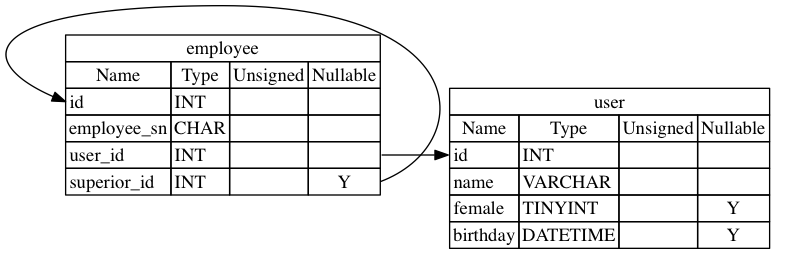
Suppose you have a database with two tables: `user` and `employee`; An `employee` must be a `user`, but a `user` need not to be an `employee`; Each `employee` must have a superior except those top dogs.
``` sql
CREATE TABLE `user` (
`id` int(11) NOT NULL AUTO_INCREMENT,
`name` varchar(64) NOT NULL,
`female` tinyint(1) DEFAULT NULL,
`birthday` datetime DEFAULT NULL,
PRIMARY KEY (`id`)
);
CREATE TABLE `employee` (
`id` int(11) NOT NULL AUTO_INCREMENT,
`employee_sn` char(32) NOT NULL,
`user_id` int(11) NOT NULL,
`superior_id` int(11) DEFAULT NULL,
PRIMARY KEY (`id`),
UNIQUE KEY `employee_sn` (`employee_sn`),
UNIQUE KEY `user_id` (`user_id`),
KEY `superior_id` (`superior_id`),
CONSTRAINT `fk_superior` FOREIGN KEY (`superior_id`) REFERENCES `employee` (`id`),
CONSTRAINT `fk_user` FOREIGN KEY (`user_id`) REFERENCES `user` (`id`)
);
```
Now run `sqlw-mysql`. You will see a `models` directory is created with several source files generated:
``` bash
$ sqlw-mysql -dsn "user:passwd@tcp(host:port)/db?parseTime=true"
$ ls ./models
... table_user.go ... table_employee.go
```
Especially, a `table_.go` is generated for each table containing structs/methods for some common single table operations:
``` go
// ./models/table_user.go
// User represents a row of table `user`.
type User struct {
Id int32 `json:"id" db:"id"`
Name string `json:"name" db:"name"`
Female null.Bool `json:"female" db:"female"`
Birthday null.Time `json:"birthday" db:"birthday"`
}
func (tr *User) Insert(ctx context.Context, e Execer) error {
// ...
}
func (tr *User) Reload(ctx context.Context, q Queryer) error {
// ...
}
```
But eventually, you will need more complex quries. For example if you want to query all `user` and its associated `employee` (e.g. `one2one` relationship), then you can write a statement XML like this:
``` xml
SELECT
,
CAST(DATEDIFF(NOW(), birthday)/365 AS UNSIGNED) AS age,
FROM
user LEFT JOIN employee AS empl ON user.id=empl.user_id
```
A statement XML contains SQL statement with special directives embeded in. Here you can see two `` directives, which are roughly equal to expanded `table_name.*`.
_See [Statement XML](#statement_xml) for detail._
Now run `sqlw-mysql` again with the statement XML directory:
``` bash
$ sqlw-mysql -dsn "user:passwd@tcp(host:port)/db?parseTime=true" -stmt ./stmts
$ ls ./models
... table_user.go ... table_employee.go ... stmt_user.go
```
A new file `stmt_user.go` is generated from `user.xml`:
``` go
// ./models/stmt_user.go
// AllUserEmployeesResult is the result of AllUserEmployees.
type AllUserEmployeesResult struct {
User *User
Age null.Uint64
Empl *Employee
nxNullUser nxNullUser
nxNullEmpl nxNullEmployee
}
// AllUserEmployeesResultSlice is slice of AllUserEmployeesResult.
type AllUserEmployeesResultSlice []*AllUserEmployeesResult
// ...
func AllUserEmployees(ctx context.Context, q Queryer) (AllUserEmployeesResultSlice, error) {
// ...
}
```
Notice that `User` and `Empl` fields in result struct are generated from those `` directives. `sqlw-mysql` is smart enough to figure out their correct positions. _See [here](#how-wildcard-directive-works) for detail._
Now you can use the newly created function to iterate through all `user` and `employee`:
``` go
slice, err := models.AllUserEmployees(ctx, tx)
if err != nil {
log.Fatal(err)
}
for _, result := range slice {
user := result.User
empl := result.Empl
if empl.Valid() {
log.Printf("User %+q (age %d) is an employee, sn: %+q\n", user.Name, result.Age.Uint64, empl.EmployeeSn)
} else {
log.Printf("User %+q (age %d) is not an employee\n", user.Name, result.Age.Uint64)
}
}
```
Another example, if you want to find subordinates of some employees (e.g. `one2many` relationship):
``` xml
SELECT
,
FROM
employee AS superior LEFT JOIN employee AS subordinate ON subordinate.superior_id=superior.id
WHERE
superior.id IN ()
```
Brief explanation about new directives:
- `` specifies an argument of the generated function.
- `` specifies arbitary variables that the template can use. `in_query="1"` tells the template that the SQL use `IN` operator.
- `` argument binding.
_See [Directives](#directives) for detail._
After re-running the command, the following code is generated:
``` go
// ./models/stmt_user.go
// SubordinatesBySuperiorsResult is the result of SubordinatesBySuperiors.
type SubordinatesBySuperiorsResult struct {
Superior *Employee
Subordinate *Employee
nxNullSuperior nxNullEmployee
nxNullSubordinate nxNullEmployee
}
// SubordinatesBySuperiorsResultSlice is slice of SubordinatesBySuperiorsResult.
type SubordinatesBySuperiorsResultSlice []*SubordinatesBySuperiorsResult
// ...
func SubordinatesBySuperiors(ctx context.Context, q Queryer, id ...int) (SubordinatesBySuperiorsResultSlice, error) {
// ...
}
```
Then, you can iterate the result like:
``` go
slice, err := models.SubordinatesBySuperiors(ctx, tx, 1, 2, 3, 4, 5, 6, 7)
if err != nil {
log.Fatal(err)
}
superiors, groups := slice.GroupBySuperior()
for i, superior := range superiors {
subordinates := groups[i].DistinctSubordinate()
if len(subordinates) == 0 {
log.Printf("Employee %+q has no subordinate.\n", superior.EmployeeSn)
} else {
log.Printf("Employee %+q has the following subordinates:\n", superior.EmployeeSn)
for _, subordinate := range subordinates {
log.Printf("\t%+q\n", subordinate.EmployeeSn)
}
}
}
```
In fact, `sqlw-mysql` doesn't care about what kind of relationships between result fields. It just generate helper methods such as `GroupByXXX`/`DistinctXXX` for these fields, thus it works for all kinds of relationships.
## Statement XML
`sqlw-mysql` use XML as DSL to describe quries, since XML is suitable for mixed content: raw SQL query and special directives.
The simplest one is a `` element with `name` attribute, without any directive, like this:
``` xml
SELECT 1
```
But this is not very useful, sometimes we want to add meta data to it, sometimes we want to reduce verbosity ...
That's why we need directives:
### Directives
Directive represents a fragment of SQL query, usually declared by an XML element. `sqlw-mysql` processes directives in several passes:
- The first pass all directives should generate fragments that form a valid SQL statement (e.g. `SELECT * FROM user WHERE id=1`). This SQL statement is then used to determine statement type, to obtain result column information by querying the database if it's a SELECT.
- The second pass all directives should generate fragments that form a text statement for template renderring (e.g. `SELECT * FROM user WHERE id=:id`). It's no need to be a valid SQL statement, it's up to the template to decide how to use this text.
- Some directives may run extra pass.
The following are a list of current builtin directives. In future new directives may be added. And should be easy enough to implement one: impelemnts a go interface.
#### Arg directive
- Name: ``/``
- Example: ``
- First pass result: `""`
- Second pass result: `""`
Declare a wrapper function argument's name and type. Always returns empty string.
#### Vars directive
- Name: ``/``
- Example: ``
- First pass result: `""`
- Second pass result: `""`
Declare arbitary key/value pairs (XML attributes) for template to use. Always returns empty string.
#### Replace directive
- Name: ``/``
- Example: `1`
- First pass result: `"1"`
- Second pass result: `":id"`
Returns the inner text for the first pass and returns the value in `by` attribute for the second pass.
### Bind directive
- Name: ``/``
- Example: `` or `10`
- First pass result: `"NULL"` or inner text of `` element.
- Second pass result: `":id"`
`` is equivalent to `NULL` and `val` is equivalent to `val`. And the bind name must be an argument name.
NOTE: `NULL` is not allowed in some clause in MySQL. For example:
```sql
SELECT * FROM user LIMIT NULL -- Invalid
```
Thus if you want to bind an argument in the `LIMIT` clause, you have to write a number explicitly:
```sql
LIMIT 1
```
#### Text directive
- Name: ``/``
- Example: `{{ if ne .id 0 }}`
- First pass result: `""`
- Second pass result: `"{{ if ne .id 0 }}"`
`innerText` is equivalent to ``.
#### Wildcard directive
- Name: ``
- Example: ``
- First pass result: ```"`empl`.`id`, ..., `empl`.`superior_id`"```
- Second pass result: ```"`empl`.`id`, ..., `empl`.`superior_id`"```
Returns the expanded column list of the table. It runs an extra pass to determine fields positions, see [here](#how-wildcard-directive-works) for detail.
##### How wildcard directive works
`` (wildcard) directive serves several purposes:
- Reduce verbosity, also it's a 'safer' version of `table.*` (It expands all columns of the table).
- Figure out the positions of these expanded columns so that template can make use of.
In the extra pass of `` directives, special marker columns are added before and after each `` directive, for example:
``` xml
SELECT NOW(), , NOW() FROM user
```
will be expanded to something like:
```
SELECT NOW(), 1 AS wc456958346a616564_0_s, `user`.`id`, ..., `user`.`birthday`, 1 AS wc456958346a616564_0_e, NOW() FROM user
```
By finding these marker column name in the result columns, `sqlw-mysql` can determine their positions.
This even works for subquery:
``` xml
SELECT * FROM (SELECT FROM user) AS u
```
And if you only selects a single column (or a few columns) like:
``` xml
SELECT birthday FROM (SELECT FROM user) AS u
```
Then the wildcard directive is ignored since you're not selecting all columns of the table.
## Template
`sqlw-mysql` itself only provides information extracted from database/DSL. Most features are in fact implemented in template. A template is a directory looks like:
``` bash
$ tree default
default
├── interface.go.tmpl
├── manifest.json
├── meta.go.tmpl
├── meta_test.go.tmpl
├── scan_type_map.json
├── stmt_{{.StmtXMLName}}.go.tmpl
├── table_{{.Table.TableName}}.go.tmpl
└── util.go.tmpl
```
A `manifest.json` contains lists of templates to render and other customizable information:
``` json
{
"scanTypeMap": "scan_type_map.json",
"perRun": [
"interface.go.tmpl",
"meta.go.tmpl",
"util.go.tmpl",
"meta_test.go.tmpl"
],
"perTable": [
"table_{{.Table.TableName}}.go.tmpl"
],
"perStmtXML": [
"stmt_{{.StmtXMLName}}.go.tmpl"
]
}
```
`manifest["scanTypeMap"]` is used to map database type (key) to go scan type (value, `value[0]` is for *NOT* nullable type and `value[1]` is for nullable type):
``` json
{
"bool": ["bool", "null.Bool"],
"int8": ["int8", "null.Int8"],
"uint8": ["uint8", "null.Uint8"],
"int16": ["int16", "null.Int16"],
"uint16": ["uint16", "null.Uint16"],
"int32": ["int32", "null.Int32"],
"uint32": ["uint32", "null.Uint32"],
"int64": ["int64", "null.Int64"],
"uint64": ["uint64", "null.Uint64"],
"float32": ["float32", "null.Float32"],
"float64": ["float64", "null.Float64"],
"time": ["time.Time", "null.Time"],
"decimal": ["string", "null.String"],
"bit": ["string", "null.String"],
"json": ["string", "null.String"],
"string": ["string", "null.String"]
}
```
`manifest["perRun"]` list templates to render once per run. `manifest["perTable"]` list templates to render once per database table. `manifest["perStmtXML"]` list templates to render once per statement xml file.
`sqlw-mysql` templates can use functions provided by [sprig](https://github.com/Masterminds/sprig/), checkout [func.go](https://github.com/huangjunwen/sqlw-mysql/blob/master/render/func.go) to see the full list of supported functions.
### Default template
If no custom template specified, or `-tmpl @default` is given, then the default template is used.
Genreated code depends on these external libraries:
- [sqlx](https://github.com/jmoiron/sqlx).
- [sqlboiler](https://github.com/volatiletech/sqlboiler)'s [null-extended](https://github.com/volatiletech/null) package.
For statement XML, the default template accept these ``:
| Name | Example | Note |
|------|---------|------|
| `use_template` | `use_template="1"` | If presented, then the statement text is treated as a go [template](https://godoc.org/text/template) |
| `in_query` | `in_query="1"` | If presented, then statement will do an "IN" expansion, see http://jmoiron.github.io/sqlx/#inQueries |
| `return` | `return="one"` | For SELECT statement only, by default the generated function returns a slice, if `return="one"`, then returns a single item instead |
An example of `use_template`:
``` xml
SELECT
FROM
user
WHERE
{{ if ne .id 0 }}
id= AND
{{ end }}
{{ if ne (len .name) 0 }}
name= AND
{{ end }}
{{ if not .birthday.IsZero }}
birthday= AND
{{ end }}
1
LIMIT 10
```
Then the generated statement will be treated as a go template and will be renderred before normal execution. This is useful when you have many `WHERE` condtions combination.
If enviroment `"CAMEL_JSON_KEY"` is given, than json tags of structs generated will be use lower camel case such as `"createdAt"`.
### Graphviz template
`sqlw-mysql` can be used to generate other text source as well. For example running with `-tmpl @graphviz` a `.dot` file will be generated containing tables and their relationships, which can be convert to a diagram like this:
## Command line options
``` bash
$ sqlw-mysql -h
Usage of sqlw-mysql:
-blacklist value
(Optional) Comma separated table names not to render.
-dsn string
(Required) Data source name. e.g. "user:passwd@tcp(host:port)/db?parseTime=true"
-out string
(Optional) Output directory for generated code. (default "models")
-pkg string
(Optional) Alternative package name of the generated code.
-stmt string
(Optional) Statement xmls directory.
-tmpl string
(Optional) Custom templates directory. Or use '@name' to use the named builtin template.
-whitelist value
(Optional) Comma separated table names to render.
```
## Licence
MIT
Author: huangjunwen (kassarar@gmail.com)