https://github.com/humanlayer/kubechain
A distributed agent scheduler optimized for simplicity, clarity, and control. It is designed for outer-loop agents that run without supervision, and make asynchronous tool calls like requesting human feedback on key operations.
https://github.com/humanlayer/kubechain
agents framework human-in-the-loop kubernetes llms orchestration outer-loops
Last synced: about 1 year ago
JSON representation
A distributed agent scheduler optimized for simplicity, clarity, and control. It is designed for outer-loop agents that run without supervision, and make asynchronous tool calls like requesting human feedback on key operations.
- Host: GitHub
- URL: https://github.com/humanlayer/kubechain
- Owner: humanlayer
- License: other
- Created: 2024-10-17T04:04:29.000Z (over 1 year ago)
- Default Branch: main
- Last Pushed: 2025-04-01T23:16:03.000Z (about 1 year ago)
- Last Synced: 2025-04-01T23:20:24.848Z (about 1 year ago)
- Topics: agents, framework, human-in-the-loop, kubernetes, llms, orchestration, outer-loops
- Language: Go
- Homepage:
- Size: 3.48 MB
- Stars: 20
- Watchers: 2
- Forks: 7
- Open Issues: 1
-
Metadata Files:
- Readme: README.md
- Contributing: CONTRIBUTING.md
- License: LICENSE
Awesome Lists containing this project
README
Smallchain
Smallchain is a cloud-native orchestrator for Autonomous AI Agents. It supports long-lived outer-loop agents that can process asynchronous execution of both LLM inference and long-running tool calls.
:warning: **Note** - SmallChain is highly experimental and has several known issues and race conditions. Use at your own risk.
[Deep Dive](./smallchain.md) | [Discord](https://discord.gg/AK6bWGFY7d) | [Documentation](./docs) | [Examples](./examples)
[](https://github.com/humanlayer/smallchain)
[](https://opensource.org/licenses/Apache-2)
## Table of contents
- [Getting Started](#getting-started)
- [Why Smallchain?](#why-smallchain)
- [Key Features](#key-features)
- [Examples](#examples)
- [Roadmap](#roadmap)
- [Contributing](#contributing)
- [License](#license)
## Getting Started
To get started, check out [Getting Started](./docs/getting-started.md), or jump straight into one of the [Examples](./examples/)
## Design Principles
- *Clarity* - it should be easy to understand what's happening, what the framework is doing with my prompts.
- *Control* - it should be possible to do anything w/ SmallChain that you can do taking the reins yourself. SmallChain MUST NOT recreate the common "i can't use this because I can't customize XYZ prompt scenario" problem.
- *Modularity* - SmallChain is composed of small control loops with a limited scope that each progress the state of the world.
- *Durability* - SmallChain is a distributed system and should be resilient to faliures.
- *Simplicity* - AI applications built on a chat completions API have the UNPRECEDENTEND benefit that the entire state of a workflow, the entire "call stack", can be expressed as the rolling context window accumulated through interactions and tool calls. Leverage this to cut corners
Stretch goals / future
- *Extensible* - it should be easy to build and share agents, tools, and tasks
- *Hackable* - it should be straightforward to unhook from the chat completions API and do whatever folks want WRT prompt / special tokens / context management
## Example
Coming Soon
Create `smallchain.yaml`:
```yaml
llms:
- name: "gpt-4o
provider: openai
model: gpt-4o
parameters:
temperature: 0.0
agents:
- name: "assistant"
system_prompt: "your goal is to assist the human with their tasks"
llm: "gpt-4o"
tools:
- agent: "calculator_operator"
- name: calculator_operator
system_prompt: "you are a skilled calculator operator"
tools:
- add
# - subtract
# - multiply
# - divide
tools:
- name: add
builtin: add
- name: subtract
description: "subtract two numbers"
parameters:
type: object
properties:
a:
type: number
description: "The first number"
b:
type: number
description: "The second number"
executor:
python: # or docker, local_nodejs, local_bash, etc.
image: "python:3.12"
command: |
python -c "print(a - b)"
requirements: []
tasks:
- name: "do_some_math"
user_message: "add (3 + 4) and (5 + 3) and add the results"
agent: assistant
runs:
- name: "my first run"
task: do_some_math
```
```shell
brew install humanlayer/smallchain/smallchain
```
```shell
smallchain apply -f smallchain.yaml
```
```shell
smallchain get events --pretty
```
```text
[2024-07-28 12:00:00] [INFO] Starting Smallchain
[2024-07-28 12:00:05] [INFO] Executing task: determine the current weather in tokyo
[2024-07-28 12:00:07] [INFO] Agent 'assistant' is executing the task
[2024-07-28 12:00:10] [INFO] Agent 'assistant' is using tool: get_current_weather
[2024-07-28 12:00:12] [INFO] Tool 'get_current_weather' executed successfully
[2024-07-28 12:00:13] [INFO] Agent 'assistant' has completed the task
[2024-07-28 12:00:14] [INFO] Task completed: determine the current weather in tokyo
[2024-07-28 12:00:15] [INFO] Output: The current temperature in Tokyo is 75°F (24°C)
[2024-07-28 12:00:16] [INFO] Run 'my first run' completed successfully
```
You can query the state of the workflow as the agent runs
```shell
smallchain get runs
```
```text
RUN NAME STATUS TASK ID DEPTH
my first run assistant Running do_some_math 0
```
Some draft-y mermaid docs
```mermaid
flowchart TD;
MC[Manager Chain];
style MC fill:#FFB0B5
MC -->MCSM(System Message - list of agents to delegate to)
style MCSM fill:#FFF
MCSM --> MCUM(User Message: Create a Blog Post and promote it on linkedin, twitter, and slack)
style MCUM fill:#FFF
MCUM -->MCLLM(LLM CALL)
MCLLM -->MCTC(Async Tool Call: Delegate to Planner Chain)
style MCTC fill:#FFF
subgraph Planner
PCSM
PCUM
PCLLM
PCFA
end
MCTC -->|launch| Planner;
MCTC -->CP1[checkpoint]
style CP1 fill:#88ffbb
PCSM(System Message)
style PCSM fill:#FFF
PCSM --> PCUM(User Message)
style PCUM fill:#FFF
PCUM --> PCLLM(LLM CALL)
PCLLM --> PCFA(Final Answer: Plan)
style PCFA fill:#FFF
MCTCR(Tool Call Response)
PCFA -->|callback| MCTCR
style MCTCR fill:#FFF
R1[resume]
style R1 fill:#88ffbb
MCTCR -->R1
MCTC --> MCTCR
CP1 --> R1
MCLLM o--o CP1
R1 --> MCLLM2[LLM CALL]
MCLLM2 --> MCTC2[Async Tool Call: Delegate to Researcher Agent]
style MCTC2 fill:#FFF
subgraph Researcher
RASM
RUM
RLLM
RLLM2
RLLM3
RTC1
RTC1X
RTCR1
RTC2
RTC2X
RTCR2
RFA
end
MCTC2 -->|launch| Researcher;
CP2[checkpoint]
style CP2 fill:#88ffbb
MCTC2 --> CP2
MCLLM2 o--o CP2
RASM[System Message]
style RASM fill:#FFF
RASM --> RUM[User Message]
style RUM fill:#FFF
RUM --> RLLM[LLM CALL]
RLLM --> RTC1[Sync Tool Call: Search Serper]
style RTC1 fill:#FFF
RTC1 --> RTCR1(Tool Call Response)
RTC1 --> RTC1X(Serper API Call)
RTC1X --> RTCR1
style RTCR1 fill:#FFF
RTCR1 --> RLLM2[LLM CALL]
RLLM2 --> RTC2[Sync Tool Call: Search Wikipedia]
style RTC2 fill:#FFF
RTC2 --> RTCR2(Tool Call Response)
RTC2 --> RTC2X(Wikipedia API Call)
RTC2X --> RTCR2
style RTCR2 fill:#FFF
RTCR2 --> RLLM3[LLM CALL]
RLLM3 --> RFA[Final Answer: Research]
style RFA fill:#FFF
MCTCR2(Tool Call Response)
style MCTCR2 fill:#FFF
RFA -->|callback| MCTCR2
R2[resume]
style R2 fill:#88ffbb
MCTCR2 --> R2
MCTC2 --> MCTCR2
CP2 --> R2
```
```mermaid
flowchart TD;
C --> D(System Message);
C --> E(User Message: Make a plan);
C --> F(LLM CALL);
F --> G[Final output: plan];
G --> H(resume);
H --> I(LLM CALL);
I -->|launch| J[Researcher Agent];
J --> K(System Message);
J --> L(User Message: Research topic for blog post);
J --> M(LLM CALL);
M -->|launch| N[Tool: Search Serper];
N --> O(Tool response);
O --> P(LLM CALL);
P -->|launch| Q[Tool: Search Wikipedia];
Q --> R(Tool response);
R --> S(LLM CALL);
S --> T[Final output: summary of recent AI news];
T --> U(resume);
U --> V(LLM CALL);
V -->|launch| W[Writer Agent];
W --> X(System Message);
W --> Y(User Message: Write blog post using research);
W --> Z(LLM CALL);
Z --> AA[Final output: great article on recent AI news];
AA --> AB(resume);
AB --> AC(LLM CALL);
AC -->|launch| AD[Publisher Agent];
AD --> AE(System Message);
AD --> AF(User Message: Review blog post and get feedback from humans);
AD --> AG(LLM CALL);
AG -->|launch| AH[Tool: Contact Head of Marketing in Slack];
AG -->|launch| AI[Tool: Contact Engineering SME in Slack];
AG -->|launch| AJ[Tool: Email to CEO for review/feedback];
AH --> AK(Tool Response);
AI --> AK;
AJ --> AK;
AK -->|several minutes later| AL[Tool responses];
AL --> AM[Checkpoint];
AM -->|several days later| AN[Tool Response];
AN --> AO(resume);
AO --> AP(LLM CALL);
AP -->|launch| AQ[Tool: Publish Post];
AQ --> AR(Tool Response);
AR --> AS(resume);
AS --> AT(LLM CALL);
AT -->|launch| AU(Twitter Agent);
AT -->|launch| AV(LinkedIn Agent);
AU --> AW(System Message: Write a Tweet Promoting the Post);
AV --> AX(System Message: Write LinkedIn Post Promoting the Post);
AW --> AY(Tool response);
AX --> AY;
AY --> AZ(Checkpoint);
AZ --> BA(LLM CALL);
BA --> BB[Final output: post was published and promoted];
BB --> BC(resume);
BC --> BD(LLM CALL);
BD -->|launch| BE[Slack Internal Promo Agent];
BE --> BF(System Message: Send Slack message to announce the post);
BF -->|...| BG;
BG --> BH(LLM CALL);
BH --> BI[Final output: post was published and promoted];
```
## Why SmallChain?
SmallChain is built to empower the next generation of AI agents - Autonomous Agents, but it's just a piece of the puzzle. To clarify "next generation", we can summarize briefly the history of LLM applications.
- **Gen 1**: Chat - human-initiated question / response interface
- **Gen 2**: Agentic Assistants - frameworks drive prompt routing, tool calling, chain of thought, and context window management to get much more reliability and functionality. Most workflows are initiated by humans in single-shot "here's a task, go do it" or rolling chat interfaces.
- **Gen 3**: Autonomous Agents - no longer human initiated, agents will live in the "outer loop" driving toward their goals using various tools and functions. Human/Agent communication is Agent-initiated rather than human-initiated.

### On Human Collaboration
Gen 3 autonomous agents will need ways to consult humans for input on various tasks. In order for these agents to perform actual useful work, they'll to do long-running things like communicate with humans and wait for a response. [HumanLayer](https://github.com/humanlayer/humanlayer) is a general-purpose framework for incorporating human feedback and approvals into agentic workflows.
## Key Features
- **Durable Agent Execution**: SmallChain implements something like async/await at the infrastructure layer, checkpointing a conversation chain whenever a tool call or agent delegation occurs, with the ability to resume from that checkpoint when the operation completes
- **Dynamic Workflow Planning**: Allow agents to reprioritize and replan their workflows mid-execution
- **Simple + Observable Control Loop Architecture**: SmallChain uses a simple, observable control loop architecture that allows for easy debugging and observability into agent execution.
- **Human Approvals and Input**: Support for durable task execution across long-running function calls means a simple tool-based interface to allow an agent to ask a human for input or wait for an approval
- **Self-Managing Agents**: Built in tools for agents to manage and budget their own spend and usage, like `check_current_spend_since()` and `sleep_until()`. Give agents an hourly or daily budget for work, and let them prioritize their own work or decide when to take a break. Or, configure hard limits on spend or time to prevent runaway agents.
## Roadmap
| Feature | Status |
|----------------------------------------|---------------------|
| Local SQLite Runtime | 🚧 Alpha |
| Tool Calling Support | 🚧 Work in progress |
| Configurable LLMs | 🚧 Work in progress |
| External Callbacks for Tool Calls | 🗓️ Planned |
| Kubernetes Runtime | 🗓️ Planned |
## Contributing
SmallChain is open-source and we welcome contributions in the form of issues, documentation, pull requests, and more. See [CONTRIBUTING.md](./CONTRIBUTING.md) for more details.
[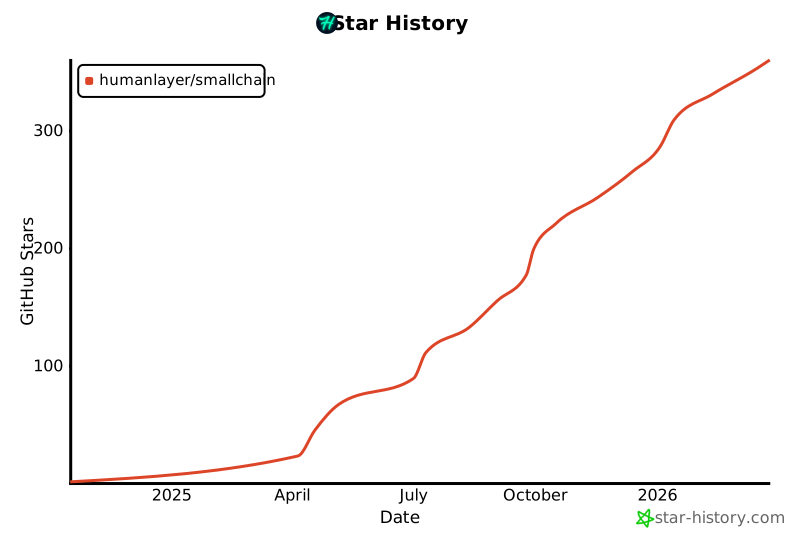](https://star-history.com/#humanlayer/smallchain&Date)
## License
SmallChain is licensed under the Apache 2 License.