https://github.com/iaceene/philosophers_42
This project is about how to use the threads and mutexes to prevent data race, you can apply the same concepts to the dining philosophers problem.
https://github.com/iaceene/philosophers_42
1337school 42cursus c cpp fork philosophers philosophers42 threads
Last synced: 2 months ago
JSON representation
This project is about how to use the threads and mutexes to prevent data race, you can apply the same concepts to the dining philosophers problem.
- Host: GitHub
- URL: https://github.com/iaceene/philosophers_42
- Owner: iaceene
- Created: 2025-01-20T17:09:51.000Z (over 1 year ago)
- Default Branch: main
- Last Pushed: 2025-02-20T17:48:08.000Z (over 1 year ago)
- Last Synced: 2025-02-20T18:41:30.023Z (over 1 year ago)
- Topics: 1337school, 42cursus, c, cpp, fork, philosophers, philosophers42, threads
- Language: C
- Homepage:
- Size: 37.1 KB
- Stars: 0
- Watchers: 1
- Forks: 0
- Open Issues: 0
-
Metadata Files:
- Readme: README.md
Awesome Lists containing this project
README
# Philosophers42
**Philosophers** : This project is part of the **42 the network**, a unique coding school that focuses on peer-to-peer learning and real-world coding practices. The goal of the Philosophers 42 project is to develop a program that simulates philosophers thinking and eating in a shared environment, inspired by the classical synchronization problem known as the **Dining Philosophers Problem**.
## Project Overview
The Dining Philosophers Problem was formulated by **Edsger Dijkstra** in 1965 and is often used to illustrate synchronization issues in concurrent programming. The problem consists of a set of philosophers sitting around a table. Each philosopher thinks and, when hungry, picks up two forks to eat. Philosophers must not starve, and they should not block each other indefinitely, ensuring a solution that avoids deadlocks and resource starvation.
In this project, you are tasked with writing a program that simulates the philosophers' behavior using threads, mutexes, and semaphores, ensuring synchronization and avoiding deadlock and resource starvation.
## Objective
The main goal is to implement a solution that allows philosophers to:
1. **Think**: Philosophers can think for an arbitrary amount of time.
2. **Eat**: Philosophers can eat for an arbitrary amount of time.
3. **Acquire forks**: Each philosopher needs two forks (mutexes) to eat.
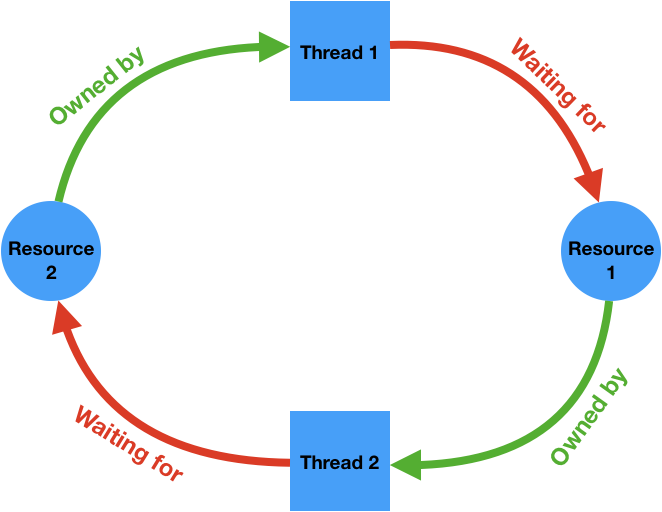
4. **Avoid deadlock**: Philosophers should never be in a state where they are all waiting for a fork (deadlock).
5. **Avoid starvation**: Philosophers should not be prevented from eating for an indefinite period (starvation).
## Requirements
- Use **pthread** (POSIX threads) to implement concurrency in C.
- Use **mutexes** or **semaphores** to protect shared resources.
- The program should simulate philosophers in a circular arrangement where each philosopher can either think or eat.
- The system should properly handle concurrency to ensure philosophers eat, think, and take turns eating without deadlocks or starvation.
- Handle edge cases like when there are very few philosophers or when no philosophers are hungry.
- Ensure all resources are properly cleaned up (e.g., destroying mutexes/semaphores before program termination).
## How It Works
### Structure of the Program:
1. **Philosopher Structure**: Each philosopher is represented by a structure that includes:
- A unique identifier (e.g., `id`).
- A state (thinking, eating, waiting).
- Mutexes for the two forks they need to pick up and eat.
2. **Forks**: Each fork is shared between two philosophers and is represented by a mutex to avoid simultaneous access.
3. **Simulation Loop**: Each philosopher operates within a loop that alternates between thinking and eating, with pauses for each action to simulate real-time behavior. Philosophers must pick up forks in a controlled manner, ensuring no deadlocks.
4. **Synchronization**: Using mutexes and semaphores, philosophers must avoid blocking each other indefinitely while ensuring that only two philosophers can eat simultaneously without interference.
### Key Components:
- **pthread_create**: Used to create threads for each philosopher.
- **pthread_mutex_t**: Mutexes are used to protect shared resources (the forks).
- **pthread_join**: Used to wait for threads to finish execution before the program terminates.
## How to Run
1. Clone the repository:
```bash
git clone https://github.com/iaceene/Philosophers_42.git
cd Philosophers_42
```
2. Compile the program:
```bash
make
```
3. Run the program:
```bash
./philo
```
Replace ``, ``, ``, and `` with appropriate values.
Example:
```bash
./philo 5 800 200 200
```
In this example, there are 5 philosophers, each philosopher must die after 800 milliseconds of not eating, and philosophers will eat and sleep for 200 milliseconds each.
## Requirements for Completion
- The program must ensure that the simulation terminates after a specified amount of time or when all philosophers are able to eat.
- The program should handle edge cases where philosophers do not get a chance to eat due to starvation.
- Proper synchronization techniques should be used to avoid race conditions and ensure the system runs efficiently.
## Resources
For additional information on synchronization and concurrency, you may want to review the following concepts:
- **DEADLOCK**: [https://cs61.seas.harvard.edu/site/2018/Synch5/]
- **POSIX Threads (pthreads)**: [https://man7.org/linux/man-pages/man3/pthread_create.3.html](https://man7.org/linux/man-pages/man3/pthread_create.3.html)
- **Mutexes and Semaphores**: [https://en.wikipedia.org/wiki/Mutex](https://en.wikipedia.org/wiki/Mutex), [https://en.wikipedia.org/wiki/Semaphore_(programming)](https://en.wikipedia.org/wiki/Semaphore_(programming))
- **Dining Philosophers Problem**: [https://en.wikipedia.org/wiki/Dining_philosophers_problem](https://en.wikipedia.org/wiki/Dining_philosophers_problem)
## Contributing
If you would like to contribute to this project, feel free to submit pull requests or open issues with suggestions. All contributions are welcome!