https://github.com/ictu/update-time
It's time to update your dependencies
https://github.com/ictu/update-time
Last synced: 6 days ago
JSON representation
It's time to update your dependencies
- Host: GitHub
- URL: https://github.com/ictu/update-time
- Owner: ICTU
- License: apache-2.0
- Created: 2026-06-22T04:39:49.000Z (about 1 month ago)
- Default Branch: main
- Last Pushed: 2026-07-21T22:44:12.000Z (8 days ago)
- Last Synced: 2026-07-22T00:29:53.081Z (8 days ago)
- Language: Python
- Homepage:
- Size: 897 KB
- Stars: 1
- Watchers: 0
- Forks: 1
- Open Issues: 8
-
Metadata Files:
- Readme: README.md
- Changelog: CHANGELOG.md
- Contributing: CONTRIBUTING.md
- License: LICENSE
- Code of conduct: CODE_OF_CONDUCT.md
- Security: SECURITY.md
- Publiccode: publiccode.yml
Awesome Lists containing this project
README
# Update-time - it's time to update your dependencies
[](https://pypi.org/project/update-time/) [](https://pypi.org/project/update-time/) [](https://github.com/ICTU/update-time/blob/main/LICENSE)
Keeping dependencies up-to-date is an important aspect of software maintenance. Update-time is a command line tool that scans your repository for [dependencies](#-what-is-updated) and updates them to their latest versions. In addition, it [pins](#-pinning) unpinned versions if possible. To protect against supply-chain attacks, it applies a [cooldown](#-cooldown) period. And it warns you about [stale dependencies](#-stale-dependencies).
Example Update-time output:
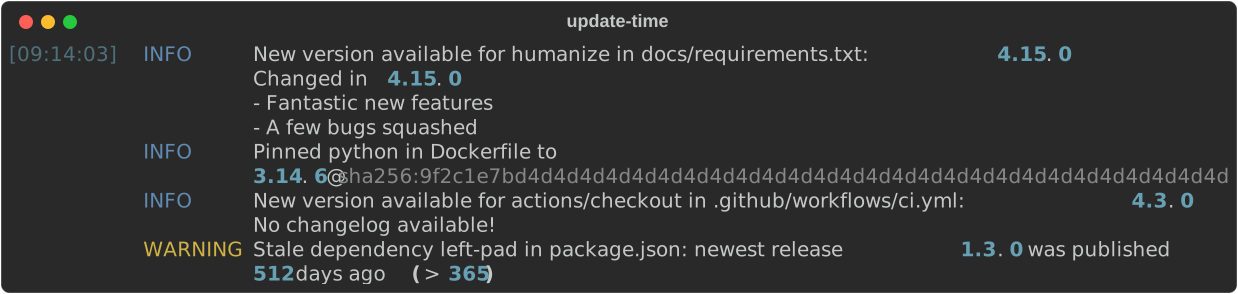
The same output as text
```console
[09:14:03] INFO New version available for humanize in docs/requirements.txt:12: 4.15.0
Changed in 4.15.0
- Fantastic new features
- A few bugs squashed
INFO Pinned python in Dockerfile:1 to
3.14.6@sha256:9f2c1e7bd4d4d4d4d4d4d4d4d4d4d4d4d4d4d4d4d4d4d4d4d4d4d4d4d4d4d4d4
INFO New version available for actions/checkout in .github/workflows/ci.yml:17: 4.3.0
No changelog available!
WARNING Stale dependency left-pad in package.json: newest release 1.3.0 was published
512 days ago (> 365)
```
## ⚡ Usage
Run Update-time without installing it using [uvx](https://docs.astral.sh/uv/):
```console
uvx update-time
```
Or install it as a [uv tool](https://docs.astral.sh/uv/concepts/tools/) so it's always available on your `PATH`:
```console
uv tool install update-time
update-time
```
Running `update-time -h` shows the full command-line interface:
```console
$ update-time -h
usage: update-time [-h] [-V] [--cooldown DAYS] [--stale-after DAYS]
[--exclude-path PATHS] [--allow-image-digest-drift]
[--force] [--log-level {DEBUG,INFO,WARNING,ERROR}]
[PATH]
Scan the PATH for pinned dependencies and update them to their latest
versions, rewriting the pinned versions in place. Looks at pyproject.toml,
requirements.txt, Python PEP 723 inline script metadata, .python-version
files, package.json, Dockerfiles, GitHub Actions workflows, pre-commit
configs, CircleCI configs, GitLab CI configs, Docker Compose and Helm
manifests, devcontainer configs, and jsDelivr URLs. A cooldown period holds
back releases that are too fresh to trust.
positional arguments:
PATH the directory to scan recursively for dependencies to
update; paths in the log are reported relative to it
(default: the current directory)
options:
-h, --help show this help message and exit
-V, --version show program's version number and exit
--cooldown DAYS number of days to hold back newly published Docker
image, GitHub Action, pre-commit hook,
requirements.txt, npm, pnpm, pyproject.toml, Python
inline script metadata, .python-version, and jsDelivr
versions (default: 7)
--stale-after DAYS warn when a dependency's newest release is older than
this many days; 0 disables the check (default: 365)
--exclude-path PATHS comma-separated list of directories, relative to the
scan root, to exclude from the scan (for example
vendor,packages/legacy); every file under an excluded
directory is skipped, on top of the always-ignored
build, node_modules, __pycache__, and hidden folders;
directories are matched by relative path, not by name:
--exclude-path vendor excludes vendor/ at the root but
not sub/vendor/; directories that don't exist are
ignored (and logged at log-level WARNING), but
absolute paths, or paths that escape the scan root
(../…), are rejected; run with --log-level DEBUG to
see excluded directories
--allow-image-digest-drift
when an already-pinned image tag has been re-pushed
under the same version, adopt its new digest instead
of only warning; equivalent to marking every image
reference with # update-time: allow[digest-drift] (an
# update-time: ignore marker still wins)
--force run even when not inside a git repository (changes are
made in place and cannot be reverted)
--log-level {DEBUG,INFO,WARNING,ERROR}
the minimum severity of messages to log; available new
versions are logged at INFO (default: INFO)
Update-time exits with status 0 when it ran successfully, 1 when an error
prevented it from finishing, and 2 when any command-line argument was invalid,
including a PATH that is not inside a git repository (unless --force is
passed). Exit status does not indicate whether anything was updated. Inspect
the diff or the INFO-level log for that.
```
### Workflow
The recommended workflow is to run Update-time on a dedicated branch, push it, and let CI do the verification:
1. Create a branch for the updates.
2. Run `update-time` in the root of your repository to update the dependencies in place.
3. Commit the changes and open a pull request.
4. Let your tests and checks run in CI to confirm nothing is broken before merging.
Because Update-time rewrites files in place, it expects to make updates inside a git repository, allowing for changes to be reverted. Update-time refuses to run when the directory to scan is not inside a git repository; printing an error and exiting with a non-zero status without touching any files. Pass `--force` to override.
Note that being inside a repository only guarantees revertability relative to the last commit: uncommitted edits to the same lines Update-time rewrites would be lost on a revert too. Although in practice Update-time only touches version pins, which rarely overlap in-progress edits.
### Increasing rate limits
To raise API rate limits while updating, set the following environment variables before running Update-time:
- `GITHUB_TOKEN` — increases the GitHub API rate limit when updating GitHub Actions. The token only needs to read public release and commit data, so no specific scope is required: both a classic token with no scopes selected and a fine-grained token with default read-only access to public repositories work.
- `DOCKER_HUB_USERNAME` and `DOCKER_HUB_TOKEN` — authenticate to the Docker Hub API (both must be set) to increase its rate limit when updating Docker images.
## 📦 What is updated
Update-time updates the following types of dependencies, found in the listed files, and using the listed sources:
| Dependency | Files | Source |
| ---------- | ----- | ------ |
| Python dependencies | `pyproject.toml`, `requirements.txt`, and PEP 723 inline script metadata (`# /// script` blocks in `*.py` files) | [PyPI](https://pypi.org) |
| npm and pnpm dependencies | `package.json` (and their lock files) | [npm registry](https://registry.npmjs.org) |
| Node engine version | `package.json` | the Node base image in the project's Dockerfile, or the latest [Node](https://hub.docker.com/_/node) release on Docker Hub |
| Python version | `.python-version` | the Python base image in the project's Dockerfile, or the latest [Python](https://hub.docker.com/_/python) release on Docker Hub |
| Docker (OCI) images (tag + digest) | Dockerfiles, CircleCI configs, `.gitlab-ci.yml`, Docker Compose files, Helm charts, and devcontainer configs | OCI registries ([Docker Hub](https://hub.docker.com), `ghcr.io`, `mcr.microsoft.com`, …) |
| GitHub Action versions (SHA + tag) | YAML files under `.github/` | [GitHub API](https://api.github.com) (releases and tags) |
| Pre-commit hook versions (SHA + tag) | `.pre-commit-config.yaml` | [GitHub API](https://api.github.com) (releases and tags) |
| jsDelivr npm URLs (version + SRI hash) | Sphinx config | [npm registry](https://registry.npmjs.org) |
### Python dependencies
#### What files are updated?
Python files containing requirements are discovered by name, case-sensitively: `pyproject.toml`, `requirements.txt`, `requirements-.txt` and `-requirements.txt` (e.g. `requirements-dev.txt` and `dev-requirements.txt`), and any `.txt` file in a `requirements/` directory. Unrelated files such as `constraints.txt` or `requirements.in` are not touched.
In addition, any `*.py` file that carries a [PEP 723](https://peps.python.org/pep-0723/) inline script metadata block is updated: a `# /// script … # ///` comment block that declares the standalone script's dependencies. `*.py` files without such a block are left untouched and never invoke uv.
Compiled or hash-pinned requirements files, such as a `requirements.txt` generated by [pip-tools](https://github.com/jazzband/pip-tools) or `uv pip compile` are skipped entirely, because bumping a single pin without recompiling its transitive dependencies and hashes would corrupt the file. Regenerate these with your compiler instead. Update-time recognises compiled or hash-pinned files by their contents (an autogenerated header or `--hash=` lines) or by the existence of a sibling `.in` file.
#### What dependencies are updated?
Update-time cannot update individual git, VCS, and URL dependencies (e.g. `git+https://github.com/org/repo.git@v8.0.3.0`, direct URLs, and `-e`/editable installs) in both `requirements.txt` and `pyproject.toml` files. Update them manually.
In a PEP 723 inline script metadata block, only the pins in the `dependencies` array are updated; the `requires-python` value and any other inline-metadata fields are left untouched.
#### What versions are updated?
Only versions specified with an exact match are updated, i.e. dependency versions pinned with `==`. Looser version specifiers are left untouched, so you can pin a maximum version to opt a dependency out of automatic updates.
### npm and pnpm dependencies
#### What files are updated?
Update-time looks for `package.json` files recursively from the starting path. The accompanying lock file is updated as well: `package-lock.json` for npm, `pnpm-lock.yaml` for pnpm.
#### What dependencies are updated?
Update-time delegates updating Node dependencies to the package manager used to manage the `package.json`. If that is npm, it runs `npm update --save --include=dev`; if it is pnpm, it runs `pnpm update`.
#### What versions are updated?
Both package managers update each dependency to the newest version that satisfies the range declared in the `package.json`, so a dependency declared as `"react": "^17.0.0"` receives `17.x` updates but never crosses into `18`. This means you can declare an upper bound to opt a dependency out of major-version updates, and pin an exact version to opt it out of automatic updates entirely, just like with [Python dependencies](#what-versions-are-updated). See the documentation of [npm update](https://docs.npmjs.com/cli/v12/commands/npm-update) and [pnpm update](https://pnpm.io/cli/update) for the finer points of how each manager resolves versions.
### Node engine version
#### What files are updated?
Update-time looks for `package.json` files that specify a [Node engine](https://docs.npmjs.com/cli/v11/configuring-npm/package-json#engines).
#### What dependencies are updated?
The Node engine version in the `package.json`.
#### What versions are updated?
The Node engine version is updated only when it contains a specific version (for example, `26.4`); a range or other non-numeric value is left untouched.
The new version is taken from the Node base image in the project's Dockerfile, so the engine and the image stay in step, provided there is a Dockerfile in the same folder, it has a Node base image, and that image has a numeric version number. When no Dockerfile declares a numeric Node base image, the engine is instead updated to the latest [Node](https://hub.docker.com/_/node) release on Docker Hub, honouring the [cooldown](#-cooldown). A Node base image pinned to a non-numeric tag such as `node:lts` is the exception: it is left alone rather than overridden with a mismatched concrete version.
### Python version
#### What files are updated?
Update-time looks for `.python-version` files recursively from the starting path, so both a repository that pins its Python version at the root and a monorepo that pins one per package are covered. `.python-version` is the de facto standard for pinning a project's Python version, read by uv, pyenv, and GitHub's `setup-python` action, among others.
#### What dependencies are updated?
Each entry that is a plain CPython version, `X.Y` or `X.Y.Z` (for example `3.12` or `3.12.6`), on a line of its own. A file may list several entries, one per line (pyenv reads more than one), each handled independently. Alternative implementations (`pypy3.10-7.3.12`, `miniconda3-…`), free-threaded and other variant suffixes (`3.13t`), prefixed forms (`cpython@3.12`, `>=3.10`), and the `system` sentinel are left untouched.
#### What versions are updated?
An entry is moved forward and pinned to a fuller version. Like the Node engine version, the new version is taken from the Python base image in the project's Dockerfile, so the development and production runtimes stay in step, provided there is a Dockerfile in the same folder with a `FROM python:` base image that has a numeric version. The entry then adopts that image's version at the precision the tag provides, so `python:3.14.2-slim` yields `3.14.2` and a bare `python:3.14` yields `3.14`; an entry already ahead of the image is left alone rather than downgraded. When no Dockerfile declares a numeric Python base image, the entry is instead updated to the latest [Python](https://hub.docker.com/_/python) release on Docker Hub, honouring the [cooldown](#-cooldown), which pins even a less precise entry to the full version, so `3.12.6` — and `3.12` — become `3.13.2` (or whatever the latest is).
Other Python version pins are left untouched: the `requires-python` value in `pyproject.toml` and in PEP 723 inline script metadata is not a `.python-version` entry and stays as it is.
### Docker images
#### What files are updated?
Update-time looks for Dockerfiles, CircleCI configs, `.gitlab-ci.yml`, Docker Compose files, Helm charts, and devcontainer configs from the starting path. Most are searched for recursively; the CircleCI and Helm configs are looked for under their conventional `.circleci/` and `helm/` folders, and GitLab CI uses a single `.gitlab-ci.yml` at the repository root. It uses the following filenames and globs:
| Files | Globs |
| ----- | ----- |
| Dockerfile | `Dockerfile`, `*.Dockerfile`, `Dockerfile.*` |
| CircleCI YAML configs | `*.yml`, `*.yaml` under `.circleci/` |
| GitLab CI config | `.gitlab-ci.yml` at the repository root |
| Docker Compose files | `docker-compose*.yml` |
| Helm charts | `*.yml`, `*.yaml` under `helm/` |
| Devcontainer configs | `.devcontainer.json`, `.devcontainer/devcontainer.json`, `.devcontainer/*/devcontainer.json` |
#### What dependencies are updated?
| Files | Dependencies |
| ----- | ------------ |
| Dockerfile | Base images (`FROM` references) |
| CircleCI YAML configs | Docker images (machine-executor images are left unchanged) |
| GitLab CI config | Docker images (`image:` references) |
| Docker Compose files | Service images (`image:` references) |
| Helm charts | Container images (`image:` references) |
| Devcontainer configs | The base image and each feature |
#### What versions are updated?
When updating an image tag, Update-time keeps the non-numeric parts of the tag and only advances its version numbers. A tag such as `python:3.14.6-alpine3.23` has three parts: the label prefix `python`, the main version `3.14.6`, and the suffix `alpine3.23`. The label prefix (`python`) and the suffix's label (`alpine`) are preserved, so a variant is never swapped out: `python` never becomes `pypy`, `slim` never becomes `fat`, and `alpine` never becomes `debian`. Both the main version and a version embedded in the suffix are upgraded, independently or together, for example `3.14.6-alpine3.23` → `3.15.0-alpine3.24`. Neither axis is ever downgraded to adopt a newer value on the other.
A suffix without an embedded version (`bookworm-slim`, `windows`) is never updated.
### GitHub Actions
#### What files are updated?
Update-time looks for `*.yml` and `*.yaml` files under the `.github/` folder, recursively, so both workflow files (`.github/workflows/*.yml`) and composite action definitions are covered.
#### What dependencies are updated?
The actions in the `uses:` references in those files. Actions referenced by a branch (e.g. `@main`) or as a local action without an `@` don't resolve to a version and are left untouched.
#### What versions are updated?
An action referenced by a version tag such as `@v4` or `@v4.1.1` is bumped to the latest version, and so is an action already pinned to a commit SHA with a version comment (`@ # v4.1.1`). That is normally the latest GitHub release, but a version that was tagged without being published as a release counts too, so an action whose repository only tags its versions — or whose releases stopped while tagging continued — is still updated. The publication date of such a version is taken from the tagged commit. See [Pinning](#-pinning) for how an unpinned action is pinned to the commit SHA of the latest version.
### Pre-commit hooks
#### What files are updated?
Update-time looks for `.pre-commit-config.yaml` files, recursively from the starting path. Pre-commit reads the file at the repository root, but a monorepo can carry one per sub-project, so every one found is updated.
#### What dependencies are updated?
The `rev:` of each hook repository hosted on GitHub. A `repo: local` or `repo: meta` entry has no `rev:` and is left untouched, as is a `rev:` that names a branch rather than a version, and a repository hosted outside GitHub.
#### What versions are updated?
A `rev:` given as a version tag such as `v4.5.0` is bumped to the latest version, and so is a `rev:` already pinned to a commit SHA with a `# frozen: v4.5.0` version comment. Like a GitHub Action, that is normally the latest GitHub release, but a version that was tagged without being published as a release counts too, so a hook repository that only tags its versions is still updated, with the publication date taken from the tagged commit. See [Pinning](#-pinning) for how an unpinned `rev:` is pinned to the commit SHA of the latest version.
### jsDelivr
#### What files are updated?
Update-time looks for Sphinx configuration files (`conf.py`) under the `docs/` folder, recursively.
#### What dependencies are updated?
The jsDelivr npm URLs and their accompanying Subresource Integrity (`integrity`) hash. For example: `https://cdn.jsdelivr.net/npm/clipboard@2.0.11/dist/clipboard.min.js`.
#### What versions are updated?
The npm package version embedded in the URL is updated to the latest version on the npm registry, and the SRI hash is updated in step so the two stay consistent. The hash is only updated when already present, never added (see [Pinning](#-pinning)).
## 📌 Pinning
Update-time strives to pin unpinned dependencies to a version or tag in combination with a digest or commit SHA to protect against supply-chain attacks.
### Dependencies pinned
What Update-time pins for each kind of dependency:
- Docker images referenced by tag only get the `@sha256:digest` of the (latest) tag appended, so the image is reproducible. This covers base images in Dockerfiles (`FROM image:tag`), CircleCI images, GitLab CI images, Docker Compose and Helm manifest images, and devcontainer base images and features. The image's registry is taken from the reference, so images on Docker Hub and on other OCI registries (`ghcr.io`, `mcr.microsoft.com`, …) are both resolved. The cooldown, however, only applies to Docker Hub, since the OCI protocol exposes no publication date.
- GitHub Actions referenced by version tag only are pinned to the commit SHA of the latest version, with the version added as a trailing comment: `uses: actions/checkout@v4` becomes `uses: actions/checkout@ # v4.1.1`.
- Pre-commit hook `rev:`s referenced by version tag only are pinned to the commit SHA of the latest version, with the version travelling in pre-commit's own `# frozen: ` comment convention: `rev: v4.5.0` becomes `rev: # frozen: v4.5.0`. This is the same format `pre-commit autoupdate --freeze` produces and understands, so the config stays interoperable with pre-commit's own tooling. The tag's `v` prefix convention is kept in the comment, so a repository that tags without a `v` gets `# frozen: 4.5.0`.
- A `.python-version` entry has no digest or commit SHA to add, so its pinning is writing a fuller version: when the version comes from Docker Hub a less precise `3.12` is pinned to the full `3.13.2`, while in the Dockerfile tier it adopts the image tag's precision instead (see [Python version](#python-version)).
### Dependencies not pinned
Some types of dependencies are not pinned by Update-time:
- Docker images without a concrete version tag are ignored: references through a `{{ ... }}` template or `${VAR}` variable substitution, and tagless base images such as `FROM scratch` or stage references.
- CircleCI machine-executor images (the `image:` under a `machine:` key, such as `ubuntu-2204:2024.01.1`) are not pinned, since they are not registry images.
- GitHub Actions referenced by a branch (e.g. `@main`) are left untouched because they don't resolve to a version.
- Pre-commit hook `rev:`s that name a branch, or that are already a bare commit SHA without a `# frozen:` comment, don't resolve to a version and are left untouched, as are `repo: local`, `repo: meta`, and repositories hosted outside GitHub.
- The Node engine version is a version constraint, not a locked dependency, so it can't be pinned.
- The SRI hash of jsDelivr npm URLs is updated when present, but not added when not present. This is a limitation of the rewrite engine of Update-time itself.
### Digest drift
Sometimes an image reference is already pinned to a digest and only that digest has changed at the registry: the tag was re-pushed (rebuilt) under the same name and version. Update-time then warns about the *digest drift*. It leaves the pin unchanged by default, so a re-pushed digest is never silently adopted (which would defeat the immutability a digest pin exists to provide).
To adopt the new digest instead, opt the reference in with an `# update-time: allow[digest-drift]` marker (see [Controlling updates per reference](#-controlling-updates-per-reference) for placement). Alternatively, pass `--allow-image-digest-drift` to opt every image reference in the scan in at once. Adopted drift is logged at `INFO`, like any other change. An `# update-time: ignore` (or `ignore[update]`) marker still wins over both, so a reference you deliberately froze is never re-pinned.
## ⏳ Cooldown
To avoid adopting releases that are too fresh to trust, Update-time honours a cooldown period during which newly published versions are not yet picked up. It defaults to **7 days** and can be changed with the `--cooldown` option, for example `update-time --cooldown 14`. How the cooldown is applied depends on the dependency type:
- **Docker images, GitHub Actions, pre-commit hooks, `requirements.txt` dependencies, jsDelivr npm URLs, and `.python-version` files** — Update-time enforces the cooldown itself, based on each image tag's push date and each release's publication date. For a GitHub Action or pre-commit hook version that was tagged without a GitHub release, the tagged commit's date is used. A `.python-version` entry updated from Docker Hub honours the cooldown through the Python image tag's push date; when it instead follows a Dockerfile, the cooldown was already applied when the image was updated.
- **npm dependencies** — Update-time passes the cooldown to `npm` via npm's `min-release-age` option (also measured in days), which npm added in 11.10.0; older npm versions ignore the option, so updates still run but without a cooldown. If your project already configures a cooldown in its `.npmrc` (`min-release-age` or `before`), Update-time leaves that in place instead of overriding it.
- **pnpm dependencies** — Update-time passes the cooldown to `pnpm` via pnpm's `minimumReleaseAge` setting, converting the value to minutes (pnpm measures the age in minutes rather than days). If your project already configures `minimumReleaseAge` (in `pnpm-workspace.yaml`), Update-time leaves that in place instead of overriding it.
- **`pyproject.toml` dependencies** — Update-time applies the cooldown through uv's `exclude-newer` setting, which it writes into your `pyproject.toml` under `[tool.uv]` (as a relative value such as `exclude-newer = "7 days"`, tagged with a `managed by Update-time` comment). It writes this to the workspace root, so a plain `uv sync --locked` keeps working afterwards without having to repeat the setting on the command line. Because the value lives in `[tool.uv]`, the cooldown then applies to every uv command in the project (`uv lock`, `uv add`, CI), not just to Update-time. Update-time keeps its own commented value in step with `--cooldown`, but never touches a value you set yourself: if your `pyproject.toml` already sets `exclude-newer` without the marker comment, or the `UV_EXCLUDE_NEWER` environment variable is set, Update-time leaves that in place instead. Remove the marker comment to take ownership of the line and stop Update-time from changing it.
- **Python inline script metadata** — Update-time also applies the cooldown through uv's `exclude-newer`, but passes it to `uv tree` on the command line rather than persisting it, since a standalone script has no lockfile to keep reproducible. The cutoff is derived from `--cooldown` on every run, so, unlike `pyproject.toml`, nothing is written into the `# /// script` block.
## ⚠️ Stale dependencies
Keeping a pin on the latest version doesn't help if that latest version is itself years old: the project may have been abandoned or superseded. Alongside updating, Update-time warns when a dependency's newest release is older than a threshold, so you can decide whether to keep it, replace it, or vendor it. The threshold defaults to **365 days** and is set with `--stale-after DAYS`; pass `--stale-after 0` to disable the check entirely. The warning is informational only — it never changes a file and never affects the exit status — and is logged at level `WARNING`. For example, a pin whose newest release came out well over a year ago is reported as:
```console
WARNING requirements.txt: Stale dependency humanize in docs/requirements.txt: newest release 4.15.0 was published 512 days ago (> 365)
```
The date compared against the threshold is the publication date of the dependency's *newest* release. For a GitHub Action or pre-commit hook whose newest version was tagged without being published as a release, the tagged commit's date is used instead. This way a project that has just published a release is never reported as stale, not even when that release is still within the [cooldown](#-cooldown) window. A reference held back with a bare `# update-time: ignore` (or `# update-time: ignore[stale]`) marker is not checked for staleness either. `# update-time: ignore[update]` holds back only the update, so its staleness is still reported (see [Controlling updates per reference](#-controlling-updates-per-reference)).
Every kind of dependency Update-time updates is checked for staleness. Two indirect cases are the Node engine version in `package.json` and the Python version in `.python-version`: when either is derived from the project's Dockerfile, only the staleness of the base image is reported, while a `.python-version` entry that follows Docker Hub is checked against the Python image tag's push date. Two data limitations narrow the check where the date isn't available. First, `package.json` dependencies given as git, file, workspace, or alias references are skipped, since they don't resolve to a registry release. Second, image tags are only checked on Docker Hub, because the push date the check relies on isn't exposed by other registries (`ghcr.io`, `mcr.microsoft.com`, …), the same limitation as the cooldown. Because a maintained image tag is rebuilt (re-pushed) periodically, its push date reflects that maintenance, so a still-maintained tag is not reported as stale even when its version is old.
## 🎛️ Controlling updates per reference
Comments of the form `# update-time: ` let you steer what happens to an individual reference — most often to hold it back, but also to bound how far it may move, or to opt it into behaviour that is off by default. To stop Update-time from changing a specific reference, add an `# update-time: ignore` comment (all lower-case). You might do this because of a known incompatibility, a deferred migration, or to keep something reproducible. The reference is then left untouched and no registry or source is queried for it. You can add a reason after the marker, for example `# update-time: ignore (pinned until the 3.13 migration)`.
By default the marker holds a reference back from both version updates and the [staleness](#-stale-dependencies) check. Add a bracketed scope to narrow it to just one:
| Marker | Version update | Staleness warning |
| ------ | -------------- | ----------------- |
| `# update-time: ignore` | held back | held back |
| `# update-time: ignore[update]` | held back | still checked |
| `# update-time: ignore[stale]` | applied | held back |
So `# update-time: ignore[update]` keeps a deliberately pinned reference frozen while still telling you when the project behind it has gone quiet, and `# update-time: ignore[stale]` silences a staleness warning you've acknowledged without freezing the version. A reason can still follow the scope, for example `# update-time: ignore[update] (pinned until the 3.13 migration)`.
One further marker does the opposite of holding a reference back. `# update-time: allow[digest-drift]` opts an already-digest-pinned image reference *into* adopting a re-pushed digest, so when only its digest has drifted the new digest is pinned instead of only warned about (see [Pinning](#-pinning)). It follows the same placement rules as the other markers, and the global `--allow-image-digest-drift` flag applies it to every image reference at once. Where an `ignore` (or `ignore[update]`) marker also applies, that wins and the reference is left untouched.
`ignore[update]` freezes a reference at its current version. Sometimes you want the middle ground: keep receiving updates *within a range* while blocking a jump you're not ready for — for example, keep getting `python:3.12` patch releases but hold off on `3.13` until you've migrated. Add a [PEP 440](https://peps.python.org/pep-0440/) version specifier directly after `update` inside the brackets, either to allow or ignore updates: `# update-time: allow[update]` **keeps only** the updates whose version satisfies the specifier, and `# update-time: ignore[update]` **drops** the updates whose version satisfies it (the plain `ignore[update]` is the drop-everything case).
For example, `allow[update<3.13]` keeps a `python` base image on its newest `3.12` release and never crosses into `3.13`:
```dockerfile
# update-time: allow[update<3.13]
FROM python:3.12.1-bookworm-slim
```
The same works inline, for image and action references — here `allow[update==7.*]` keeps Redis on its `7.x` line and `ignore[update>=5]` keeps `checkout` below `v5`:
```yaml
image: redis:7.2 # update-time: allow[update==7.*]
uses: actions/checkout@v4 # update-time: ignore[update>=5]
```
The specifier filters the candidate versions *before* the highest is picked, so a bounded reference still advances as far as the bound allows: when on `3.12.8`, `allow[update<3.13]` still adopts a freshly published `3.12.9`, it just never crosses into `3.13`.
`allow` and `ignore` are complements, which matters for ranges. For a one-sided bound the two are interchangeable — `allow[update<3.13]` and `ignore[update>=3.13]` express the same ceiling. For a *range* they are opposites: with versions `3.13` through `3.16` available, `allow[update>=3.13,<3.15]` keeps the reference *within* `[3.13, 3.15)` and picks `3.14`, whereas `ignore[update>=3.13,<3.15]` *excludes* that range and skips ahead to `3.16`.
Choose the operator deliberately. To keep `3.12` together with its patch releases while blocking `3.13`, use `<3.13`, `==3.12.*`, or `~=3.12.0`. Don't use `<=3.12` if you want to stay on `3.12`: since `3.12.1 > 3.12` in PEP 440, it also blocks `3.12.1`, which is rarely what "stay on 3.12" means.
A bound with a specifier names the version it must not reach, so it goes stale: after migrating to `3.13`, an `allow[update<3.13]` blocks every update (Update-time warns about it) until the comment is rewritten. To express the policy ("no major jumps") rather than the fence ("not past 3.13"), bound the update by its *level* instead: `# update-time: ignore[major-update]` or `ignore[minor-update]`, or their complements `allow[minor-update]` and `allow[patch-update]`. An update's level is the most significant version component it changes relative to the currently pinned version: a major update changes the first component, a minor update the second, and a patch update the third. A component the current version doesn't have counts as zero, so `node:22` followed by `23` is a major update, and `22` followed by `22.1` a minor one. `ignore` holds back updates of the named level *or more significant*, `allow` keeps updates of the named level *or less significant* — "block minor but allow major" is never meaningful — which makes the two verbs exact complements, just like specifier bounds:
| Directive | Effect | Complement |
| --------- | ------ | ---------- |
| `ignore[major-update]` | minor and patch updates only | `allow[minor-update]` |
| `ignore[minor-update]` | patch updates only | `allow[patch-update]` |
Pick whichever verb reads best in context. Unlike a specifier bound, a level-based bound is anchored to the currently pinned version on every run, so it ratchets along as the reference advances: `ignore[minor-update]` on `python:3.12.1` blocks `3.13` today and, once you migrate the pin to `3.13`, blocks `3.14` — the comment never needs editing:
```dockerfile
# update-time: ignore[minor-update]
FROM python:3.12.1-bookworm-slim
```
The levels are positional, not semantic: they refer to the component's position in the version, not to the project's compatibility promises. Projects may ship breaking changes in releases that bump the *second* component, so "stay on Python 3.12" is `ignore[minor-update]` despite Python 3.13 shipping breaking changes (it removed 19 legacy modules from the standard library). The same caution applies to projects using calendar versioning. And as with specifier bounds, the level applies to a Docker tag's main version; a version embedded in the suffix (the `3.23` in `alpine3.23`) is unaffected by the bound.
A few rules govern how a bound — with a specifier or level-based — interacts with the other markers and checks:
- A bare `# update-time: ignore` (or `# update-time: ignore[update]` with no specifier) holds back *all* updates and wins over any bound on the same reference.
- Use a single bound per reference; pairing two bounds, say an `allow[update]` with an `ignore[update]`, or a specifier bound with a level-based one, on one reference is undefined.
- A bound narrows updates only, not staleness. Staleness is always measured against the project's newest overall release; the bound doesn't come into play.
- The digest is still pinned or refreshed for whichever version the bound selects, exactly as without a bound.
- To combine a bound with another directive of the same verb (say, `allow[digest-drift]`), list both as comma-separated items in one bracket: `# update-time: allow[update<3.13, digest-drift]` or `# update-time: allow[minor-update, digest-drift]`. To combine directives of different verbs, list them after the `# update-time:` prefix, separated by a space: `# update-time: ignore[stale] allow[update<3.13]`. A reason can still follow the last directive.
Update-time logs a `WARNING` when a bound is redundant. That may happen in two ways:
- Either the bound **never has an effect**, so removing it would change nothing: the current version and every version above it satisfy the bound, for example `allow[update>=3.12]` on a `3.12` pin, or `allow[major-update]` on any pin (it allows every update, so it says nothing).
- Or the bound **blocks every update**, so it is just a frozen `ignore[update]` in disguise (use that instead if the freeze is intended): no version above the current one satisfies the bound, for example `ignore[update>=3.12]` on a `3.12` pin, or `ignore[patch-update]` on any pin.
Any of these markers can be placed two ways:
- **Inline**, on the reference's own line (in YAML files, `requirements.txt`, `devcontainer.json`, and `.python-version` files):
```yaml
image: python:3.12 # update-time: ignore
```
```text
humanize==4.15.0 # update-time: ignore
```
```jsonc
"ghcr.io/devcontainers/features/node:1": {} // update-time: ignore
```
- **On the line directly above** the reference. Use this form in Dockerfiles, which don't allow inline comments:
```dockerfile
# update-time: ignore
FROM ghcr.io/astral-sh/uv:python3.12-bookworm-slim
```
This works for every reference Update-time rewrites line by line: Dockerfiles, Docker Compose and Helm manifests, CircleCI and GitLab CI configs, GitHub Actions workflows, `.pre-commit-config.yaml` files, `devcontainer.json` files, `requirements.txt` files, and `.python-version` files. Use a `#` comment everywhere except `devcontainer.json` (which is JSONC), where the marker goes in a `//` comment. An inline marker pins only its own line, so it never accidentally pins the reference on the line below it. In a `.pre-commit-config.yaml`, an inline marker follows the `# frozen:` comment on the `rev:` line when both are present. In a `.python-version` file both forms are recognised, but uv rejects an inline comment on a `.python-version` line (it then ignores the entry and silently resolves a different Python), so the line-above form is the safer placement for a uv project; either way the marker wins over a version derived from the Dockerfile, so a deliberately held-back development version is never dragged forward by an image update.
Run with `--log-level DEBUG` to confirm a marker is recognised: every recognised marker is logged, as is every update it holds back. Since the marker is case-sensitive, a typo (or wrong case) simply produces no such log and the reference is updated as usual.
For `pyproject.toml`, `package.json`, and PEP 723 inline script metadata — which are updated through uv, npm, and pnpm rather than line by line — the marker does not apply. Opt a dependency out there by pinning it with a maximum or non-`==` version specifier instead (for example `package<=3.12`). The marker likewise has no effect on jsDelivr URLs, which are rewritten through a whole-file substitution rather than the line-by-line engine; there is currently no way to exclude a specific jsDelivr URL from updates.
## 📮 Point of contact
Point of contact for this repository is [Frank Niessink](https://github.com/fniessink).